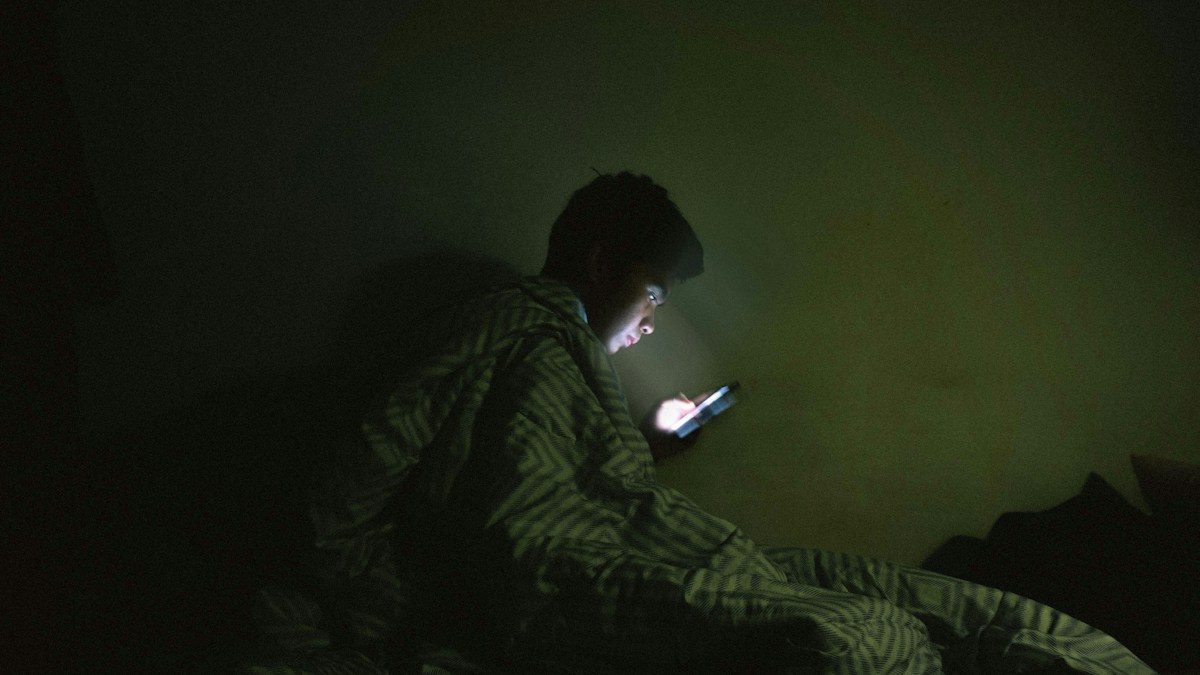
You only picked up your phone to check the weather for tomorrow.
That was at 9.45pm. Now the lamp is still on, your thumb is still moving, and you have read four versions of the same grim story, a thread about a disaster on another continent and a comment section you will not remember by morning.
You feel worse than you did an hour ago. You also feel oddly unable to stop.
There is a name for this, and since 2022 there has been a validated scale to measure it. Researchers at the University of Florida defined doomscrolling as “habitual, immersive scanning for timely negative information on social media newsfeeds”. Separate work from Texas Tech University suggests that for roughly one adult in six, the habit has drifted into territory that looks a lot like a problem.
The good news, if you can stand some, is that none of this happens by accident. Each stage of a doomscrolling evening is driven by a fairly well-understood piece of psychology. Once you can see the machinery, it gets much easier to switch it off. So let’s follow one evening, hour by hour.
9.45pm: The first bad headline and your brain’s negativity bias
The weather app is boring. The news alert underneath it is not. It is about something frightening, and before you have consciously decided anything, you have tapped.
That pull is old. In 2001 the psychologists Roy Baumeister, Ellen Bratslavsky, Catrin Finkenauer and Kathleen Vohs published a long review in Review of General Psychology with a blunt title: “Bad is stronger than good”. Pulling together research from across psychology, they found that negative events, emotions and information tend to have larger and longer-lasting effects than positive ones of the same size.
Their explanation was evolutionary. An ancestor who missed a sign of danger might not survive to try again; one who missed a nice opportunity usually got another chance. The authors wrote that it may be “evolutionarily adaptive for bad to be stronger than good.”
A brain built that way treats a threatening headline as information it cannot afford to ignore. It does not know that the threat is on another continent, or that reading about it at 9.45pm changes nothing.
Your attention is not broken. It is doing exactly what it was designed to do, in a world it was not designed for.


10.05pm: Why refreshing the feed feels like a slot machine
Twenty minutes in, you have read the main story. So why are you still pulling the page down to refresh?
Because some refreshes give you something. A new detail, a fresh video, a reply from someone who seems to know more. Most give you nothing new at all. That unpredictability is the hook.
In a well-known 2003 experiment published in Science, Christopher Fiorillo, Philippe Tobler and Wolfram Schultz recorded the activity of dopamine neurons in monkeys that had learned to link different pictures with different chances of getting a drop of juice. As well as the familiar response to rewards that beat expectations, the team found a slower ramp of activity that tracked uncertainty itself. It was strongest when the odds of a reward were 50:50, and weaker when the outcome was close to certain either way.
That is a study of monkeys and juice, not people and phones, so it cannot tell us exactly what happens in your head on the sofa. But it fits a long line of behavioural research showing that rewards which arrive unpredictably keep animals and humans responding far longer than rewards that arrive every time.
A news feed is close to a perfect version of that schedule. You never know which swipe will deliver the new fact, so every swipe carries a small charge of maybe.
10.30pm: Scrolling for certainty that never arrives
By now you are not really learning anything. You are looking for something else: the sense that you finally understand what is happening, and how worried you should be.
Benjamin Johnson, an advertising researcher at the University of Florida and one of the authors of that 2022 doomscrolling study, described the habit in a university press release as “this obsession with trying to make sense of the crisis or all of our crises.”
The trouble is that big, unfolding stories rarely resolve in an evening. Each update answers one question and opens two more. It is the same itch that keeps unfinished tasks buzzing in your head, a pattern psychologists call the Zeigarnik effect: open loops nag at us until they close.
With a crisis, the loop does not close. So you keep scrolling, chasing a feeling of closure that the format cannot provide.
You are not scrolling for information any more. You are scrolling for a feeling of safety the feed was never going to give you.
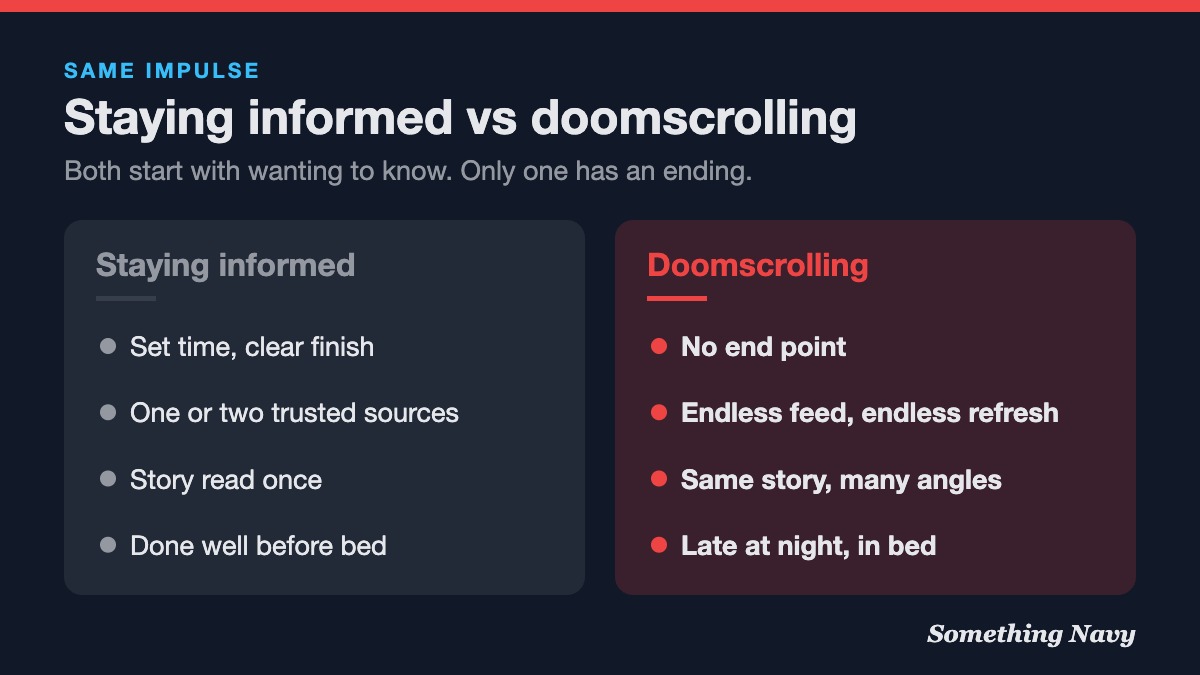
This is also the point where the line between staying informed and doomscrolling becomes visible. Both begin with the same reasonable impulse. They end in very different places.
11pm: The doomscrolling scale and who scores highest
For years “doomscrolling” was internet slang. Bhakti Sharma, Susanna Lee and Benjamin Johnson at the University of Florida wanted to know whether it was a real, distinct behaviour or just a new label for heavy social media use.
Their paper, published in January 2022 in the American Psychological Association journal Technology, Mind, and Behavior, ran in three stages. First came online focus groups with 10 university students. Then the team tested a large bank of questionnaire items on 401 adults recruited through the Prolific research platform, whittling it down to a 15-item scale. Finally they checked that scale on a fresh sample of 502 people from 27 countries.
Doomscrolling turned out to hang together as its own thing. Scores were moderately linked to online vigilance (feeling constantly “on call” to your phone), social media addiction and fear of missing out, but not so tightly that they were the same measure.
People who scored higher also tended to report more anxiety, lower self-control and less positive emotion. Men scored slightly higher than women, and younger and less educated participants tended to score higher too.
Some honest caveats. The data were collected in March 2021, in the middle of pandemic lockdowns and vaccine news, when almost everyone was scrolling more than usual. The samples were mostly young and European. And because it was a one-off survey, it cannot say whether doomscrolling makes people anxious, or anxious people doomscroll. The authors suspected the two feed each other.
One result was surprisingly flat: doomscrolling scores were not linked to a general measure of psychological wellbeing. It seems to travel with anxiety and low mood in the moment more than with how people rate their lives overall.


11.30pm: How negative news shifts your mood, one headline at a time
You might tell yourself the scrolling is harmless because nothing you are reading is happening to you. Your mood disagrees.
Natascha de Hoog and Peter Verboon, psychologists at the Open University of the Netherlands, wanted to see how ordinary daily news affects people in real time rather than in a lab. For their study in the British Journal of Psychology, 63 Dutch adults aged 18 to 82 installed an app that pinged them five times a day for 10 days. Each time, they reported whether they had recently seen or heard news, how negative it felt, how personally relevant it was, and how they were feeling.
The pattern was consistent. The more negative people judged the news they had just seen, the more negative emotion and the less positive emotion they reported. The effect was stronger when the story felt personally relevant.
Their conclusion is worth quoting: “news does not have to be very severe or shocking for people to be affected by it emotionally.”
It was a small, mostly well-educated sample recruited through the researchers’ own networks, and the effects were modest. But it captures what happens across an evening of scrolling: not one big blow, but dozens of small dips that add up.
Notice, too, that it is now 11.30pm. Many people recognise this stretch as the hour they meant to go to bed. If the phone feels like the only time that is truly yours, you may be sliding into revenge bedtime procrastination as well.
Midnight: When more hours of coverage mean more stress
At midnight the story has not changed much since 10pm. You have simply watched it from more angles.
That repetition matters. After the Boston Marathon bombings in April 2013, E. Alison Holman, Dana Rose Garfin and Roxane Cohen Silver at the University of California, Irvine surveyed 4,675 American adults from a nationally representative panel, two to four weeks after the attack. They asked about direct exposure (being at or near the scene) and about how many hours a day people had spent following coverage in the week afterwards.
In their paper in PNAS, people who reported six or more hours a day of bombing-related media had higher acute stress scores than people who had been directly exposed to the bombings. Acute stress rose steadily with each extra hour of coverage.
The authors were clear about the limits. The survey was cross-sectional, so it shows a link, not proof of cause. People who were already distressed may well have sought out more coverage, and the relationship probably runs both ways. Hours were also recalled weeks later rather than tracked.
Still, the finding should give any late-night scroller pause. Watching a frightening event repeatedly is not a neutral act of witness. It is an exposure in its own right.
12.30am: The 16.5% whose news habit looks like a problem
For most people a bad evening like this is occasional. For some, it is most evenings.
Bryan McLaughlin of Texas Tech University, with Melissa Gotlieb and Devin Mills, surveyed 1,100 American adults online for a study published in Health Communication in 2022. Participants rated statements such as “I find it difficult to stop reading or watching the news”, and reported how often they had experienced stress, anxiety and physical symptoms in the past month.
Of the sample, 16.5% showed what the researchers classed as “severely problematic” news consumption, the high end of a scale built around absorption in the news and difficulty stopping.
The contrast with everyone else was stark. In that group, 73.6% reported mental symptoms such as stress and anxiety “quite a bit” or “very much”, compared with 8% of other participants. For physical symptoms, including fatigue, pain, poor concentration and stomach problems, the figures were 61% versus 6.1%.
The study controlled for demographics, personality traits and overall news use, which suggests the problem lies in the compulsive pattern rather than in simply following the news. But it was a single snapshot, so again it cannot show which came first.
This is the useful takeaway. The issue is not caring about the world. It is the loss of an off switch.

The morning after: Why four in ten people now avoid the news
Here is the twist. Many people who doomscroll on a bad night swing to the opposite extreme the next morning: they stop looking altogether.
The Reuters Institute for the Study of Journalism at the University of Oxford runs the largest annual survey of news habits in the world. Its Digital News Report 2026, based on 97,520 people across 48 markets, found that 42% now say they sometimes or often actively avoid the news. When the institute started measuring this in 2017, the figure was 29%.
The 2025 edition asked avoiders why. The most common answer had nothing to do with bias or boredom.
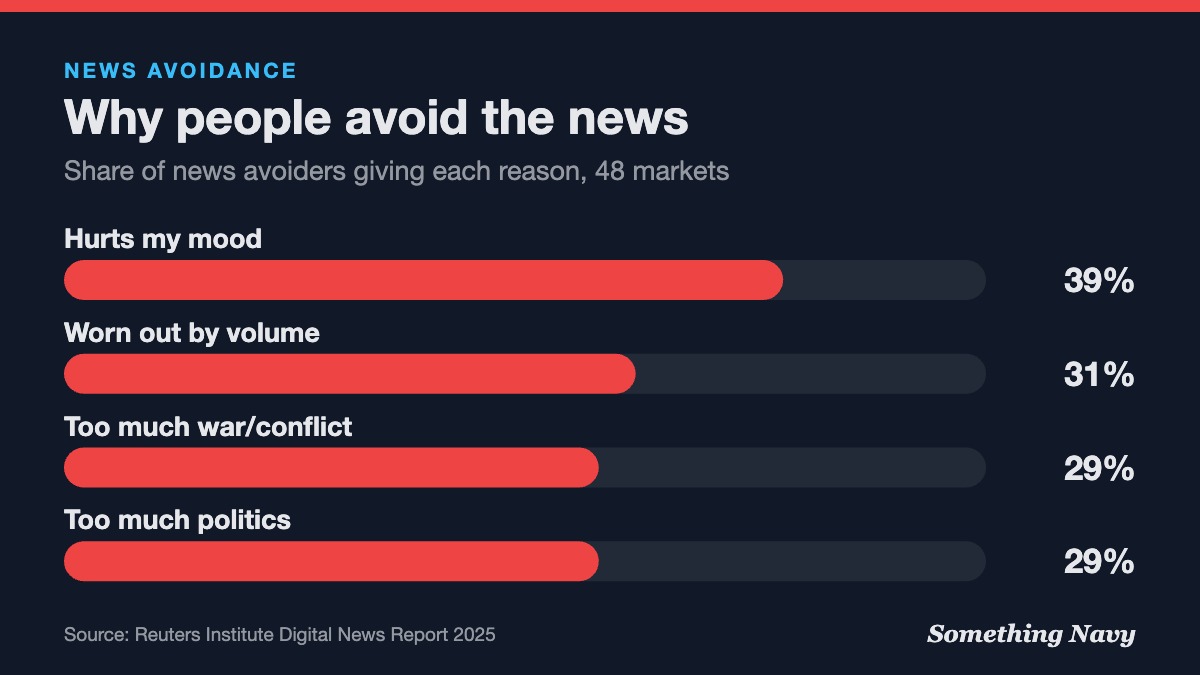
Thirty-nine per cent of avoiders said the news has a negative effect on their mood, and 31% said they feel worn out by the sheer amount of it. Around 29% each pointed to too much coverage of war and conflict, and of politics.
Read those reasons again and they sound like the morning after a doomscroll. Bingeing and blackout turn out to be two sides of the same coin.
Neither is ideal. Total avoidance leaves you less able to act on things that genuinely affect you, from a local flood warning to an election. The aim is something in between: a news habit with edges.
Why quitting everything is not the only way to stop doomscrolling
The obvious advice is to delete the apps. For some people that works, and if you are weighing it up, our guide to what happens when you quit social media looks at the evidence.
But doomscrolling is mostly about news, and most of us want to stay informed. The research above points to a gentler fix. The problem lies in three features of the evening: no end point, unpredictable rewards and repeated exposure late at night. Change those features, and you can keep the news while losing most of the doom.
It also helps to remember what the Florida team suggested: people who become aware that the habit makes them feel worse may go on to change their media habits. Noticing is not a small step. It is the first one.
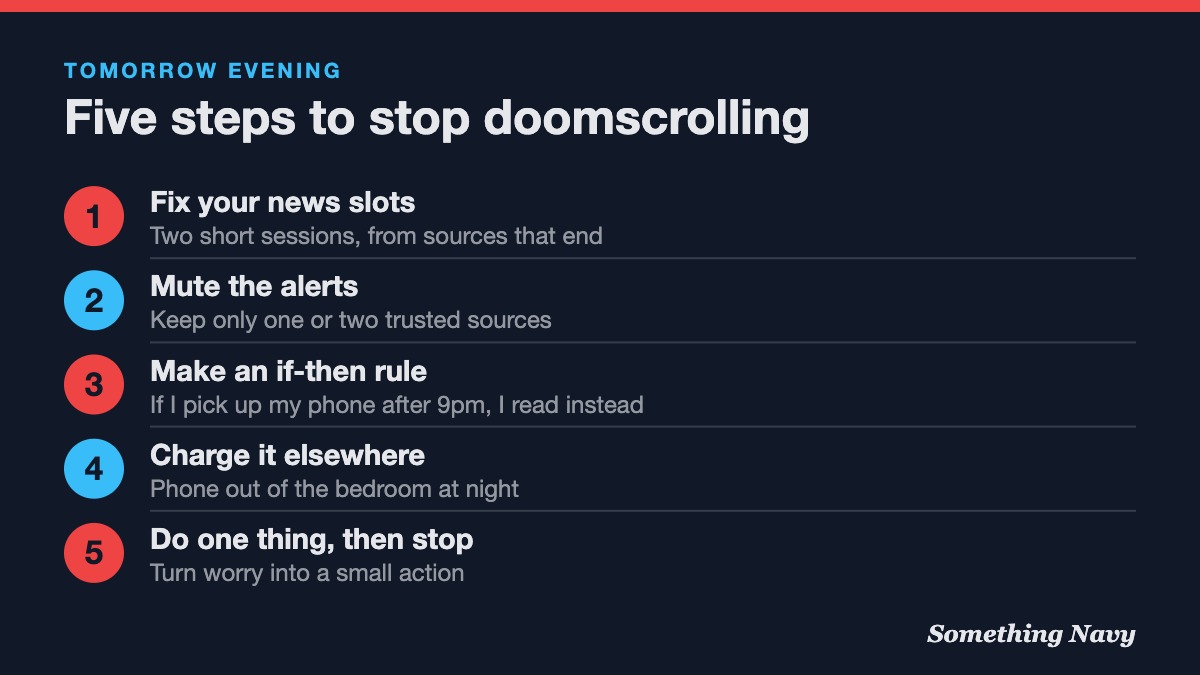
A practical plan to stop doomscrolling tomorrow evening
None of these steps has been tested as a package in a trial, so treat them as sensible experiments rather than a cure. Each one targets a mechanism from the evening above.
Give the news a start and a finish
Doomscrolling has no natural end, so build one. Pick one or two fixed slots, say 15 minutes at breakfast and 15 after work, and use a source that ends: a daily briefing, a newsletter, a radio bulletin or a newspaper’s front page. When it ends, you are done.
Make the slot machine boring
Turn off breaking-news alerts for everything except the one or two sources you trust most. Move news and social apps off your home screen. Every extra tap weakens the variable-reward loop, because you stop being ambushed by maybes.
Set an if-then rule for the evening
Vague intentions crumble at 10pm. Specific plans hold up better, as research on if-then planning shows. Try: “If I pick up my phone after 9pm, then I open my book app instead.” Or: “If I have read the same story twice, then I close the app.”
Move the phone out of reach
Charging the phone outside the bedroom removes the cue entirely. Even having it on the table can tug at your attention, as studies on the brain drain of a nearby phone suggest.
Trade one scroll for one action
Much of the misery of doomscrolling comes from feeling powerless. When a story gets to you, do one concrete thing (donate, message a friend, check on a neighbour, sign up to volunteer) and then put the phone down. Action closes the loop that reading cannot.
Try this tonight
- Before you open a news app, say out loud what you want to know. When you have the answer, close it.
- Check in with your body after 10 minutes: jaw, shoulders, breathing. Tension is a signal to stop.
- If you scroll past 11pm, note it in your phone’s notes app. Patterns are easier to change once you can see them.
- Swap the last 20 minutes before sleep for something with an ending: a chapter, a podcast episode, a crossword.
What a better evening looks like
Picture the same evening a week from now. You check the weather. You see the alert. You read the story once, from one source you trust, and you know roughly what is happening and whether it affects you.
Then you put the phone on the charger in the hall.
The world is no less troubled than it was. You are simply not carrying all of it to bed. Staying informed was never about reading everything. It is about knowing enough to act, and resting enough to care tomorrow.
Sources
- Baumeister, R. F., Bratslavsky, E., Finkenauer, C., & Vohs, K. D. (2001). Bad is stronger than good. Review of General Psychology, 5(4), 323–370. DOI
- de Hoog, N., & Verboon, P. (2020). Is the news making us unhappy? The influence of daily news exposure on emotional states. British Journal of Psychology, 111(2), 157–173. DOI
- Fiorillo, C. D., Tobler, P. N., & Schultz, W. (2003). Discrete coding of reward probability and uncertainty by dopamine neurons. Science, 299(5614), 1898–1902. DOI
- Holman, E. A., Garfin, D. R., & Silver, R. C. (2014). Media’s role in broadcasting acute stress following the Boston Marathon bombings. Proceedings of the National Academy of Sciences, 111(1), 93–98. DOI
- McLaughlin, B., Gotlieb, M. R., & Mills, D. J. (2022). Caught in a dangerous world: Problematic news consumption and its relationship to mental and physical ill-being. Health Communication, 38(12), 2687–2697. DOI
- Reuters Institute for the Study of Journalism. (2025). Digital News Report 2025. University of Oxford. Link
- Reuters Institute for the Study of Journalism. (2026). Digital News Report 2026. University of Oxford. Link
- Sharma, B., Lee, S. S., & Johnson, B. K. (2022). The dark at the end of the tunnel: Doomscrolling on social media newsfeeds. Technology, Mind, and Behavior, 3(1), 144–156. DOI
Cover photo: Dipqi Ghozali on Unsplash. Charts and graphics: Something Navy.
How we reported this. We went back to the original research for this story, 8 sources in all, listed above, and checked every figure against them. If you think we have got something wrong, tell us and we will look at it. Read more about how we work.