

Tap out “Happy Birthday” on the table in front of you. Go on, just the rhythm, with one knuckle.
In your head, the whole song is playing. You can hear the melody rise on the third “happy birthday”, the little pause before the name. Now imagine someone across the table who hears only what you are actually producing: a string of dull knocks, like a woodpecker with no sense of occasion.
That was the set-up of a small experiment run in 1990 by Elizabeth Newton, then a graduate student in psychology at Stanford University. One person, the “tapper”, picked a well-known tune and drummed its rhythm. A second person, the “listener”, had to name it. Before the listener guessed, the tapper estimated the odds of success.
Over the course of the study, 120 songs were tapped. Tappers thought their listeners would get about half of them. Listeners correctly named three. That is a hit rate of 2.5%, or one song in 40, as Chip Heath and Dan Heath recount in their 2006 Harvard Business Review essay on the study.
The tappers were not bad at tapping. They were cursed.
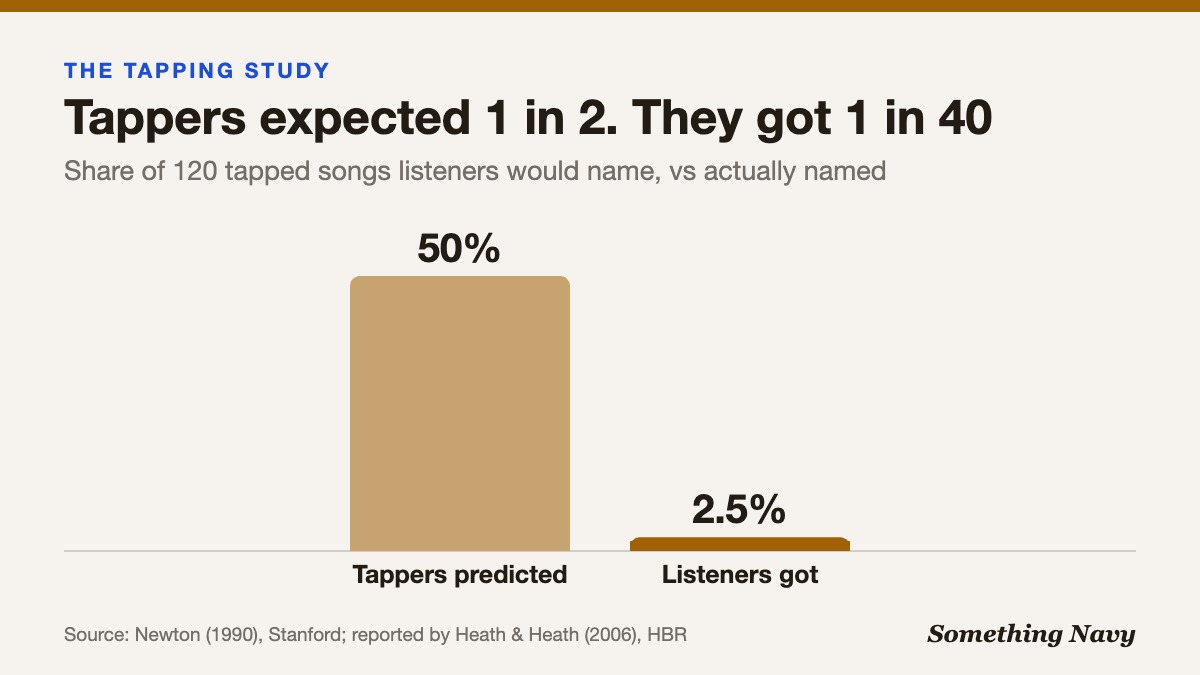
The tapping study and the music only you can hear
What makes Newton’s experiment so memorable is that the tappers could not switch off the tune. Once you know the song, you cannot hear your own knocking the way a stranger hears it. The melody fills in every gap automatically, so the knocks sound obvious, almost melodic.
When listeners failed, the Heaths note, tappers were often visibly frustrated. How could anyone miss something so plain?
This is the trap in a sentence: the knowledge that lets you do something well is the same knowledge that stops you imagining what it is like not to have it.
A word of caution about the study itself. Newton’s work was a doctoral dissertation, titled “The rocky road from actions to intentions”, not a large peer-reviewed trial, and most people (including us) know its numbers through the Heaths’ retelling. It is best read as a vivid demonstration rather than a precise measurement. The reason it has lasted is that the effect it shows has turned up again and again in very different settings.
Where the curse of knowledge got its name: an economics lab in 1989
The phrase “curse of knowledge” comes from economists, not psychologists. In 1989 Colin Camerer, George Loewenstein and Martin Weber published a paper in the Journal of Political Economy that tested a basic assumption of economic theory: that a better-informed person can simply set aside what they know when predicting what a less-informed person will think.
The design was neat. First, 51 students at the Wharton School read company reports and forecast the 1980 earnings of eight firms. Then a second group, who were told the real 1980 earnings, had to estimate what the first group had predicted. They were paid to get it right, so there was every reason to ignore the answer they had been handed.
They could not. Their estimates of the uninformed forecasts drifted towards the true figures, as if anyone could have seen the results coming. Feedback on their errors did not cure the bias. When the researchers let people trade in a small market, prices ended up somewhere in between, cutting the bias roughly in half but not removing it.
The conclusion was awkward for textbook economics. More information is not always an advantage, because the person who has it struggles to stop using it.
Why experts explain badly, and why trying harder rarely helps
If the curse of knowledge only tripped up business students guessing earnings forecasts, it would be a curiosity. The trouble is that it gets worse the more you know.
In a study published in 1999 in the Journal of Experimental Psychology: Applied, Pamela Hinds, a management scientist now at Stanford, looked at mobile phones. She asked people with different levels of experience to predict how long a complete beginner would take to learn to use a phone. Then she gave beginners the phone and its printed instructions and timed them.
As the cognitive scientist Sian Beilock describes the results, the novices took around 30 minutes. The salespeople who knew the phones best estimated less than 13. They also failed to anticipate most of the problems the beginners actually hit. The best forecasters were people in the middle: customers with some experience, who could still remember being confused.
Hinds also tried ways of “debiasing” the experts, and the title of her paper hints at how well that went: the curse of expertise held up.
It is worth separating this from overconfidence about your own ability, the territory of the Dunning-Kruger effect. The cursed expert is usually right about the subject. What they misjudge is the distance between their mind and yours.
The expert is usually right about the subject. What they misjudge is the distance between their mind and yours.


The curse of knowledge at work: jargon, emails and the “obvious” next step
Most workplaces are full of tappers. The engineer who writes “just restart the service” to a colleague in finance. The manager who says “make the deck punchier” and cannot understand why the second draft is no closer. The handover note that skips the one step everyone on the old team did without thinking.
Email makes it worse, because it strips out your voice, the way a tapped song strips out the melody. In 2005, Justin Kruger, Nicholas Epley and colleagues published a set of experiments in the Journal of Personality and Social Psychology on exactly this. In one, pairs of students emailed each other statements, half meant sarcastically and half seriously, and recipients had to say which was which.
According to a summary by the American Management Association, senders expected roughly 78% of their messages to be read correctly. Recipients got about 56% right, not far above a coin toss. Recipients, for their part, were sure they had decoded the tone almost every time.
The sender hears the wry tone in their head. The reader sees only the words.
There was a useful twist. When senders said a sarcastic line aloud in a deadpan voice before sending it, they became better at predicting that it would fall flat, as the British Psychological Society’s Research Digest reported. Hearing your message without the music is the first step to fixing it.
In the classroom: why the best scholar is not always the best teacher
Anyone who has sat through a lecture by a brilliant researcher who could not explain anything has met the curse of knowledge at full strength. The lecturer skips steps not out of arrogance but because, for them, those steps no longer exist. Years of practice have fused them into a single move.
This is also why the most helpful explanation sometimes comes from the student who sat next to you, who only understood the topic last week. Like Hinds’s intermediate phone users, they still remember where the hard part was.
The effect starts early. Psychologists Susan Birch and Paul Bloom, writing in Psychological Science in 2007, adapted a classic children’s test of “false belief” for adult students at Yale. Participants heard a story in which a girl, Vicki, leaves her violin in one place and her sister Denise moves it while she is out. When participants were told where Denise had put the violin, they became more likely to think Vicki would look there first, even though Vicki could not have known.
That finding needs a footnote. In 2014, Rachel Ryskin and Sarah Brown-Schmidt ran seven larger experiments on the same task and found the effect pointed in the same direction but was less than half the size of the original estimate. The broad pattern survives. The precise strength of this particular version is smaller than first reported, which is a good reminder that one clever study is a starting point, not a verdict.
In relationships: the people closest to you understand you less than you think
You might assume the curse fades with people who know you well. Partners share a history, a vocabulary, a hundred in-jokes. Surely they can hear the tune.
Kenneth Savitsky, Boaz Keysar, Nicholas Epley and colleagues tested this in a study published in the Journal of Experimental Social Psychology in 2011. In one experiment, 24 married couples sat back to back and took turns saying ambiguous everyday phrases, each of which could mean several things, to either their spouse or a stranger.
Speakers were more confident that their spouse had understood them. In fact, as the University of Chicago reported, spouses and strangers were statistically no different in how accurately they read the messages. Closeness raised confidence, not accuracy.
“People commonly believe that they communicate better with close friends than with strangers,” Keysar said at the time. The research suggests that belief is where the trouble begins: we stop checking.
This is one quiet engine behind arguments that seem to come from nowhere. “I told you I was tired” can mean “please cancel tonight” in your head and “I am mildly tired” in your partner’s. Neither of you is lying. One of you is tapping. It is the same mechanism that makes us overestimate how much others notice about us, a cousin of the spotlight effect: our inner experience feels so loud that we assume it must be audible.
Small misreadings like these are rarely the end of anything. What does damage, as the research on how couples argue suggests, is when a misunderstanding gets treated as a character flaw rather than a communication gap.
How to beat the curse of knowledge: what actually helps
There is no switch that turns the curse off. Camerer’s traders could not will it away, and Hinds’s experts did not simply think their way out of it. What works is changing the situation so that you are forced to hear your own knocking.
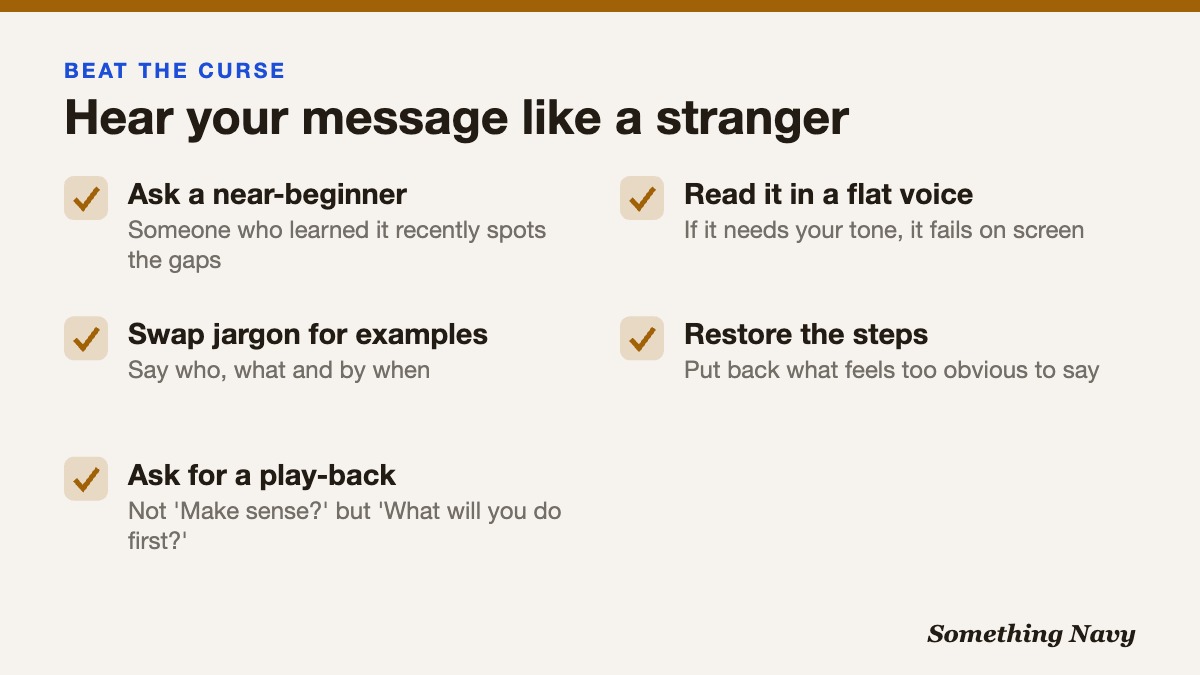
Borrow someone who still remembers being lost
The strongest practical lesson from Hinds’s study is that the person who learned something recently is often a better guide to a beginner than the master. If you are writing instructions, a training plan or a product page, have someone a step or two behind you read it, not your fellow expert.
Make it concrete before you make it clever
Abstract language is where the curse hides. “Optimise stakeholder alignment” sounds full of meaning to the person who wrote it, because they know the meeting, the people and the problem behind it. A concrete example (who, what, by when) carries its own context with it.
Test, do not assume
The cheapest fix is the oldest: ask the other person to say back what they understood. Not “Does that make sense?”, which almost everyone answers with yes, but “So what will you do first?” Their answer is the listener naming the song.
Read it in a flat voice
For written messages, borrow the Kruger trick. Read the key sentence aloud in a monotone. If it only works with your tone of voice, it will not work on screen.
Try this: the five-minute tapping test
- Pick something you know well: your job, a hobby, a recipe you make without looking.
- Write a three-sentence explanation of it for someone who has never encountered it.
- Underline every word a 14-year-old might not know, and every step you left out because it is “obvious”.
- Give it to someone outside your field and ask them to explain it back to you without looking.
- Notice where their version wanders. That is where your tune was playing and your knocks were not.
A before-and-after explanation: the same message, uncursed
Here is what the curse looks like on a real page. Imagine an IT lead telling the office about a new security step.
Before: “From Monday we’re enforcing MFA on all SSO-linked accounts. Please enrol via the portal before the cut-off to avoid lockout.”
Every word is accurate. To the person who wrote it, it is perfectly clear. To many of the people reading it, it is three acronyms, an unnamed portal and an unexplained threat.
After: “From Monday, logging in to your work email and shared drive will need two things: your password and a code sent to your phone. It takes about five minutes to set up. Go to the staff page, click ‘Security’, and follow the steps. If you have not done it by Monday, you will not be able to log in until IT resets your account.”
The second version is longer, and that is fine. It names the thing in everyday terms, says what it will feel like, gives the exact route and spells out the consequence. It is what the message sounds like when the writer stops listening to the melody in their head and starts listening to the knocks.
Notice what did not change: the facts. Uncursing an explanation is rarely about dumbing it down. It is about putting back the steps your expertise quietly deleted.
What the research cannot tell you yet
It is fair to ask how solid all this is. The core idea, that knowing something makes it hard to imagine not knowing it, has been found in economics labs, in learning experiments, in false-belief tasks and in studies of couples and friends. That breadth is reassuring.
But individual studies vary. The tapping experiment is famous partly because it is so easy to picture, and its numbers come to most of us second-hand. The Birch and Bloom effect proved smaller when it was repeated with larger samples. Many of these studies used university students, who are not the whole of humanity. And the research is much better at showing the bias exists than at proving which fixes work best in a busy office or a tired kitchen at 10pm.
What it does justify is a modest habit: assuming that you are less clear than you feel, and checking.
The quiet upside of being cursed
There is something oddly comforting in all of this. The colleague who loses you in the first minute of a meeting is probably not trying to show off. The partner who “should have known” what you meant was, very likely, hearing a different song. And if you have ever felt stupid in front of an expert, it may have been the explanation that failed, not you.
The curse of knowledge is the price of knowing things. You cannot avoid paying it, but you can stop pretending it is free. Before the next important email, instruction or late-night conversation, ask yourself one question.
What does this sound like to someone who cannot hear the tune?
Sources
- Camerer, C., Loewenstein, G., & Weber, M. (1989). The curse of knowledge in economic settings: An experimental analysis. Journal of Political Economy, 97(5), 1232–1254. DOI
- Heath, C., & Heath, D. (2006). The curse of knowledge. Harvard Business Review, December 2006 (describing Newton, E. L., 1990, The rocky road from actions to intentions, doctoral dissertation, Stanford University). Link
- Hinds, P. J. (1999). The curse of expertise: The effects of expertise and debiasing methods on prediction of novice performance. Journal of Experimental Psychology: Applied, 5(2), 205–221. DOI
- Beilock, S. (2011). The curse of expertise. Psychology Today. Link
- Kruger, J., Epley, N., Parker, J., & Ng, Z.-W. (2005). Egocentrism over e-mail: Can we communicate as well as we think? Journal of Personality and Social Psychology, 89(6), 925–936. DOI
- Birch, S. A. J., & Bloom, P. (2007). The curse of knowledge in reasoning about false beliefs. Psychological Science, 18(5), 382–386. DOI
- Ryskin, R. A., & Brown-Schmidt, S. (2014). Do adults show a curse of knowledge in false-belief reasoning? A robust estimate of the true effect size. PLOS ONE, 9(3), e92406. DOI
- Savitsky, K., Keysar, B., Epley, N., Carter, T., & Swanson, A. (2011). The closeness-communication bias: Increased egocentrism among friends versus strangers. Journal of Experimental Social Psychology, 47(1), 269–273. DOI
Cover photo: Centre for Ageing Better on Unsplash. Charts and graphics: Something Navy.
How we reported this. We went back to the original research for this story, 8 sources in all, listed above, and checked every figure against them. If you think we have got something wrong, tell us and we will look at it. Read more about how we work.