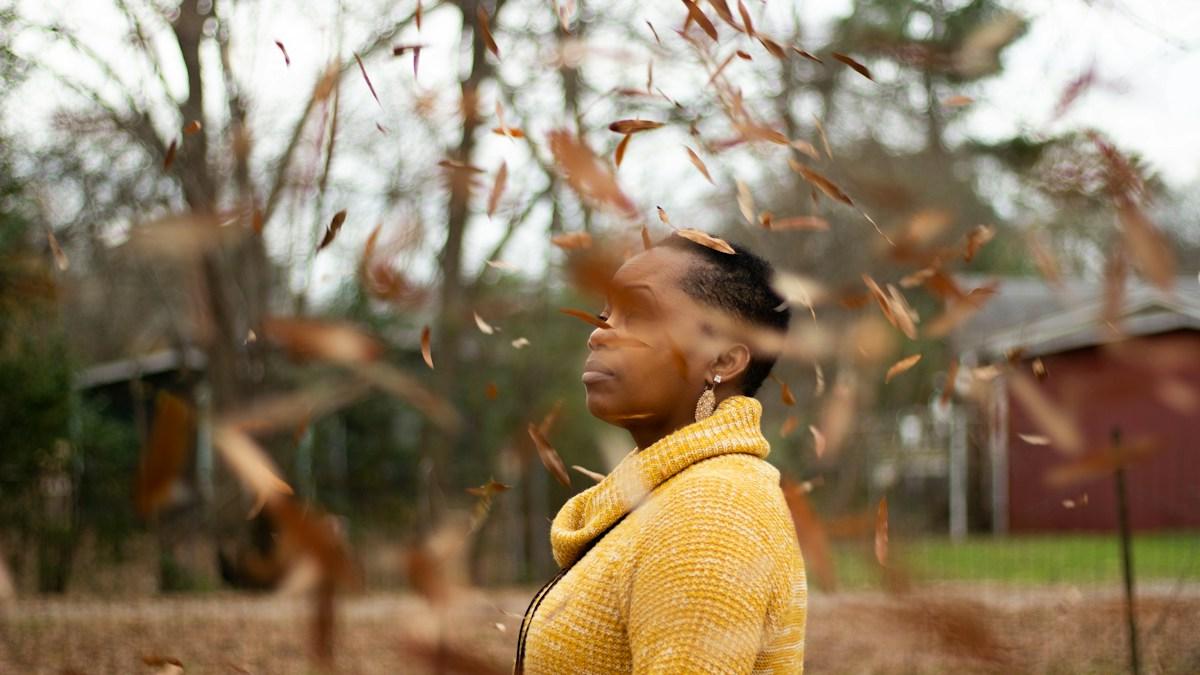
It is a grey Tuesday in February. You reach past the navy and the black and pull out the mustard jumper you bought on a whim, and something small and pleasant happens before you have even put it on.
Social media has a name for that flicker. It calls it dopamine dressing: wearing loud, saturated, joyful colour on purpose, to make yourself feel better.
The idea is appealing, and part of it holds up surprisingly well. When researchers asked 4,598 people in 30 countries which emotions they linked to colour words, the answers lined up across continents with remarkable consistency. Yellow meant joy almost everywhere.
The part that does not hold up is the name. Nobody has shown that a pink coat pushes dopamine around your brain. What the research does show is more interesting, and more useful when you are standing in front of the wardrobe.
Where dopamine dressing came from
Bright clothes are not new. What changed was the label and the timing. The phrase is widely credited to Dawnn Karen, a fashion psychologist who has taught at the Fashion Institute of Technology in New York, and it surfaced in coverage around her book Dress Your Best Life, published by Little, Brown Spark in April 2020.
That month mattered. Much of the world was at home, dressing for no one but themselves and a laptop camera. When restrictions eased in 2021 and 2022, fashion coverage swung noticeably towards colour. Pinterest’s trend forecast for 2022, published in December 2021, said searches for “vibrant outfits” had risen more than sixteenfold on the previous year.
The hashtag did the rest. A catchy phrase, a neuroscience word and before-and-after outfit videos are a powerful mix. Within a couple of years “dopamine” had been attached to décor, playlists and lunch.
Which raises the obvious question: what can science actually say about colour and mood?
The 30-nation colour and emotion survey
The most ambitious answer so far comes from a team led by Domicele Jonauskaite and Christine Mohr at the University of Lausanne, working with more than 30 co-authors. In a 2020 paper in Psychological Science, they reported on 4,598 people from 30 nations, answering in 22 native languages.
The method was simple. Participants saw 12 colour words, such as red, yellow and turquoise, and for each one picked any emotions they associated with it from a list of 20 on the Geneva Emotion Wheel. On average, each colour word drew about three emotions.
Then the team compared every country’s pattern of answers with the global average. A score of 1 would mean identical patterns. The average country scored 0.88. Spain was closest to the global pattern at 0.94, and even the most distinctive nation, Egypt, reached 0.68. Any two countries compared directly averaged 0.78.
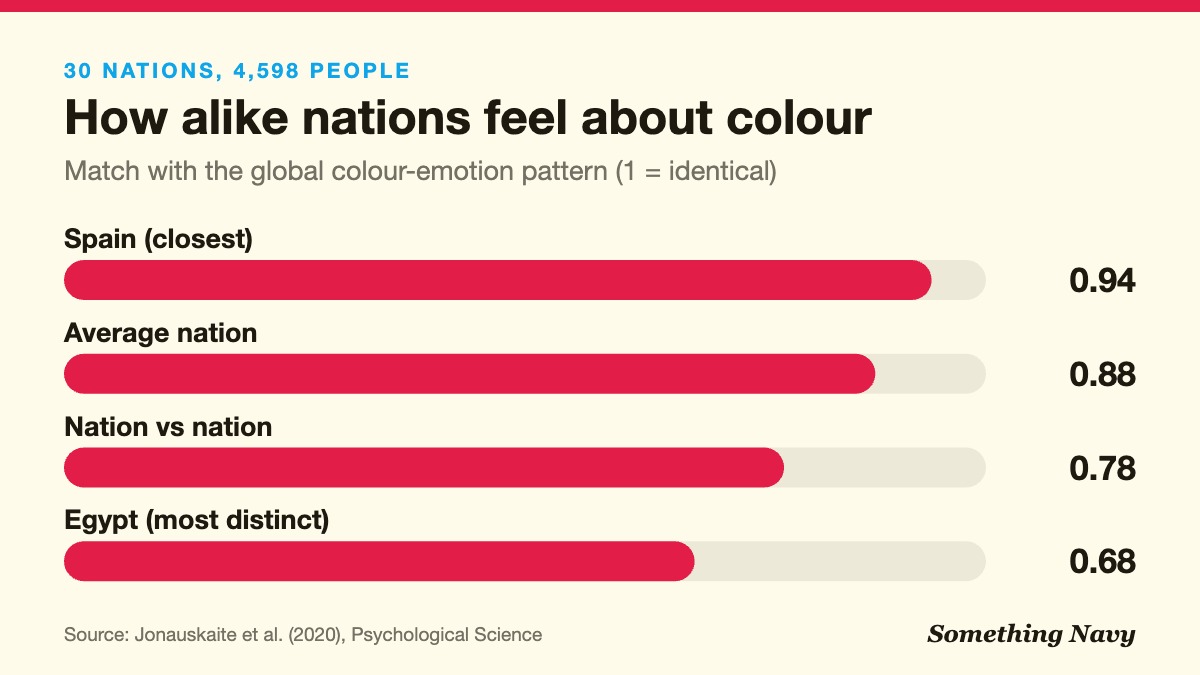
In plain terms: people who have never met, speaking different languages, link colours to feelings in strikingly similar ways.
But not identical ways. A computer model trained on the answers could guess a participant’s country 34.4% of the time, against a chance rate of 9.7%. Countries that were closer in language and geography had more similar patterns. Culture leaves fingerprints on colour.
Colour does not carry a mood into you. It carries a meaning, and you bring the mood.


A colour by colour guide to what the research found
The Lausanne team flagged the pairings that were chosen most often, those with a probability of at least 0.4. Here is what those findings suggest for the clothes on your rail, and what they do not.
| Colour word | Strongest emotion links (30 nations) | Worth knowing |
|---|---|---|
| Red | Love, anger | One of the two most emotional colours everywhere |
| Pink | Love, joy, pleasure | Very consistent across nations |
| Yellow | Joy | Link is stronger in rainier countries far from the equator |
| Orange | Joy, amusement | Reliably positive |
| White | Relief | In China, also linked to sadness |
| Grey | Sadness, disappointment | One of the few clearly negative colours |
| Black | Sadness, fear, hate | Highly emotional, mostly negative |
| Brown | No strong link | The least emotional colour in every nation |
Red: love and anger in the same garment
In every nation in the study, red and black were the colour words most likely to trigger any emotion at all. Red pulled two ways, towards love and towards anger. That double meaning is worth remembering: a red dress or tie is energising, not automatically cheerful.
Red also has the most famous clothing claim attached to it, that it makes you more attractive. A 2018 meta-analysis by Lehmann, Elliot and Calin-Jageman found a small average effect, with signs that the findings have been inflated by publication bias and that effects may have shrunk over time. We looked at that story in detail in our piece on whether red really makes you more attractive.
Pink: the most reliably happy colour
Pink was linked to love, joy and pleasure, and it was among the colours whose pattern varied least between countries. If dopamine dressing needs a mascot colour, pink is a fair choice on the evidence.
Yellow and orange: joy, with a weather twist
Yellow and orange both leaned strongly towards joy, and orange towards amusement too. The yellow finding comes with a fascinating footnote. In a 2019 study of 6,625 people in 55 countries, the same research group found that people living further from the equator, and in rainier countries, were more likely to associate yellow with joy.
The suggestion is that yellow feels most joyful where sunshine is scarce. Which makes the mustard jumper on a wet February morning in Manchester feel less like a fashion choice and more like a small act of weather defiance.
Blue and green: calm, but not in the way you think
Everyday language says we “feel blue” when sad. The 30-nation data did not back that up: blue was not among the colours strongly tied to sadness. Grey and black were.
Green and turquoise produced no single dominant emotion, yet their patterns were among the most stable across countries. Blue is also the colour most people like best. In a 2010 study at the University of California, Berkeley, Stephen Palmer and Karen Schloss asked 48 people to rate 32 colours. Blues came out on top, and dark yellow (olive) and brown near the bottom.
Their explanation is neat. We like colours that remind us of things we like, such as clear sky and clean water, and dislike colours that remind us of things we do not. How people felt about the objects linked to each colour explained 80% of the variation in colour preference.
White and purple: where culture speaks loudest
White was most often linked to relief, a feeling that fits crisp linen on a hot day. Yet in China, participants also tied white to sadness, a reminder that it is a colour of mourning in parts of East Asia.
Purple was one of the two colours whose meaning shifted most between countries, alongside yellow. Most nations saw it as positive, but Greek participants linked purple with sadness. If you dress for a wedding or a funeral abroad, these differences are not trivia.
Black and grey: the wardrobe default with a heavy load
Black was strongly linked to sadness, fear and hate; grey to sadness and disappointment. That does not mean a black coat will make you gloomy. Black is also elegant, practical and, in fashion terms, powerful. The associations are about the word on its own, stripped of a cut, a fabric or a context.
Brown: the colour that barely registers
Brown was the least emotional colour in every nation. Fittingly, the camel coat is a classic precisely because it stays out of the way. If your aim is a mood lift, brown is unlikely to do much heavy lifting.
Why the dopamine label is a stretch
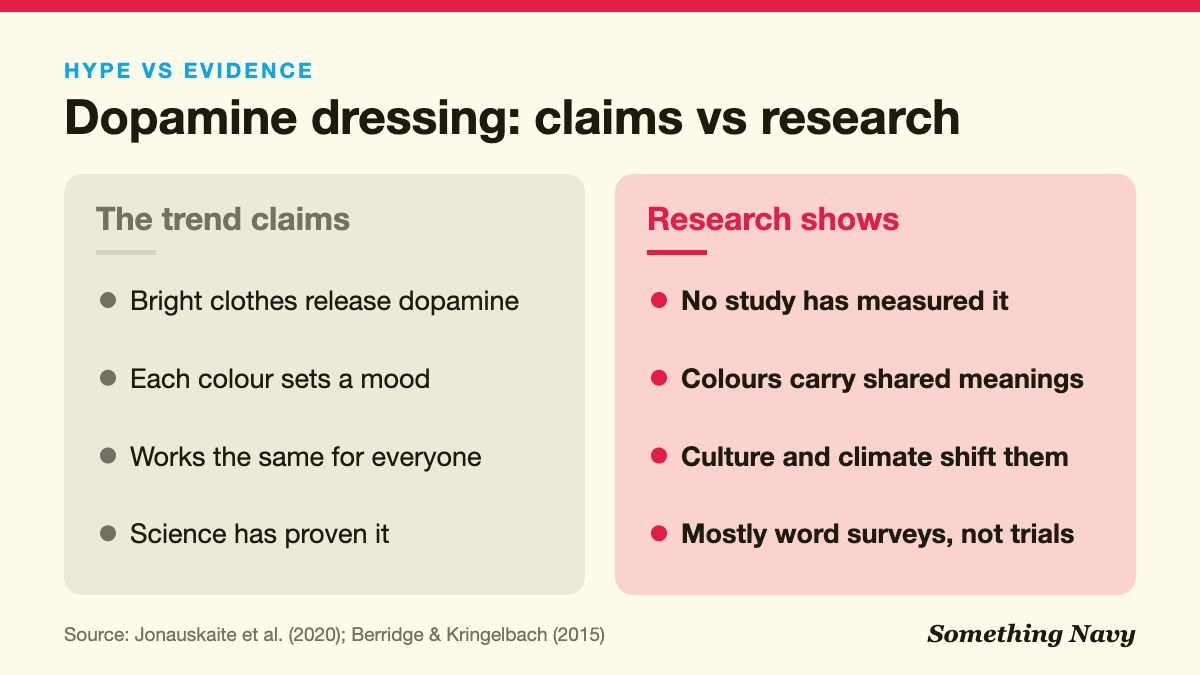
Dopamine is a real and important brain chemical, but it is not a happiness dispenser. In a 2015 review in Neuron, the neuroscientists Kent Berridge of the University of Michigan and Morten Kringelbach of Oxford argued that the brain’s main dopamine pathway is better understood as driving “wanting”, the pull towards a reward, than as producing the pleasure itself.
More to the point, nobody has measured dopamine in people choosing or wearing bright clothes. There is no brain scan, blood test or trial behind the word in the hashtag. It is a metaphor wearing a lab coat.
The phrase is borrowed credibility.
It also hides a more honest story. The colour research above measures what people associate with colour words. The authors themselves point out that they used terms, not colour patches, and that they cannot tell whether those links play out as felt emotion when you actually see a colour, let alone wear it.
What clothes really do to mood, and the other way round
The best-known clothing and mood study points in an unexpected direction. In 2012, Professor Karen Pine at the University of Hertfordshire asked 100 women what they wore when they felt low and when they felt happy.
When depressed, 57% said they would reach for a baggy top; only 2% would do so when happy. A favourite dress was the opposite: 62% would wear one when happy, just 6% when low.
Notice what this shows. Mood shapes what we pull out of the wardrobe. That is the reverse of the dopamine dressing claim, and it is a self-report survey, not an experiment. It still hints at something useful: if low mood steers you towards shapeless greys, choosing differently is a small way of interrupting the pattern.
There is also the wider idea of enclothed cognition, that clothes affect how we think through the meaning we give them. Its headline 2012 lab coat result did not hold up in a preregistered replication by Devin Burns and colleagues in 2019. A 2025 meta-analysis by Horton, Adam and Galinsky, pooling 40 studies with 3,789 participants, found reasons to doubt the early studies but more convincing evidence in work published after 2015.
So the honest summary is modest. Clothes carry meaning. Colour carries widely shared associations. Whether that adds up to a reliable mood boost for you has never been properly tested.
That is not a reason to give up on colour. It is a reason to treat it as an experiment rather than a prescription.


How to try dopamine dressing without the hype
If the evidence is thin, the cost of trying is also tiny. You already own clothes. Here is a sensible way to see whether colour does anything for you.
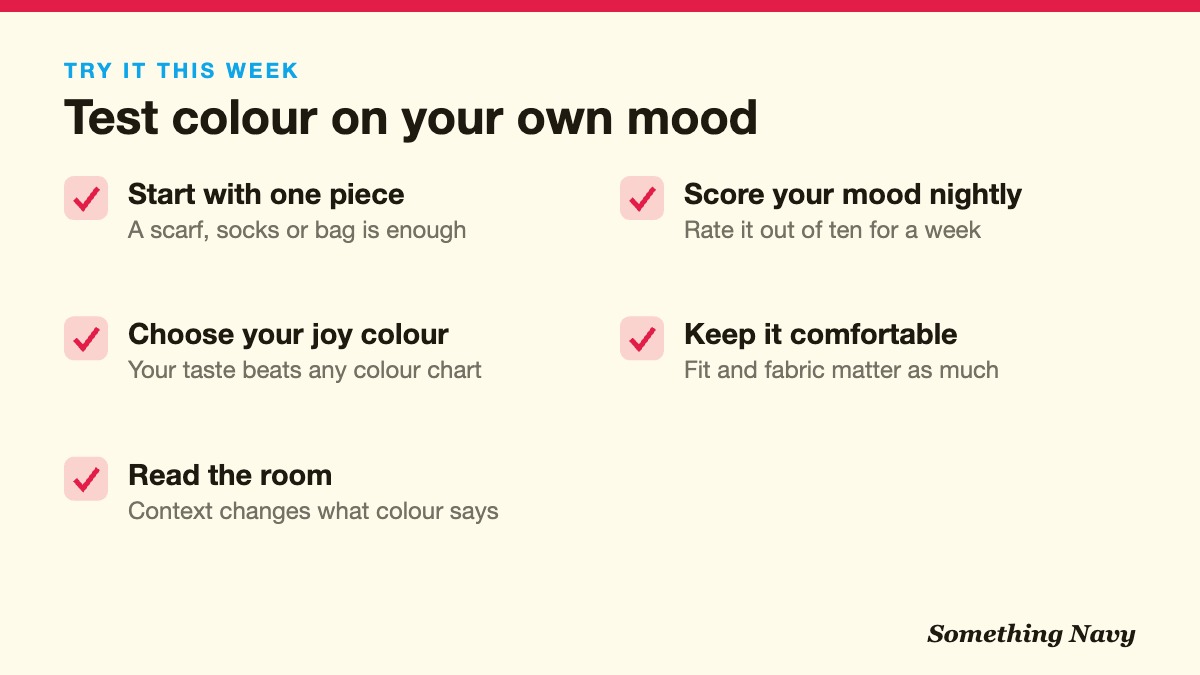
Try this for a week
- Start small. One bright piece, such as a scarf, socks or a bag, is enough to notice a difference without feeling in costume.
- Pick your own joy colour. The shared associations are averages. If cobalt makes you happy and yellow makes you feel ill, trust yourself.
- Read the room. Red can read as warm or aggressive; black can read as chic or sombre. Context changes the message.
- Keep score. Rate your mood out of ten each evening and note what you wore. A week of honest numbers beats any hashtag.
- Do not sacrifice comfort. A scratchy fabric or a tight waistband will cancel out any colour.
If you want a bolder look, layering clashing tones is a skill of its own; our guide to mixing pattern and texture covers how to do it without looking chaotic. If you would rather keep things calm, a capsule wardrobe with two or three accent colours gives you a daily choice without the clutter.
One more practical point: notice whether the lift comes from the colour or from the novelty. Anything you have not worn in months can feel fresh for a day or two. If the bright piece still makes you smile in its third week, that is a better sign it suits you.
The real reason that mustard jumper works
There is a strong case that the pleasure of bright clothes comes less from the colour itself than from what you are doing when you pick it. You are making a deliberate choice for yourself, on a day when the default would be easier.
That act of choosing sits close to what the colour research actually found: colours carry meanings we learn, share and partly inherit from our culture and our weather. When you pull out the yellow on a dark morning, you are drawing on a meaning millions of people would recognise.
That is not a chemical trick. It is a language, and you happen to be fluent in it.
Wear the colour that says what you want the day to say. Then pay attention to whether it does.
Frequently asked questions
Partly. Large surveys show people across many countries link colours such as yellow, orange and pink to positive emotions, but no study has shown that bright clothes raise dopamine or reliably lift mood.
Across 30 nations, yellow, orange and pink were most strongly tied to joy. Personal taste matters too, so the colour you love is a better bet than any chart.
There is no evidence of that. Black is linked with sadness as a word, but associations with a colour term are not the same as how you feel wearing a well-cut black jacket.
Run a small test. Wear one bright piece on some days and not others for a week or two, and rate your mood each evening before you look back at what you wore.
Sources
- Berridge, K. C., & Kringelbach, M. L. (2015). Pleasure systems in the brain. Neuron, 86(3), 646–664. DOI
- Burns, D. M., Fox, E. L., Greenstein, M., Olbricht, G. R., & Montgomery, D. (2019). An old task in new clothes: A preregistered direct replication attempt of enclothed cognition effects on Stroop performance. Journal of Experimental Social Psychology, 83, 150–156. DOI
- Horton, C. B., Adam, H., & Galinsky, A. D. (2025). Evaluating the evidence for enclothed cognition: Z-curve and meta-analyses. Personality and Social Psychology Bulletin, 51(2), 203–221. DOI
- Jonauskaite, D., Abdel-Khalek, A. M., Abu-Akel, A., et al. (2019). The sun is no fun without rain: Physical environments affect how we feel about yellow across 55 countries. Journal of Environmental Psychology, 66, 101350. DOI
- Jonauskaite, D., Abu-Akel, A., Dael, N., et al. (2020). Universal patterns in color-emotion associations are further shaped by linguistic and geographic proximity. Psychological Science, 31(10), 1245–1260. DOI
- Lehmann, G. K., Elliot, A. J., & Calin-Jageman, R. J. (2018). Meta-analysis of the effect of red on perceived attractiveness. Evolutionary Psychology, 16(4). DOI
- Palmer, S. E., & Schloss, K. B. (2010). An ecological valence theory of human color preference. Proceedings of the National Academy of Sciences, 107(19), 8877–8882. DOI
- University of Hertfordshire (2012, 8 March). Happiness: It’s not in the jeans. ScienceDaily. Link
Cover photo: Paris Lopez on Unsplash. Charts and graphics: Something Navy.
How we reported this. We went back to the original research for this story, 8 sources in all, listed above, and checked every figure against them. If you think we have got something wrong, tell us and we will look at it. Read more about how we work.