
By the numbers
- 7 or more hours of sleep a night is what sleep scientists recommend for adults.
- Around 1 in 3 US adults regularly sleep less than that, according to the CDC.
- 79% of adults in one 2023 study used their phone in bed.
- 2,431 Dutch adults took part in one of the largest early studies of bedtime procrastination.
The day is finally over. The children are asleep, the emails have stopped, the dishes are done or at least abandoned. You know you should go to bed, and you are tired enough that you could fall asleep in minutes. Instead you pick up your phone, and suddenly it is 1am.
If that sounds familiar, you are in large company. The habit has become so widely recognised that it has its own name, revenge bedtime procrastination, and its own body of research. The science suggests it is not simply a lack of willpower, and that the “revenge” part of the name may be closer to the truth than it first appears.
A phrase born of long working days
The term comes from China, where the phrase 报复性熬夜 roughly translates as “retaliatory staying up late”. It grew out of frustration with punishing work schedules, including the so-called “996” pattern of working from 9am to 9pm, six days a week. With almost no free time during the day, people clawed some back at night, even at the cost of sleep.
The English version took off in 2020, after the journalist Daphne K. Lee translated it as “revenge bedtime procrastination” on social media, according to a 2021 report in The Spokesman-Review. It struck a nerve at a moment when the pandemic had blurred the line between work and home for millions of people.
Is it really revenge?
The word “revenge” can sound dramatic, but it captures something the research keeps circling back to: a sense of fairness. When most of the day belongs to an employer, a commute, children or caring responsibilities, the hours after everyone else is asleep can feel like the only time that is genuinely yours. Giving that time up for sleep can feel like losing twice.
Seen this way, the behaviour is less irrational than it looks. People are not staying up because they do not value sleep. They are trading sleep for something they value more in the moment: autonomy, quiet, a sense of being a person rather than a role. The trade only becomes a problem because the cost arrives the next morning, when the alarm goes off and the same demands are waiting.
That framing also explains why advice to simply “go to bed earlier” rarely works on its own. If the late night is meeting a real need, the need has to be met somewhere else, or the habit will keep coming back.
What the research calls it
Scientists had been studying the behaviour for several years before it went viral. The term “bedtime procrastination” was introduced in 2014 by Floor Kroese and colleagues at Utrecht University in a paper in Frontiers in Psychology. They defined it as “failing to go to bed at the intended time, while no external circumstances prevent a person from doing so.”
The second half of that definition matters. Staying up because a baby woke, a shift ran late or a neighbour’s party is in full swing is not procrastination. Bedtime procrastination is when nothing is stopping you, you intend to go to bed, and you still do not.
In their first study of 177 adults, people who scored lower on self-regulation, the ability to steer their own behaviour towards their goals, were more likely to put off bedtime. Those who procrastinated more slept fewer hours, felt more tired during the day and more often felt they had not slept enough. A follow-up study of 2,431 Dutch adults, published in 2016, found the same pattern and showed that a large share of people regularly go to bed later than they would like.
Not one habit, but three
Not everyone who stays up late is doing it for the same reason. In a 2019 study in Behavioral Sleep Medicine, researchers led by Sanne Nauts interviewed people about why they delay going to bed and found three distinct patterns.
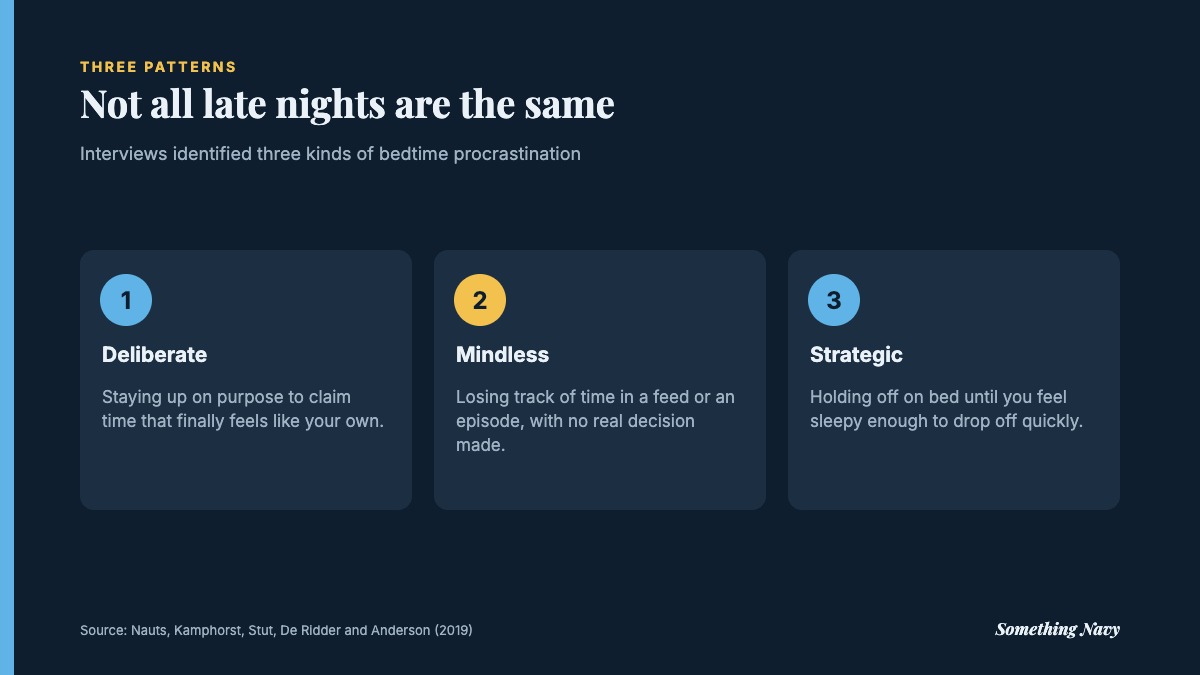
Some people procrastinated deliberately. They knew exactly what they were doing and felt they deserved some time for themselves after a demanding day. This is the closest the research comes to the “revenge” idea. Others procrastinated mindlessly, losing track of time while watching, scrolling or reading, and only noticing the hour when it was already late. A third group described something more like a strategy: delaying bed because they expected to lie awake if they went too early.
The distinction is useful because each pattern calls for a different response. Someone staying up deliberately may need more protected free time during the day. Someone losing track of time may benefit from a simple alarm. Someone avoiding a sleepless hour in bed may be dealing with something closer to insomnia.


Owl or self-control?
There is a lively debate among researchers about what drives bedtime procrastination. A 2018 diary study of 108 employees by Jana Kühnel and colleagues, published in Frontiers in Psychology, found that “evening types”, people whose body clocks naturally run late, reported more bedtime procrastination on workdays. The authors argued this challenged the idea that the behaviour was mainly a failure of self-control. Night owls, they suggested, may simply be going to bed before their bodies are ready.
The original Utrecht team disagreed. In a reply in the same journal, Kroese and colleagues wrote that they “firmly oppose reducing the complex phenomenon of bedtime procrastination to a biological issue.” The most likely answer is that both play a part: body clocks set the stage, and habits and self-regulation shape what happens on it.
Where phones and work come in
A 2023 study of 310 Spanish adults in Behavioral Sciences found that almost four in five used their phone in bed, and more than two-thirds had poor sleep quality. Problematic phone use did not seem to damage sleep directly. It did so indirectly, by pushing back the time people went to bed.
Work follows people to bed too. In a 2022 survey of 415 public employees in the United States and China, published in Frontiers in Psychology, using a smartphone for work outside working hours was linked to more bedtime procrastination, partly through depleted self-control. A 2026 meta-analysis of 18 studies and more than 35,000 university students, in the same journal, found a moderate link between bedtime procrastination and stress. Neither design proves cause and effect, but both fit the idea that a crowded, stressful day spills into a late night.
Screens may also affect sleep more directly. In a laboratory study published in 2015 in PNAS, Anne-Marie Chang and colleagues compared reading on a light-emitting e-reader with reading a printed book before bed. The e-reader readers had lower levels of melatonin, the hormone that helps regulate sleep, took longer to fall asleep and were less alert the next morning.
Why the lost hour matters
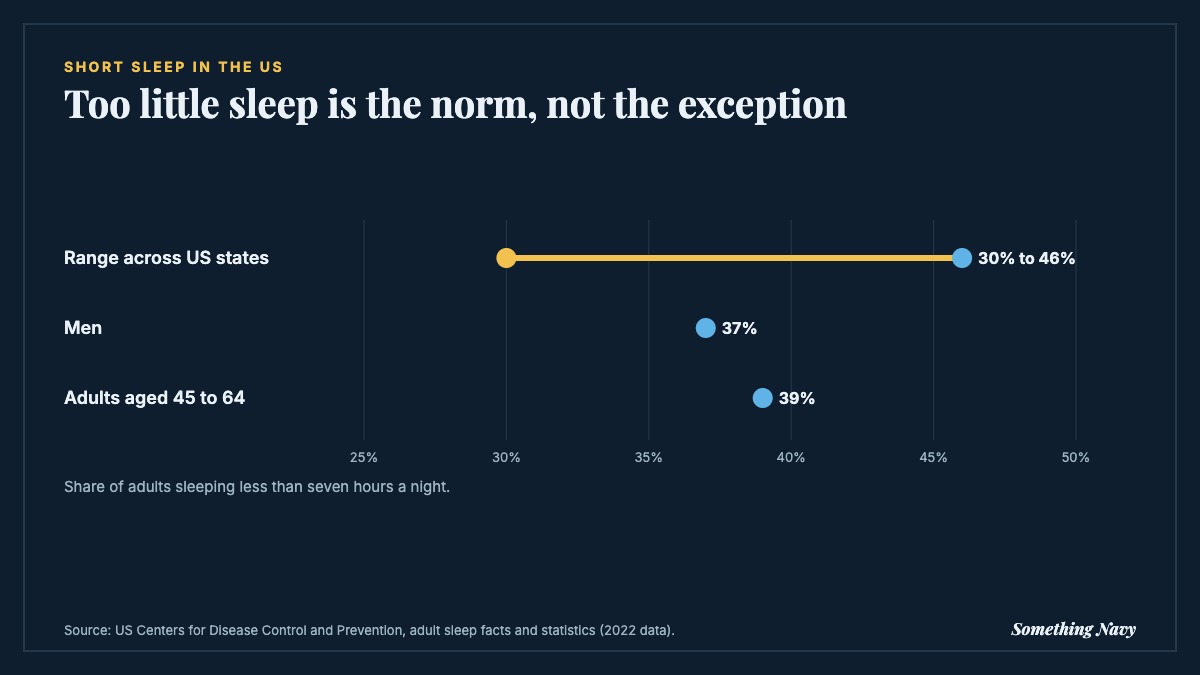
The American Academy of Sleep Medicine and the Sleep Research Society recommend that adults “sleep 7 or more hours per night on a regular basis to promote optimal health”. According to the US Centers for Disease Control and Prevention, the share of adults getting less than that in 2022 ranged from 30% in some states to 46% in others, with rates largely unchanged over the past decade.
Regularly sleeping too little has been linked to weight gain, diabetes, high blood pressure, heart disease, depression and more accidents and errors. A single late night will not do lasting harm. The problem is when the late night becomes the routine.
It is not only an individual problem
Most advice about bedtime procrastination is aimed at the person staying up. But if long hours and work messages arriving late at night are part of the cause, some of the solutions sit elsewhere. The study of public employees in the US and China suggests that after-hours work on smartphones is linked to later bedtimes. Workplaces that set clear expectations about when messages need answering, and managers who avoid sending them late at night, may be doing their teams’ sleep a favour.
The same is true at home. In households where one person carries most of the evening chores or childcare, the “free” time may only begin once everyone else is asleep. Sharing those tasks more evenly can create space earlier in the evening, which takes some of the pressure off the late-night hours.
None of this removes personal responsibility for going to bed. It simply recognises that the urge to stay up is often a response to how the rest of the day is organised, and that changing the day can be as powerful as changing the night.
When late nights are a sign of something else
Not every late night is procrastination. Some people lie awake for long periods despite going to bed at a sensible time, wake repeatedly in the night or feel unrefreshed however long they sleep. Others have body clocks that run so late that a conventional bedtime is almost impossible. These patterns can point to sleep problems such as insomnia or a delayed sleep rhythm, which are different from simply choosing to stay up.
If poor sleep is affecting your mood, concentration or health over several weeks, or if you regularly feel very sleepy during the day, it is worth talking to a doctor. Sleep problems are common and often treatable, and getting the right help can make a much bigger difference than any bedtime routine.
What helps
The most promising evidence for changing the habit comes from planning. In two randomised trials published in 2020 in Psychology & Health, a technique that combines picturing your goal and its obstacles with specific “if-then” plans reduced bedtime procrastination compared with control groups. We explain how to make these plans in our article on if-then planning.
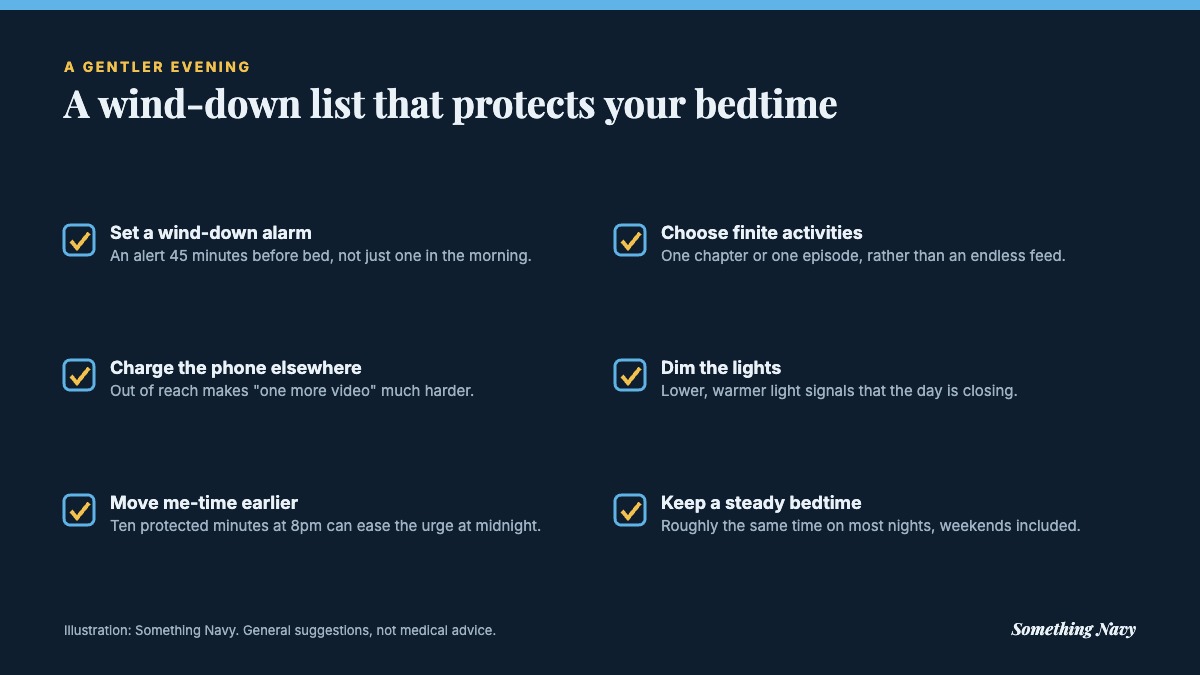
- Set a “wind-down” alarm rather than a bedtime alarm, so you start getting ready while there is still time.
- Keep the phone out of reach. Charging it outside the bedroom removes the easiest route into a late-night scroll. The NHS suggests putting your phone away before bed.
- Protect some free time earlier. If you stay up late to claim time for yourself, even half an hour of guarded leisure in the evening can reduce the urge.
- Keep regular hours. The Sleep Foundation recommends consistent bed and wake times, including on days off.
- Be kind about slip-ups. One late night is not a failure. The goal is a pattern, not perfection.
If staying up late is one part of a wider habit of putting things off, our article on the fresh start effect explains why a new week can be a good time to reset. And our piece on the “brain drain” of a nearby phone looks at why our devices are so hard to put down.
Frequently asked questions
It is staying up later than you intended, without a good reason, to claw back free time that a busy day did not allow. The term comes from a Chinese phrase linked to long working hours.
Research points to several reasons: wanting time for yourself after a demanding day, losing track of time on screens, a naturally late body clock, and low self-control at the end of the day.
Sleep experts recommend at least seven hours a night for adults on a regular basis.
Making specific if-then plans, setting a wind-down alarm, keeping your phone out of the bedroom and protecting some free time earlier in the evening can all help.
More in our Modern Life section.
Sources
- Kroese, F. M., De Ridder, D. T. D., Evers, C., & Adriaanse, M. A. (2014). Bedtime procrastination: Introducing a new area of procrastination. Frontiers in Psychology, 5, 611. DOI
- Kroese, F. M., Evers, C., Adriaanse, M. A., & de Ridder, D. T. D. (2016). Bedtime procrastination: A self-regulation perspective on sleep insufficiency in the general population. Journal of Health Psychology, 21(5), 853–862. DOI
- Nauts, S., et al. (2019). Behavioral Sleep Medicine, 17(6), 753–762. DOI
- Kühnel, J., Syrek, C. J., & Dreher, A. (2018). Frontiers in Psychology. DOI
- Kroese, F. M., et al. (2018). Frontiers in Psychology, 9, 915. DOI
- Correa-Iriarte, Hidalgo-Fuentes & Martí-Vilar (2023). Behavioral Sciences, 13(10), 839. DOI
- Hu, W., Ye, Z., & Zhang, Z. (2022). Frontiers in Psychology, 13, 850802. DOI
- Azeem, O., Sulaiman, F., & Haidong, Z. (2026). Frontiers in Psychology, 17. DOI
- Chang, A.-M., Aeschbach, D., Duffy, J. F., & Czeisler, C. A. (2015). PNAS, 112(4), 1232–1237. DOI
- Valshtein, Oettingen & Gollwitzer (2020). Psychology & Health, 35(3), 275–301. DOI
- Watson, N. F., et al. (2015). Recommended amount of sleep for a healthy adult. American Academy of Sleep Medicine and Sleep Research Society. PDF
- Centers for Disease Control and Prevention. Adult sleep facts and stats. CDC
Cover photo: Brittani Burns on Unsplash. Charts and graphics: Something Navy.