

You open the email, read the first line and feel your face go hot. The pitch was rejected. The exam came back with a number you will not be telling anyone.
Within seconds a voice starts up. Typical. You never prepare properly. You always do this. And somewhere underneath that voice sits a belief most of us never examine: that the harshness is useful. That if you stopped being hard on yourself, you would stop trying altogether.
It is a reasonable fear. It is also, according to a growing body of research, mostly wrong.
In 2012, two psychologists at the University of California, Berkeley, gave students a vocabulary test designed so that most of them would fail. Then they offered some of them a couple of sentences of kindness. Those students did not slack off. They spent noticeably longer studying for the next round than students who got no message at all.
That study, and the work around it, sits at the centre of one of the more useful ideas in modern psychology: the difference between feeling good about yourself and treating yourself well when you are not doing well at all. Here are five things people believe about self-compassion, and what the evidence actually says.
Kristin Neff’s three components of self-compassion
The term was brought into research psychology by Kristin Neff, a developmental psychologist at the University of Texas at Austin. In a 2003 paper in Self and Identity, she described self-compassion as the way you treat yourself when you fail, fall short or are simply having a hard time.
She broke it into three parts, each with an opposite:
- Self-kindness rather than self-judgement. Responding to your own mistakes with the warmth you would offer a friend, instead of a lecture.
- Common humanity rather than isolation. Remembering that failing and struggling are part of being a person, not proof that you alone are broken.
- Mindfulness rather than over-identification. Noticing a painful feeling clearly, without either pushing it away or letting it swallow the whole picture.
Notice what is missing from that list. There is nothing about deciding you are brilliant, special or above average. Self-compassion is not a verdict on your worth. It is a way of responding when the verdict looks bad.
That distinction matters, because the myths about self-compassion nearly all come from confusing it with something else.
Myth 1: Being kind to yourself after failure makes you lazy
This is the big one, and it is the question Juliana Breines and Serena Chen set out to test at Berkeley. Their results, published in Personality and Social Psychology Bulletin in 2012, came from four separate experiments.
The cleverest design was in the third. Eighty-six undergraduates took a 10-item test of difficult GRE-style antonyms, pitched so that most would struggle; the average score was about 4 out of 10. Everyone was told they would get a second test and could study a word list beforehand for as long as they liked.
Before studying, participants were split three ways. One group read a self-compassionate message, which included the line “If you had difficulty with the test you just took, you’re not alone”, and told them to try not to be too hard on themselves. A second group got a self-esteem boost, including the reassurance that they must be intelligent if they got into Berkeley. A third group got no extra message.
Then the researchers simply timed how long people studied.
The self-compassion group studied for an average of about 307 seconds. The self-esteem group studied for about 230 seconds, and the no-message group for about 203. That is roughly 50% more study time than the group that heard nothing.
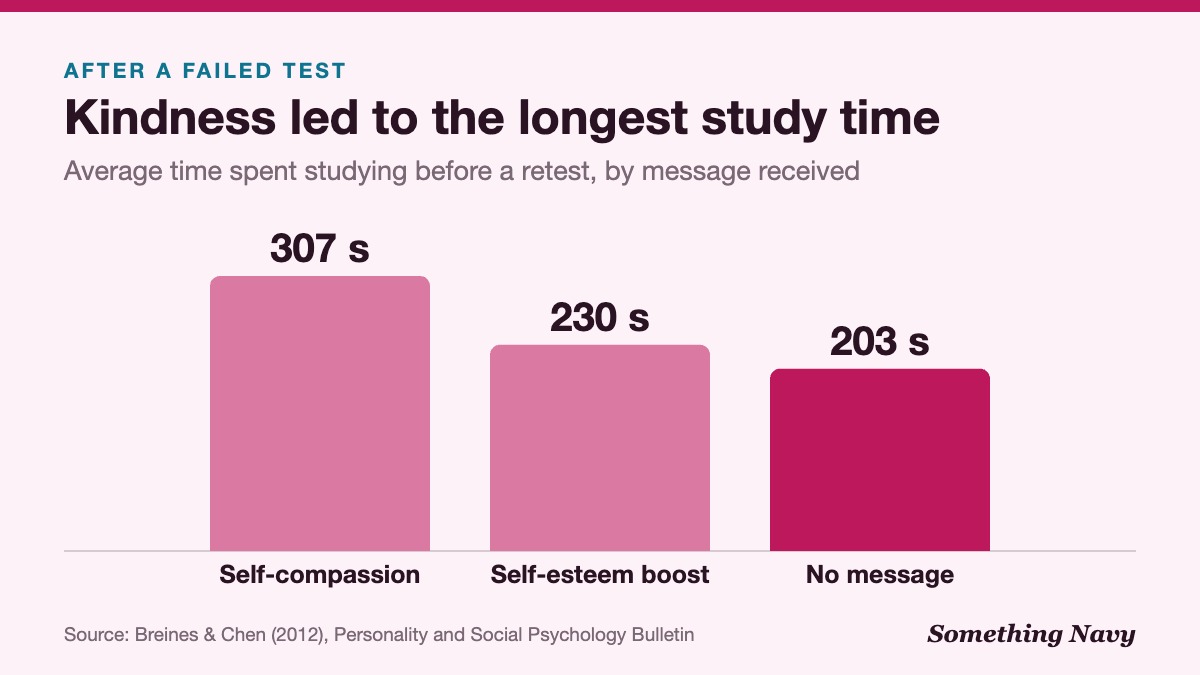
It is worth being honest about what this does and does not show. The groups were small, around 30 people each. The difference between self-compassion and self-esteem was only marginally significant, and scores on the second test did not differ much between groups. So this is evidence about effort and motivation, not proof that kindness makes you score higher.
Still, the direction of the effect is the opposite of what the “tough love” theory predicts. If self-kindness bred complacency, the self-compassion group should have studied least. They studied most.
What the Berkeley studies did
- Experiment 1: 68 students wrote about their biggest weakness. Those prompted to be compassionate were more likely to see the weakness as changeable.
- Experiment 2: 91 students recalled something they felt guilty about. The self-compassion group reported more motivation to make amends and not repeat it.
- Experiment 3: 86 students failed a hard test. The self-compassion group studied longest before a retest.
- Experiment 4: 73 US adults recruited online reflected on a weakness. The self-compassion group reported more motivation to change it.
The authors’ own interpretation is that self-compassion makes failure less threatening. If a mistake does not feel like a referendum on who you are, you can afford to look at it closely, and looking at it closely is how you get better. It fits with what we know about why we procrastinate: avoidance is often a way of escaping a bad feeling, not a lack of discipline.


Myth 2: Self-compassion is just self-esteem with a softer name
It is easy to see why people lump the two together. Both sound like “feeling OK about yourself”, and people who score high on one tend to score at least moderately high on the other.
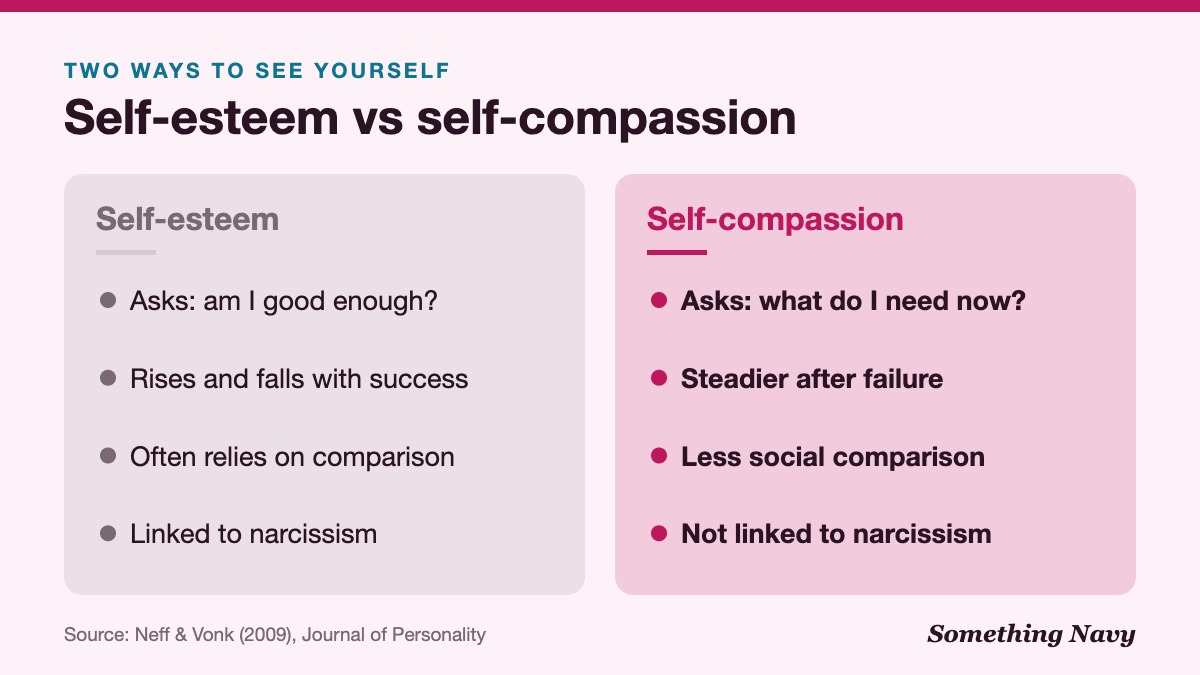
But they work very differently. Self-esteem is an evaluation: am I good, competent, likeable? It tends to rise when you succeed and fall when you do not. And it often depends on comparison, because being “good” usually means being better than someone.
Self-compassion does not need you to win. It asks a different question: given that this is hard, how do I treat myself right now?
Neff and the Dutch social psychologist Roos Vonk tested how the two play out in a large community study in the Netherlands, published in the Journal of Personality in 2009. Participants were assessed 12 times over eight months, so the researchers could watch how people’s sense of self-worth moved from week to week.
Self-compassion predicted a steadier sense of self-worth over that period than global self-esteem did. People higher in self-compassion were also less likely to make their worth depend on their looks or their performance, and less prone to social comparison, rumination and anger. The sharpest contrast came with narcissism: self-esteem was linked to it, while self-compassion was not.
This is a correlational study, so it cannot say that self-compassion causes stability. What it does show is that the two traits are not interchangeable. One behaves like a share price. The other behaves more like a floor.
If you have ever felt like a fraud right after a promotion, this makes intuitive sense. Imposter feelings are a self-esteem problem that success does not fix, because the next test is always coming. Self-compassion is less fragile because it was never conditional on passing.
Self-esteem asks whether you are good enough. Self-compassion asks what you need now that you are not.
Myth 3: Self-compassion lets you off the hook for bad behaviour
A related worry is moral rather than practical. If you forgive yourself too easily, won’t you keep doing the thing you should feel bad about?
The second Berkeley experiment addressed this directly. Students recalled a recent time they had done something they felt guilty about, the everyday kind of lapse typical of student life. One group then wrote to themselves with kindness and understanding about it, one wrote about their positive qualities, and one wrote about a hobby they enjoyed.
Afterwards, everyone rated how motivated they were to apologise, make amends and avoid repeating the behaviour. On a seven-point scale, the self-compassion group averaged 4.97, against 4.11 for the self-esteem group and 4.36 for the hobby group.
Later work from Chen’s lab pushed further. In a 2016 set of three studies, Jia Wei Zhang and Serena Chen looked at regrets. People who wrote about a regret in a self-compassionate way reported more personal improvement afterwards, and the analysis suggested part of the reason was acceptance: they could admit what had happened instead of defending against it.
That is the key idea. Harsh self-criticism feels like taking responsibility, but it often makes a mistake so painful to look at that we look away instead. We justify, minimise or blame someone else.
Kindness lowers the cost of honesty.
It also explains why self-compassion is different from self-pity. Self-pity tends to make your suffering the centre of the story. The “common humanity” part of self-compassion does the opposite, reminding you that other people get things wrong too, including the people you may have let down.
Myth 4: Self-compassion is just self-indulgence with good PR
Scroll any wellness feed and “self-care” often looks like a bath bomb, a takeaway and cancelled plans. So it is fair to ask whether self-compassion is just permission to do whatever feels nice.
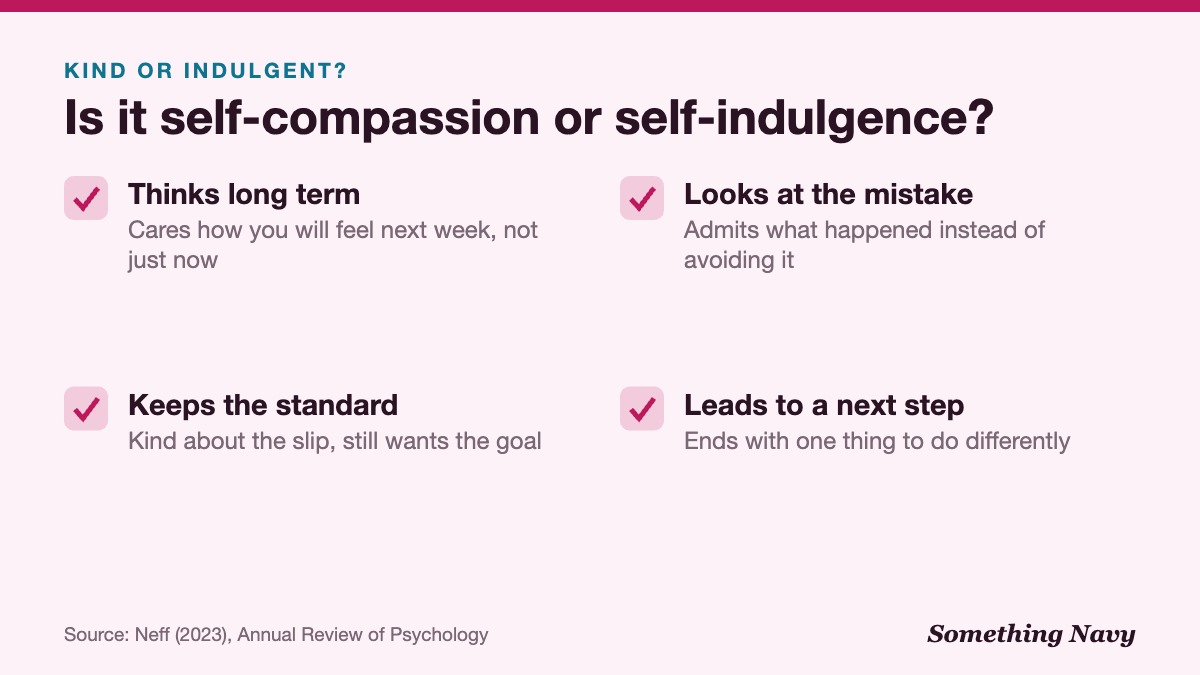
Neff’s answer, set out in her 2023 review in the Annual Review of Psychology, is that self-indulgence means trading long-term wellbeing for short-term pleasure, and compassion cares about the long term. A kind parent does not let a child eat sweets all day, precisely because they care.
An older experiment shows how this can play out. In 2007, Claire Adams and Mark Leary at Duke University studied a well-known pattern among dieters: after breaking a food rule, people who eat restrictively often write off the rest of the day and then eat more, not less.
The researchers asked college women to eat an unhealthy food, then gave some of them a short self-compassionate message about it while others got none. Afterwards, the self-compassion message reduced distress and reduced how much the most restrictive eaters ate.
In other words, kindness after a slip did not open the floodgates. It closed them. The guilt was what had been doing the damage.
It is one study, with a specific group of young women, and eating behaviour is complicated. But it maps neatly onto everyday life. The person who misses one gym session, calls themselves useless and then skips the rest of the month is not being held to a high standard. They are being knocked off course by their own commentary.


Myth 5: The science on self-compassion is just feel-good fluff
Self-compassion has become popular enough to attract suspicion, and some scepticism is healthy. So what does the bigger picture look like?
The best-known early synthesis came from Angus MacBeth and Andrew Gumley at the University of Glasgow. Their 2012 meta-analysis in Clinical Psychology Review pooled 20 samples from 14 studies and found a strong negative link between self-compassion and symptoms of depression, anxiety and stress, with a correlation of about r = −0.54.
That is a large effect by the standards of psychology. But it is a correlation. People who are less anxious might simply find it easier to be kind to themselves, rather than the other way round.
For causation you need experiments. In 2019, Madeleine Ferrari and colleagues in Australia pooled 27 randomised controlled trials of self-compassion programmes, published in Mindfulness. Compared with control groups, the interventions improved outcomes across 11 measures, including moderate effects on stress, depression and self-criticism, and a large effect on rumination.
Again, there are caveats. The authors themselves flagged the possibility of publication bias, and the programmes were too varied to compare against one another. Group courses seemed to work better than solo ones.
There is also a lively academic argument about measurement. Peter Muris at Maastricht University and colleagues have argued that the standard Self-Compassion Scale blends kindness towards yourself with the absence of harsh self-judgement, and that the second half does most of the work in predicting distress. Neff disputes this, and her 2023 review sets out her case.
For everyday purposes, that debate points in the same practical direction. Whether the benefit comes from adding kindness or turning down the inner critic, the inner critic is not the secret weapon we imagine it to be.
One more thing worth saying clearly: self-compassion is a skill for ordinary hard days, not a treatment. If low mood or anxiety is getting in the way of life, that is a conversation for a GP or a qualified professional.
Why self-criticism feels like it works
If the evidence leans this way, why do so many of us cling to the harsh voice?
Partly because it is loud at exactly the moment we try hard again, so it gets the credit. You berate yourself, you knuckle down, you improve, and the story writes itself. What you never see is the version where you were kinder and knuckled down anyway.
Partly, too, because it feels like protection. If you criticise yourself first, nobody else can catch you out. That instinct is understandable, and it may be the same reason cringe memories replay so vividly: the mind is trying to stop you being caught out again.
The trouble is that fear is a short-term motivator. It gets you moving, but it also makes you avoid feedback, hide mistakes and quit when things go wrong, all of which make improvement harder.
Self-compassion keeps the standard and drops the threat.
A five-minute self-compassion practice to try after your next setback
You do not need a course to start. This is a simple sequence based on the three components above, the kind of reflective writing used in the Berkeley experiments. It takes about five minutes and works best on paper, or in the notes app on your phone.
1. Name what happened, plainly
Write one or two sentences about the mistake or setback, as if you were a neutral reporter. “I missed the deadline on the report.” Not “I’m hopeless”. This is the mindfulness step: seeing it clearly without inflating it.
2. Add the common-humanity line
Write a sentence that places you among other people. “Lots of people miss deadlines when they are juggling too much.” It can feel a little cheesy. Write it anyway. The point is to break the sense that this happens only to you.
3. Write to yourself as you would to a friend
Imagine a friend told you the exact same story. What would you actually say to them? Write that, addressed to yourself. Most people find they are kind but also practical: they would not tell a friend the mistake did not matter, but they would not call them useless either.
4. Ask one improvement question
Finish with: “What is one thing I could do differently next time?” This is where the Berkeley result lives. The kindness is not the end point. It is what makes this question bearable to answer honestly.
If you already keep a journal, this slots neatly into it. (We looked at whether journaling really helps in a separate piece.)
A few things that help it stick:
- Keep the standard. Being kind is not the same as lowering the bar. You can still want the promotion, the grade or the personal best.
- Watch for “but”. If every kind sentence ends with “but you should have known better”, the critic has snuck back in.
- Start small. Practise on minor annoyances, like a burnt dinner or a missed train, before the big failures.
None of this will stop setbacks hurting. It is not supposed to. Pain is information.
What changes is what you do with it. The students in that Berkeley lab did not feel better because someone told them they were clever. They kept going because someone told them failing was normal and they did not need to beat themselves up about it.
That is a message worth passing on, and worth learning to give yourself.
Sources
- Neff, K. D. (2003). Self-compassion: An alternative conceptualization of a healthy attitude toward oneself. Self and Identity, 2(2), 85–101. DOI
- Neff, K. D., & Vonk, R. (2009). Self-compassion versus global self-esteem: Two different ways of relating to oneself. Journal of Personality, 77(1), 23–50. DOI
- Breines, J. G., & Chen, S. (2012). Self-compassion increases self-improvement motivation. Personality and Social Psychology Bulletin, 38(9), 1133–1143. DOI
- Zhang, J. W., & Chen, S. (2016). Self-compassion promotes personal improvement from regret experiences via acceptance. Personality and Social Psychology Bulletin, 42(2), 244–258. DOI
- Adams, C. E., & Leary, M. R. (2007). Promoting self-compassionate attitudes toward eating among restrictive and guilty eaters. Journal of Social and Clinical Psychology, 26(10), 1120–1144. DOI
- MacBeth, A., & Gumley, A. (2012). Exploring compassion: A meta-analysis of the association between self-compassion and psychopathology. Clinical Psychology Review, 32(6), 545–552. DOI
- Ferrari, M., Hunt, C., Harrysunker, A., Abbott, M. J., Beath, A. P., & Einstein, D. A. (2019). Self-compassion interventions and psychosocial outcomes: A meta-analysis of RCTs. Mindfulness, 10(8), 1455–1473. DOI
- Neff, K. D. (2023). Self-compassion: Theory, method, research, and intervention. Annual Review of Psychology, 74, 193–218. DOI
Cover photo: Kelly Sikkema on Unsplash. Charts and graphics: Something Navy.
How we reported this. We went back to the original research for this story, 8 sources in all, listed above, and checked every figure against them. If you think we have got something wrong, tell us and we will look at it. Read more about how we work.