
You sit down to write the email you have been dreading. The phone is face down beside the keyboard, sound off, screen dark. You are not touching it. You are barely aware of it.
And yet, according to one of the most shared psychology findings of the last decade, it is quietly taking a share of your mind.
That is the “brain drain” hypothesis, and it has had a remarkable career. It has been retold in parenting columns, productivity books and staff-room arguments. In 2026 it sits somewhere in the background of new statutory guidance that expects schools in England to keep the school day phone-free.
So it deserves a proper hearing. Below, we put the claim on trial: the original evidence, the witnesses who could not repeat it, the two meta-analyses that weighed everything, and what the verdict means for classrooms and for your own desk.
Spoiler: the effect seems to be real, but it is far smaller than the headlines promised.
The charge: a phone you are not touching still takes its cut
The claim is specific, which is what makes it testable. It is not that notifications distract you; nobody disputes that a buzzing phone breaks concentration. It is that the mere presence of your own smartphone, silent and untouched, reduces the mental capacity you have available for other work.
The proposed mechanism is attention as a budget. Your phone is the most personally relevant object in most rooms: it holds your friends, your work, your news. Keeping yourself from checking it is a small act of self-control, and self-control draws on the same limited working memory you need for the task in front of you.
If you have ever felt a buzz that never happened, you have met a cousin of this idea. Our piece on phantom vibrations explains how the brain stays on alert for the phone even when it is silent.


Exhibit A: the 2017 experiments in Texas
The case begins with a paper published in 2017 in the Journal of the Association for Consumer Research. Its authors were Adrian Ward, then an assistant professor at the McCombs School of Business at the University of Texas at Austin, with Kristen Duke, Ayelet Gneezy and Maarten Bos.
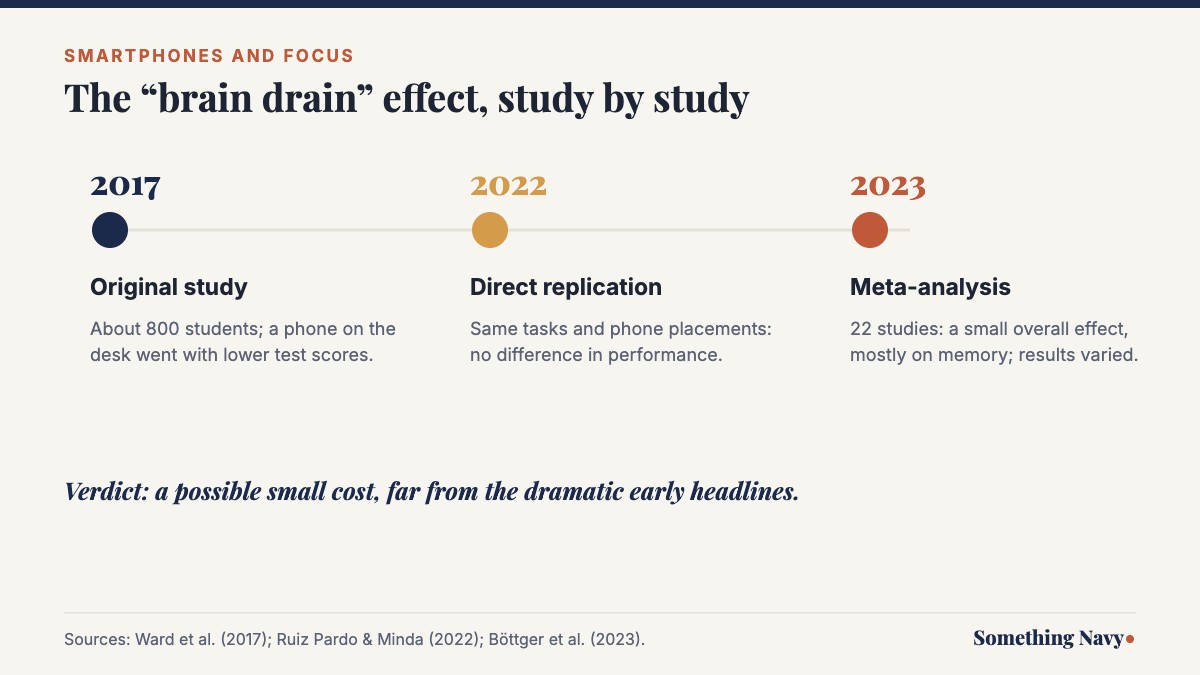
In the first experiment, 520 undergraduate smartphone users were randomly told to leave their phone in one of three places: face down on the desk, in a pocket or bag, or in another room. Everyone set their phone to silent. They then completed two demanding tests: an operation span task, which measures working memory by asking you to hold letters in mind while solving maths problems, and a set of Raven’s matrices, a standard test of fluid intelligence.
The pattern was neat. People whose phones were in another room significantly outperformed those whose phones sat on the desk, and slightly outperformed those with phones in a pocket or bag. The further away the phone, the better the scores.
A second experiment with 275 undergraduates kept the three locations and told some participants to switch their phones off. Switching off made no difference. What did matter was attachment: the students who said they depended most on their phones did worse than less dependent peers, but only when the phone was on the desk or in a pocket or bag.
What the study did
- Who: 520 undergraduates in experiment 1 and 275 in experiment 2, nearly 800 in total
- Where the phone went: face down on the desk, in a pocket or bag, or in another room
- What was measured: working memory and fluid intelligence in experiment 1; working memory and attention in experiment 2
- Headline result: phone in another room beat phone on the desk; on or off made no difference
Ward’s own summary in the university’s press release was blunt: “It’s a brain drain.” He stressed the drop was not caused by notifications. The participants were not being interrupted at all.
It was a tidy story with a satisfying villain, and it travelled fast.
The first crack: a careful replication in Ontario
Psychology has learned, often painfully, that a striking single study is a starting point rather than a conclusion. So in 2022 Ana Ruiz Pardo and Paul Minda at Western University in Canada ran a pre-registered direct replication of Ward’s second experiment, published in Acta Psychologica.
Pre-registered means they wrote down their predictions and analysis plan before collecting any data, so they could not tweak things after the fact. They used the same six conditions (three phone locations, phone on or off), an operation span task, a go/no-go attention task, and a questionnaire on phone attachment and dependency.
The result: the effect did not replicate. Where the phone was made no difference to performance on either task.
One failed replication does not acquit a hypothesis. Samples differ, students change, and by 2022 smartphones were even more woven into daily life than in 2017. But it shifted the burden of proof. The question became not “is it true?” but “how big is it, and when does it show up?”
Calling in the meta-analysts
When individual studies disagree, the next step is a meta-analysis: pool every comparable experiment, weight each by its size and precision, and see what the combined evidence says.
The first came in September 2023. Tobias Böttger, Michael Poschik and Klaus Zierer of the University of Augsburg gathered 22 studies with 43 effect sizes for the journal Behavioral Sciences and asked whether a nearby phone hurts memory, attention and general thinking.
Across everything, they found a small negative effect (Hedges’ g = −0.14). For context, psychologists usually call 0.2 “small”, so this sits below even that modest threshold.
Broken down, the picture got more interesting. Memory showed the clearest effect (g = −0.23). Attention showed almost nothing (−0.07, not statistically significant). General cognitive performance was, if anything, slightly positive and nowhere near significant.
Then there was geography. Studies run in Asia showed a clear effect (g = −0.39). Studies from Europe showed a smaller one that did not reach significance (−0.20), and studies from North America, where the idea was born, showed virtually nothing (−0.03). The authors admitted they had no satisfying explanation for the regional gap.
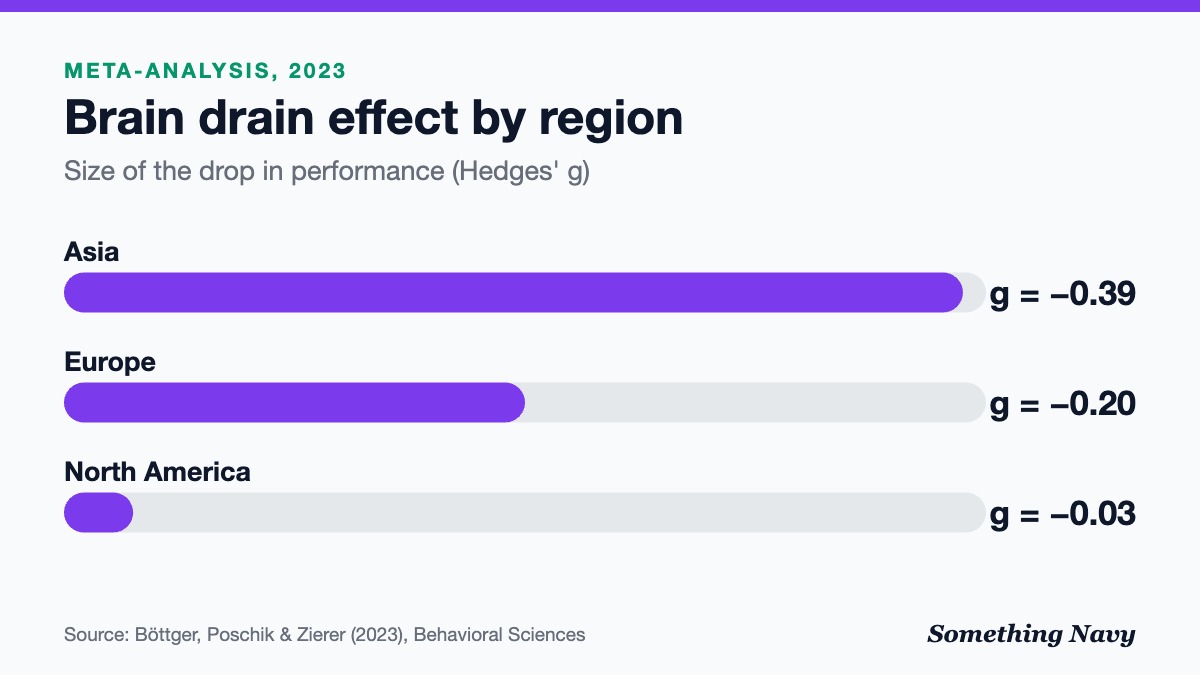
Results also varied a great deal between studies, a sign that the “effect” may depend heavily on who is tested, which task they do and how the phone is placed.
A second meta-analysis narrows the case further
A larger review followed in 2024. Douglas Parry, a media researcher then at Stellenbosch University in South Africa, published a systematic review and six meta-analyses in Media Psychology, covering 56 effect sizes and 7,093 participants.
Parry split the outcomes into separate mental skills: working memory, sustained attention, inhibitory control, cognitive flexibility and fluid intelligence. Only working memory showed a statistically significant drop when a phone was nearby, and that drop was smaller than the original theory implied. For the other four, the pooled results were null.
He also flagged two weaknesses across the field: big differences in how studies were run, and generally poor statistical power, meaning many studies were too small to detect an effect of the size that probably exists. His conclusion was cautious: the literature offers only limited support for a small brain drain effect.
Speaking to Scientific American, Parry put the logic plainly. If the effect were huge, he said, “we would all be distracted all the time.”
A silent phone on the desk is not stealing your intelligence. At most, it is skimming a little off the top of your working memory.

Why small studies keep disagreeing
It helps to see how a single new experiment can still make headlines. In June 2023, Jeanette Skowronek, Andreas Seifert and Sven Lindberg, in a study led from Paderborn University in Germany, reported in Scientific Reports that 42 adults aged 20 to 34 showed significantly better attention on concentration tests when no phone was present.
That is a genuine finding, carefully reported. But 42 people is a small sample, and small studies swing widely by chance. Some land on a big effect, some on none. Journals and the press are more interested in the former, which is one reason meta-analyses matter: they let the swings cancel out.
There are other reasons for the scatter:
- Different tests. Working memory tasks seem more sensitive than attention or reasoning tasks, so a study’s choice of test shapes its result.
- Different people. Ward found heavier phone dependence made the effect stronger; populations differ in how attached they are.
- Different set-ups. Whose phone, how visible, whether people know the study is about phones: all vary between labs.
- Short tasks. Most experiments test people in a single short session, not across a working day, so they say little about cumulative effects.
None of this means the original team did anything wrong. It means one lab result, however elegant, is rarely the whole story.
The verdict: guilty, but of a minor offence
Weigh it all and the most defensible verdict, as of 2026, looks like this.
There is probably a real but small cost to having your phone in sight, showing up mostly in working memory, the mental scratchpad you use to hold and juggle information. It is not reliably found for attention, reasoning or general intelligence. It varies across studies and countries, and it is far smaller than the 2017 headlines suggested.
Small does not mean meaningless. Working memory is precisely what you lean on to follow a complex argument, do mental arithmetic or draft a tricky paragraph. A slight tax on it, paid hour after hour, may add up. It may also be swamped by the much bigger cost of actually picking the phone up, which is the subject of our piece on the myth of multitasking.
The phone does not need to ring to matter. But it matters less than you have been told.
From lab to classroom: England makes phone-free the rule
While researchers argued about effect sizes, governments acted. In February 2024 England’s Department for Education issued non-statutory guidance on mobile phones in schools. In January 2026 it published a revised version that set a firmer expectation of phone-free school days.
Then the rules hardened. According to the Department for Education’s own guidance page, the guidance became statutory on 29 June 2026, and schools should begin following it from 1 September 2026. It covers maintained schools, academies, free schools and independent schools, but not standalone post-16 institutions such as sixth-form colleges.
England is not alone. The Netherlands introduced a national ban on phones and other devices in classrooms from 1 January 2024. Brazil’s President Luiz Inácio Lula da Silva signed a law restricting smartphone use in schools in January 2025.
It is worth being clear about how these policies relate to the brain drain research. Ministers have justified them on many grounds: behaviour, bullying, wellbeing, social media and sleep, as well as concentration. The mere-presence studies are only one strand, and as we have seen, a thin one. Note, too, that many school policies still let pupils keep a phone switched off in a bag, which is exactly the condition where the lab evidence is weakest.
What the first school studies actually show
The best-known evaluation so far comes from the University of Birmingham. In the SMART Schools study, published in The Lancet Regional Health: Europe in February 2025, Victoria Goodyear, Miranda Pallan and colleagues compared 1,227 pupils at 30 secondary schools in England: 20 with restrictive phone policies and 10 with permissive ones.
They found no difference between the two groups in mental wellbeing, anxiety, depressive symptoms, sleep, physical activity, English and maths attainment, or disruptive classroom behaviour. Restrictive policies did cut phone use during the school day, by around 40 minutes, and social media use by about 30 minutes, but they did not meaningfully reduce pupils’ total daily use.
The same study found something the authors considered more important: across all pupils, more time on phones and social media was linked to worse wellbeing, poorer sleep, lower attainment and more disruptive behaviour. Their message was that bans alone are not enough, not that phone use is harmless.
There are limits. It was a cross-sectional snapshot, comparing schools at one point rather than following a change over time, and schools that choose strict policies may differ in other ways.
A different kind of evidence came from the Netherlands in July 2025. A government-commissioned survey of 317 secondary schools, reported by Reuters, found that three-quarters (75%) said the ban had improved pupils’ concentration, nearly two-thirds reported a better social climate, and one-third saw better academic performance. These are teachers’ and leaders’ judgements, not test scores, and the people answering had a stake in the policy working. Still, the reported gains in focus line up, loosely, with the lab story.
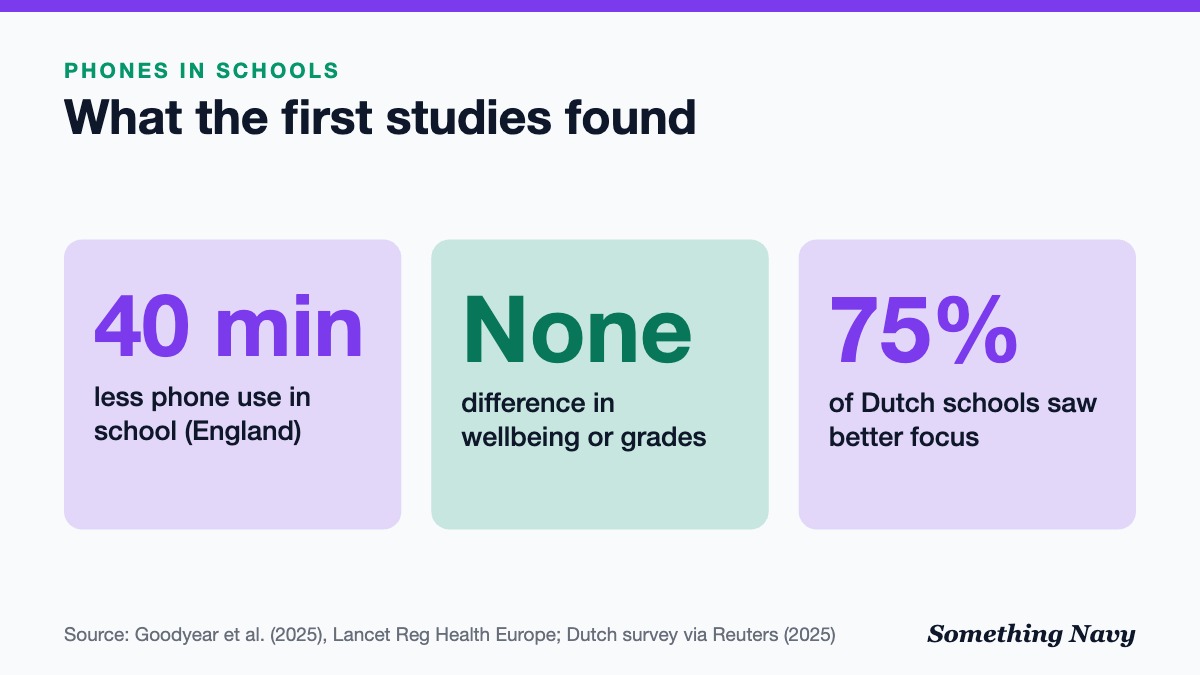
The honest summary for parents: phone-free schools reduce phone use in school and may help the classroom atmosphere. Whether they raise grades or wellbeing is not yet shown. And the brain drain research cannot settle that question either way.
How to put a small effect to work at your own desk
Here is the useful thing about a small, uncertain effect: when the fix is free, you do not need certainty to act on it.
Moving your phone to another room for an hour costs nothing. If the brain drain is real for you, you gain a little working memory. If it is not, you still remove the far larger temptation to check, scroll and lose twenty minutes. Either way you win.
Try this
- Out of the room, not just out of sight. In Ward’s study, a bag or pocket helped less than another room. For deep work, put the phone somewhere you would have to stand up to reach.
- Batch, do not trickle. Turn off non-essential notifications and check messages at set times. Interruptions, not mere presence, are the proven focus-killer.
- Watch the wrist. A smartwatch can bring the phone back onto your body. Our guide to smart and wearable tech looks at how connected the things we wear have become.
- Keep it off the dinner table. The evidence on conversations is mixed, but putting the phone away is a cheap signal that the person in front of you comes first. See our piece on phubbing.
It is the same logic behind a capsule wardrobe: you do not rely on willpower to resist options; you simply remove them from view. Fewer choices on the rail, fewer temptations on the desk.
And if you check your phone the moment you finish reading this, do not panic about lost IQ points. The science does not support that fear. It supports something gentler and more practical: that your attention is worth protecting, and a closed door is one of the easiest ways to protect it.
Put the phone in the other room. Then see how the next hour feels.
Frequently asked questions
No. The best current evidence finds no reliable effect on fluid intelligence or reasoning. The most consistent finding is a small dip in working memory when the phone is close by.
In Ward’s 2017 experiments, switching the phone off made no difference; distance did. If you want to test the effect yourself, put the phone in another room rather than simply powering it down.
Not yet proven. A 2025 study of 1,227 pupils in England found no difference in English and maths attainment between restrictive and permissive schools, although Dutch schools reported better concentration after their 2024 ban.
Many are small, use different tests and phone set-ups, and study people with very different levels of phone attachment. Meta-analyses that pool them point to a small effect, mainly on working memory.
Sources
- Ward, A. F., Duke, K., Gneezy, A., & Bos, M. W. (2017). Brain drain: The mere presence of one’s own smartphone reduces available cognitive capacity. Journal of the Association for Consumer Research, 2(2), 140–154. DOI
- Ruiz Pardo, A. C., & Minda, J. P. (2022). Reexamining the “brain drain” effect: A replication of Ward et al. (2017). Acta Psychologica, 230, 103717. DOI
- Böttger, T., Poschik, M., & Zierer, K. (2023). Does the brain drain effect really exist? A meta-analysis. Behavioral Sciences, 13(9), 751. DOI
- Parry, D. A. (2024). Does the mere presence of a smartphone impact cognitive performance? A meta-analysis of the “brain drain effect”. Media Psychology, 27(5), 737–762. DOI
- Skowronek, J., Seifert, A., & Lindberg, S. (2023). The mere presence of a smartphone reduces basal attentional performance. Scientific Reports, 13, 9363. DOI
- Goodyear, V. A., Randhawa, A., Adab, P., et al. (2025). School phone policies and their association with mental wellbeing, phone use, and social media use (SMART Schools): A cross-sectional observational study. The Lancet Regional Health: Europe, 51, 101211. DOI
- Department for Education. (2026). Mobile phones in schools (statutory guidance, updated 29 June 2026). GOV.UK. Link
- Reuters. (2025, July 6). Study finds smartphone bans in Dutch schools improved focus. Malay Mail. Link
Updated 20 October 2026: we expanded this article with newer research, fresh figures and new sections. Cover photo: Vitaly Gariev on Unsplash. Charts and graphics: Something Navy.
How we reported this. We went back to the original research for this story, 8 sources in all, listed above, and checked every figure against them. If you think we have got something wrong, tell us and we will look at it. Read more about how we work.