
You are in a queue, or halfway through a sentence, and there it is: a short, firm buzz against your thigh. Your hand is already in your pocket before you have decided to reach.
The screen is blank. No message, no missed call, no app nudging you about anything.
If that sounds familiar, you are in a very large club. In the best-known surveys of hospital staff, students and junior doctors, somewhere between two-thirds and almost all of the people asked say they have felt a phone vibrate when it had not. Researchers call it phantom vibration syndrome, although nobody treats it as a real syndrome. It is better thought of as a small mystery with a surprisingly clear trail of evidence.
So let us follow the trail.
The crime scene: a buzz that never happened
The first proper investigation took place in a hospital. In 2010 a team led by Michael Rothberg at Baystate Medical Center in Springfield, Massachusetts, surveyed medical staff who carried pagers and phones at work. Of the 169 people who answered the question, 115 (68%) reported phantom vibrations. Their findings were published in the BMJ.
Most people said the sensations started somewhere between one month and one year after they began carrying the device. About 13% felt them every day. And very few minded: only 7% of those affected called the experience bothersome or very bothersome.
In 2012 Michelle Drouin and colleagues at Indiana University-Purdue University Fort Wayne asked 290 undergraduates the same kind of question. In their study in Computers in Human Behavior, 89% said they had felt a phantom vibration, typically about once every two weeks. Again, few found it troubling.
Then, in 2013, came the most dramatic number. A Taiwanese team led by Yu-Hsuan Lin followed 74 medical interns through their first hospital year. Three months in, 95.9% were reporting phantom vibrations.
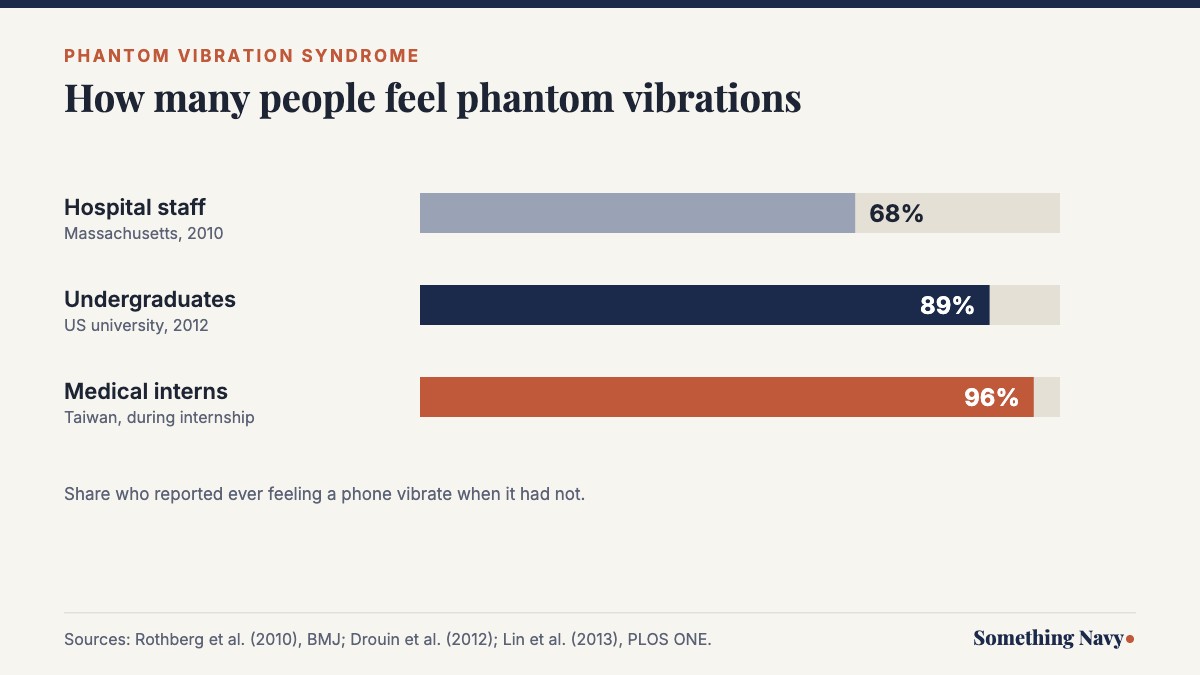
Three studies, three very different groups, one consistent result. The phantom buzz is not a quirk of a few anxious people. It is something ordinary brains do.
The question is why.
Clue one: your brain is a smoke alarm set to sensitive
The first clue comes from signal detection theory, a framework psychologists use to describe how anyone picks a faint signal out of background noise.
Your skin sends your brain a steady stream of small signals: a seam rubbing, a muscle twitching, a key shifting in your pocket. Most of the time the brain ignores them. But when it is waiting for something specific, such as a reply from a friend or a call from work, it lowers the bar for what counts as that something.
In this framework you can feel a real buzz (a hit), miss one (a miss), or mistake a twitch for a buzz (a false alarm).
The key insight is that you cannot cut misses and false alarms at the same time. If missing a message feels costly, the brain trades upwards in false alarms to make sure it catches the real thing. It is the same logic as a smoke alarm that goes off when you burn toast: annoying, but better than one that sleeps through a fire.
Seen this way, a phantom buzz is not your brain failing. It is your brain doing exactly what you have trained it to do, rather too keenly.
Rothberg’s hospital data fit this picture neatly. Staff who carried a device in a breast pocket were more likely to report phantom vibrations than those who wore it on a belt, and the risk rose with the number of hours they carried it. The more time a patch of skin spends waiting for a buzz, the more readily it seems to find one.
If your everyday wardrobe basics include a chest pocket where the phone always lives, that small patch of skin may be on permanent watch.
Clue two: the people who are waiting hardest
If expectation drives the false alarms, then people who care more about incoming messages should feel more phantom buzzes. That is the next lead researchers chased.
Drouin’s team looked at personality. Students who scored higher on conscientiousness reported fewer phantom vibrations. Students who reacted more emotionally to text messages were more likely to say the phantom buzzes bothered them.
In 2016 Daniel Kruger and Jaikob Djerf at the University of Michigan went a step further. They surveyed two separate groups of undergraduates, 168 and then 243, and measured attachment style: the habits of trust and worry we bring to close relationships. Their paper in Cyberpsychology, Behavior, and Social Networking was pointedly titled “High Ringxiety”.
People high in attachment anxiety (those who tend to worry about being rejected or left out) reported more phantom ringing, and in the first group more phantom notifications too. The ringing link held up in the second sample, a replication many psychology findings never get. Our guide to attachment styles explains what that anxiety looks like day to day.
Kruger put it simply in the University of Michigan’s write-up: “The cell phone often is your connection to your outside social world.”
Two honest caveats, though. The authors described the effects as small. And, oddly, attachment anxiety did not significantly predict phantom vibration itself in either group, only ringing and notifications. Worry shapes the experience, but it is not the whole story.
Your phone did not buzz. Your brain was listening a little too hard for someone it cares about.


Clue three: the junior doctors who could not switch off
Some of the strongest evidence that circumstances matter came from Lin’s study of medical interns, published in PLOS ONE in 2013. It is the only study in this story that followed the same people over time, which lets us watch phantom vibrations rise and fall.
The interns were tested before their internship, at three, six and twelve months, and again two weeks after it ended. Their working lives in between were punishing: the paper reports an average of about 86.7 hours a week, with stretches of about 33.5 hours on duty in a row.
Before the internship, 78.1% already reported phantom vibrations. At three months it was 95.9%, at six months 93.2% and at twelve months 80.8%. Two weeks after the internship finished, it had dropped to 50%.
Phantom ringing was even more striking. It was reported by 27.4% at baseline and by 84.9% three months into the internship, then fell to 54.2% after it ended.
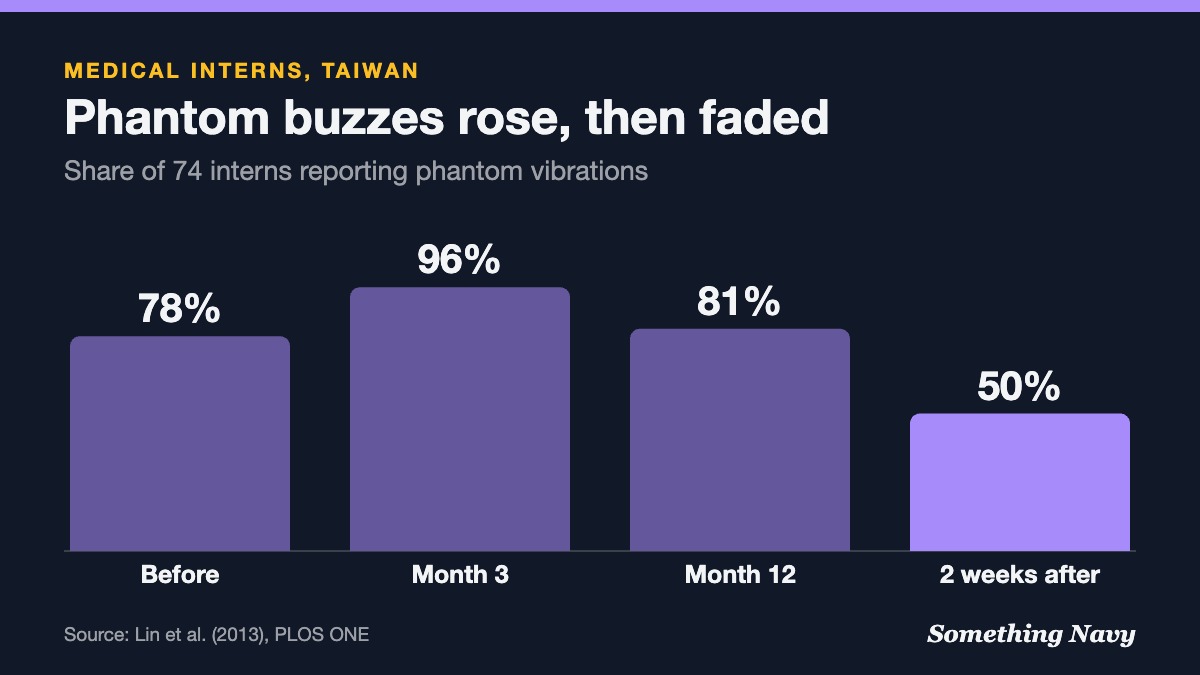
Here is the twist that makes this study so useful. The interns’ anxiety and depression scores also climbed during the year and recovered afterwards, so you might expect those scores to explain the phantom buzzes. They did not. The researchers found no significant link between the phantom experiences and anxiety or depression.
What did show up was the phone setting. Interns who kept their phone on vibrate had higher odds of phantom vibrations. (All of the interns used ringing mode, so the team could not test the equivalent effect for phantom rings.)
The most plausible reading is that it is not low mood that produces phantom buzzes, but the state of being on call: constantly braced for a summons that might matter. When the summons stopped, the false alarms faded with it.
It was 74 people at one hospital, all self-reported. Still, it strongly suggests a stressful stretch can switch the alarm to sensitive, and that the setting can come back down.
What the internship study did
- Who: 74 medical interns (46 men, 28 women, average age 24.8) at one hospital in Taiwan.
- When: Before the internship, at 3, 6 and 12 months, and two weeks after it ended.
- Found: Phantom vibrations peaked at 95.9% at three months and fell to 50% after the internship.
- Surprise: No significant link between phantom buzzes and anxiety or depression scores.
- Caveat: Small, single-site and based on self-report.
Clue four: the buzz moves to your wrist
The classic studies were done when a phone lived in a pocket and announced itself with a buzz or a ring. Many of us now wear a second device that taps the wrist, lights up and chimes. The phantom has more places to hide.
Researchers have started to widen their language to match. A 2024 review in Current Problems of Psychiatry by Kamil Soroka and colleagues uses the umbrella term phantom phone signalling to cover vibrations, rings and false notifications together.
Pulling together the existing studies, the review found that phantom signals were more common in younger people, that the number and intensity of phantom vibrations related to where the phone was carried, and that the literature links phantom signals with problematic phone use, as well as with anxiety and depression. The authors call for bigger, longer studies with more varied groups.
Kruger and Djerf had already found the visual version in 2016: 50% of their first group and 44% of the second reported phantom notifications.
What we do not yet have is solid research on phantom taps from smartwatches and fitness bands. We looked, and the peer-reviewed evidence simply has not caught up with the gadgets. Signal detection theory would predict the same pattern on a wrist as in a pocket: wherever the body is trained to expect a signal, it will sometimes invent one. But that is a reasonable guess, not a finding.
If you are adding more smart clothing and wearables to your life, remember that every device that buzzes is a new patch of skin learning to listen.
The 2025 twist: not everyone feels it as often
If phantom buzzes were a fixed fact of phone ownership, newer surveys would simply repeat the old numbers. They do not.
In a study published in April 2025, Pratik Padyal and colleagues surveyed 370 medical students at a tertiary care centre in central India. Only 39.45% reported phantom vibrations and 40% phantom ringing, far below the near-universal figures from the US and Taiwan.
Why the gap? Surveys word the question differently, cover different time spans and reach people with different phone habits. Comparing them is a bit like comparing rainfall measured in different-sized buckets.
The pattern within the study, though, matches the older work. Students who scored higher on a smartphone addiction scale were significantly more likely to report both phantom ringing and phantom vibrations. As with every survey of this kind, that is an association, not proof that heavy phone use causes the phantoms. It could run the other way, or both could stem from something else, like stress.
The accomplice: fear of being without your phone
Researchers keep finding phantom signals in the same neighbourhood as a related idea: nomophobia, short for “no mobile phone phobia”, the unease people feel when they are separated from their phone or cannot use it.
It is far from rare. A 2023 meta-analysis in Healthcare Informatics Research by Kimberly Tuco and colleagues pooled studies of 11,300 university students from eight countries. On standard questionnaires, 56% fell into the moderate nomophobia range and 17% into the severe range.
No study we found has directly tied nomophobia scores to phantom buzzes, so we will not pretend it has. But the overlap in theme is hard to miss. Both describe a mind that is partly tuned to the phone at all times, even when it is out of reach. That same background tuning is what research on having your phone nearby suggests can quietly tax attention.
Put the clues together and a suspect emerges. Not a disorder, not a nerve problem, but a habit of vigilance: an expectation of contact, sharpened by worry, multiplied by pressure and kept alive by constant contact with the device.
Case closed? Not quite, and that is reassuring
Before the practical part, a reality check. Almost all of this research relies on people remembering and reporting their own sensations. Samples are often small, young or drawn from medicine, where pagers and on-call duty make phantoms especially likely.
And the most consistent finding across the decades is a calm one. In the hospital study only 7% found phantom vibrations bothersome, and Drouin’s students were mostly untroubled too. For the large majority of people, this is a curiosity, not a symptom.
Feeling a buzz that is not there is evidence of a well-trained brain, not a broken one.
How to quieten the phantom buzz
If the false alarms do annoy you, the evidence points to some simple fixes. Rothberg’s hospital survey is the clearest record of what people actually tried, but the numbers were small, so treat these as useful leads rather than guarantees.
Turn off vibrate
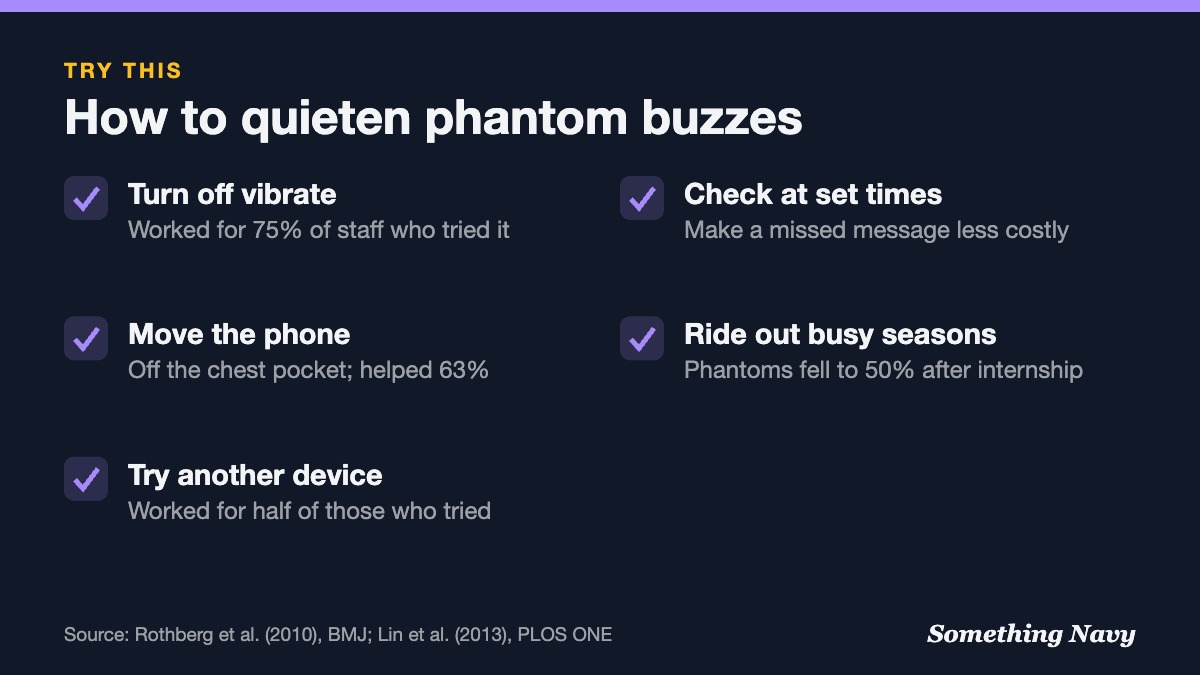
Among hospital staff who tried it, switching off vibrate mode worked for 75%. It also fits Lin’s finding that vibrate mode raised the odds of phantom vibrations. If you need alerts, a ring or a screen notification gives your skin nothing to listen for.
Move the phone
Changing where the device was carried helped 63% of those who tried. Breast pockets carried more risk than belts in that study, so moving your phone to a bag, a coat or the desk breaks the link between that patch of skin and the expectation of a buzz.
Try a different device
Swapping to a different device worked for half of those who tried it. Perhaps a new device starts without the learned association, though the study could not show why.
Lower the stakes of a missed message
This is the signal detection lesson. The brain lowers its threshold when missing something feels costly. Checking your phone at set times, telling people you reply in batches, and muting non-urgent apps all reduce the cost of a miss, so the alarm can afford to be less twitchy.
Treat the busy season as temporary
Lin’s interns show that phantom buzzes can surge during a demanding stretch and ease once it ends. If you are in a hectic job, exam period or new-parent fog, more phantoms may simply be a sign of how switched-on you are right now.
One caution: if you notice other unexplained physical sensations, or feel your phone use is out of control and affecting sleep, work or relationships, it is worth talking to your GP or a mental health professional. Phantom buzzes on their own are not a reason to worry.
The quiet after the alarm
The buzz you felt was your brain doing something it has always done: listening for the people and things that matter to it, and erring on the side of not missing them. Phones have simply given it a very specific thing to listen for.
So the next time your leg buzzes and the screen stays dark, you do not have to check. You can treat it as a small reminder that somebody, somewhere, matters enough for your body to keep an ear out. And then you can put the phone in a bag and let it wait.
Sources
- Drouin, M., Kaiser, D. H., & Miller, D. A. (2012). Phantom vibrations among undergraduates: Prevalence and associated psychological characteristics. Computers in Human Behavior, 28(4), 1490–1496. DOI
- Kruger, D. J., & Djerf, J. M. (2016). High ringxiety: Attachment anxiety predicts experiences of phantom cell phone ringing. Cyberpsychology, Behavior, and Social Networking, 19(1), 56–59. DOI
- Lin, Y.-H., Lin, S.-H., Li, P., Huang, W.-L., & Chen, C.-Y. (2013). Prevalent hallucinations during medical internships: Phantom vibration and ringing syndromes. PLOS ONE, 8(6), e65152. DOI
- Padyal, P., Bhelkar, S., Narlawar, U., Jain, M., & Kumar, M. (2025). Prevalence of phantom sensations and its relation to smartphone use among medical students of a tertiary care centre in Central India: A cross-sectional study. International Journal of Community Medicine and Public Health, 12(5), 2135–2139. DOI
- Rothberg, M. B., Arora, A., Hermann, J., Kleppel, R., St Marie, P., & Visintainer, P. (2010). Phantom vibration syndrome among medical staff: A cross sectional survey. BMJ, 341, c6914. DOI
- Soroka, K., Samardakiewicz-Kirol, E., Szawłoga, T., Styk, W., & Samardakiewicz, M. (2024). Phantom phone signaling (PPS) and mental health: A review. Current Problems of Psychiatry, 25, 177–185. DOI
- Tuco, K. G., Castro-Diaz, S. D., Soriano-Moreno, D. R., & Benites-Zapata, V. A. (2023). Prevalence of nomophobia in university students: A systematic review and meta-analysis. Healthcare Informatics Research, 29(1), 40–53. DOI
Updated 20 October 2026: we expanded this article with newer research, fresh figures and new sections. Cover photo: Mikaela Shannon on Unsplash. Charts and graphics: Something Navy.
How we reported this. We went back to the original research for this story, 7 sources in all, listed above, and checked every figure against them. If you think we have got something wrong, tell us and we will look at it. Read more about how we work.