

It is Sunday evening. The new notebook is on the table, the running shoes are by the door, and you have told yourself, quite firmly, that tomorrow is when it all begins.
Not tonight. Tomorrow. Because tomorrow is Monday, and Monday feels clean in a way that a Sunday at 9pm never could.
That feeling is not a personal quirk. It shows up in millions of internet searches, thousands of gym swipes and tens of thousands of signed promises. Psychologists call it the fresh start effect, and a decade of research says the urge to begin again on a special date is real, measurable and surprisingly easy to trigger.
The newer research adds a twist. The reset works best as a starting gun, not as a strategy, and waiting for the perfect date can quietly cost you.
The study that put numbers on Monday motivation
The phrase comes from a 2014 paper in Management Science by Hengchen Dai, Katherine Milkman and Jason Riis, a team based at the Wharton School of the University of Pennsylvania. Rather than ask about resolutions, they tracked what people actually did.
First, US Google searches for the word “diet” between 2004 and 2012. Searches rose 14.4% at the start of a week and 82.1% at the start of a year, and they ticked up after public holidays too.
Second, card swipes at a university gym, covering 11,912 undergraduates over roughly 15 months. Third, 66,062 commitment contracts signed on stickK, a website where people pledge money against their own goals. New contracts jumped 62.9% at the start of a week and 145.3% at the start of a year.
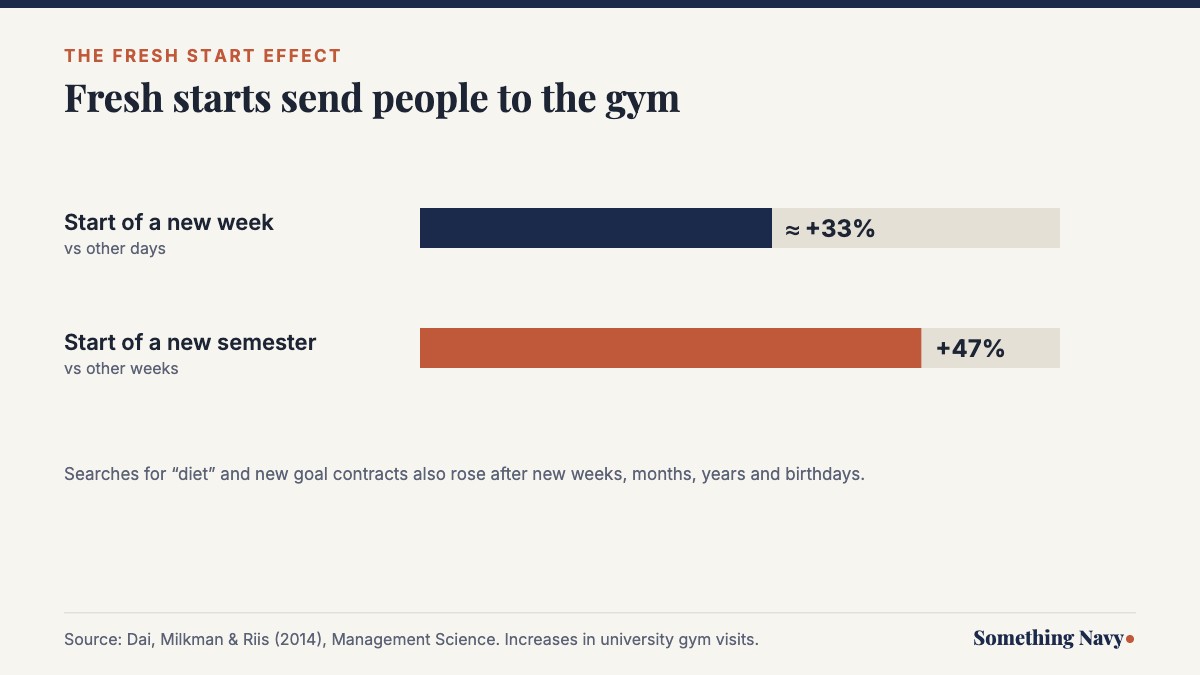
The gym data is the most vivid. The chance that a student worked out rose by about a third at the start of a week, and by 47.1% at the start of a new semester. Visits also rose after school breaks and, more modestly, after birthdays.
Nothing practical changes on those dates. What changes is the story you tell about yourself.


What a landmark does inside your head
Dai and her colleagues called these dates temporal landmarks: moments that stand out from the ordinary flow of days and split time into chapters. They proposed two things happen when a new chapter opens.
The first is distance. A landmark lets you file your failures under “the old me”. The person who skipped the gym all of last month starts to feel like someone else, which makes it easier to believe the new you will behave differently.
The second is perspective. Landmarks lift your attention from the daily to-do list to the bigger question of where your life is heading.
The team tested the first idea directly in a 2015 paper in Psychological Science. In one of its five studies, described by the Association for Psychological Science, 165 online volunteers picked a day in March for an email reminder about a personal goal. When 20 March was labelled “the first day of spring”, 26% chose it. When the same date was called “the third Thursday in March”, only 7% did.
Same day. Different name. More than three times the takers.
From the lab to the letterbox
Can a fresh-start nudge change real behaviour where money is on the line? So far, a cautious yes.
In a field experiment published in 2021 in Organizational Behavior and Human Decision Processes, John Beshears of Harvard, Dai, Milkman and Shlomo Benartzi mailed 6,082 employees at US universities an invitation to start saving for retirement, or to save more. People could sign up immediately or pick a future start date.
For some, the future date was neutral, such as “in two months”. For others, it was framed as a fresh start: after their next birthday, or on the first day of spring. The fresh-start framing drew more people to commit, and the researchers found those employees went on to contribute more to their plans over the following eight months.
January loyalists, take note. A Boston College summary reports that New Year’s Day drew a weak response here, possibly because it is now too familiar to feel new.
When the reset message barely moved the needle
Not every test has been kind to the idea, and the most instructive recent one came from South Africa.
In a trial published in AIDS in 2024, Christine Njuguna and colleagues texted more than 9,000 people living with HIV in Limpopo province who had missed clinic appointments by over 28 days. One group got no message. One got a plain invitation to come back. One got a message pegged to a public holiday, Youth Day or Mandela Day, promising that “your new beginning starts at Reception”.
Texting helped a little, mainly among people whose messages were actually delivered. But the fresh-start version did no better than the plain one. Around Youth Day, 12.3% of the framed group returned within 45 days, against 14.5% of the unframed group, a difference that was not statistically significant.
The lesson is not that the effect is fake. It is that a holiday chosen by someone else may not feel like a landmark to you. Fresh starts are personal, and the label only works if the reader believes it.
The 2025 check-up: January goals are not special
In a study published in November 2025 in Psychological Reports, Marina Milyavskaya of Carleton University and colleagues recruited 362 adults, mostly from the UK, and asked them to set three goals either in early January or in early March. They rated each goal on 16 qualities and reported progress monthly for six months.
The January and March goals looked almost identical. The only meaningful difference was a small boost in planning among the January group. Progress climbed, levelled off and drifted down, a little more steeply for January goals. The authors found little evidence of a lasting fresh start effect.
That fits neatly with the original 2014 data. Landmarks are brilliant at getting people through the door. They say much less about who is still there in March.


The hidden cost of waiting for Monday
There is a darker side, and it arrives before the landmark rather than after.
In 2020, Minjung Koo, Hengchen Dai, Ke Michael Mai and Camilla Song published an archival study and four experiments showing that when people can see a fresh start coming, they often ease off on goals they are already pursuing. The future self, people assume, will sort it out. They did not make up the lost ground afterwards, though reminding them of their small daily routines weakened the effect.
Anyone who has eaten a whole packet of biscuits on a Sunday because “the diet starts tomorrow” has run this experiment on themselves.
A similar trap follows a slip. If one missed workout on a Wednesday makes the week feel “ruined”, the brain starts scanning for the next clean slate, and suddenly you are waiting for Monday again. Habits do not need that kind of drama. In a well-known University College London study, Phillippa Lally and colleagues followed 96 volunteers building a new daily habit and found it took a median of 66 days to become automatic, with a range from 18 to 254 days. Missing a single day did not meaningfully set people back. We unpack that research in how long it really takes to form a habit.
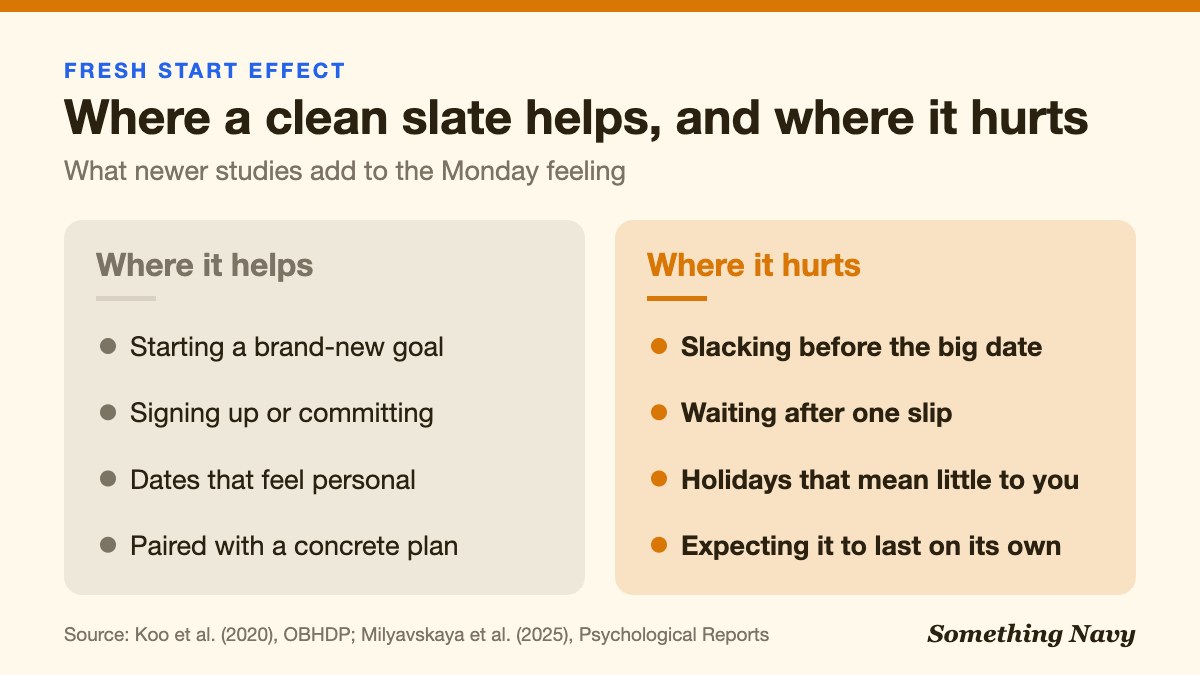
A fresh start is a good match. It is a poor fuel tank.
Birthdays, new homes and other private new years
Not every landmark is on the shared calendar. Some of the strongest belong to you alone.
Birthdays are the obvious one. In the 2014 gym data, workouts rose 7.5% after a birthday, with one telling exception: after their 21st, students went to the gym less, not more.
Moving house may be even more powerful, because it does not just feel like a new chapter. It breaks the cues that drive your habits: the route to work, the shop on the corner. Bas Verplanken and Deborah Roy at the University of Bath tested this in a 2016 field experiment with 800 households in Peterborough. Half received an intervention encouraging greener habits, and half of each group had recently moved. Across 25 behaviours over eight weeks, the intervention worked better for movers, with a window of about three months after the move.
New jobs, the end of a big project, a child starting school: all loosen old routines in the same way. That is also part of why time seems to rush by when life is unchanging, as we explored in why time speeds up as we get older. Landmarks are what make a year feel like it had chapters.
Fresh start dates you can use
You do not need to wait for January. Here are landmarks with evidence behind them.
| Landmark | How often | What the evidence shows |
|---|---|---|
| A new week (Monday) | 52 times a year | Gym visits up about a third; stickK contracts up 62.9% (2014) |
| The 1st of the month | 12 times a year | Gym visits up 14.4% (2014) |
| New term or semester | 2 to 3 times a year | Gym visits up 47.1%, the biggest jump in the study (2014) |
| Back after a break or holiday | Several times a year | Gym visits up 24.3% after school breaks (2014) |
| The first day of spring | Once a year | Picked 26% vs 7% when framed as a beginning (2015) |
| Your birthday | Once a year | Gym visits up 7.5%, except after a 21st (2014); boosted savings sign-ups (2021) |
| Moving house | Rare | Habit change easier for about three months (2016) |
| New job, end of a project | Rare | Untested directly, but they disrupt routines in the same way |
How to use the effect without waiting for Monday
The most useful finding in this whole field is the spring experiment. The date did not change; only its name did. That means you can create a landmark whenever you need one.
Try this
- Name today. “Day one of the new routine” or “the first day of autumn term” is a landmark the moment you call it one.
- Find the nearest real one. There is almost always a new week, month or term within a few days. You rarely have to wait long.
- Attach a plan. Motivation fades; a cue does not. Pair your fresh start with an if-then plan, such as “if it is 7am on a weekday, I put my trainers on”.
- Protect the run-up. If a big date is coming, keep your current small routines going until then rather than letting them lapse.
- Shrink the slip. Miss a day? Treat tomorrow morning as the reset, not next Monday.
Small rituals help the story land. If a wardrobe clear-out is your ritual, keeping it to a small capsule wardrobe means fewer morning decisions standing between you and the new habit. The same goes for leaning on a few good basics. The point is a visible signal that something has changed.
And be honest about what the reset is for. Use the burst of energy to set up the boring scaffolding (the alarm, the calendar slot, the packed gym bag) while you still feel new. When the feeling fades, the scaffolding keeps you standing.
A clean slate is a story you tell
The fresh start effect is, at heart, a piece of self-editing. You draw a line under the last chapter so the next one can be written differently.
That is a genuinely useful trick, as long as you remember who holds the pen. Mondays, birthdays and the first warm day of spring are handy prompts. But the research keeps pointing to the same quiet conclusion: the best day to begin is the one you decide to call a beginning.
Which could be this afternoon.
Frequently asked questions
It is the extra motivation people feel after a moment that marks a new beginning, such as a new week, a birthday or a move. The term comes from a 2014 Wharton study.
It reliably boosts the start of new efforts, from gym visits to savings sign-ups. Evidence that it keeps people going is much weaker, and a 2024 text-message trial found fresh-start wording did no better than a plain reminder.
Not necessarily. A 2025 study found goals set in January and March were rated almost the same, and a savings experiment found New Year’s Day drew a weaker response than birthdays or the first day of spring.
Yes. A 2020 study found people ease off current goals when a fresh start is approaching, and do not make up the lost effort later.
Sources
- Beshears, J., Dai, H., Milkman, K. L., & Benartzi, S. (2021). Using fresh starts to nudge increased retirement savings. Organizational Behavior and Human Decision Processes, 167, 72–87. DOI
- Dai, H., Milkman, K. L., & Riis, J. (2014). The fresh start effect: Temporal landmarks motivate aspirational behavior. Management Science, 60(10), 2563–2582. DOI
- Dai, H., Milkman, K. L., & Riis, J. (2015). Put your imperfections behind you: Temporal landmarks spur goal initiation when they signal new beginnings. Psychological Science, 26(12), 1927–1936. DOI
- Koo, M., Dai, H., Mai, K. M., & Song, C. E. (2020). Anticipated temporal landmarks undermine motivation for continued goal pursuit. Organizational Behavior and Human Decision Processes, 161, 142–157. DOI
- Lally, P., van Jaarsveld, C. H. M., Potts, H. W. W., & Wardle, J. (2010). How are habits formed: Modelling habit formation in the real world. European Journal of Social Psychology, 40(6), 998–1009. DOI
- Milyavskaya, M., Thorne, T., Sullivan, M., & Esselink, N. A. (2025). Goals across time frames and temporal landmarks: Do time of year and goal age influence goal perceptions? Psychological Reports. DOI
- Njuguna, C., Long, L., Mistri, P., Chetty-Makkan, C., Maughan-Brown, B., Buttenheim, A., et al. (2024). A randomized trial of ‘fresh start’ text messaging to improve return to care in people with HIV who missed appointments in South Africa. AIDS, 38(10), 1579–1588. DOI
- Verplanken, B., & Roy, D. (2016). Empowering interventions to promote sustainable lifestyles: Testing the habit discontinuity hypothesis in a field experiment. Journal of Environmental Psychology, 45, 127–134. DOI
Updated 18 October 2026: we expanded this article with newer research, fresh figures and new sections. Cover photo: 2H Media on Unsplash. Charts and graphics: Something Navy.
How we reported this. We went back to the original research for this story, 8 sources in all, listed above, and checked every figure against them. If you think we have got something wrong, tell us and we will look at it. Read more about how we work.