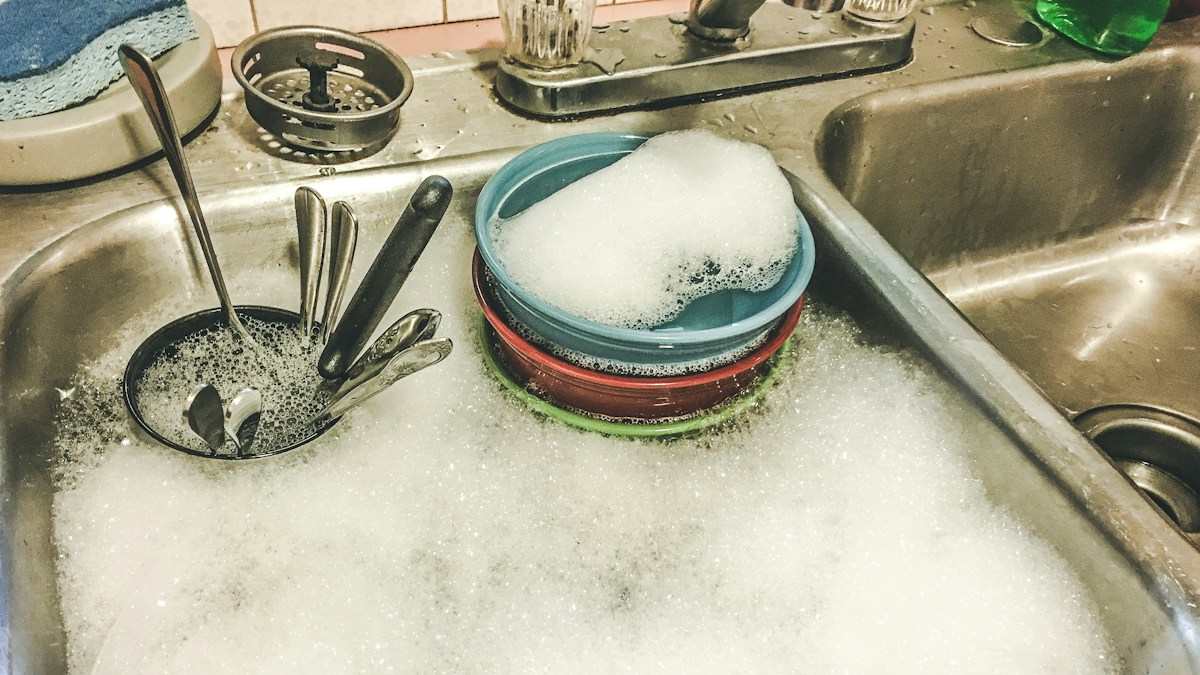
It is 9.40 on a Monday night. A frying pan sits in the sink under a skin of cold water, “soaking”, and has been since dinner.
One of you walks past it twice. The other one notices every time.
Nobody says anything yet. But by Thursday that pan will have become a conversation about respect, about who remembers the school forms, about whether one of you is even paying attention. Most couples know this fight. Fewer know that sociologists have found the dishes to be one of the most telling chores in a relationship, and that the real trouble usually starts somewhere you cannot see.
This is the story of one ordinary week in one ordinary kitchen, and what the research says is going on underneath it.
Meet Sam and Jo, who do not exist
Sam and Jo are a composite. They are not real people and nothing below happened to anyone in particular. They are a device: a mid-thirties couple with full-time jobs, a seven-year-old, a dishwasher that is always half full and a shared calendar that only one of them really reads.
We built them out of the patterns that keep turning up in time-use diaries and couples surveys, so that each day of their week can carry one finding. The details are invented. The numbers are not.
And the first number is the one that explains why we started in the kitchen at all.


Monday: the pan that tells you everything
In 2018 the sociologists Daniel Carlson, Amanda Miller and Sharon Sassler published a study in Socius that looked at individual chores rather than housework as one big lump. They compared two large samples of middle- to low-income American couples: one from the National Survey of Families and Households, collected in 1992–94, and one from the 2006 Marital and Relationship Survey.
Across the two periods, couples became more likely to share most routine tasks. The biggest shifts were in laundry and washing up: the share of couples who split the dishes rose from 16% to 29%.
Then came the finding that made headlines. Of all the tasks they looked at, dishwashing was the one most strongly tied to relationship quality, especially for women. In the 2006 data, women who did most of the dishes reported more discord, lower relationship satisfaction and less satisfying sex than women who shared the job with their partner.
Why the dishes, and not the hoovering? The study cannot say for certain, and it is worth being clear that these are associations, not proof that an unwashed pan causes unhappiness. But the dishes have a few unusual features. They come back every single day. Nobody thanks you for doing them. And a dirty plate usually has an obvious owner, which makes it hard to read a pile of them as anything other than a message.
So on Monday night, Jo is not really looking at a pan. Jo is looking at a small, daily, visible piece of evidence about how the week is going to go.
Tuesday: the diary that settles the argument
Suppose Sam, stung, says the obvious thing: “I do loads around here.” What would a stopwatch say?
The best large-scale answer in the US comes from the American Time Use Survey, run by the Bureau of Labor Statistics, in which thousands of people recount exactly how they spent the previous day. In 2023, on an average day, 48% of women did housework such as cleaning or laundry, compared with 22% of men. For food preparation and clean-up the figures were 71% of women and 51% of men.
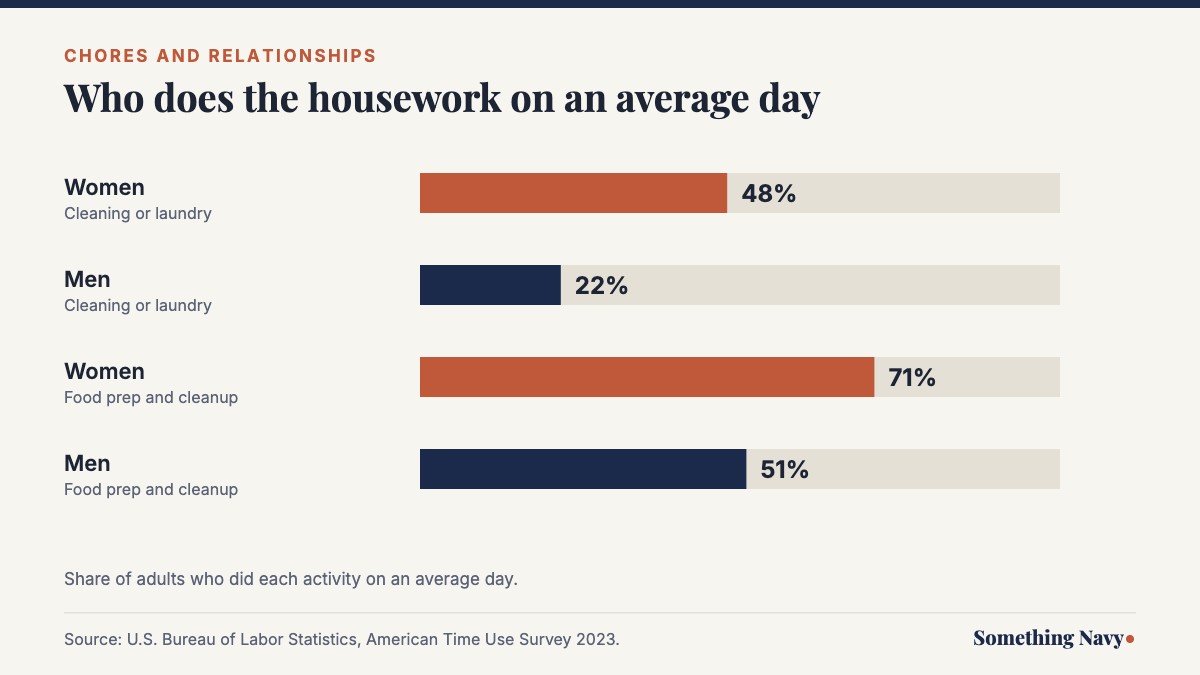
Those were the latest figures when we first wrote about this. The newest release, published in June 2026 and covering 2025, tells a similar story with one small shift. Women’s housework figure held at 48%, while men’s edged up to 24%. Men’s food preparation and clean-up rose to 58%, against 72% for women.
It is tempting to call that progress, and it may be. But single-year changes in a survey can wobble, so it is safer to read it as a gap that is narrowing slowly, if at all, rather than one that is closing.
Here is how the 2025 day breaks down across the main household categories.
| Activity, US, 2025 | Women doing it on an average day | Men doing it on an average day |
|---|---|---|
| Any household activity | 87% | 75% |
| Food preparation and clean-up | 72% | 58% |
| Housework (cleaning, laundry) | 48% | 24% |
| Household management | 23% | 14% |
| Lawn and garden care | 9% | 11% |
The pattern is familiar. The chores that happen daily and indoors lean heavily towards women. The occasional, outdoor ones lean slightly towards men. And “household management”, the paperwork and organising, is the one people tend to forget is a chore at all.
Which brings us to Wednesday.
Wednesday: the list nobody wrote down
On Wednesday morning Jo realises the child needs a costume for Friday, that the dentist has not been booked, and that the washing tablets will run out at the weekend. None of this appears in a time diary. Jo did all of it in the shower.
In 2019 Allison Daminger, then a doctoral researcher in sociology at Harvard, gave this work a name. For a paper in the American Sociological Review, she interviewed 70 college-educated, married parents of young children, the two members of 35 couples, about how household tasks actually got done.
She found that what we loosely call the mental load has four separate parts: anticipating a need, identifying the options for meeting it, deciding between them, and monitoring whether the decision worked. Women did more of the cognitive labour overall, and particularly the anticipating and the monitoring. Decision-making, the part most connected to power, was shared roughly equally.
That last detail matters. Sam might genuinely feel involved because Sam helps choose the dentist. What Sam does not see is the noticing that came before it and the checking that comes after.
Daminger’s sample was small and relatively well off, so it shows how this labour works rather than how common it is. But it explains something the stopwatch cannot: why someone can feel exhausted by a household even in a week when the hours look roughly even. It is the same reason unfinished tasks tend to nag at us long after we have stopped working on them.
Invisible work does not feel like work to the person not doing it. It feels like nothing at all.


Thursday: “I thought we were about even”
By Thursday the pan has become a row, and Sam says, sincerely, that things feel pretty equal. This is where recent research gets interesting.
In a study published online in December 2024 in the Journal of Marriage and Family, Ana Catalano Weeks of the University of Bath and Leah Ruppanner of the University of Melbourne surveyed 3,000 US parents about who handles the thinking behind everyday household tasks, from cleaning and cooking to scheduling, finances and social plans.
Mothers reported handling 71% of these mental tasks, while fathers reported handling 45%. The split was sharper still for daily, never-ending jobs such as cleaning and childcare: 79% for mothers against 37% for fathers. Fathers reported a bigger share only of episodic tasks, such as finances and home repairs, at 65% against 53% for mothers.
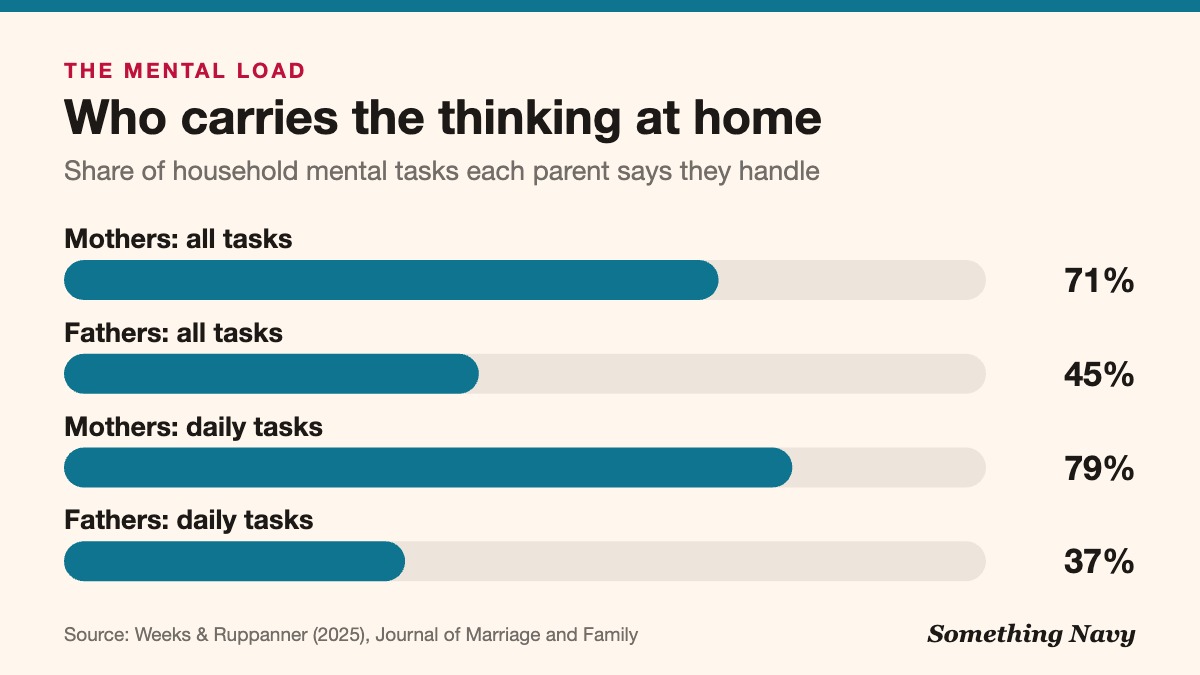
Notice that the numbers do not add up to 100%. That is most likely because these are parents’ own reports of their own share, not one agreed figure per household. It is a quiet reminder that the mental load is partly about perception, and that perception is exactly where Sam and Jo disagree.
The authors are careful to point out the limits: mental work is hard to measure, and a survey can only capture what people recognise in themselves. But the shape of the result is hard to miss. The tasks that recur every day are the tasks that fall to women, and those are the ones that never let up.
Friday: equal pay, unequal sink
Friday is payday. Sam and Jo earn almost exactly the same, which, you might think, would settle things.
It does not, at least on average. In 2023 the Pew Research Center analysed American Time Use Survey data from 2016 to 2021 for married couples in which both spouses earned about the same. Wives in these egalitarian marriages still spent 4.6 hours a week on housework, compared with about two hours for husbands. Husbands, meanwhile, had more leisure time: 25.2 hours a week against 21.6 for wives.
Money, in other words, does not automatically buy an even split at home. The habits come from somewhere else: what each partner saw growing up, what they think “helping” means, and who quietly became the default the first time the bin was full.
An equal salary will not wash a single plate.


Saturday: why fairness beats fifty-fifty
On Saturday, Sam and Jo try the classic fix. They draw up a rota. Sam gets the bins and the car, Jo gets the kitchen and the laundry, and on paper the hours come out level.
Research suggests this is the right instinct with the wrong design. In 2022 Daniel Carlson of the University of Utah told TIME about analyses showing that couples who carved housework into separate “his” and “her” jobs, with no shared tasks, were less satisfied than couples who shared at least three chores, whether by doing them together or by taking turns. In recent cohorts, 99% of couples who shared all tasks equally said their arrangement was fair. Among couples who split the hours 50/50 but shared no tasks, only half did.
Why would sharing beat splitting? Nobody knows for sure. One idea, raised in the same TIME piece by the sociologist Joanna Pepin, who was not involved in the research, is that a shared task makes the effort visible. If you have both scrubbed the roasting tin, neither of you can pretend it takes five minutes.
Another is that shared chores force a little conversation and teamwork, and couples who share tasks did tend to communicate better. The catch is direction: good communicators may simply be better at sharing in the first place. And sharing does not have to mean standing at the sink together. Alternating weeks counts, as long as the job is genuinely the same one.
The newest evidence points the same way. In 2026 Molly Smith, Thomas Bradbury and Benjamin Karney published a study in the Journal of Marriage and Family using survey and time-diary data from 3,455 people in same-sex and different-sex couples, drawn from the National Couples’ Health and Time Study.
Across every kind of couple, people who were more satisfied with how the housework was divided reported higher relationship and sexual satisfaction. But the diary measures, the objective count of who did what, were less strongly linked to those outcomes than people’s own sense of the arrangement. The link with relationship satisfaction was also stronger in different-sex couples than in same-sex ones.
That does not mean the hours are irrelevant. Couples who feel the split is fair may also be doing a fairer split. But it does suggest that what couples are really arguing about is meaning, not arithmetic.
The fight is rarely about the minutes. It is about what the minutes are taken to mean.
Sunday: the British version of the same row
On Sunday, Jo’s sister calls from Leeds and the conversation turns, inevitably, to whose turn it is to do the roast potatoes. The UK numbers suggest she would recognise the week.
In its time use survey for late September 2023, the Office for National Statistics found that women spent an average of 3 hours 37 minutes a day on unpaid work, which includes housework, caring for others and volunteering. Men spent 2 hours 43 minutes. The 54-minute gap was smaller than the 1 hour 12 minutes recorded in autumn 2020, so the direction of travel is encouraging.
It is still almost an hour a day. Across a year, that adds up to roughly two working months.
And that figure, like the American ones, only counts what people write in a diary. It does not count the shower-time planning from Wednesday.
What changes the following Monday
The good news in all of this is that the most promising fixes are small, cheap and available tonight. None of them requires a perfect fifty-fifty split. They require making the invisible part visible and turning “my jobs” and “your jobs” into some “our jobs”.
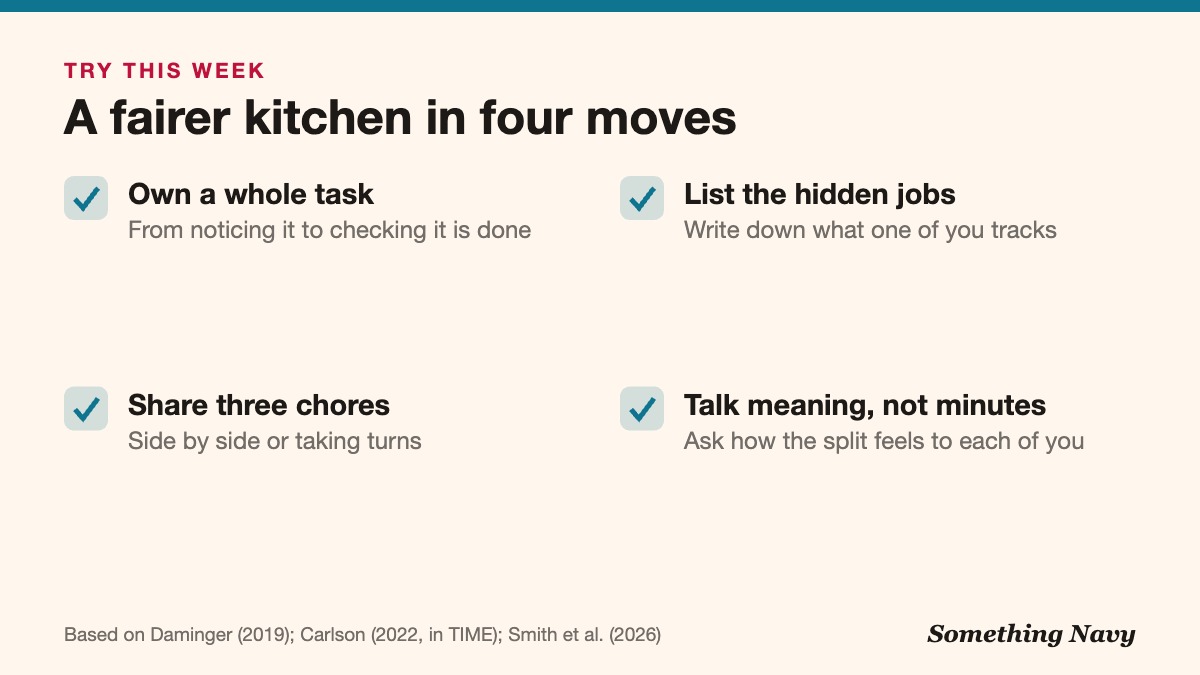
Try this before the next pan appears
- Hand over a whole task, not a step. Pick one recurring job and give it fully, from noticing to checking, in Daminger’s terms. “You own packed lunches” is different from “you make them when I ask”.
- Share at least three chores. Do them side by side or alternate weeks. Carlson’s analyses suggest shared tasks, not separate kingdoms, are what feel fair.
- Write the hidden list down. Spend ten minutes listing everything one of you tracks in your head. Most couples are surprised by how long it gets.
- Talk about meaning, not minutes. Ask what the dishes feel like, not just who did them last. Satisfaction with the split tracks relationship quality more closely than the diary does.
- Notice the effort out loud. Thanks cost nothing and the dishes are, by design, a job nobody thanks you for.
A few practical shortcuts help too. A smaller wardrobe, along the lines of a capsule wardrobe, means smaller laundry piles. Agreeing who handles repairs, including mending and patching clothes, takes one more item off the invisible list.
And if the dishes row has started to come with eye-rolling or sarcasm, it is worth knowing how contempt and criticism wear a relationship down far faster than any chore ever could. The best time to talk is not with your hands in the sink at 9.40pm. Choose a calm moment, say what you have noticed rather than what they have failed to do, and agree to revisit the plan when life changes: a new job, a baby, a move.
For Sam and Jo, the next Monday looks almost the same. The pan is still there after dinner. But this time Sam has already put it on the list of things Sam owns, and Jo, for once, walks past without counting.
That is what a fair kitchen looks like. Not a spotless sink, but a pan that only one of you has to think about, and you both know which one.
Sources
- Carlson, D. L., Miller, A. J., & Sassler, S. (2018). Stalled for whom? Change in the division of particular housework tasks and their consequences for middle- to low-income couples. Socius, 4. DOI
- Daminger, A. (2019). The cognitive dimension of household labor. American Sociological Review, 84(4), 609–633. DOI
- Weeks, A. C., & Ruppanner, L. (2025). A typology of US parents’ mental loads: Core and episodic cognitive labor. Journal of Marriage and Family, 87(3), 966–989. DOI
- Smith, M. G., Bradbury, T. N., & Karney, B. R. (2026). Division of housework, sexual intimacy, and relationship quality in different-sex and same-sex couples. Journal of Marriage and Family. Advance online publication. DOI
- US Bureau of Labor Statistics. (2026). American Time Use Survey: 2025 results. Link
- US Bureau of Labor Statistics. (2024). American Time Use Survey: 2023 results. Link
- Office for National Statistics. (2023). Time use in the UK: 23 September to 1 October 2023. Link
- Pew Research Center. (2023). In a growing share of U.S. marriages, husbands and wives earn about the same. Link
- Luscombe, B. (2022, April 25). The way couples split chores can improve relationships, according to a new study. TIME. Link
Updated 20 October 2026: we expanded this article with newer research, fresh figures and new sections. Cover photo: John Edgar on Unsplash. Charts and graphics: Something Navy.
How we reported this. We went back to the original research for this story, 9 sources in all, listed above, and checked every figure against them. If you think we have got something wrong, tell us and we will look at it. Read more about how we work.