
You check the clock. Twelve minutes until you need to leave, which is loads of time, so you answer one more email, make a quick tea and start looking for your keys.
Twenty minutes later you are running for the bus, genuinely baffled. It happens almost every time, and almost every time you are surprised.
That surprise has a name. Psychologists call it the planning fallacy: our habit of underestimating how long a task will take, even when we know from experience that similar tasks have overrun before.
The odd part is not that we get it wrong. It is that we get it wrong in the same direction, over and over, and never seem to learn.
Daniel Kahneman and Amos Tversky gave the bias its name in 1979, in a paper on the errors of intuitive prediction. Since then, researchers have measured it everywhere from student essays to opera houses, and found a few fixes that genuinely help. None involve trying harder.
The students who swore they’d be done in a month
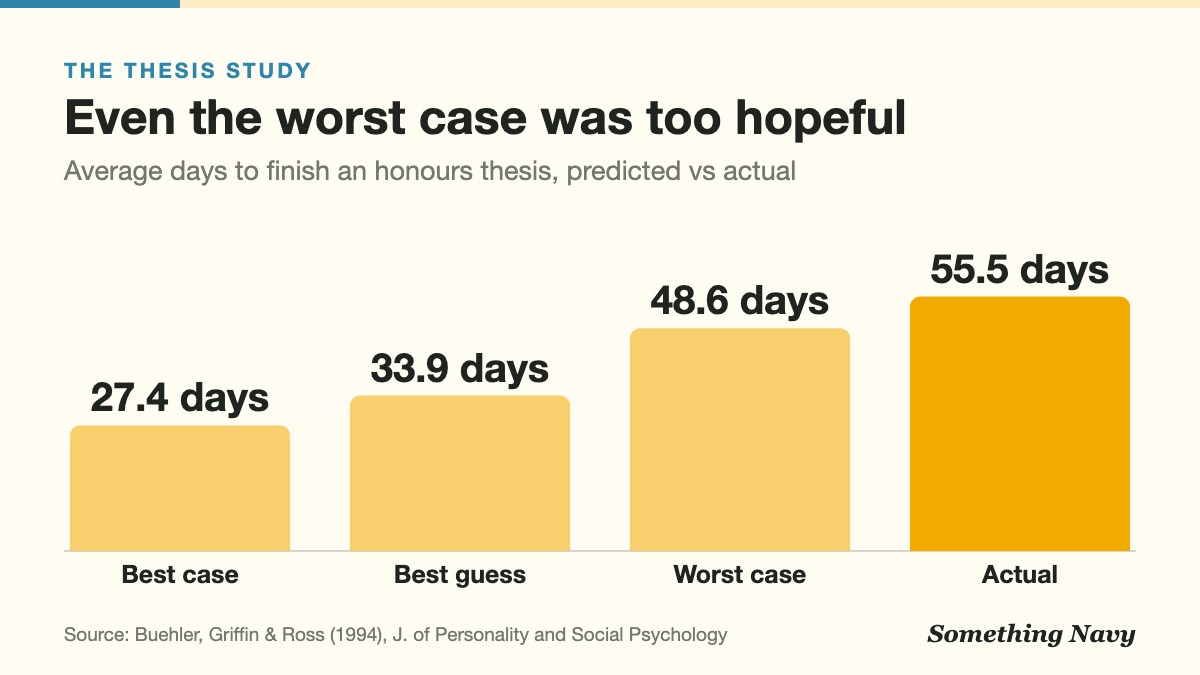
The study that turned the idea into hard numbers came from Canada. In 1994, Roger Buehler, Dale Griffin and Michael Ross asked 37 final-year psychology students at the University of Waterloo to predict when they would hand in their honours thesis.
The students gave three answers: their best guess, a forecast assuming everything went as well as it possibly could, and one assuming everything went as badly as it possibly could.
Their best guess averaged 33.9 days. Their worst-case scenario averaged 48.6 days.
The theses actually took 55.5 days on average.
Only about 30% of the students finished by the date they had predicted. Even their gloomiest, everything-goes-wrong forecast turned out to be too hopeful for more than half of them: fewer than half (48.7%) were done by their own worst-case date.
The finding was not a fluke of thesis season. In a follow-up study in the same paper, students predicted how long everyday projects would take, from academic assignments to tasks around the house. Academic projects they expected to finish in 5.8 days took 10.7. Non-academic ones forecast at 5.0 days took 9.2.
Small tasks, big tasks, work, home. The pattern held.
A building meant to take four years took fourteen
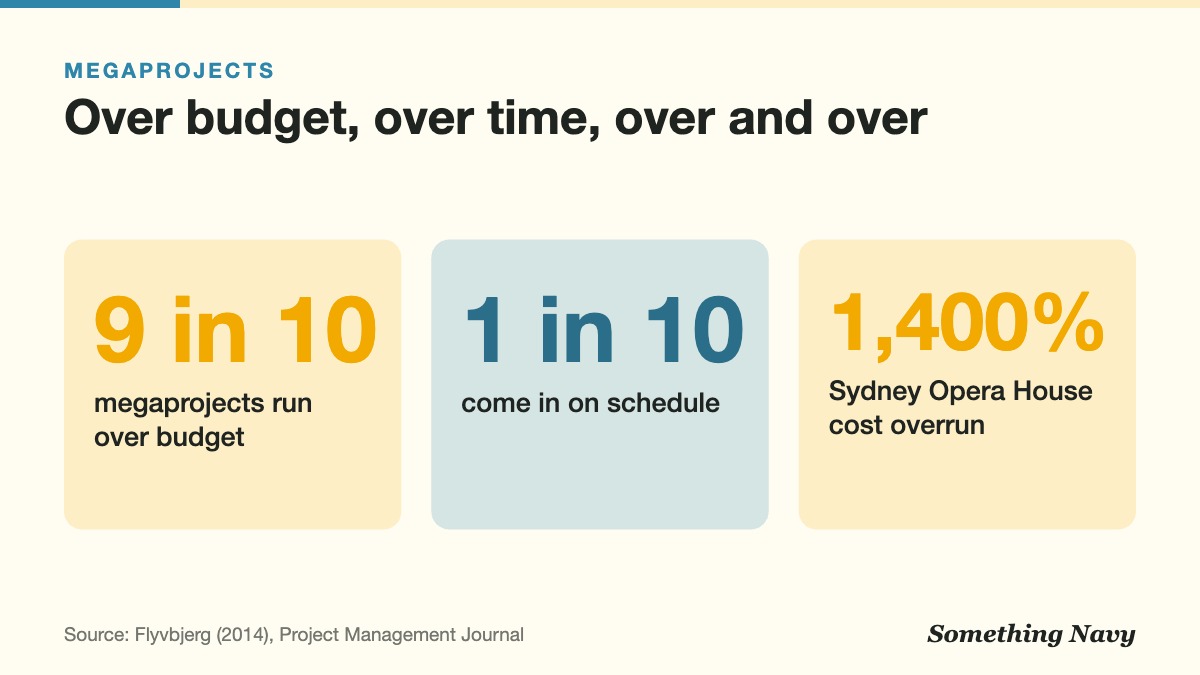
Scale the problem up and it stops being funny. When construction started on the Sydney Opera House in 1959, the original plan was for a four-year build costing $7 million. It opened in October 1973, having cost $102 million.
Bent Flyvbjerg, a professor at the University of Oxford who has spent decades collecting data on giant infrastructure projects, puts the Opera House’s cost overrun at 1,400% in real terms. In a 2014 review in the Project Management Journal, he summed up what he calls the “iron law” of megaprojects: “Over budget, over time, over and over again.”
His figures are bracing. Roughly nine out of ten megaprojects run over budget. Only about one in ten comes in on schedule. And, by his estimate, about one in a thousand hits its budget, its timeline and its promised benefits all at once.
Experts are not immune. Kahneman himself told the story of a team he led in Israel in the 1970s, writing a curriculum and textbook to teach judgement and decision-making in high schools. When he asked everyone how long it would take, the answers clustered around two years.
Then he asked the team’s curriculum expert, Seymour Fox, how long similar teams had taken. Fox thought for a moment and admitted that about 40% never finished at all, and that he could not think of any group that had finished in less than seven years. Kahneman’s team carried on regardless. The book took eight years, and by then nobody used it.
The cognitive scientist Douglas Hofstadter captured the absurdity in his 1979 book Gödel, Escher, Bach, in what became known as Hofstadter’s Law: “It always takes longer than you expect, even when you take into account Hofstadter’s Law.”
It is a joke, but it is also a decent description of the data.
| Task | Predicted | Actual |
|---|---|---|
| Honours thesis (Waterloo students) | 33.9 days | 55.5 days |
| Everyday academic project | 5.8 days | 10.7 days |
| Everyday non-academic project | 5.0 days | 9.2 days |
| Kahneman’s curriculum textbook | About 2 years | 8 years |
| Sydney Opera House | 4 years, $7 million | 14 years, $102 million |
So why do sensible people keep doing this? Three reasons come up again and again in the research.


1. You picture the plan, not the problems
When you estimate a task, your mind runs a little film of it going well. You see yourself sitting down, writing the introduction, finding the references, pressing send. What the film leaves out is the dentist’s appointment, the corrupted file and the afternoon lost to a friend’s crisis.
Kahneman and Tversky called this taking the “inside view”: focusing on the specifics of the case in front of you. Buehler’s team caught it happening in real time. In a third study, they asked students to think aloud while predicting when they would finish an assignment. About 74% of their thoughts were about future plans. Only 7% referred to relevant past experiences.
And the predictions? Fewer than half of those students (43.6%) finished on time.
A plan is a story about the best route. Reality takes the scenic one.
2. Your past feels like it doesn’t count
Ask people about their track record and most will admit they usually finish late. They simply do not apply that knowledge to the next job.
In a 2019 essay for the Society for Personality and Social Psychology, Buehler, now at Wilfrid Laurier University, explained that people often “feel that their previous experiences are not relevant to the new task.” Last time the printer broke. This time is different, surely.
Every delay feels like a one-off. Put together, the one-offs are the pattern.
Buehler’s 1994 paper tested this directly. Students in a computer-assignment study were split into three groups. One group simply made a forecast. A second was first asked to recall how long similar past assignments had taken. A third recalled past assignments and was then asked to spell out how that history applied to the new one.
Only that last group got it right on average: they predicted 7.0 days and took 7.0 days, and 60% finished on time, against 29.3% in the group that just guessed. Merely remembering the past did not help much. Connecting it to the present did.
3. You want it to be quick, and you are the one doing it
Hope plays its part. We want the essay finished, the flat packed, the kitchen done, and wanting nudges the estimate.
There is also something special about forecasting your own work. In another of Buehler’s studies, outside observers were asked to predict when other students would finish a task. The observers guessed 8.5 days on average, compared with 5.5 days from the students themselves, and they actually erred on the pessimistic side. Observers were far more likely to think about the person’s past behaviour: 48% mentioned it, compared with 2.4% of the people doing the task.
Strangers are better at predicting your deadlines than you are, mostly because they are not dazzled by your plan.
It is worth adding that the bias is not a character flaw. Buehler notes that conscientious people tend to finish earlier than procrastinators, but both groups underestimate how long things will take. If you are someone who puts things off, the planning fallacy is a separate problem stacked on top.
Three fixes that have evidence behind them
You cannot switch the bias off by knowing about it. Hofstadter’s Law is the proof. But researchers have found ways to work around it.


1. Ask what usually happens, not what should happen
Kahneman’s antidote is the “outside view”. Instead of building a forecast from the details of your task, you start with a reference class: a set of similar tasks and how long they really took. Then you adjust a little for anything genuinely unusual about this one.
Flyvbjerg turned this into a formal method called reference-class forecasting, now used on large public projects. In his 2014 review he describes it as a way to take the outside view systematically, by anchoring forecasts in the actual outcomes of comparable past projects. It is mostly looking things up.
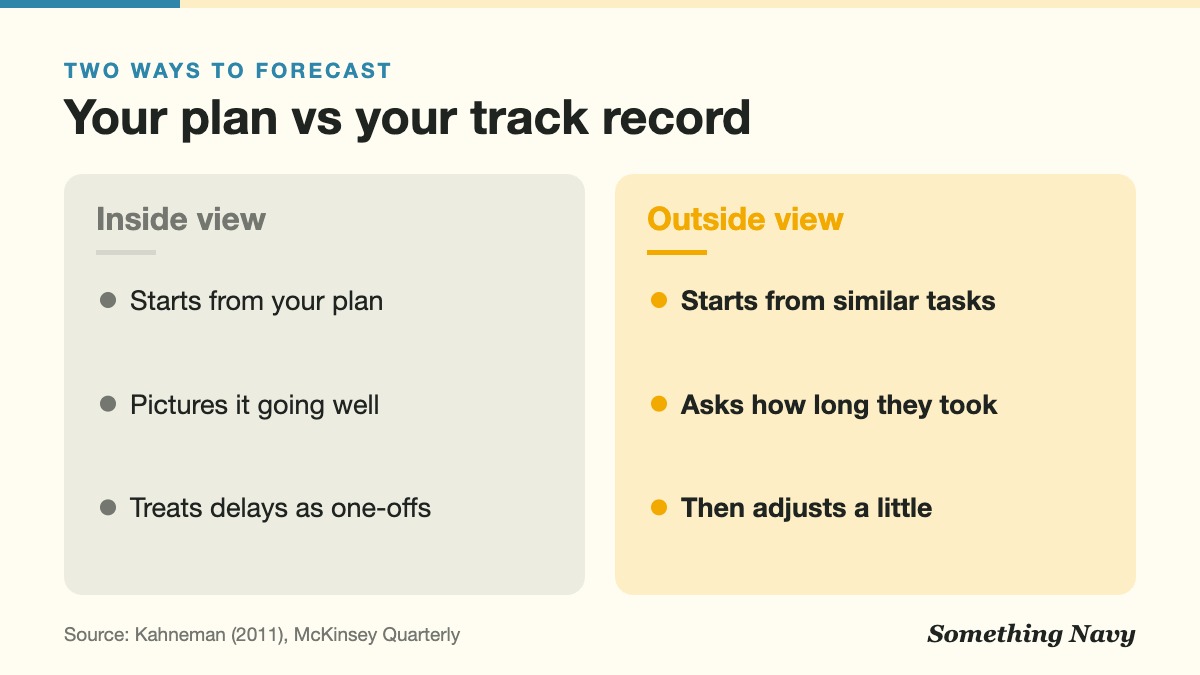
For your own life, the reference class is your history. How long did the last three essays take? How many weekends did the bathroom really eat? What time do you actually leave the house when you think you have “plenty of time”? Your past is the most accurate forecasting tool you own, and the one you are most likely to ignore.
2. Break the task into its smallest parts
In 2004, Justin Kruger, the psychologist better known for the Dunning-Kruger effect, and his colleague Evans published a paper with a memorable title: “If you don’t want to be late, enumerate”. Their argument was that people do not naturally break multi-step tasks into enough detail, so the small jobs hiding inside a big one never make it into the estimate.
In one of their best-known examples, participants estimated how long their Christmas shopping would take. Some gave a single overall estimate. Others first listed the people they were buying presents for. Listing the recipients led to longer and more realistic forecasts. They found similar effects for tasks such as getting ready for a date and formatting a document.
“Do the shopping” is one item. Twelve names, each with a decision, a queue and possibly a return, is a lot more.
There is a caveat. A 2014 follow-up in the same journal found that unpacking does not always lengthen estimates. Listing the typical steps sometimes left forecasts unchanged, and listing certain unusual but quick steps could even shorten them. Unpacking works best when it drags hidden, time-hungry parts of the job into view.
3. Decide exactly when and where you will start
The third fix works on the other side of the gap: rather than making your estimate more pessimistic, it makes your behaviour faster.
Psychologists Sander Koole and Mascha van’t Spijker, working in the Netherlands, gave 120 undergraduates a small assignment: write a short report about a day of their leisure time. Half simply set the goal of finishing. The other half also chose a specific time and place to start writing, pictured themselves there and committed to it. This kind of plan is called an implementation intention, the formal name for if-then planning.
The planners actually made slightly more optimistic predictions. But they started sooner and were interrupted less, so their actual performance improved even more. For them, the gap between forecast and reality largely closed; in the goal-only group it stayed wide. The study was modest (mostly women, self-reported timings, a single type of task), but it points to something useful: you can make a deadline more realistic by changing the plan, not just the estimate.
Moving house, essays and the kitchen that ate the summer
The research mostly comes from students and engineers, but the lessons travel well.
Moving house. “Packing” is not a task, it is fifty. Walk round with a notepad and list every room, cupboard and loft space, then remember how long the last move really took. Most people forget the last day: cleaning, meter readings, that one drawer.
Essays and work reports. Pull up the dates of your last few deadlines and note when you actually finished. That is your reference class. Then book a specific start slot in your diary, with a place attached. “Tuesday, 9am, library, introduction only” beats “this week”.
Home renovations. Ask friends or neighbours how long their similar job took, and how far over budget it went. Their story is your outside view. Builders’ quotes describe the plan; other people’s kitchens describe reality.
Getting out of the door. Time yourself once, from “I should start getting ready” to the door clicking shut. Most people are startled by the number. Use it instead of the one in your head.
Try this before your next deadline
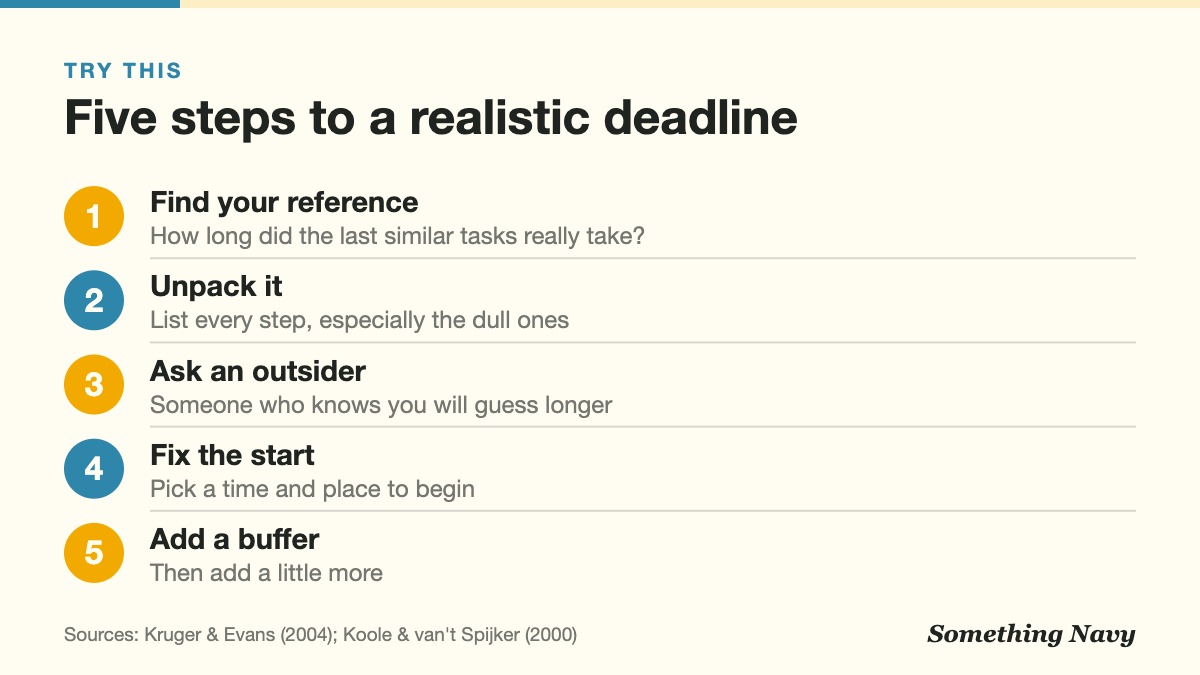
- Find your reference class. Write down how long the last two or three similar tasks really took.
- Unpack it. List every step, especially the dull ones: printing, waiting, checking, travelling.
- Ask an outsider. Someone who knows your habits will usually guess longer, and is more often right.
- Fix the start. Choose a time and place to begin, not just an end date.
- Add a buffer. Then remember Hofstadter, and add a little more.
Plan for the person you actually are
There is something oddly kind about the planning fallacy, once you see it. It means the version of you making plans is an optimist, someone who believes the next job will go smoothly. That optimism is probably part of why people start ambitious things at all.
The trouble only comes when the optimist is also in charge of the calendar.
So let the optimist pick the goal, and let the record keeper set the deadline. Next time you think you have twelve minutes, look at what the last twelve minutes actually turned into, and put your shoes on now.
Frequently asked questions
Daniel Kahneman and Amos Tversky introduced it in 1979, in work on the errors people make in intuitive prediction.
No. Procrastination is delaying the start of a task; the planning fallacy is misjudging how long it will take. Conscientious people who start promptly still underestimate task length, though the two problems often make each other worse.
It helps, but people tend to underestimate even their worst-case forecasts, as the Waterloo thesis students did. A buffer based on how long similar tasks took you in the past is far more reliable than one picked by gut feeling.
Observers are more likely to think about your past behaviour, while you focus on your plan for this particular task. In Buehler’s research, outside observers gave longer, more cautious estimates than the people doing the work.
Sources
- Buehler, R., Griffin, D., & Ross, M. (1994). Exploring the “planning fallacy”: Why people underestimate their task completion times. Journal of Personality and Social Psychology, 67(3), 366–381. DOI
- Flyvbjerg, B. (2014). What you should know about megaprojects and why: An overview. Project Management Journal, 45(2), 6–19. DOI
- Kahneman, D. (2011, November 1). Daniel Kahneman: Beware the ‘inside view’. McKinsey Quarterly (excerpt from Thinking, Fast and Slow). Link
- Kruger, J., & Evans, M. (2004). If you don’t want to be late, enumerate: Unpacking reduces the planning fallacy. Journal of Experimental Social Psychology, 40(5), 586–598. DOI
- Koole, S., & van’t Spijker, M. (2000). Overcoming the planning fallacy through willpower: Effects of implementation intentions on actual and predicted task-completion times. European Journal of Social Psychology, 30(6), 873–888. DOI
- Buehler, R. (2019, May 30). The planning fallacy. Character & Context, Society for Personality and Social Psychology. Link
Cover photo: Towfiqu barbhuiya on Unsplash. Charts and graphics: Something Navy.
How we reported this. We went back to the original research for this story, 6 sources in all, listed above, and checked every figure against them. If you think we have got something wrong, tell us and we will look at it. Read more about how we work.