A half-written email. A suitcase you never quite unpacked. A TV episode that cut to black just as things got interesting. Unfinished business has a way of tapping you on the shoulder, and pop psychology has a ready-made name for it: the Zeigarnik effect, the idea that we remember unfinished tasks better than finished ones.
It turns up everywhere, from productivity blogs to screenwriting guides and marketing courses. But when two researchers recently gathered up nearly a century of experiments, they found that the famous version of the effect is shaky. A lesser-known cousin, though, held up remarkably well, and it may be the one that actually explains that nagging feeling.
A Berlin café and a psychology lab
The story usually begins with Kurt Lewin, an influential psychologist in 1920s Berlin, noticing that a waiter could remember complicated unpaid orders perfectly, then forget them the moment the bill was settled. Whether or not the café anecdote happened exactly as told, it inspired one of his students, Bluma Zeigarnik, to test the idea properly.
In a study published in 1927, Zeigarnik gave people a series of small tasks, such as puzzles, arithmetic and modeling figures, and interrupted some of them before they could finish. Afterwards, participants seemed to recall the interrupted tasks better than the completed ones. Lewin’s explanation was that taking on a goal creates a kind of mental tension that only eases once the goal is reached. Until then, the task stays “live” in the mind.
Around the same time, another of Lewin’s students, Maria Ovsiankina, looked at a related question: when people are interrupted and later given a free moment, do they go back to the unfinished task on their own, even when nobody asks them to?


What nearly 100 years of studies add up to
In 2025, Romain Ghibellini and Beat Meier published a meta-analysis in Humanities and Social Sciences Communications, combining 38 publications on the Zeigarnik effect and 20 on the Ovsiankina effect.
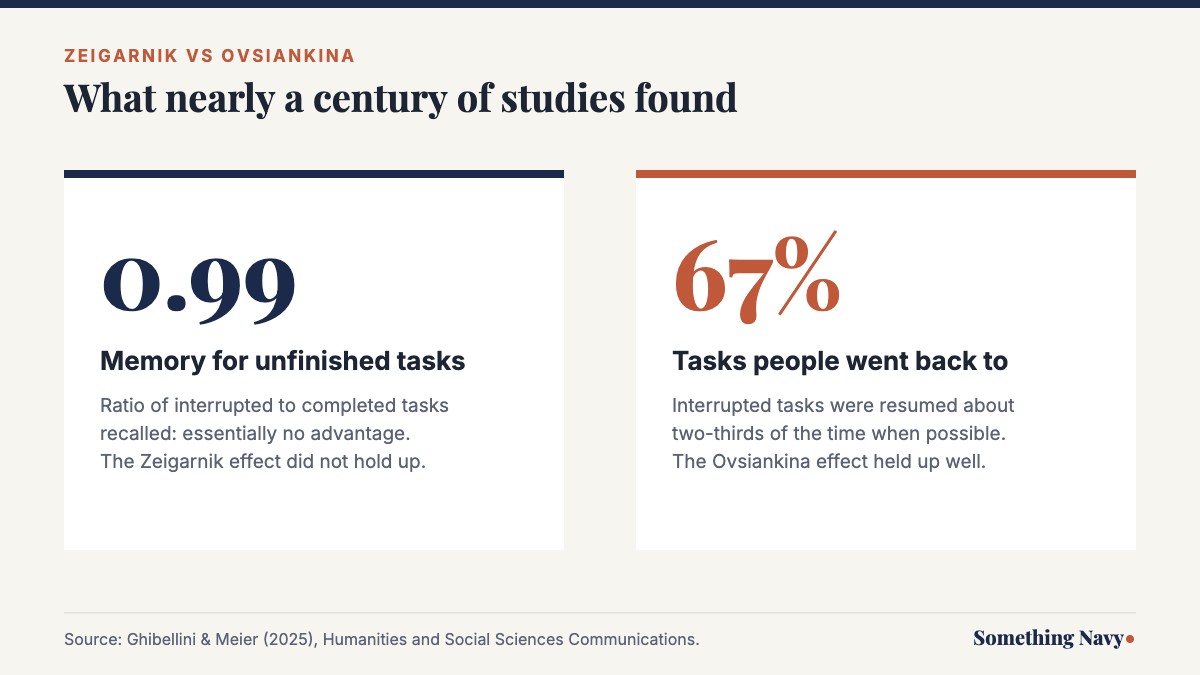
The memory advantage did not survive as a general rule. On the most common measure, people recalled interrupted and completed tasks at almost exactly the same rate, a ratio of 0.99. The authors concluded that the Zeigarnik effect “lacks universal validity.”
The urge to go back, on the other hand, was solid. Across studies, people resumed interrupted tasks about two-thirds of the time when they had the chance. That is the Ovsiankina effect, and on the evidence it is the more reliable of the two.
Why the original result is hard to repeat
The authors offer a few explanations for why Zeigarnik’s memory effect has faded. Her original participants worked under an experimenter with considerable authority, on tasks they were heavily invested in, in a world with far fewer distractions. Modern participants juggle notifications, emails and multitasking, and may care much less about a puzzle handed to them in a lab.
Interestingly, the memory advantage did appear under relaxed conditions, but not when participants felt they were being tested or were simply neutral about the task. Context, in other words, matters a great deal, which helps explain why the effect shows up in some studies and not others.
So why do unfinished tasks keep nagging?
Read together, the findings suggest that what we feel is less a sharper memory for unfinished things and more a pull to complete them. An open goal stays quietly active, which is why it surfaces at odd moments: in the shower, at 2 a.m., in the middle of a conversation about something else.
It also explains why cliffhangers work. They do not necessarily make us remember more of the episode. They make us want to press play on the next one.
Making a plan quiets the mind
If open goals keep pulling at our attention, the obvious fix is to finish them. But there is evidence that you do not always have to. In a 2011 set of experiments, psychologists E. J. Masicampo and Roy Baumeister reminded people of important goals they had not yet completed. Those people were more distracted by intrusive thoughts during an unrelated reading task, and understood less of what they read.
But when participants were also asked to make a specific plan for how, when and where they would complete the goal, the distraction disappeared, even though they had made no actual progress. Making the plan seemed to reassure the mind that the task was in hand.
A related idea has been tested at bedtime. In a 2018 sleep-lab study, Michael Scullin and colleagues asked 57 young adults to spend five minutes before bed writing either a to-do list for the coming days or a list of things they had already done. Those who wrote to-do lists fell asleep about nine minutes faster, and the more detailed the list, the quicker they dropped off. It was a small study of healthy students, so it is not a treatment for insomnia, but the direction of the result fits the wider research.
Putting the pull to work
If you are putting something off, starting it for five minutes can create just enough of that pull to bring you back. Some writers deliberately stop mid-sentence at the end of a session for the same reason; the next morning, finishing the sentence is an easy way in.
The flip side is that too many half-started projects can leave your attention scattered. Writing down what is open, and exactly when you will return to it, seems to take some of the pressure off. It is closely related to the if–then plans that psychologists use to help people follow through.
Frequently asked questions
It is the claim that people remember unfinished or interrupted tasks better than completed ones. It is named after Bluma Zeigarnik, who published experiments on it in 1927.
A 2025 meta-analysis found no general memory advantage for unfinished tasks. What did hold up was the Ovsiankina effect: people tend to go back to interrupted tasks about two-thirds of the time.
It is the tendency to resume a task after being interrupted, even without being asked. It was first studied by Maria Ovsiankina in the 1920s.
Research suggests that making a concrete plan for when and how you will finish a task can reduce intrusive thoughts about it, even before you make progress.
If you have ever been sure a small lapse was the talk of the office, you may also recognize the spotlight effect. More in our Psychology section.
Sources
- Ghibellini, R., & Meier, B. (2025). Interruption, recall and resumption: A meta-analysis of the Zeigarnik and Ovsiankina effects. Humanities and Social Sciences Communications, 12, 962. Nature.com
- Masicampo, E. J., & Baumeister, R. F. (2011). Consider it done! Plan making can eliminate the cognitive effects of unfulfilled goals. Journal of Personality and Social Psychology, 101. PDF
- Scullin, M. K., Krueger, M. L., et al. (2018). The effects of bedtime writing on difficulty falling asleep: A polysomnographic study comparing to-do lists and completed activity lists. Journal of Experimental Psychology: General, 147(1), 139–146.
- Zeigarnik, B. (1927). Das Behalten erledigter und unerledigter Handlungen. Psychologische Forschung, 9, 1–85.
- Ovsiankina, M. (1928). Die Wiederaufnahme unterbrochener Handlungen. Psychologische Forschung, 11, 302–379.
How we reported this. We went back to the original research for this story, five sources in all, listed above, and checked every figure against them. If you think we have got something wrong, tell us and we will look at it. Read more about how we work.
Cover photo: Bennett Frazier on Unsplash. Charts and graphics: Something Navy.