
It is about four o’clock. The roast is done, the light outside has gone a shade thinner, and somewhere between the washing-up and the sofa your stomach drops.
Nothing has happened. You are still on your weekend. But your head has already clocked in.
The internet calls this the “Sunday scaries”. It is not a diagnosis, and you will not find it in any clinical manual. Yet it is a strangely specific feeling: dread that arrives on a schedule, for a week that has not started.
Here is the twist the research offers. When scientists tracked the moods of hundreds of thousands of people, Monday turned out to be no worse than Tuesday, Wednesday or Thursday. The dip we brace for on Sunday night is real. The cliff we imagine on Monday morning mostly is not.
So let’s walk through a Sunday evening, hour by hour: what is going on in your mind, and what to do about it.
4pm: the moment the weekend tips over
Sunday afternoon is the hinge. In 2010, Richard Ryan of the University of Rochester, with Jessey Bernstein and Kirk Warren Brown, followed 74 working adults aged 18 to 62, all doing at least 30 hours a week. For three weeks, the participants were paged at random three times a day and asked how they felt, what they were doing and who they were with.
Weekends won, clearly. People reported better moods, more vitality and fewer physical complaints such as headaches and low energy.
The reason was not simply “no work”. On weekends, people felt freer to choose what they did and closer to the people around them. Oddly, they also felt more competent. The researchers tied this to self-determination theory: wellbeing rests on autonomy, competence and connection.
That gives the 4pm drop a sharper outline. What you start to grieve on a Sunday afternoon is not leisure in the abstract. It is the feeling of running your own day.
What helps at 4pm:
- Notice the shift and name it. “That’s the Sunday drop” is more useful than “something is wrong with me”.
- Keep one chosen, sociable thing in the late afternoon: a walk with a friend, a phone call, a film you picked.
- Avoid opening your work inbox “just to check”. It drags the week forward by 16 hours.
5pm: a feeling most of your colleagues share
If the dread feels private, it probably isn’t. In August 2018, The Harris Poll surveyed 1,017 working adults in the US for LinkedIn. Some 80% said they experienced the Sunday scaries, and more than one in three said they got them every week. Among millennials and Gen Z, the figure was over 90%.
The top triggers were telling. Worrying about workload came first, at 60%. Balancing work and personal to-dos followed at 44%, and tasks left unfinished from the week before at 39%.
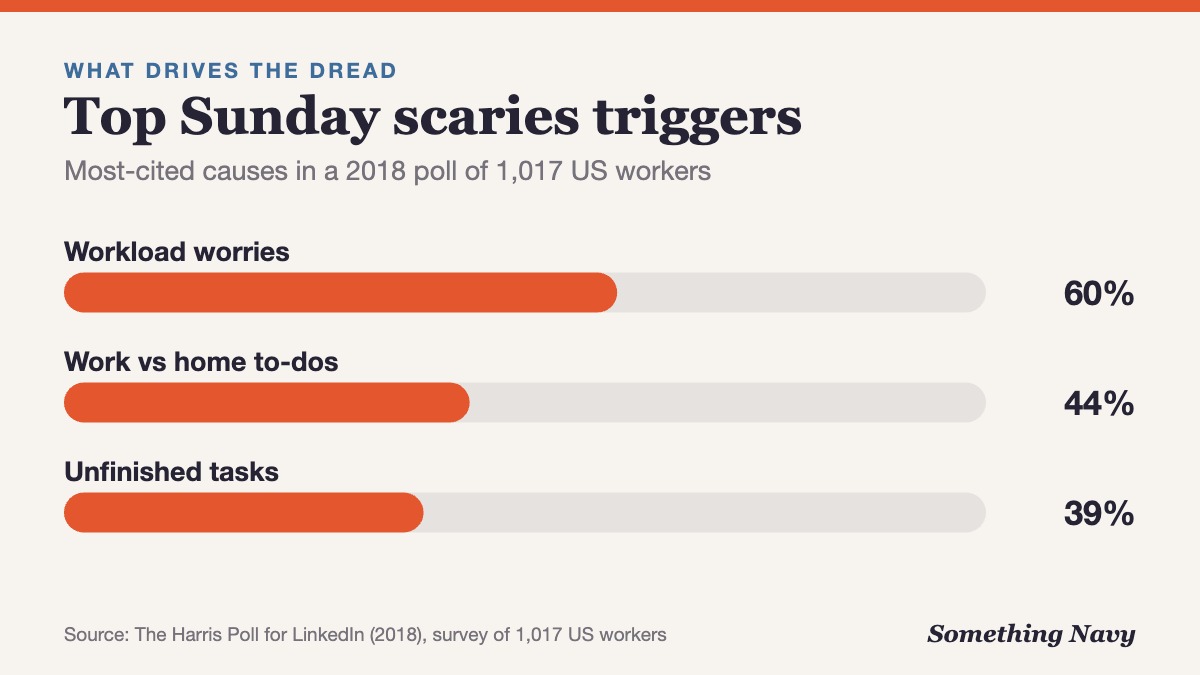
A word of caution: this is a commissioned poll of American workers, not a peer-reviewed study, and the question wording shapes the answers. Still, two of the top three triggers are about things left undone, and that matches what experiments predict.
Unfinished business does not stay in the office. It comes home with you.
6pm: why your mind keeps replaying Friday’s loose ends
Psychologists have long noticed that incomplete tasks linger in memory more stubbornly than finished ones, an idea often traced to the Zeigarnik effect. In 2011, psychologists E. J. Masicampo and Roy Baumeister tested what quiets that nagging.
Across a series of experiments, they reminded people of goals they had not yet met. Those unfinished goals leaked into unrelated tasks: more intrusive thoughts while reading a passage, quicker recognition of goal-related words, and poorer performance on anagrams.
Then came the useful bit. When participants were allowed to make a specific plan for when and how they would deal with the goal, those effects disappeared. They had not completed anything. They had simply decided.
That is why a vague “I’ve got so much on this week” feels so heavy. It is an open loop with no instructions attached.
What helps at 6pm:
- Write down the three things you are most worried about for the week.
- Next to each one, add a when and a where: “Budget report, Monday 10am, after stand-up.” This is the same logic behind if-then planning.
- Stop there. The goal is a plan, not a head start on the work.
7pm: what the stress hormone is doing
It is tempting to say Sunday dread “floods you with cortisol”. The evidence is more specific than that.
In 2004, Wolff Schlotz and colleagues, including the mood researcher Arthur Stone, asked 219 people to collect saliva samples on waking and 30, 45 and 60 minutes later, for six days in a row starting on a Saturday. Cortisol normally rises sharply in the first half hour after you wake, a pattern called the cortisol awakening response.
That morning rise differed between weekends and weekdays. And people who reported chronic work overload and more worrying had a bigger cortisol rise on weekday mornings, plus higher average levels. On weekend days, that link did not show up.
Your body seems to know what kind of day it is waking into.
This study measured mornings, not Sunday evenings, so it cannot tell us what your hormones do at 7pm on the sofa. It does suggest the load you carry matters more than the calendar.
8pm: the good news about Monday
Now for the reassurance. In 2012, Arthur Stone and Stefan Schneider, working with Gallup’s Jim Harter, analysed around 340,000 telephone interviews with American adults, looking at how mood changed across the week.
Fridays, Saturdays and Sundays brought clearly better moods. But they found little support for a special “Blue Monday”. Monday moods were roughly the same as the rest of the working week. The weekend lift was also smaller for older and retired people.
So the mood drop is about leaving the weekend, not about Monday being uniquely awful. Your Sunday brain is forecasting a cliff edge. The data shows a step down onto a fairly ordinary floor.
The dread on Sunday night is usually bigger than the Monday it is dreading.
What helps at 8pm:
- Recall last Monday honestly. Was it as bad as Sunday-you predicted?
- Put one small pleasant thing in Monday’s diary: lunch with a colleague you like, a coffee from the good place, a walk at 3pm.
- If a real, specific problem is waiting (a hard conversation, a missed deadline), plan its first step. Vague dread shrinks when it gets a time slot.
9pm: the ritual that closes the weekend
A lot of Sunday anxiety comes from the evening having no shape. The weekend fades out rather than ending, and the gap fills with scrolling and worrying.
A short ritual gives the evening a full stop. Think 20 minutes, not a second shift.
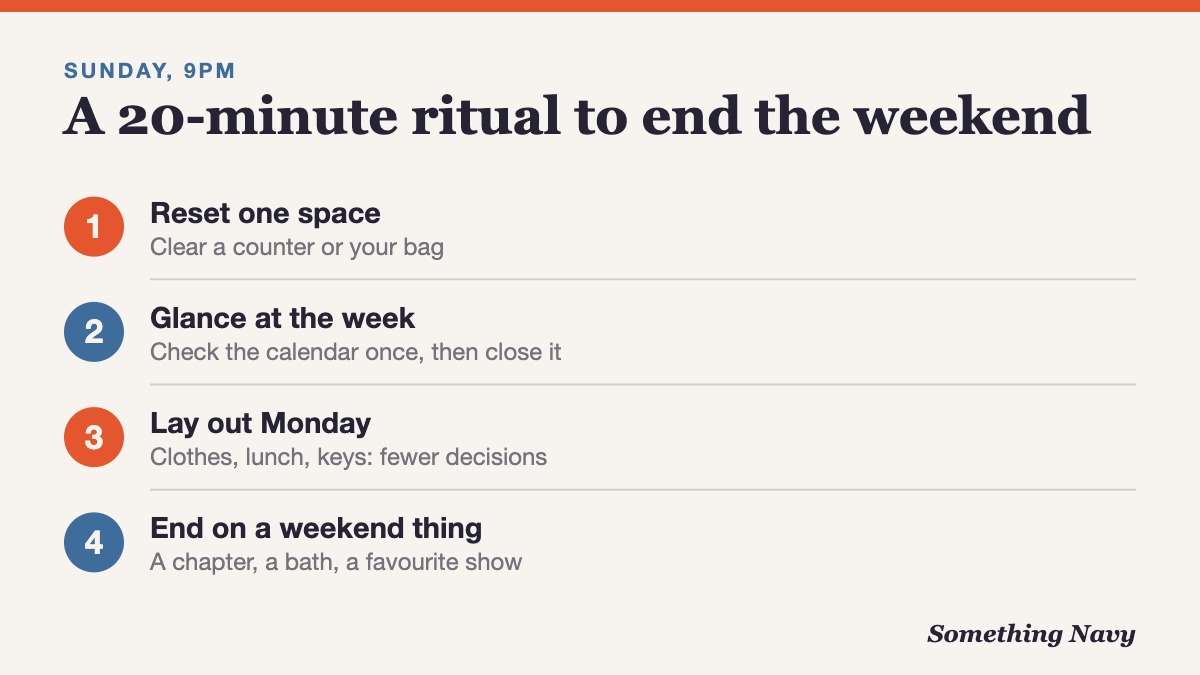
- Reset one space. Clear the kitchen counter or your bag. A small visible tidy signals “done”.
- Glance at the week. Look at the calendar once, note anything unusual, then close it.
- Lay out Monday. Clothes, lunch, keys. Fewer decisions tomorrow morning.
- Do one weekend thing last. A chapter of a novel, a bath, a favourite programme. End on your time, not work’s.
The fresh start effect suggests a new week is a natural moment for new intentions. Just keep Sunday night for planning, not overhauling your life.
10pm: write the list, then put down the pen
The most practical study here came in 2018, when Michael Scullin at Baylor University and colleagues brought 57 healthy adults aged 18 to 30 into a sleep lab on a weeknight. Before lights out, half spent five minutes writing a to-do list for the coming days. The other half wrote about tasks they had already completed.
Their sleep was measured with polysomnography, which tracks brain waves. The to-do group fell asleep in about 15 minutes on average. The completed-tasks group took about 25. And the more detailed the to-do list, the faster its writer dropped off.
It is a small study of young people without sleep problems, so it is not a cure for insomnia. But it fits the planning research: writing the list seems to offload worry, not feed it.
Try this tonight
- Set a timer for five minutes.
- Write everything you need to do in the next few days, as specifically as you can.
- Close the notebook and leave it outside the bedroom.
- If a new task pops up in bed, say “it’s on the list” and let it go.
11pm: why last night’s worry doesn’t have to wreck Monday
One more study offers an odd comfort. In 2019, Jinshil Hyun, Martin Sliwinski and Joshua Smyth at Penn State gave 240 adults aged 25 to 65 a smartphone app for two weeks. Each morning they rated whether they expected a stressful day; during the day they did short memory tests; and at night they rated how stressful they expected the next day to be.
Expecting stress on waking predicted weaker working memory later that day, even when nothing stressful actually happened. But the expectation reported the night before did not predict next-day performance.
It is one study, and it looked at memory, not mood. Still, it hints that Sunday-night dread is not necessarily a prophecy. What may matter more is the frame you wake up with on Monday.
Which makes the final hour of Sunday worth protecting. Phone down, lights low, and if you notice yourself pushing bedtime later just to make the weekend last, that is revenge bedtime procrastination, and it usually leaves Monday harder.
Friday, 4.30pm: where a calm Sunday really starts
The best fix for Sunday may happen two days earlier. If unfinished tasks are a top trigger, the end of the working week is the moment to close those loops, or at least label them.
A Friday shutdown routine takes about 15 minutes:
- Capture. Write down every open task still rattling around, from emails to half-finished drafts.
- Schedule. Give the top three a day and time next week. That is the plan your brain needs to stop rehearsing them.
- Write Monday’s first move. One concrete action, so Monday morning starts with doing rather than deciding.
- Say it out loud, or type it. “Shutdown complete.” It sounds silly, but it marks a clear end.
- Close everything. Tabs, apps, notifications. Leave the desk the way you would like to find it.
None of this will make every Sunday glorious. If the dread spills into most days, ruins your sleep or comes with low mood that does not lift, it is worth talking to your GP, because that is more than a Sunday feeling.
For most of us, though, the scaries are a forecast, and forecasts can be revised.
Make the plan on Friday. Write the list on Sunday. Then let the weekend have its last hour.
Frequently asked questions
No. It is an informal name for anticipatory anxiety about the working week. It is common and usually harmless, but persistent anxiety on most days is worth discussing with a GP.
Large US data suggests not. An analysis of about 340,000 Gallup interviews found Monday moods were similar to Tuesday to Thursday, with the real lift arriving on Friday and the weekend.
In one sleep-lab study, the opposite happened: people who wrote a specific five-minute to-do list fell asleep faster than those who wrote about finished tasks.
The LinkedIn poll included part-time and self-employed workers, and the main triggers were workload and unfinished tasks, which can follow you anywhere. A clear end-of-week shutdown helps whatever your setup.
Sources
- Hyun, J., Sliwinski, M. J., & Smyth, J. M. (2019). Waking up on the wrong side of the bed: The effects of stress anticipation on working memory in daily life. The Journals of Gerontology: Series B, 74(1), 38–46. DOI
- LinkedIn. (2018). Your guide to winning @Work: Decoding the Sunday scaries [Survey conducted by The Harris Poll, 8–22 August 2018, n = 1,017]. Link
- Masicampo, E. J., & Baumeister, R. F. (2011). Consider it done! Plan making can eliminate the cognitive effects of unfulfilled goals. Journal of Personality and Social Psychology, 101(4), 667–683. DOI
- Ryan, R. M., Bernstein, J. H., & Brown, K. W. (2010). Weekends, work, and well-being: Psychological need satisfactions and day of the week effects on mood, vitality, and physical symptoms. Journal of Social and Clinical Psychology, 29(1), 95–122. DOI
- Schlotz, W., Hellhammer, J., Schulz, P., & Stone, A. A. (2004). Perceived work overload and chronic worrying predict weekend–weekday differences in the cortisol awakening response. Psychosomatic Medicine, 66(2), 207–214. DOI
- Scullin, M. K., Krueger, M. L., Ballard, H. K., Pruett, N., & Bliwise, D. L. (2018). The effects of bedtime writing on difficulty falling asleep: A polysomnographic study comparing to-do lists and completed activity lists. Journal of Experimental Psychology: General, 147(1), 139–146. DOI
- Stone, A. A., Schneider, S., & Harter, J. K. (2012). Day-of-week mood patterns in the United States: On the existence of ‘Blue Monday’, ‘Thank God it’s Friday’ and weekend effects. The Journal of Positive Psychology, 7(4), 306–314. DOI
Cover photo: Samuel Regan-Asante on Unsplash. Charts and graphics: Something Navy.
How we reported this. We went back to the original research for this story, 7 sources in all, listed above, and checked every figure against them. If you think we have got something wrong, tell us and we will look at it. Read more about how we work.