In the autumn of 2018, nearly 600 Americans accepted $102 to do something that sounds trivial: switch off their Facebook accounts for four weeks. Many of them had told the researchers they would need roughly that much money to agree. By the end of the month, a large share said the break had been good for them, and many kept using Facebook less once it was over.
That is the curious thing about quitting social media. We tend to talk about it as a vow or a detox, a dramatic gesture. Scientists have instead treated it as an experiment, and over the past decade they have run it again and again with Danish Facebook users, American students, British adults and tens of thousands of US voters.
Their answers are more modest, and more interesting, than the headlines suggest.
Five studies, five different questions
Most research on social media and mood is correlational. Heavy users report feeling worse, but that could mean the apps make people miserable, or that miserable people scroll more. The only clean way to separate the two is to change how much people use social media at random and watch what happens.
That is what the five studies below have in common. In each, one group logged off or cut down while a comparison group carried on (or took a shorter break), and the researchers measured the difference. They differ in nearly everything else: size, length, platform, who took part and what counted as an outcome. Taken one at a time, each has a clear catch. Taken together, they tell a fairly consistent story.
Denmark: one week without Facebook
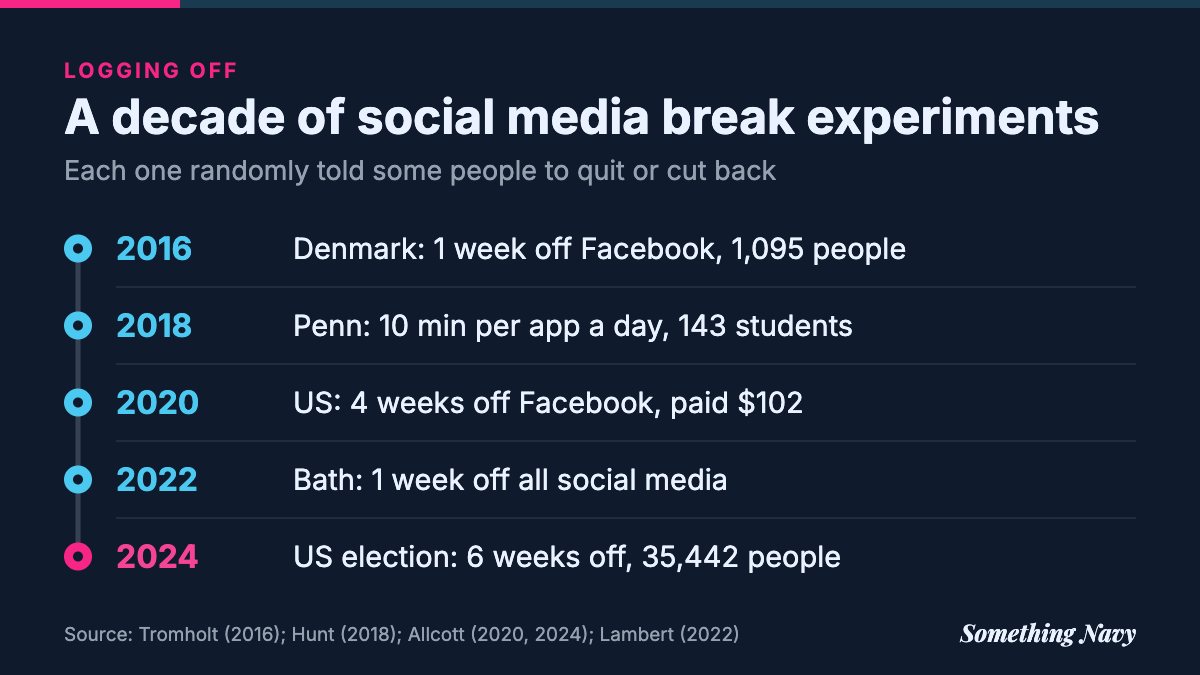
What they did. In late 2015, Morten Tromholt of the University of Copenhagen recruited Facebook users in Denmark and split them at random into two groups. Half were asked to stay off Facebook completely for one week; the other half carried on as normal. Everyone filled in a questionnaire on life satisfaction and emotions at the start and the end. The results appeared in Cyberpsychology, Behavior, and Social Networking in 2016.
Who took part. There were 1,095 participants, around 86% of them women, with an average age of 34. They were regular users, on Facebook for about an hour a day.
What changed. After a single week, the people who quit reported higher life satisfaction and more positive emotions than those who kept scrolling. The gains were largest for three groups: heavy users, passive users who mostly watched rather than posted, and people who tended to envy others on the site. Tromholt wrote that the study “provides causal evidence that Facebook use affects our well-being negatively.”
The catch. There is no such thing as a blind social media break. Every participant knew whether they had quit, and people who sign up for a study about leaving Facebook may well expect to feel better without it. All the outcomes were self-reported, and the follow-up stopped after seven days. Around 13% of the quitters also slipped and used Facebook at least once, which Tromholt argued would make his estimates conservative rather than inflated.
Philadelphia: ten minutes a day, not zero
What they did. Melissa Hunt, a psychologist at the University of Pennsylvania, wanted to know whether cutting back worked as well as cutting out. In a study published in the Journal of Social and Clinical Psychology in 2018, she and her colleagues Rachel Marx, Courtney Lipson and Jordyn Young first tracked participants’ normal use for a week. Then they randomly assigned half to carry on as usual and half to a strict limit: 10 minutes per platform per day on Facebook, Instagram and Snapchat, for three weeks.
Who took part. 143 Penn undergraduates. Rather than relying on memory, the team asked students to send screenshots of their iPhone battery screens, which show how long each app has been active.
What changed. The limited group showed significant drops in loneliness and depression compared with the controls, and the effect was strongest among students who had been more depressed at the start. Smaller decreases in anxiety and fear of missing out were also observed. “It is a little ironic that reducing your use of social media actually makes you feel less lonely,” Hunt said at the time.
It is a little ironic that reducing your use of social media actually makes you feel less lonely.
Melissa Hunt, University of Pennsylvania
The catch. This was a small sample of students at one elite university, using one brand of phone. Only three platforms were limited, so nobody knows what happened to time on YouTube or messaging apps. And the study could not say whether 10 minutes is the right dose or simply the one the researchers chose. Still, its central message has proved useful: you may not need to delete anything to feel a difference.
The economists’ version: paying people to log off
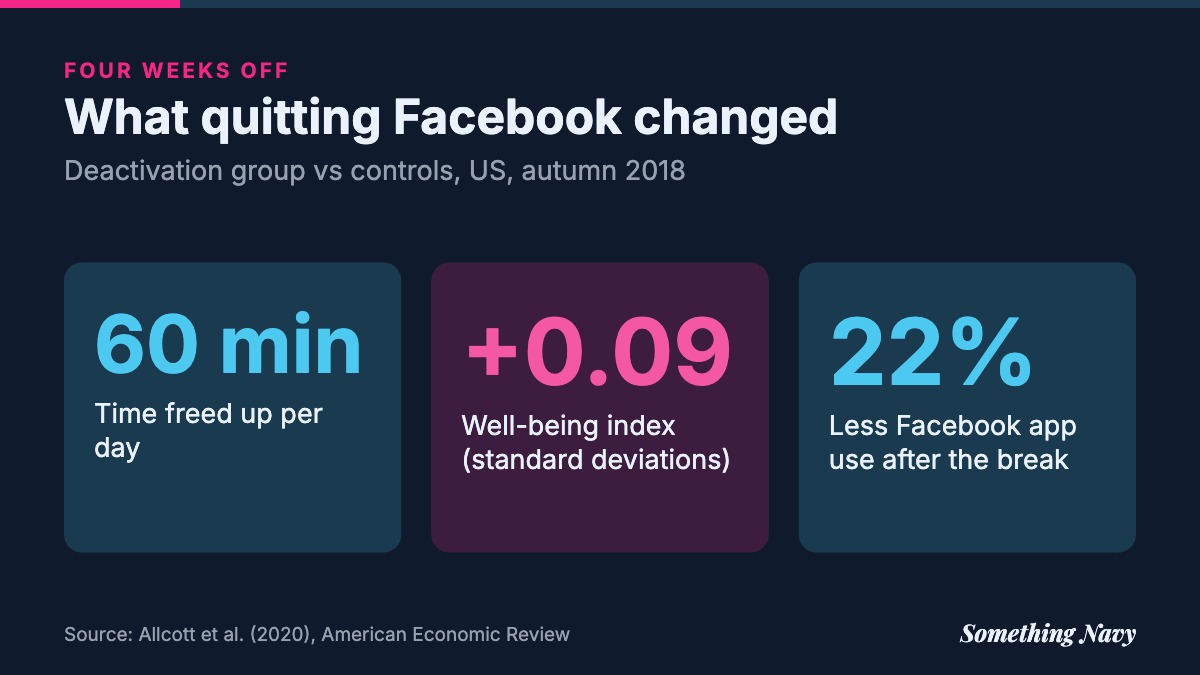
What they did. The study from the opening of this piece was led by the economists Hunt Allcott, Luca Braghieri, Sarah Eichmeyer and Matthew Gentzkow, and published in the American Economic Review in 2020. They recruited US Facebook users through adverts, asked how much money it would take for them to deactivate, then paid a randomly chosen group $102 to switch off their accounts for four weeks around the November 2018 midterm elections.
Who took part. The main analysis covered 1,661 adults: 580 in the deactivation group and 1,081 controls. The typical participant valued four weeks of Facebook at about $100.
What changed. Deactivation freed up about 60 minutes a day. People did not simply move to other websites; offline activities rose, including both socialising with family and friends and watching TV alone. Subjective well-being, an index built from questions about happiness, life satisfaction, loneliness, depression and anxiety, improved by 0.09 standard deviations. News knowledge fell by about 0.19 standard deviations and political polarisation by about 0.16.
Perhaps the most telling result came afterwards. Once their accounts were back, the former quitters used the Facebook mobile app about 22% less than the controls, and they valued the platform less than before. About 80% agreed that the break had been good for them.
The catch. The well-being effect was real but small, about a tenth of a standard deviation. That is noticeable across a population and easy to miss in a single life. The sample was also people willing to give up Facebook for money, during a politically charged month, and outcomes such as mood were again self-reported. The trade-off on news knowledge is a reminder that the apps do something people value, even when they cost something too.


Bath: a week off everything
What they did. Jeffrey Lambert and colleagues at the University of Bath ran a randomised controlled trial in which one group stopped using all social media for a week while the other carried on. Their paper appeared in Cyberpsychology, Behavior, and Social Networking in 2022. They measured well-being with the Warwick-Edinburgh Mental Wellbeing Scale, depression with the PHQ-8 and anxiety with the GAD-7, all standard clinical questionnaires.
Who took part. 154 adults aged 18 to 72, who were using social media for around eight hours a week at the start. The most-used platforms were Instagram, Facebook, Twitter and TikTok.
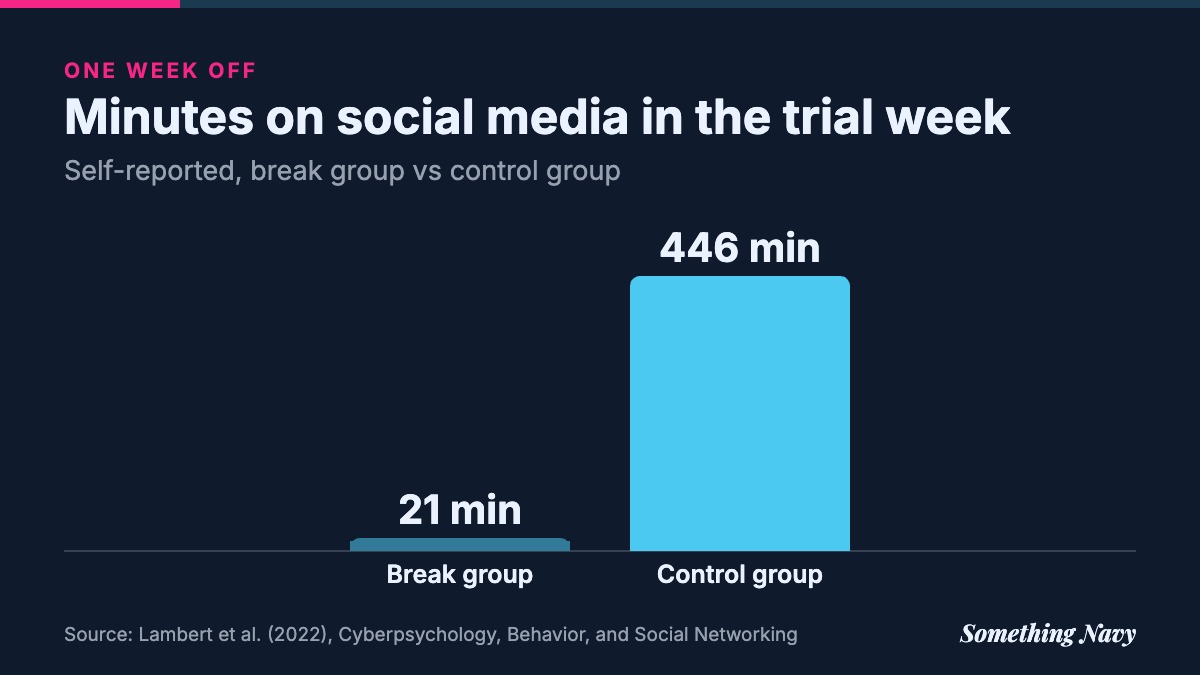
What changed. Compliance was impressive. During the trial week, the break group reported about 21 minutes of social media use against roughly 446 minutes in the control group. After adjusting for starting scores, age and gender, the break group scored about 4.9 points higher for well-being, 2.2 points lower for depression and 1.7 points lower for anxiety. “This suggests that even just a small break can have an impact,” Lambert said.
The catch. The authors list their own limitations frankly. Participants were mostly young, white, female and in higher education, and none were recruited from clinical services. The trial ran during the Covid-19 pandemic, when social media use and mood were both unusual. People willing to sign up for a week off may differ from those who would never consider it. And seven days says nothing about whether the gains last.
Thirty-five thousand voters and an election
What they did. The largest experiment of all came from a collaboration between academic researchers and Meta, run during the 2020 US presidential campaign and published in PNAS in 2024. Allcott, Gentzkow and more than two dozen co-authors paid a treatment group $150 to deactivate Facebook or Instagram for the six weeks before polling day. Rather than carrying on as normal, the control group was paid $25 to deactivate for just one week, a clever design that made both groups equally aware they were part of a quitting study.
Who took part. 19,857 Facebook users and 15,585 Instagram users, all regular users of the platform in question.
What changed. The headline political results were mostly null. Deactivation had near-zero effects on polarisation, on views of the election’s legitimacy and on turnout. Facebook deactivation slightly reduced news knowledge, may have reduced belief in online misinformation, and reduced online political activity such as posting and signing petitions. It may also have nudged self-reported votes slightly away from Donald Trump, but that estimate fell just short of the significance threshold the team had set in advance.
The same experiment also measured mood. In a follow-up working paper released in 2025, the researchers reported that six weeks off Facebook improved an index of happiness, depression and anxiety by 0.060 standard deviations relative to the controls, and six weeks off Instagram by 0.041. Exploratory analyses suggested the Facebook benefit was concentrated among people over 35, and the Instagram benefit among women under 25.
The catch. The emotional-state results have not yet been through peer review, and the subgroup findings were exploratory rather than planned. The effects are smaller than in the earlier, smaller studies. That pattern is common in science: as samples grow and designs tighten, effect sizes tend to shrink towards their true value.
The studies side by side
| Study | Who | Break | Main finding |
|---|---|---|---|
| Tromholt (2016) | 1,095 Danish adults | 1 week off Facebook | Higher life satisfaction and better mood |
| Hunt et al. (2018) | 143 US undergraduates | 10 min per platform per day, 3 weeks | Less loneliness and depression |
| Allcott et al. (2020) | 1,661 US adults | 4 weeks off Facebook | Well-being up 0.09 SD; news knowledge and polarisation down |
| Lambert et al. (2022) | 154 adults aged 18–72 | 1 week off all social media | Better well-being, less depression and anxiety |
| Allcott et al. (2024) | 35,442 US adults | 6 weeks off Facebook or Instagram | Near-zero effects on polarisation and turnout; small mood gains |
Why the effects keep coming out small
Read in sequence, the studies point the same way. Nobody has found that taking a break makes people feel worse, and several have found that it makes them feel somewhat better, especially those who were struggling, envious or using the apps heavily. The direction is consistent. The size is the argument.
Part of the reason is method. Mood is measured by asking people how they feel, and people know when they are on a break. In the smaller studies, the control group simply carried on, so some of the improvement could be a hopeful story participants told themselves. The 2020 election study tackled that by giving controls a short break too, and its effects are the smallest of the lot.
Another reason is substitution. When one app goes, time leaks elsewhere: to other apps, to television, to the phone itself. Allcott’s 2018 participants spent some of their freed hour socialising and some of it watching TV alone, and only the first is likely to lift anyone’s mood. Even having a phone in reach carries a measurable mental cost, whichever app happens to be open.
Finally, averages hide people. A small average effect can contain a large benefit for a minority and almost nothing for everyone else. Tromholt’s envious, passive scrollers, Hunt’s more depressed students and the older Facebook users in the 2020 data all hint at this. The useful question is less “Is social media bad?” and more “Is the way I use it bad for me?”
What fills the gap matters most
One quietly radical finding runs through this research. In the 2018 study, participants who quit said they would value Facebook less afterwards and went on using it less, even though nobody asked them to. The break worked partly as an experiment on themselves. They discovered how much they actually missed it, which was less than they had guessed.
That suggests a different way of thinking about a break. It is not a cure or a punishment. It is a way of collecting evidence about your own habits, in the same way the researchers collected evidence about theirs. And as Hunt’s results show, the evidence may point towards cutting back rather than quitting outright.
Running your own experiment
If you want to try a break
- Measure first. Check your phone’s screen-time report for a normal week, as the Penn and Bath teams did, so you know your real starting point.
- Choose a clean start. A Monday or the start of a month can help; researchers call this the fresh start effect.
- Cut, or quit. A full week off worked in Denmark and Bath, but 10 minutes per app per day also helped in Philadelphia.
- Plan the gap. Decide in advance what you will do instead. A simple if-then plan, such as “If I reach for Instagram on the bus, then I will open my book”, makes it easier.
- Check in after a week. Ask how your mood, sleep and time have changed, then decide what to keep.
None of these experiments proves that social media is poison, and none proves it is harmless. What they show, again and again, is that most people have never tested the question for themselves. The volunteers who logged off for a week, a month or an election season came out with something more useful than a verdict. They knew, from experience, what their feeds were giving them and what they were taking.
Sources
- Tromholt, M. (2016). The Facebook experiment: Quitting Facebook leads to higher levels of well-being. Cyberpsychology, Behavior, and Social Networking, 19(11), 661–666. DOI
- Hunt, M. G., Marx, R., Lipson, C., & Young, J. (2018). No more FOMO: Limiting social media decreases loneliness and depression. Journal of Social and Clinical Psychology, 37(10), 751–768. DOI
- Allcott, H., Braghieri, L., Eichmeyer, S., & Gentzkow, M. (2020). The welfare effects of social media. American Economic Review, 110(3), 629–676. DOI
- Lambert, J., Barnstable, G., Minter, E., Cooper, J., & McEwan, D. (2022). Taking a one-week break from social media improves well-being, depression, and anxiety: A randomized controlled trial. Cyberpsychology, Behavior, and Social Networking, 25(5), 287–293. DOI
- Allcott, H., Gentzkow, M., Mason, W., Wilkins, A., Barberá, P., Brown, T., et al. (2024). The effects of Facebook and Instagram on the 2020 election: A deactivation experiment. Proceedings of the National Academy of Sciences, 121(21), e2321584121. DOI
- Allcott, H., Gentzkow, M., Tucker, J. A., et al. (2025). The effect of deactivating Facebook and Instagram on users’ emotional state (NBER Working Paper No. 33697). National Bureau of Economic Research. Link
How we reported this. We went back to the original research for this story, 6 sources in all, listed above, and checked every figure against them. If you think we have got something wrong, tell us and we will look at it. Read more about how we work.
Cover photo: Vitaly Gariev on Unsplash. Charts and graphics: Something Navy.