

You have been at the new job, or the new city, for three months. There is a colleague you laugh with at the coffee machine and a neighbour you nod to every morning. Pleasant people. And yet, on a Friday night, there is nobody you would think to text.
It is easy to read that as a verdict on yourself. Too awkward, too old, too busy, too something.
The research suggests a duller, more hopeful explanation. Friendship runs on a clock, and most of us badly underestimate how many hours it needs.
Jeffrey Hall, a communication researcher at the University of Kansas, put numbers on that clock. His estimate: more than 200 hours together before an acquaintance becomes a close friend. Think of it less as a wall and more as a ladder, with rungs you can see and climb.
The study that put a stopwatch on friendship
Hall ran two studies, published in the Journal of Social and Personal Relationships (online in 2018, in print in 2019). In the first, 355 adults who had moved to a new place within the previous six months described someone they had met since the move. They estimated how many hours they had spent together, what they did, and where the relationship stood: acquaintance, casual friend, friend, or close friend.
The second study followed 112 first-year students. Two weeks into term, each named two people they had just met, then reported back over nine weeks on the hours they had shared and how close they felt.
Pooling both, Hall concluded that a casual friendship takes somewhere between 40 and 60 hours in the first six weeks after meeting. The odds of becoming a proper friend pass 50% at around 80 to 100 hours. Close or best friends need more than 200.
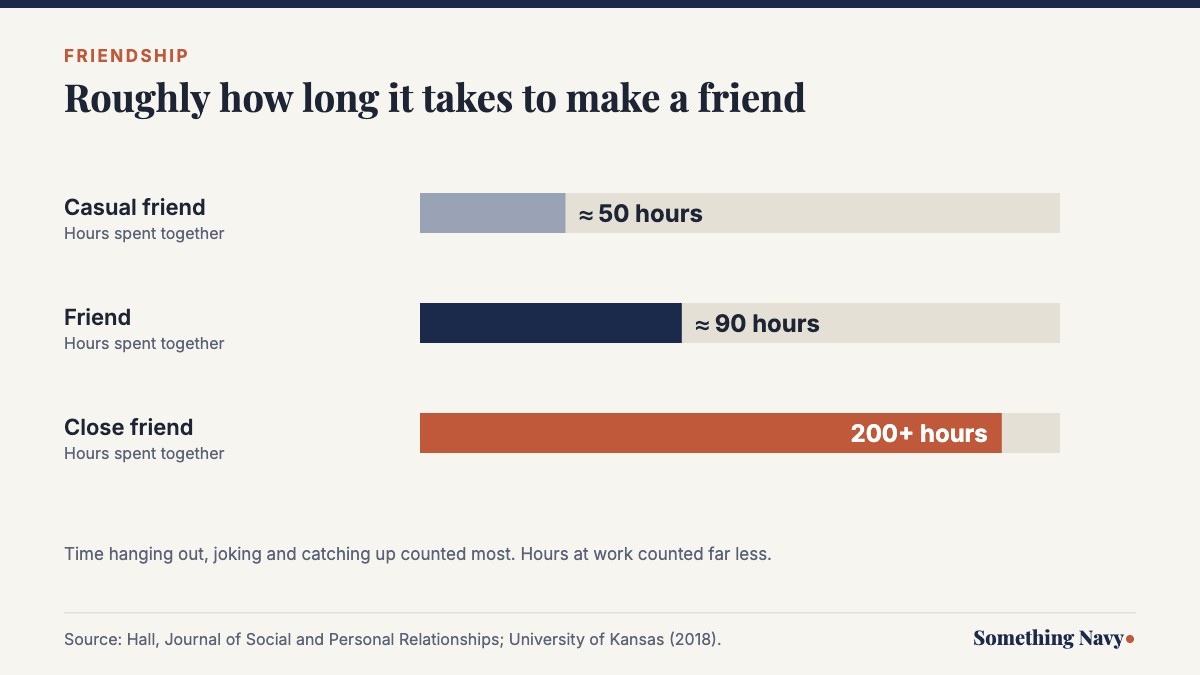
Those are estimates, not a recipe. People guessed their own hours, which gets harder the longer you have known someone, and the adult study only captured friendships that lasted, so the ones that fizzled were never counted. Hall himself treats the figures as rough. Still, the scale is the point. Two hundred hours is roughly five working weeks of someone’s company.
Nobody becomes your close friend by accident. They become your friend by accumulation.
Here is how that accumulation tends to unfold, one rung at a time.
Rung 1: The familiar stranger (hours together: almost none)
Every friendship starts as background. The barista, the person who always takes the same train carriage, the parent at the school gate. You have not spoken properly, but you recognise each other.
That background matters more than it looks. In 2014 Gillian Sandstrom and Elizabeth Dunn, then at the University of British Columbia, tracked students and adults through their daily interactions. Students reported more happiness and a stronger sense of belonging on days when they talked to more classmates than usual, and the pattern held when the researchers counted every kind of daily encounter. Their conclusion was that even the outer edges of our social networks feed our well-being.
These weak ties are also the raw material for everything above them. Repeated, low-stakes contact makes faces familiar, and familiarity tends to make people seem more likeable, a pattern psychologists call the mere exposure effect. You cannot become close to someone you never see.
The practical move at this rung is tiny: say hello, use a name, ask one real question. Our guide to talking to strangers covers why that feels riskier than it is.
Rung 2: The first conversation, and the gap that stalls it
At some point the nod turns into a chat. It goes fine. Then, walking away, a familiar voice starts its post-match analysis. Did I talk too much? Were they just being polite?
That voice is usually wrong, and there is good evidence for it. Erica Boothby, Gus Cooney, Gillian Sandstrom and Margaret Clark reported in Psychological Science in 2018 that after a conversation, people consistently underestimate how much the other person liked them and enjoyed their company. They found this “liking gap” among strangers meeting in a lab, among first-year students sharing a hall of residence, and among adults at a personal development workshop. In the student sample it lasted for months.
Why does that matter for the hour count? Because hours only add up if someone suggests the next meeting. If both people leave thinking the other was merely being kind, neither asks, and the friendship freezes at a few pleasant minutes. We look at the research in more depth in our piece on the liking gap.
The other person probably liked you more than you think. Act on that, not on the post-mortem.


Rung 3: Acquaintance to casual friend, roughly 40–60 hours
This is the rung where timing matters most. Hall’s student data suggested that the odds of an acquaintance becoming a casual friend passed 50% at about 43 hours together in the first three weeks after meeting. That is a lot of time packed into a short window, and it explains why university halls, summer jobs and first weeks anywhere are such efficient friendship factories.
It also explains what happened to the students whose friendships moved up. In Hall’s student study, those who grew closer to one new person roughly doubled their time with them, while spending less time with others whose friendships did not progress. Hall told the university press office that he found students who spent a third of their waking hours in a month with one good friend.
Adults rarely have that kind of slack. A 40-hour week, a commute and caring duties leave scattered evenings, not concentrated weeks. So for adults, this rung usually takes longer in calendar time, even if the hours needed are similar.
One line from Hall in that release is worth keeping on a sticky note: “You can’t make people spend time with you, but you can invite them.”
Rung 4: Casual friend to friend, roughly 80–100 hours
Here comes the twist that surprises most people. Not all hours count equally.
Hall found that time spent in obligatory settings, the office or the classroom, was not associated with closeness. In the adult study, more time at work together was actually linked to less closeness. Plenty of us have a colleague we have sat beside for 1,000 hours without ever learning their partner’s name.
What did count was hanging out, relaxing together and leisure time. And two kinds of talk stood out in the student study: catching up on each other’s lives and joking around. Hall reported that these predicted growing closeness over and above the raw number of hours. In other words, they let a friendship climb faster on fewer hours.
Why talk is not all equal: the social energy budget
Hall’s reasoning draws on a framework he and Daniel Davis set out in 2017 in Communication Theory: Communicate Bond Belong theory. Its core idea is that every social interaction spends energy, and we have a limited supply. Only some interactions are what the authors call “striving behaviors”, ones that actually feed the need to belong.
On this view, small talk with a colleague is energy spent without much return, while a proper catch-up with a friend is energy invested. That helps explain the common experience of feeling drained after a day of meetings and restored after an hour at the pub with one good friend. The theory also predicts that people protect their energy, which is why new friendships compete with existing ones for the same evenings.
Sitting next to someone is not the same as spending time with them.
Rung 5: Friend to close friend, 200 hours and counting
The last rung is the steepest. Hall estimated that more than 200 hours are likely needed for friends to become good or best friends, and the adult figures from his first study ran higher still.
There is a reason the top of the ladder is narrow. Hall built on the work of the Oxford psychologist Robin Dunbar, whose “social brain” research describes our relationships as a set of nested layers. In the framing Hall uses, the innermost layer holds about one to five people, mostly partners and family. Around it sits a “sympathy group” of 10 to 15, then a friendship group of 40 to 50, then an outer ring of 120 to 150.
Hall then did the sums. By his estimate, a sympathy group of 13 to 15 friends represents 2,000 to 3,000 hours of invested time just to reach that status, before any upkeep.
That is why the close-friend layer cannot be large, and why it shifts at big life moments. A move, a new baby or a demanding job does not just take time; it takes the specific, unstructured time that the top rung needs. If you want a sense of how many close friends adults typically report, our piece on how many close friends adults have looks at the survey data.
By the numbers
- 40–60 hours: acquaintance to casual friend (Hall, 2019)
- 80–100 hours: the point where becoming a friend is more likely than not (Hall, 2019)
- 200+ hours: friend to close or best friend (Hall, 2019)
- 2,000–3,000 hours: Hall’s estimate of the time behind a circle of 13–15 close friends
- 1 in 6: people worldwide affected by loneliness (WHO, 2025)
- 7%: adults in England who feel lonely often or always (Community Life Survey, 2024/25)
Why the ladder feels steeper now
If all this sounds like a lot of hours, you are not imagining that the hours have become harder to find.
In June 2025 the World Health Organization Commission on Social Connection reported that about one in six people worldwide are affected by loneliness, and linked it to more than 871,000 deaths a year, roughly 100 every hour. Among 13 to 29-year-olds, 17% to 21% reported feeling lonely, with teenagers highest.
An earlier global picture came from Gallup and Meta, who surveyed people in 142 countries between June 2022 and February 2023. Some 24% said they felt very or fairly lonely. Young adults aged 19 to 29 reported the most loneliness, at 27%, and people aged 65 and over the least, at 17%.
Closer to home, the Community Life Survey for 2024/25, based on more than 175,000 responses in England, found that 7% of adults felt lonely often or always. That was a small dip on the previous year. The rate was 9% among 16 to 24-year-olds and 4% among 65 to 74-year-olds, while 21% of adults said they never felt lonely.
Notice the pattern across all three: the young, who in theory have the most chances to meet people, report the most loneliness. The hours have to be spent.
The 2026 twist: friends we have, time we don’t
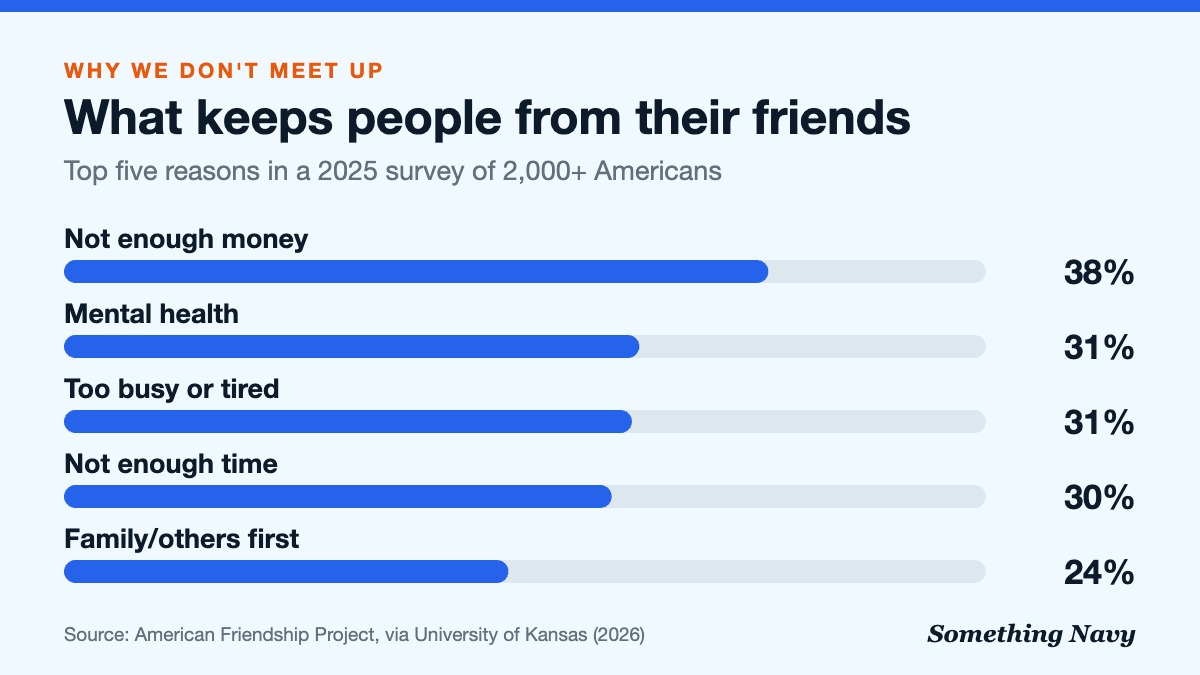
The most recent data comes from Hall himself. In July 2026, the University of Kansas reported early findings from the American Friendship Project, a collaboration between Hall, Natalie Pennington of Colorado State University and Amanda Holmstrom of Michigan State University. Their 2025 survey of more than 2,000 Americans found that 57% had visited with friends or family the previous day, lower than in polls from 1995 to 2014. Some 58.6% said they visited friends monthly or more often.
Asked what got in the way, respondents named money first (38%), then mental health (31%) and being too busy or tired (31%). Not having enough time (30%), putting other relationships such as family first (24%) and work getting in the way (19%) followed. Hall’s reading was blunt: “It seems people have friends, but what they really want is more time to spend with those friends.” He also noted that many people seem to be swapping nights out with friends for nights in with family. The release does not point to a published paper, so treat the details as provisional.
Where to find the hours
None of this means clearing your diary. It means finding hours that are already there and steering them towards the kind of time that counts. Some approaches that fit the research:
Turn one-offs into fixtures
The fastest climbs happen when contact is frequent and built in. A weekly class, a five-a-side game, a running club, a standing coffee on Thursdays. Each gives you hours without needing a fresh invitation every time, which matters because the liking gap makes each new invitation feel bigger than it is.
Making things with your hands works well, because the activity carries the silences. A sewing circle or repair café gives your hands a job while the talk catches up; our pieces on the revival of handcrafted styles and customising your own clothes have ideas if you want a project to bring along.
Move work hours across the line
Since office time barely counts, the trick is to convert it. Lunch away from your desks, a walk after a meeting, a drink after work. The same person, but now the hours are leisure, and the talk can shift from deadlines to each other’s lives.
Front-load the first weeks
Hall’s student data shows friendships moving fastest when many hours land early. If you click with someone, suggest a second meeting within days, not months. Momentum is cheaper than a restart.
Spend hours on the two kinds of talk that count
Catching up and joking around did more than other talk in Hall’s student study. So ask what happened since you last met. Remember the job interview or the sick cat. Let yourself be silly. A shared joke is closeness in miniature.
Look after the rungs you have already climbed
An existing close friendship represents hundreds of invested hours, and a voice note or a ten-minute call keeps it warm far more cheaply than building a new one. Rebuilding a lapsed friendship is often quicker than starting from scratch, because some of the hours are still banked.
Be honest about the real barrier
If money is the obstacle, as it was for the largest share of the American Friendship Project respondents, pick free fixtures: a walk, a park run, cooking at home, a library group. If exhaustion is the obstacle, protect one evening rather than promising three.
A slow climb is still a climb
It helps to do the arithmetic kindly. Two hours a week with one new person gets you to casual friendship in about six months and past 200 hours in about two years. That is not fast, and Hall’s data suggest that packing more hours in early speeds things up. But it is not a failure either.
The colleague by the coffee machine and the neighbour with the morning nod are not dead ends. They are the bottom rungs. Someone has to suggest the first drink, and the evidence says the other person is more pleased to be asked than you would guess.
Friendship is not a talent you lack. It is a number of hours you have not spent yet.
Sources
- Hall, J. A. (2019). How many hours does it take to make a friend? Journal of Social and Personal Relationships, 36(4), 1278–1296. DOI
- University of Kansas. (2018, March 6). Study reveals number of hours it takes to make a friend. KU News. Link
- Hall, J. A., & Davis, D. C. (2017). Proposing the communicate bond belong theory: Evolutionary intersections with episodic interpersonal communication. Communication Theory, 27(1), 21–47. DOI
- Boothby, E. J., Cooney, G., Sandstrom, G. M., & Clark, M. S. (2018). The liking gap in conversations: Do people like us more than we think? Psychological Science, 29(11), 1742–1756. DOI
- Sandstrom, G. M., & Dunn, E. W. (2014). Social interactions and well-being: The surprising power of weak ties. Personality and Social Psychology Bulletin, 40(7), 910–922. DOI
- World Health Organization. (2025, June 30). Social connection linked to improved health and reduced risk of early death. Link
- Gallup. (2023, October 24). Almost a quarter of the world feels lonely. Link
- Department for Culture, Media and Sport. (2025). Community Life Survey 2024/25: Loneliness and support networks. GOV.UK. Link
- University of Kansas. (2026, July 28). Research shows people aren’t lonelier; they’re changing how they spend their time. KU News. Link
Updated 20 October 2026: we expanded this article with newer research, fresh figures and new sections. Cover photo: Priscilla Du Preez on Unsplash. Charts and graphics: Something Navy.
How we reported this. We went back to the original research for this story, 9 sources in all, listed above, and checked every figure against them. If you think we have got something wrong, tell us and we will look at it. Read more about how we work.