
It is 6.40 on a Tuesday evening. The gym bag is by the door, exactly where you put it on Sunday when you promised yourself this week would be different.
You look at it. You look at the sofa. The sofa wins, and you tell yourself you will go tomorrow.
Nothing about that moment is a failure of wanting. You genuinely meant it. Psychologists have a name for the space between meaning to and actually doing, the intention-behaviour gap, and they have spent more than three decades testing one surprisingly plain way to close it.
It fits in a single sentence: if a particular situation arises, then I will do a particular thing.
The idea sounds almost too simple to work. The early studies suggested it worked spectacularly. The newest evidence, published in 2025 and drawing on hundreds of experiments, tells a more grown-up story: smaller effects than the headlines, a clearer picture of when the trick fails, and a sharper sense of how to write a plan that holds.
A sentence that does your deciding in advance
The psychologist Peter Gollwitzer, who has worked at New York University and the University of Konstanz, called these plans “implementation intentions”. Most of us know them as if-then plans.
A goal says what you want: “I will exercise more.” An if-then plan says when and where it happens: “If it is 7am on a weekday, then I put on my running shoes before I check my phone.”
The difference matters because of how the plan is stored. Linking a specific cue to a specific response means the decision has already been made before the moment arrives. When 7am comes, you are not weighing up whether you feel like running. You are just doing the next thing on a list you wrote when you were calm and well rested.
Researchers describe this as handing control from deliberate thought to the situation itself. The cue does the remembering for you.
Good intentions ask you to be brave in the moment. If-then plans let you be brave once, in advance.

The 2002 study that made the idea famous
The experiment people still quote was run in England by Milne, Orbell and Paschal Sheeran and published in the British Journal of Health Psychology in 2002. They randomly split 248 students into three groups.
One group simply recorded how often they exercised. A second read material about the health risks of inactivity and the benefits of exercise, designed to raise motivation. A third got the same reading and was then asked to write down exactly when and where they would exercise in the following week.
The motivational reading on its own did nothing useful. About 35% of that group exercised at least once in the follow-up period, compared with 38% of the controls. In the group that also wrote a plan, the figure was 91%.
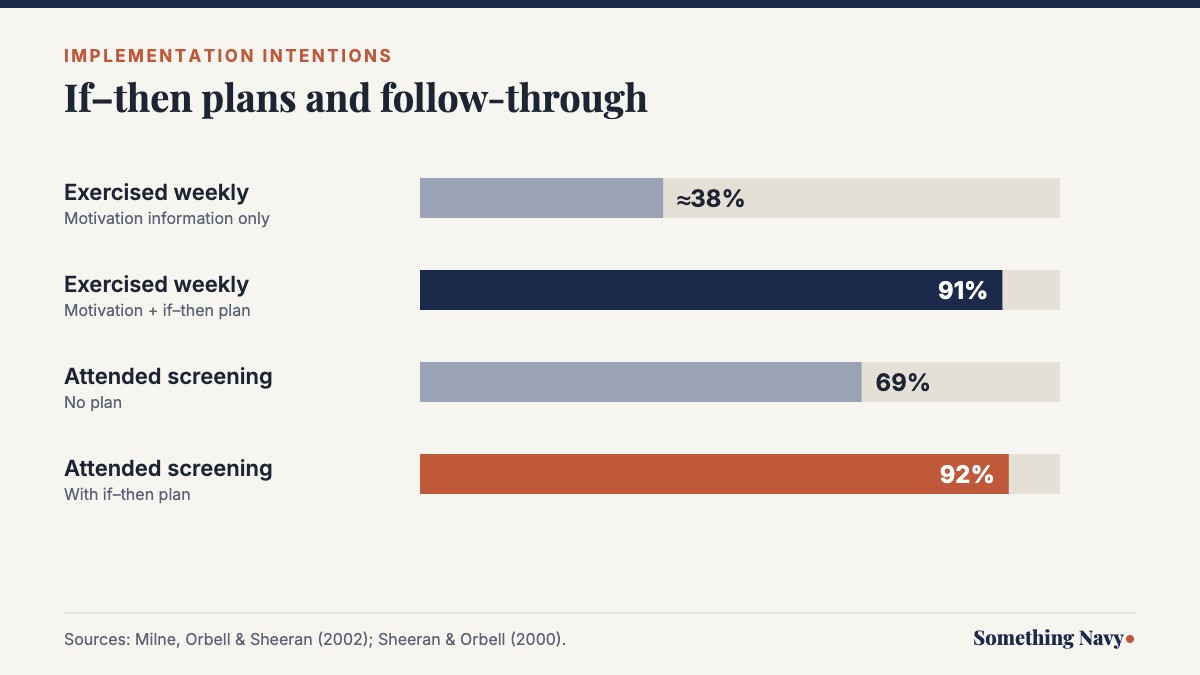
Two years earlier, Sheeran and Orbell had tried the same move on something with higher stakes. In a study of 114 women registered at a medical practice in rural England, those who wrote down when, where and how they would book a cervical screening appointment attended at a rate of 92%, against 69% in the comparison group.
Results like these spread fast, and for good reason. In 2006 Gollwitzer and Sheeran pooled 94 independent tests and reported an average effect of d = 0.65, which psychologists class as medium to large. For a one-sentence intervention that costs nothing, that is a remarkable number.
It also turned out to be a high-water mark.
What 642 experiments say now
Meta-analyses age. Small early studies with dramatic results tend to get published first, and later, larger studies usually find something more modest. So it matters that the field has since gone back and counted again.
The biggest recount so far was published in the European Review of Social Psychology in 2025 (online in 2024) by Paschal Sheeran, now at the University of North Carolina at Chapel Hill, with Listrom and Peter Gollwitzer. They analysed 642 independent tests of implementation intentions.
The headline: if-then plans worked across the board, improving behaviour, thinking and emotional outcomes. But the effect sizes ranged from d = 0.27 to d = 0.66 depending on what was being measured. The bottom of that range is a small effect, not a medium-to-large one.
The more useful part of the paper is the list of conditions that made plans work better. Effects were larger when people:
- wrote the plan in a genuine “if… then…” format, rather than a vaguer statement of when they hoped to act;
- were already strongly motivated to reach the goal;
- rehearsed the plan, for example by repeating it or picturing the moment.
An earlier meta-analysis from China pointed the same way. Wang, Wang and Gai, publishing in Frontiers in Psychology in 2021, looked specifically at if-then planning combined with mental contrasting, a technique explained further down. Across 24 effect sizes and 15,907 participants they found an average effect of g = 0.34, which they described as small to medium.
Then they checked for publication bias. The funnel plot was lopsided, which usually means unflattering results are missing from the record. After statistically correcting for that, the estimate fell to 0.24.
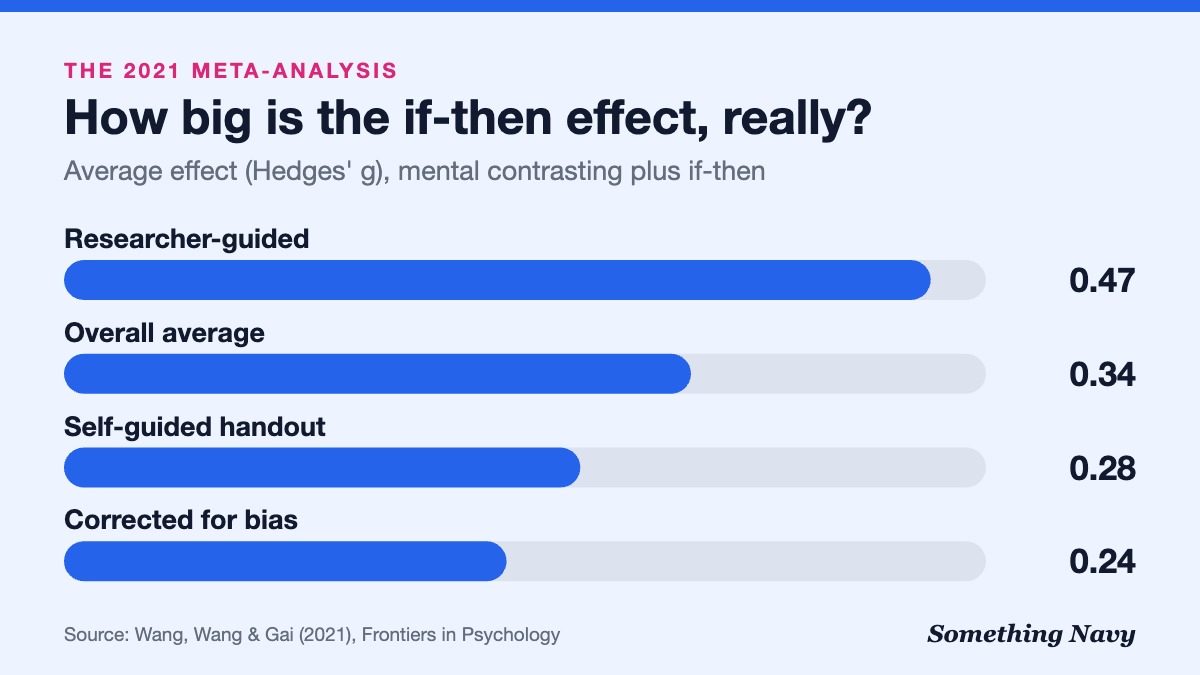
The same review found something worth knowing for anyone trying this at home. When a researcher guided people through the exercise, the effect was g = 0.47. When people worked through it alone from a written handout, it was 0.28. Plans you write carefully, perhaps with someone else, seem to beat plans you skim through.
None of this means the 91% figure was wrong. It means it was one good result in a favourable setting, and the average across hundreds of studies is real but smaller. A small effect repeated every day can still add up to a lot.
Where if-then plans run out of road
Knowing when a tool fails is part of using it well. The recent evidence points to a few weak spots.
When you do not really want the goal
A plan converts motivation into action. It does not manufacture motivation from nothing. The 2025 meta-analysis found effects grew with motivation, which matches what most of us suspect: no sentence will make you jog if you privately think jogging is pointless.
When the plan is a date, not a moment
Katherine Milkman of the Wharton School and colleagues tested planning prompts on 3,272 employees of a large US utility company offered free workplace flu jabs, reported in PNAS in 2011. Among staff who got a reminder with space to write down a date and a time, vaccination reached about 37%, against 33% for those whose mailing had no planning prompt. Writing just a date made a smaller difference that was not statistically significant.
The more precise the cue, the better it seems to fire.
When the obstacle is not in your head
At Stanford, René Kizilcec and Geoffrey Cohen gave learners on two large online courses an eight-minute writing exercise that ended in if-then plans, published in PNAS in 2017. Across everyone it had no substantive effect. Learners from individualist countries such as the United States finished the course more often, by 32% in the first experiment and 15% in the second, while learners from more collectivist countries such as China and India saw no benefit.
The researchers also found the exercise helped with obstacles a person could realistically get round, like work or family demands, but not with practical constraints such as poor internet access. A plan can redirect your attention. It cannot give you more hours or a better connection.
When there are too many plans
Most studies test one or two plans aimed at one goal over a few weeks, often with university students. There is far less evidence on what happens when someone writes ten plans at once for a whole new life. If every moment of the day has a trigger attached, none of them stands out.


The WOOP upgrade: picture the wall before you hit it
Gabriele Oettingen, a psychologist at New York University, spent years studying a less cheerful finding: indulging in positive fantasies about a goal can sap the energy needed to pursue it. Her answer was mental contrasting, which means imagining the outcome you want and then, deliberately, the obstacle inside you most likely to get in the way.
Paired with if-then planning, the technique is known as MCII, or more memorably WOOP: Wish, Outcome, Obstacle, Plan.
- Wish: a goal that is challenging but feasible, for the next few weeks.
- Outcome: the single best thing about achieving it, imagined vividly.
- Obstacle: the main thing in you (a habit, a feeling, an excuse) that tends to stop you.
- Plan: “If [that obstacle] shows up, then I will [specific action].”
What this adds is aim. A basic if-then plan picks a time. A WOOP plan picks the exact moment you are most likely to fold, and puts the response there. The Stanford course exercise and the studies pooled by Wang and colleagues were both versions of this combined approach.
The best place for a plan is not the start of the task. It is the moment you usually give up.


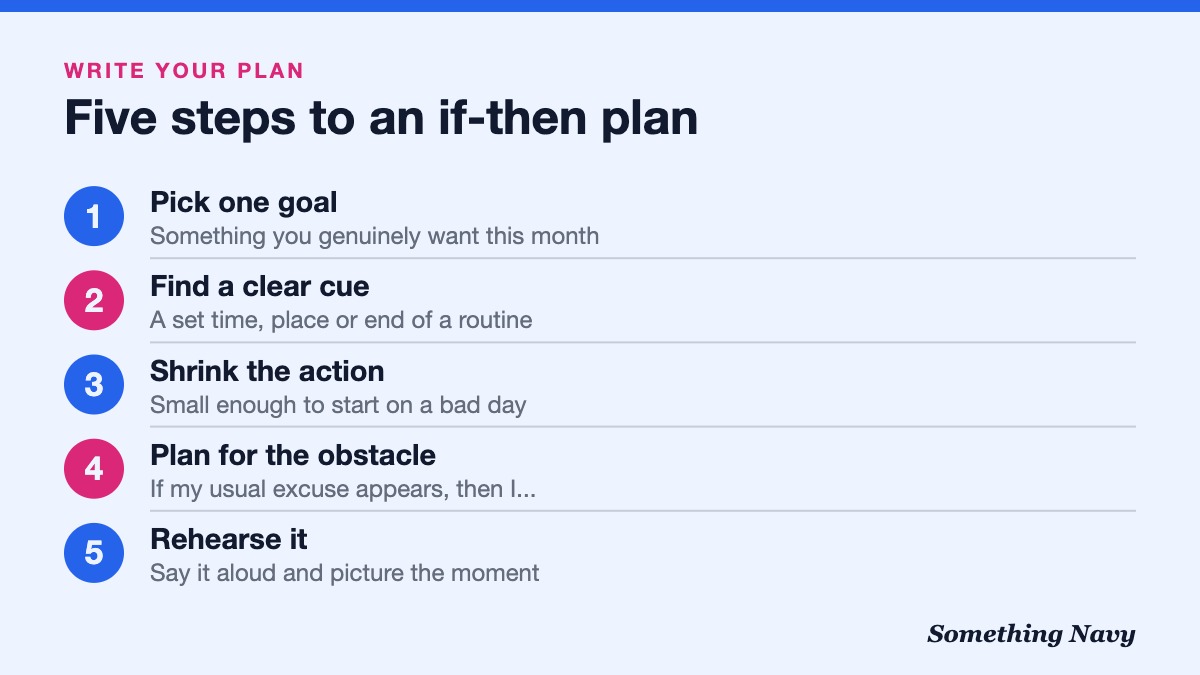
Write your plan: five steps, ten minutes
Everything above boils down to a short method. Do it with a pen; writing slows you down enough to be specific.
Step 1: Choose one goal you actually care about
Motivation is the fuel the plan runs on, so start with something you would be genuinely pleased to have done in a month. One goal, not five. If you are still weighing whether to tell friends about it, our piece on whether announcing your goals backfires is worth a read first.
Step 2: Find a cue you cannot miss
The best triggers are specific and already in your day: a time and place (“at 1pm at my desk”), or the end of something you already do (“after I pour my morning coffee”). “When I have a spare moment” is not a cue. Spare moments do not announce themselves.
Step 3: Shrink the action
Make the “then” small enough to start even on a bad day. “Then I put on my trainers and walk to the end of the road” beats “then I run 5km”. Once the habit is under way, you can scale it up; our guide to how long habits really take to form explains why the early weeks matter most.
Step 4: Name the obstacle and plan for it
Ask what usually stops you. Then write a second line that starts with that obstacle: “If I get home and want to sit down first, then I change into my kit before I take my coat off.” This is the WOOP step, and it is the one most people skip.
Step 5: Say it, picture it, repeat it
The 2025 review found rehearsed plans worked better. Read the sentence aloud, imagine the cue happening and yourself responding, and do it again tomorrow morning. Ten seconds is enough.
Example if-then scripts
- Exercise: If it is 7am on a weekday, then I put on my trainers before I look at my phone.
- Getting dressed: If it is Sunday evening, then I lay out Monday’s outfit from my capsule wardrobe.
- Spending: If I add clothes to a basket online, then I close the tab and work out the cost per wear before buying.
- Focus: If I reach for my phone while working, then I put it in another room for 25 minutes.
- Health: If my GP surgery sends a screening invitation, then I book the slot before I put the letter down.
- Kindness: If I think of a friend I have not spoken to in a while, then I send them one line straight away.
The timing trick almost nobody uses
If-then plans pair well with natural turning points. A new month, a birthday or the first day back after a holiday all make people more willing to start something, a pattern researchers call the fresh start effect. Write your plan the evening before one of those dates and the cue arrives at the moment your motivation is highest.
It also pays to review the plan after a week. If the cue never fired, it was too vague or too rare. If it fired and you ignored it, the action was probably too big. Rewriting a plan is not cheating; most of the research uses plans written once, and you can do better than that.
Keeping the promise realistic
It is worth being honest about what the evidence does and does not show. Many trials last weeks rather than years. Many rely on people reporting their own behaviour, and in the Wang review those self-reported effects were larger than the objectively measured ones (0.40 against 0.27). Students are over-represented, and culture seems to matter more than early researchers assumed.
So expect a nudge, not a transformation. On the evidence so far, an if-then plan raises your odds of following through, sometimes a great deal, more often modestly, and the odds rise further when the goal matters to you and the plan is precise.
That is still a good deal for a sentence. The gym bag by the door was never the problem. It just needed an instruction attached to it: if I see this bag at 6.30, then I pick it up and go.
Sources
- Gollwitzer, P. M., & Sheeran, P. (2006). Implementation intentions and goal achievement: A meta-analysis of effects and processes. Advances in Experimental Social Psychology, 38, 69–119. DOI
- Kizilcec, R. F., & Cohen, G. L. (2017). Eight-minute self-regulation intervention raises educational attainment at scale in individualist but not collectivist cultures. Proceedings of the National Academy of Sciences, 114(17), 4348–4353. DOI
- Milkman, K. L., Beshears, J., Choi, J. J., Laibson, D., & Madrian, B. C. (2011). Using implementation intentions prompts to enhance influenza vaccination rates. Proceedings of the National Academy of Sciences, 108(26), 10415–10420. DOI
- Milne, S., Orbell, S., & Sheeran, P. (2002). Combining motivational and volitional interventions to promote exercise participation: Protection motivation theory and implementation intentions. British Journal of Health Psychology, 7(2), 163–184. DOI
- Sheeran, P., Listrom, O., & Gollwitzer, P. M. (2025). The when and how of planning: Meta-analysis of the scope and components of implementation intentions in 642 tests. European Review of Social Psychology, 36(1), 162–194. DOI
- Sheeran, P., & Orbell, S. (2000). Using implementation intentions to increase attendance for cervical cancer screening. Health Psychology, 19(3), 283–289. DOI
- Wang, G., Wang, Y., & Gai, X. (2021). A meta-analysis of the effects of mental contrasting with implementation intentions on goal attainment. Frontiers in Psychology, 12, 565202. DOI
Updated 18 October 2026: we expanded this article with newer research, fresh figures and new sections. Cover photo: Alexa Williams on Unsplash. Charts and graphics: Something Navy.
How we reported this. We went back to the original research for this story, 7 sources in all, listed above, and checked every figure against them. If you think we have got something wrong, tell us and we will look at it. Read more about how we work.