

You have a report due at nine tomorrow and two places you could finish it. The library on the corner is so quiet you can hear the radiator tick. The café across the road has a hissing milk steamer, a queue, and a low tide of conversation that never quite stops.
You pick the café, because the library feels like an exam hall and the café feels like a place where work actually happens. An hour later you have a page of decent ideas and a nagging suspicion that you have read the same paragraph of your notes four times.
Both feelings are probably right. Psychologists have spent four decades testing what background sound does to the mind, and the answer is not “noise is bad” or “noise is good”. It depends on how loud the sound is, whether it contains words, and, above all, what you are trying to do.
The coffee shop study: why moderate noise helped creative thinking
The paper that made café working respectable appeared in the Journal of Consumer Research in 2012. Ravi Mehta of the University of Illinois, Rui (Juliet) Zhu of the University of British Columbia and Amar Cheema of the University of Virginia ran five experiments on ambient noise and creativity.
Rather than the white or pink noise used in earlier lab work, they played everyday multi-talker background noise, the sort of blended chatter you get in a busy room. People heard it at low (50 decibels), moderate (70 decibels) or high (85 decibels) volume. Popular write-ups of the study describe the main task as the Remote Associates Test, a word puzzle where you are given three words such as “shelf”, “read” and “end” and must find the one that links them (“book”).
Moderate noise won. At 70 decibels, which the university’s press release compared to a passenger car on a motorway, people did better on creative tasks than at 50 decibels. At 85 decibels, roughly the din of heavy traffic, creativity dropped. In the press release, Mehta said “around 70 decibels is the sweet spot.”
Why a little distraction might loosen your thinking
The authors’ explanation is neat. Moderate noise makes processing slightly harder, and that mild difficulty nudges people to think in broader, more abstract terms, which is useful when you need fresh connections. Loud noise goes too far: it simply cuts down how much information you can take in. The result is an inverted U, with too little and too much both worse than the middle.
The study also found that moderate noise made people more likely to say they would buy innovative products, which is why it ran in a consumer journal. This was one set of experiments, testing a particular kind of task, and it showed a benefit for generating ideas, not for careful reading, checking figures or memorising anything.

The irrelevant speech effect: why words are the real problem
If the café helps with ideas, why does that paragraph keep slipping away? The answer comes from a much older line of research.
In 1982, the psychologists Salamé and Baddeley published a paper in the Journal of Verbal Learning and Verbal Behavior on how unattended speech disrupts short-term memory. People were shown digits to remember while speech they had been told to ignore played in the background. They could not simply tune it out. The leading explanation, set out in the pair’s later work, is that heard speech gets automatic access to the same mental store you use when you silently rehearse words or numbers. Your inner voice and the voice at the next table are, in effect, competing for the same desk.
In 1989, in The Quarterly Journal of Experimental Psychology, the same researchers turned to music. In their first experiment, errors on a digit memory task averaged about 51% with vocal music, 41% with instrumental music and 37% in silence. In both experiments that tested it, vocal music was the most disruptive. Instrumental music sat in between, sometimes no worse than silence and sometimes clearly worse.
It is the change, not the meaning
Jones, Macken and Murray added a twist in a 1993 paper in Memory & Cognition. Their “changing-state” account holds that sound disrupts memory for sequences when it varies over time and breaks into distinct chunks. A smooth, continuous gliding tone barely mattered; the same glides chopped up by brief silences did. The paper also cites earlier work showing that reversed speech, which has no meaning at all, disrupts recall about as much as normal speech.
That helps explain why a steady hum is easier to work in than one nearby conversation: the hum barely changes. A conversation is all stops, starts and shifting pitch, exactly the sort of sound the brain keeps processing whether you want it to or not.
Music with lyrics and reading comprehension
In 2014, Perham and Currie, psychologists at Cardiff Metropolitan University, put that to the test in Applied Cognitive Psychology.
Thirty undergraduates sat reading comprehension tests in four conditions: quiet, music with lyrics they liked, music with lyrics they disliked, and music without lyrics. Performance was best in quiet and with instrumental music, and worst in both lyrical conditions. Quiet was significantly better than either lyrical condition, and liking the songs made no measurable difference. Instrumental music did not differ significantly from quiet.
The students rated the two lyrical conditions as the most distracting, scoring them around 75 to 79 out of 100, against about 10 for quiet. Asked how well they thought they had done, they rated quiet highest and the two lyrical conditions lowest. The sample was small and the music was chosen for a lab, but the direction fits neatly with the irrelevant speech research. If you are reading words, other people’s words get in the way. It is a useful counterweight to the hope that the right soundtrack makes you sharper, an idea with a long history that we examined in our piece on the Mozart effect.
This is one more reason that the brain’s appetite for doing two things at once is weaker than it feels, a theme that runs through the research on the multitasking myth.
White noise for focus: the ADHD evidence and the rest of us
White noise apps promise a cleaner kind of background, a steady hiss with no words and no surprises. The research here is genuinely mixed, and much of it has focused on attention difficulties.
Stochastic resonance and ADHD
In 2007, Göran Söderlund, Sverker Sikström and Andrew Smart reported in the Journal of Child Psychology and Psychiatry that white noise improved memory task performance in children with ADHD but made it worse for children without the condition. They explained this with stochastic resonance, the idea that a moderate amount of noise can help a weak signal get through, and suggested that people with lower dopamine levels may need more background stimulation to perform at their best.
A 2024 meta-analysis in the Journal of the American Academy of Child and Adolescent Psychiatry, led by Joel Nigg of Oregon Health & Science University, pooled 13 studies with 335 young people who had ADHD or high levels of attention problems. White and pink noise gave a small but statistically significant benefit on lab attention tasks, an effect size of about 0.25. In comparison groups without ADHD, the effect ran the other way, a small negative effect of about 0.21. The authors called for more research, including on safe volume levels, and no studies of brown noise were found.
Quiet white noise in a single office study
For adults without ADHD, one of the more detailed recent experiments comes from Awada and colleagues at the University of Southern California, published in Scientific Reports in 2022. Thirty-nine graduate students, all described as neurotypical, completed a battery of tests in a private office under three conditions: the normal office background (about 42 decibels, without headphones), white noise at 45 decibels, and white noise at 65 decibels, both through headphones.
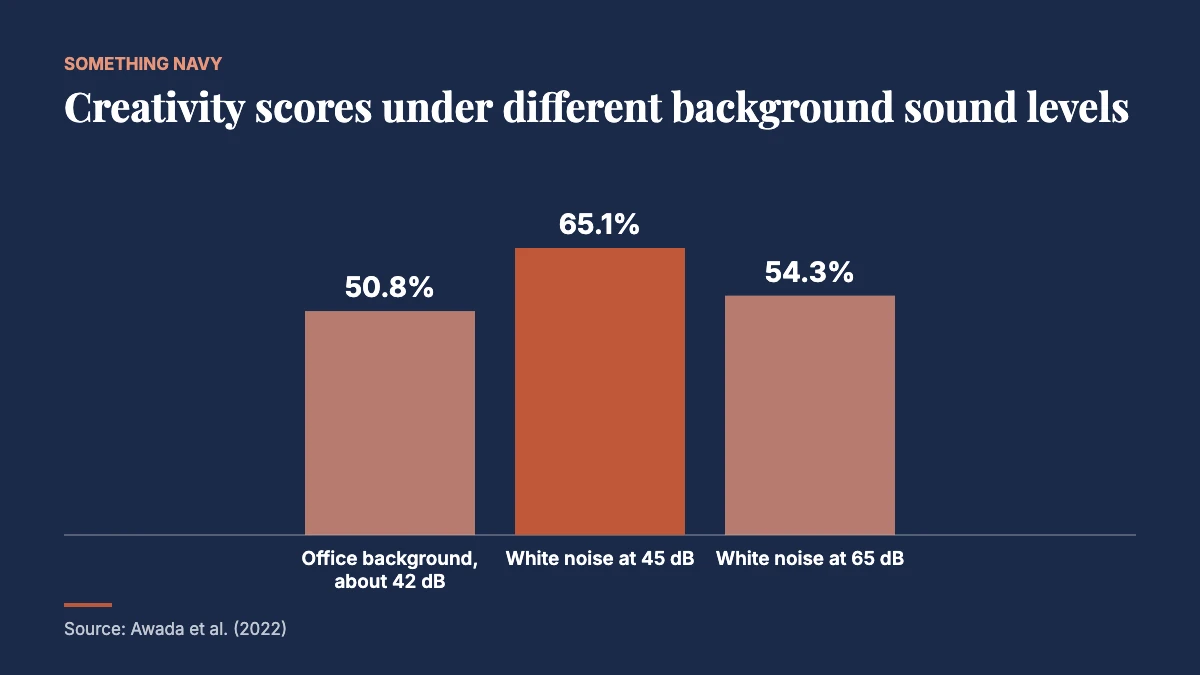
Soft white noise at 45 decibels came out best for creativity and sustained attention, beat the louder setting on typing speed and accuracy, and was linked to lower physiological stress than 65 decibels. The louder setting gave a small boost to working memory compared with the office background, but came with higher stress and more typing errors than the soft one. On creativity, 65 decibels did not differ significantly from either of the other conditions.
Two caveats matter. The sample was small and drawn from one university. And the normal office condition was the only one without headphones, so some of the difference could come from wearing headphones rather than the noise itself, a confound the paper does not address. Notice, too, that the sweet spot here sat far below Mehta’s 70 decibels. The two studies used different sounds and different people, which is a good reminder that no single number applies to every kind of noise.
Open-plan offices and background conversation
If chatter is the main culprit, open-plan offices ought to be the worst place to think. The picture is subtler than that, as anyone who has read our piece on open-plan offices will recognise.
In a 2012 conference study by Jørn Toftum and colleagues, presented at the Healthy Buildings conference in Brisbane, 49 open-plan employees spent two simulated workdays in a lab, one with recorded office noise (phone calls, conversation, laughter, printers) and one without. Measured performance on typing, dictation, arithmetic, reasoning and reading did not change significantly. But with noise, people rated their own performance lower, found the environment less acceptable and reported somewhat stronger headaches.
What seems to matter most is how clearly you can hear the words. Jahncke, writing in Noise & Vibration Worldwide in 2013, summarised work showing that performance fell as background speech became more intelligible, with tasks involving memory and searching for information hit hardest. She suggested keeping speech intelligibility between desks below a set threshold, which in practice means designing offices so that nearby talk turns into murmur rather than sentences.


Which background sound suits which task
Side by side, the studies suggest a pattern, though most were short, small and run in labs.
| Sound type | Best for | Evidence |
|---|---|---|
| Silence or near silence | Reading, memorising, detailed checking | Quiet beat lyrical music for reading comprehension (Perham & Currie, 2014) |
| Café hum at about 70 dB | Brainstorming and idea generation | Five experiments, one research team (Mehta et al., 2012) |
| Loud noise at about 85 dB | Nothing tested | Creativity fell compared with moderate noise (Mehta et al., 2012) |
| Instrumental music | Reading, if you like it on | No significant difference from quiet in one study; sometimes worse than silence for memory (Salamé & Baddeley, 1989) |
| Music with lyrics | Tasks that use no words | Hurt reading and memory in the lab studies above |
| Clearly audible nearby conversation | Very little | Performance falls as speech gets more intelligible (Jahncke, 2013) |
| Soft white noise | Masking chatter; possibly attention in ADHD | Small benefit in ADHD, small cost for others (Nigg et al., 2024); one small office study (Awada et al., 2022) |
Back to your report. The café was a sensible place to start, when the job was working out what to say. For the part where you check figures and reread your notes, the evidence points towards somewhere quieter, or at least towards taking the lyrics out of your headphones. Many people already do something like this instinctively, drafting in a busy room and editing somewhere quieter.
The sound itself matters less than the fit. Noise that is steady, moderate and wordless tends to be the easiest to live with. Words you can make out, whether sung or spoken, are the ones that keep tugging at the part of your mind you need for reading.
Official links and research
- Awada, M., Becerik-Gerber, B., Lucas, G., & Roll, S. (2022). Cognitive performance, creativity and stress levels of neurotypical young adults under different white noise levels. Scientific Reports, 12, 14566. DOI
- Jahncke, H. (2013). How much does irrelevant speech impair employees’ work performance in open-plan offices? Noise & Vibration Worldwide, 44(9), 10–15. DOI
- Jones, D. M., Macken, W. J., & Murray, A. C. (1993). Disruption of visual short-term memory by changing-state auditory stimuli: The role of segmentation. Memory & Cognition, 21(3), 318–328. DOI
- Mehta, R., Zhu, R. (J.), & Cheema, A. (2012). Is noise always bad? Exploring the effects of ambient noise on creative cognition. Journal of Consumer Research, 39(4), 784–799. DOI
- Nigg, J. T., Bruton, A., Kozlowski, M. B., Johnstone, J. M., & Karalunas, S. L. (2024). Systematic review and meta-analysis: Do white noise or pink noise help with task performance in youth with attention-deficit/hyperactivity disorder or with elevated attention problems? Journal of the American Academy of Child and Adolescent Psychiatry, 63(8), 778–788. DOI
- Perham, N., & Currie, H. (2014). Does listening to preferred music improve reading comprehension performance? Applied Cognitive Psychology, 28(2), 279–284. DOI
- Salamé, P., & Baddeley, A. (1982). Disruption of short-term memory by unattended speech: Implications for the structure of working memory. Journal of Verbal Learning and Verbal Behavior, 21(2), 150–164. DOI
- Salamé, P., & Baddeley, A. D. (1989). Effects of background music on phonological short-term memory. The Quarterly Journal of Experimental Psychology, 41A(1), 107–122. DOI
- Söderlund, G., Sikström, S., & Smart, A. (2007). Listen to the noise: Noise is beneficial for cognitive performance in ADHD. Journal of Child Psychology and Psychiatry, 48(8), 840–847. DOI
- Toftum, J., Lund, S., Kristiansen, J., & Clausen, G. (2012). Effect of open-plan office noise on occupant comfort and performance. Proceedings of Healthy Buildings 2012, 10th International Conference, Brisbane. Link
Cover photo: Vitaly Gariev on Unsplash. Charts and graphics: Something Navy, with photography by Brooke Cagle on Unsplash.
How we reported this. Every figure was checked against the 10 sources above. Reviewed by Valentino Adkins, Senior Content Manager. Report an error · How we work