

You are halfway through your eggs when Priya puts her phone face down and says it. The new man, the one she has been vague about for three weeks, is 46. She is 34.
Nobody says anything for a second. Then everybody talks at once. Someone does the maths out loud. Your friend Tom, who has never once been asked for his opinion on anyone’s love life, announces that it “never lasts” and reaches for the toast.
You say nothing, because you are not sure what you think. Is twelve years a lot? And is Tom right, or just repeating something he heard?
How big is the typical age gap between partners?
Start with what is normal, because most of us guess wrong. In August 2024, Richard Fry of the Pew Research Center analysed US census and American Community Survey data on opposite-sex married couples who live together, covering about 680,000 marriages in the 2022 survey alone.
The average gap between husbands and wives in 2022 was 2.2 years. In 1880 it was 4.9 years, and by 2000 it had already shrunk to 2.4. Couples are, slowly, converging.
Fry defined spouses as roughly the same age if they were within two years of each other. By that measure, 51% of US marriages in 2022 were same-age matches, up from 46% in 2000. In 40% of marriages the husband was three or more years older, and in 10% the wife was.
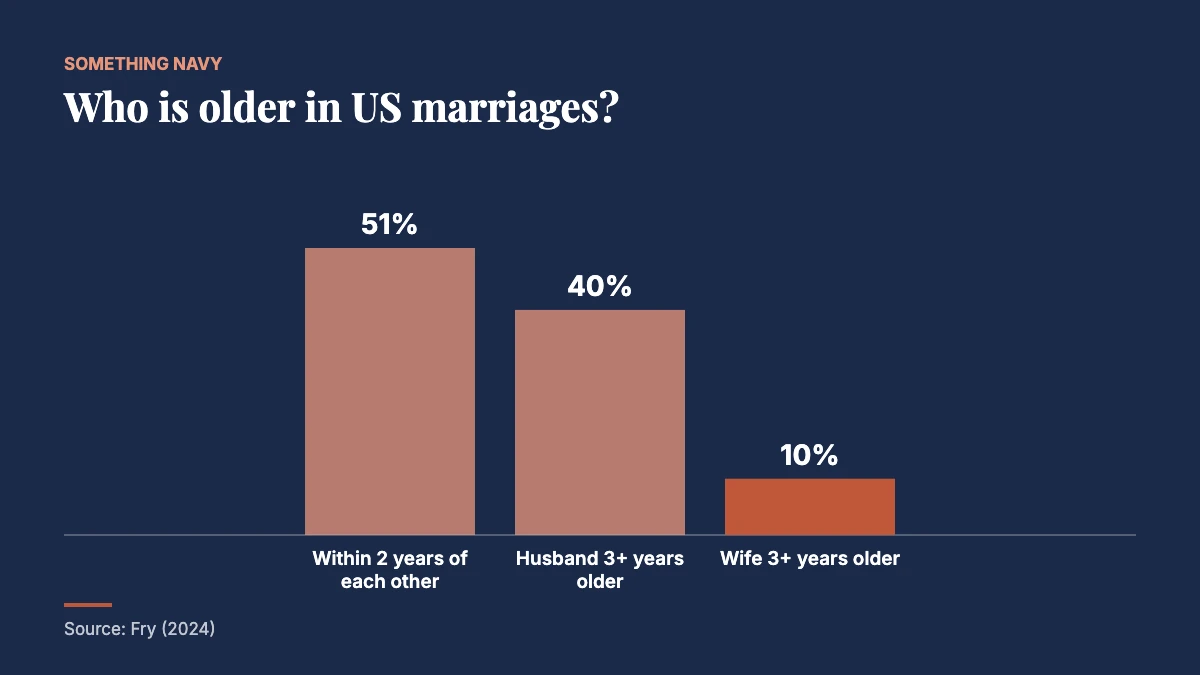
So Priya’s twelve years puts her well outside the middle of the curve. Unusual, though, is not the same as doomed.
Do age-gap couples start out happier?
The most careful study on this comes from Australia. Wang-Sheng Lee of Deakin University and Terra McKinnish of the University of Colorado used the Household, Income and Labour Dynamics in Australia survey, known as HILDA, which interviews the same households year after year. Their paper appeared in the Journal of Population Economics in 2018.
They looked at 3,374 couples in their first marriage, aged 20 to 55, across survey waves from 2001 to 2013.
The early glow
At first, the pattern looks like a vote in favour of age gaps, at least for whoever got the younger spouse. Men married to younger women reported higher satisfaction than men in same-age marriages, and men with older wives reported lower satisfaction.
The surprise was the women. They showed the same tilt: on average, women were more satisfied with younger husbands and less satisfied with older ones. The popular image of the contented woman with a much older man did not appear in this data.
The fade
Then time did its work. Satisfaction fell over the years in age-gap marriages faster than it did in similar-aged ones. In the authors’ words, “these relative declines erase the initial higher levels of marital satisfaction.” By their estimate, the early advantage of having a younger spouse was gone within six to ten years of marriage.
Lee and McKinnish also tested one explanation. When couples were hit by a negative financial shock, satisfaction dropped more in age-gap marriages, particularly for men. Their tentative reading is that couples born years apart may be less resilient when life gets hard. Health shocks, interestingly, mostly did not show the same effect.
An age gap seems to work less like a fault line and more like a thinner layer of padding for the bad years.
What this study cannot tell you
It is a strong dataset, but still observational. The authors tried a statistical technique to isolate cause and effect and reported that it failed because the tools available were too weak. They also say they could only partly account for couples who divorced and left the data, which may skew the picture.
Does an age gap raise the risk of divorce?
This is Tom’s real claim, and it has an odd origin. Andrew Francis-Tan and Hugo Mialon, economists at Emory University, set out to study whether expensive weddings predict shorter marriages. Age gaps were one of many background factors they controlled for, and that side finding is the one most often quoted.
Their paper, published in Economic Inquiry in 2015, drew on an online survey run in July and August 2014 through Amazon Mechanical Turk. After exclusions, 3,151 people who had ever been married remained. The researchers reweighted the sample to look more like the US population of ever-married adults, but they acknowledged that a large national probability sample would have been better.
In their main model, each extra year of age difference between spouses was linked to a roughly 2% higher risk of divorce. That sounds modest, but the details matter. Before other factors were accounted for, the age-gap link was not statistically significant at all. Split by sex, it held for men but not women in the full group, and the reverse among the recently married.
You may have seen sharp, round percentages for 10-year and 20-year gaps quoted online. The published paper does not present age gaps that way; it gives a single per-year figure. And the authors themselves are cautious, writing that “noncausal mechanisms could underlie these results.” A bigger age gap may simply travel with other things the survey did not capture.
It is the same puzzle as living together before marriage and divorce risk: real in the numbers, hard to read as cause.


Are women with older partners more committed?
A different line of research looks at commitment rather than divorce. Justin Lehmiller and Christopher Agnew, then at Purdue University, published a study in Psychology of Women Quarterly in 2008 on heterosexual women in three kinds of relationships: with a notably older partner, a notably younger one, or someone close to their own age.
Women with older partners reported the highest satisfaction and the highest commitment of the three groups. On its face, that cuts against the Australian finding, though the studies differ in almost every way: women’s relationships in general versus first marriages only, one snapshot versus years of follow-up.
The more interesting result was what predicted commitment. The usual ingredients, such as how satisfied someone is, how much they have invested and what alternatives they see, explained less of the picture in age-gap couples than in same-age couples. Lehmiller and Agnew concluded that something beyond the standard recipe may be holding age-gap relationships together.
A 2025 update from the UK
The newest work we found is small. In 2025, Samantha Banbury of London Metropolitan University and colleagues published a study in Sexual and Relationship Therapy based on 126 people in relationships with a gap of roughly seven years or more, recruited through social media.
Men dating younger partners showed higher relationship satisfaction, although the pairwise comparisons did not reach significance. Older women dating younger men reported higher sexual satisfaction than younger women dating older men. The authors are clear that their sample was small, not representative and measured at a single point in time, so treat this as a prompt for bigger studies rather than a verdict.
| Study | Who was studied | Main finding | Biggest caveat |
|---|---|---|---|
| Lee & McKinnish (2018) | 3,374 Australian couples in first marriages, 2001 to 2013 | Early satisfaction edge for the partner with a younger spouse fades within 6 to 10 years | Observational; causal method failed |
| Francis-Tan & Mialon (2015) | 3,151 ever-married US adults, online survey | About 2% higher divorce risk per extra year of gap | Not a probability sample; result shifts by subgroup |
| Lehmiller & Agnew (2008) | Heterosexual women in three partner-age groups | Women with older partners most satisfied and committed | Single snapshot; women only |
| Banbury et al. (2025) | 126 people with gaps of about 7+ years | Some satisfaction differences by gender and partner age | Small, self-selected sample |
Where does “half your age plus seven” come from, and is it any good?
Back at brunch, someone will invoke the rule. Halve your age and add seven for the youngest person you should date; subtract seven and double for the oldest.
For Priya, at 34, the rule’s window runs from 24 to 54, so her new partner sits comfortably inside it. Even folk wisdom is less alarmed than Tom.
The useful test is whether the rule matches what people actually want. In 2001, a team led by Bram Buunk published a study in Evolution and Human Behavior asking people aged 20, 30, 40, 50 and 60 for the youngest and oldest partners they would consider, across five levels of involvement: marriage, a serious relationship, falling in love, casual sex and sexual fantasies.
Women, at every age and every level, tended to prefer partners around their own age. Men preferred younger long-term partners, and for casual sex and fantasies their preferences stayed fixed on women in their reproductive years regardless of how old the men were.
Theresa DiDonato, a social psychologist at Loyola University Maryland, compared those preferences with the rule in 2014 using values read from the study’s charts. Her verdict was that the minimum works tolerably well for men’s serious relationships but undersells women’s choices, and the maximum is usually far too generous. The rule says a 30-year-old woman could date someone as old as 46. Women that age in the Buunk data put their own ceiling at about 37.
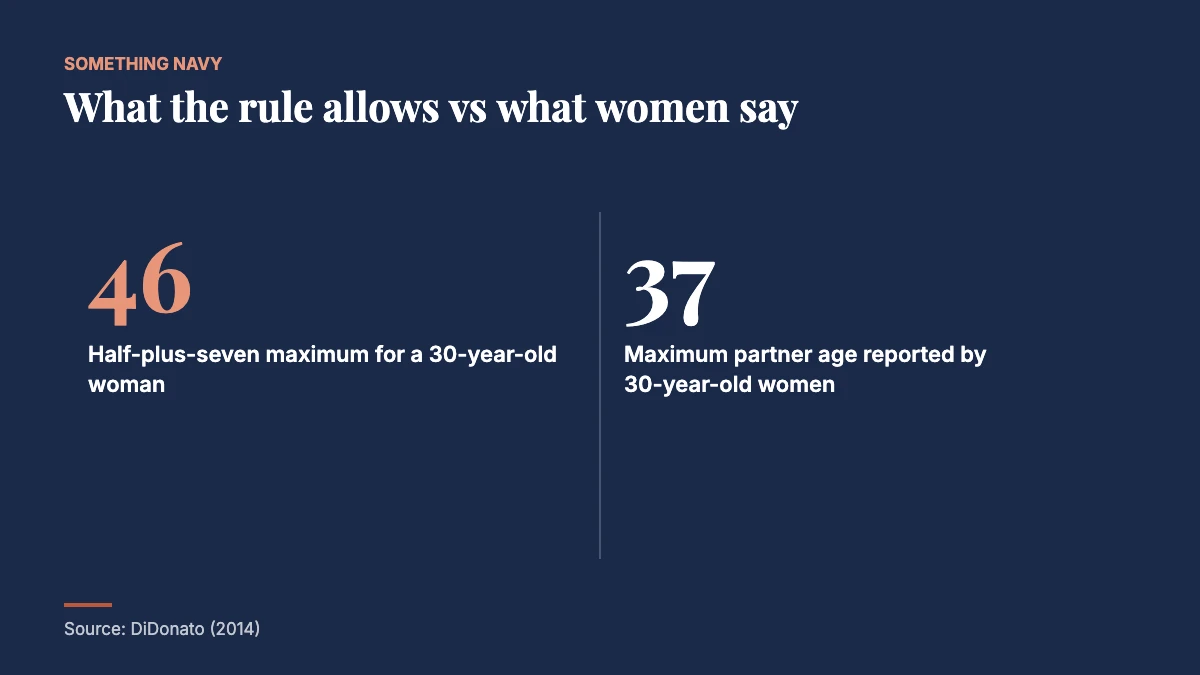
The rule describes social acceptability, not desire, and it is looser than most people’s own limits.
So, do age gaps matter?
Here is a fair summary to take back to the table. Big age gaps are uncommon: half of US marriages are within two years. The best long-term data suggests any early happiness bonus from a younger spouse tends to wear off, and age-gap couples may take money troubles harder. The divorce link is real but modest, wobbly across subgroups and not proven to be causal.
None of that says Priya’s relationship will fail. Averages describe thousands of couples, not one. What predicts staying power in any couple, gap or no gap, is how they handle conflict and stress, the territory of Gottman’s four horsemen, and how much they genuinely share, which is a question we explored in do opposites attract.
A twelve-year gap is a fact about two birth certificates. Whether it matters is mostly decided by the years they spend together.
Frequently asked questions
In the US, the average gap between husbands and wives was 2.2 years in 2022, according to Pew Research Center analysis of census data. About half of married couples are within two years of each other.
One US survey of 3,151 ever-married adults linked each extra year of age difference with about a 2% higher divorce risk. The authors stress this is an association, and the result was not consistent across all subgroups.
Not directly. When its limits are compared with preference data from Buunk and colleagues (2001), the minimum roughly fits men’s serious relationships, while the maximum is far more generous than what most people say they would accept.
Official links and research
- Banbury, S., Pacan, B., Kostadinova, D., Hada, J., Morriss-Roberts, C., Quarcoo, S., & Chandler, C. (2025). The relationship between age-gap relationships/dating, sexual function, relationship satisfaction, sexual self-efficacy and well-being. Sexual and Relationship Therapy, 40(3), 548–563. DOI
- Buunk, B. P., Dijkstra, P., Kenrick, D., & Warntjes, A. (2001). Age preferences for mates as related to gender, own age, and involvement level. Evolution and Human Behavior, 22(4), 241–250. DOI
- DiDonato, T. E. (2014, May 2). Who is too young or too old for you to date? Psychology Today. Link
- Francis-Tan, A., & Mialon, H. M. (2015). “A diamond is forever” and other fairy tales: The relationship between wedding expenses and marriage duration. Economic Inquiry, 53(4), 1919–1930. DOI
- Fry, R. (2024, August 15). A growing share of U.S. husbands and wives are roughly the same age. Pew Research Center. Link
- Lee, W.-S., & McKinnish, T. (2018). The marital satisfaction of differently aged couples. Journal of Population Economics, 31(2), 337–362. DOI
- Lehmiller, J. J., & Agnew, C. R. (2008). Commitment in age-gap heterosexual romantic relationships: A test of evolutionary and socio-cultural predictions. Psychology of Women Quarterly, 32(1), 74–82. DOI
Cover photo: Fotógrafo Samuel Cruz on Unsplash. Charts and graphics: Something Navy.
How we reported this. Every figure was checked against the 7 sources above. Reviewed by Valentino Adkins, Senior Content Manager. Report an error · How we work