

You are standing in a half-empty flat, holding a box marked KITCHEN?? in someone else’s handwriting. The lease is signed. Your partner is downstairs arguing with a sofa that will not turn the corner on the stairs.
Somewhere between the second trip to the van and the moment you find the kettle, a relative’s voice floats into your head. Living together first, they told you at a birthday lunch, is how people end up divorced. They read it somewhere. They seemed very sure.
You put the box down. Is that true? And if it was true once, is it still true for you, now, in this flat with the sofa wedged in the stairwell?
Why living together before marriage was linked to divorce in the first place
The worry did not come from nowhere. For roughly two decades, a run of large studies found that couples who lived together before marrying were more likely to split up than couples who moved in on their wedding night. Researchers gave it a name, the “cohabitation effect”, and it travelled from journals into newspapers, pulpits and family dinners with remarkable speed.
It stuck partly because it felt counterintuitive. Surely a trial run should help: you discover the wet towels on the bed and either make peace with them or leave before the paperwork. The 1980s and 1990s datasets seemed to say the opposite.

The 1980s and 1990s: the cohabitation effect is born
A surprising result from Sweden
One of the early studies came from Sweden, a country where living together outside marriage was already common. Neil Bennett, Ann Klimas Blanc and David Bloom used data from the 1981 Women in Sweden survey and published their findings in the American Sociological Review in 1988.
Their result was striking. Women who had lived with a partner before marrying had marital dissolution rates almost 80% higher than women who had not. Longer cohabitation did not seem to help either: women who had cohabited for more than three years before the wedding had dissolution rates more than 50% higher than those who had lived together for shorter spells.
There was a detail in that paper that got far less attention. Among marriages that survived eight years, the cohabitors and the non-cohabitors had identical dissolution rates from that point on. The authors read their results as a sign of weaker commitment to marriage among people who cohabited first.
Selection versus experience
American studies of the period found the same broad pattern, and the field split over what it meant. William Axinn and Arland Thornton framed the question neatly in the title of a 1992 paper in Demography, asking whether the link reflected selectivity or causal influence.
In plain English, the selection explanation says cohabitation does not damage marriages. Instead, the kinds of people who chose to live together in, say, 1985 were different from those who did not. They may have been younger, less traditional, or simply more willing to leave an unhappy marriage. Those traits would raise divorce rates whether or not anyone shared a flat first. Living together is a marker, not a cause.
The experience explanation says something about cohabiting itself changes people or relationships. Perhaps it softens views of marriage as permanent.
Think of umbrellas. People who carry them are often the ones who saw storms in the forecast; the umbrella does not summon the rain. In the 1980s, cohabitors were a self-selected group, and early studies had limited ways to separate who they were from what they did.
The 2000s: sliding, deciding and the engagement question
The inertia hypothesis
By the mid-2000s, a University of Denver team had offered a third way of thinking, somewhere between selection and experience. In a 2006 paper in Family Relations, Scott Stanley, Galena Rhoades and Howard Markman described what they called inertia.
The idea is simple and slightly uncomfortable. Moving in together makes a relationship harder to leave. You share a lease, a dog, a sofa that took three people to get up the stairs. For some couples, those constraints build up before either partner has really decided that this is the person they want to marry. Some end up marrying partly because breaking up has become so complicated. The authors called this sliding rather than deciding.
The phrase is quietly brilliant. Listen to how couples describe moving in. It is so often “his lease ran out” and so rarely “we agreed”.
Before or after the ring?
In 2009, the same team tested a sharper version of the idea in the Journal of Family Psychology. Rhoades, Stanley and Markman surveyed 1,050 men and women who had married within the previous ten years, recruited through a random telephone survey.
The couples who had moved in before getting engaged reported lower marital satisfaction, lower commitment and confidence, more negative communication and a greater proneness to divorce. Couples who moved in only after engaging looked no different from couples who had not lived together before marriage at all. The authors described what they had found as a “pre-engagement, but not a premarital cohabitation effect.”
Two caveats. The differences were small, as the authors said, and the design was correlational, so it cannot show that moving in early caused the difficulties. It did hold up when the researchers accounted for length of marriage, age, income, education and religiousness, and it held among people who had only ever lived with their current spouse.
In a University of Denver press release about the work, Rhoades suggested that some couples “may wind up sliding into marriage partly because they are already cohabiting.” Anyone who has stayed in a flatshare longer than planned because leaving felt like admin will recognise the mechanism.
The first big meta-analysis
In 2010, a team led by A. Jose, with K. Daniel O’Leary and A. Moyer, pooled the existing evidence in a meta-analysis for the Journal of Marriage and Family. Across 16 studies of marital stability, premarital cohabitation was linked to lower stability, and it was linked to lower marital quality across 12 studies.
The most interesting result was in the subgroups. When the analysis was restricted to people who had only lived with the person they went on to marry, the link with marital instability disappeared. The effect seemed to belong largely to people who had lived with more than one partner.
The question was never really whether you share a kitchen first. It was who you were, how old you were and whether anyone actually decided anything.
The 2010s: when the cohabitation effect started to crumble
Cohabitation becomes the normal route to marriage
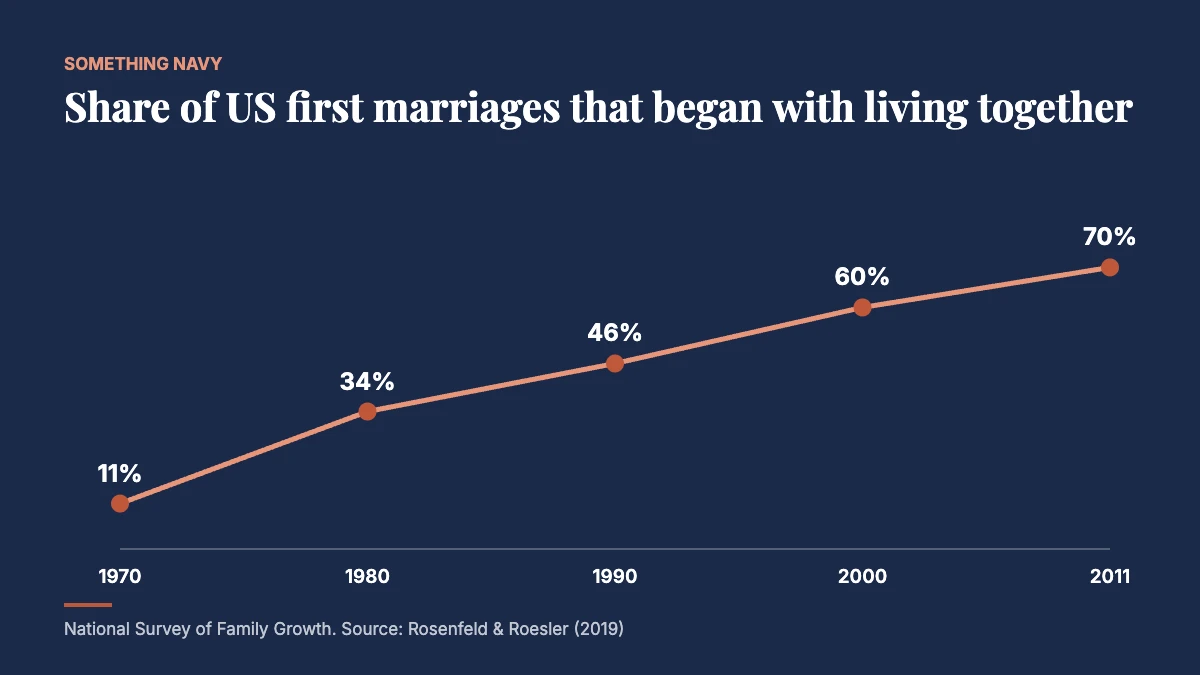
By the 2010s, living together first was no longer a minority choice. It was the main path to the altar. Using six waves of the US National Survey of Family Growth, Michael Rosenfeld of Stanford University and Katharina Roesler estimated that the share of first marriages preceded by cohabitation rose from 11% in 1970 to 70% by 2011.
The UK has moved even further. Figures from the Office for National Statistics show that in 2017, 88% of opposite-sex couples marrying in England and Wales had lived together first. Even among couples marrying in a religious ceremony the figure was 81%.
That shift matters for the selection argument. When cohabitation is what nine in ten couples do, the people who move in first can no longer be an unusual, rule-breaking group. If the effect was mostly selection, it should shrink as the practice spreads. This idea is sometimes called diffusion: as a behaviour spreads, it stops marking people out.
No longer a predictor for recent marriages
Wendy Manning of Bowling Green State University and Jessica Cohen tested exactly this in a 2012 paper in the Journal of Marriage and Family. They used the 2006 to 2008 National Survey of Family Growth and focused on 2,003 women and 1,483 men whose first marriages began in 1996 or later.
About 61% of these recently married women and men had lived with their spouse before the wedding. And for this cohort, premarital cohabitation with a spouse was not significantly linked to a higher risk of the marriage ending, for women or for men. When they looked back at marriages from 1986 to 1995, the older pattern reappeared, which is consistent with the idea that the effect had faded as cohabitation spread.
They also looked at engagement. Roughly a third of recently married people, 34.8% of women and 33.4% of men, were engaged or had definite marriage plans when they moved in. For women, moving in while engaged was associated with modestly lower risk, and the benefit was concentrated among groups who otherwise faced higher divorce risk, such as women without a college degree. Men showed no significant engagement effect.
It was the age, not the address
Then came the paper that, for many researchers, reframed the whole question. Arielle Kuperberg of the University of North Carolina at Greensboro published it in the Journal of Marriage and Family in 2014. She studied 7,037 women in first marriages formed between 1985 and 2009, again using the National Survey of Family Growth.
Her insight was about which age you measure. Most earlier studies compared cohabitors and non-cohabitors by their age at marriage. But a couple who moves in at 22 and marries at 25 actually began their shared life at 22. Comparing them with a couple who married and moved in at 25 is not a fair fight. They started younger, and youth is itself a well-known risk factor for divorce.
So Kuperberg compared couples by the age at which they first lived together. Without any controls, women who had cohabited before marriage had a 40% higher hazard of their marriage ending. Once she accounted for age at coresidence and standard demographic factors, that figure fell to 9%, and it was no longer statistically significant. When she instead measured by age at marriage, the old way, the gap stayed large.
In plain English: much of the cohabitation effect looked like a youth effect in disguise. Women who first set up home with their future husband very young were more likely to see the marriage end, whether they married first or moved in first. Kuperberg also found that having lived with a previous partner did not significantly predict divorce in her models.
The result rests on age at coresidence being the right yardstick, but the logic is persuasive: in practical terms, a shared life starts when the shared home does.


The 2020s: a short-term boost, a longer-term gap and an unsettled debate
The first-year advantage
Just as the cohabitation effect seemed to be fading into history, Rosenfeld and Roesler complicated things again. Their study, published in the Journal of Marriage and Family in 2019, drew on 24,888 women in first marriages across six survey waves, between 1988 and 2015, covering 216,455 years of married life.
They found that couples who had lived together first had a lower rate of breaking up in their first year of marriage than couples who had not. The difference was clearest in the first six months. The authors suggest this reflects practical experience: if you have already survived your first fight about the bins, the first months of marriage hold fewer surprises.
After the first year or two, though, the pattern reversed. Cohabitors had a higher risk of the marriage ending, and the gap was most pronounced after five years. Across the whole period, they estimated that premarital cohabitation was associated with roughly 30% higher odds of dissolution after adjusting for other factors, and the association was fairly stable across decades.
Studies that tracked only the early years of marriage, they argued, had mistaken that first-year advantage for a disappearing effect.
The rebuttal and the reply
Not everyone agreed. In 2021, Manning, Pamela Smock and Kuperberg published a comment in the same journal arguing that the cohabitation effect has faded for recent marriages. As Scott Stanley summarised the exchange for the Institute for Family Studies, the critics took issue with how the analysis handled time and age, and preferred limiting samples to marriages of ten years or less. Rosenfeld and Roesler published a reply defending their approach.
It sounds like a squabble about spreadsheets, but it matters. Divorce is slow: some marriages that will end have not ended when a survey takes its snapshot, and reasonable researchers handle those cases differently.
Engagement, again
The engagement thread has also continued into this decade. In a 2023 report for the Institute for Family Studies, Stanley and Rhoades analysed a national sample of Americans who first married between 2010 and 2019, checking in on their marriages in 2022.
Among couples who lived together before getting engaged, 34% of marriages had ended. Among those who moved in only after engagement or marriage, 23% had. That makes the pre-engagement group 48% more likely to see their marriage end.
That is a notable gap, with cautions. This is a think-tank report rather than a peer-reviewed journal article, the published summary does not give the sample size, and like everything else in this field it is correlational. Couples who get engaged before moving in may simply differ from those who do not. The authors themselves describe the link as reflecting both selection and experience.

What the research on cohabitation and divorce actually shows
Here is where the evidence sits now, claim by claim.
| Claim | What the research shows | How solid |
|---|---|---|
| Living together first doubles or nearly doubles your divorce risk | Early Swedish data found cohabitors had almost 80% higher dissolution rates, but that was in 1981, when cohabitors were a smaller and more distinct group | Outdated |
| Cohabitation itself causes divorce | Most of the link has been explained by who cohabits and how young they were when they moved in; no study can randomly assign couples to live together | Weak |
| Moving in very young is linked to higher divorce risk | Kuperberg found age at coresidence explained much of the gap; the link held whether or not couples married first | Strong |
| Living only with your future spouse is risk-free | A 2010 meta-analysis found no link with instability for spouse-only cohabitors; other studies still find small gaps | Fairly strong |
| Moving in before engagement is riskier than after | Several studies from the Denver team find small but consistent differences; Manning and Cohen found a similar pattern for women only | Moderate, and debated |
| The cohabitation effect has completely vanished | Manning and Cohen and Kuperberg say largely yes for recent marriages; Rosenfeld and Roesler say a gap remains after the first year | Still contested |
| Living together first helps a marriage get off to a smoother start | Rosenfeld and Roesler found lower break-up rates in the first year of marriage for cohabitors | Moderate, one large study |
So should you move in before marriage?
No study can tell you whether to move in with your particular person, but the research does point to which parts of the decision seem to matter.
The first is age. Setting up home very young is linked to higher odds of a later marriage ending. That does not doom young couples; the early twenties are simply a time of rapid change.
The second is the number of live-in relationships. Studies disagree on how much this matters, but the clearest finding from the 2010 meta-analysis was that people who had only lived with their eventual spouse did not show the instability gap.
The third, and the one most within your control, is whether you actually decide. The Denver team’s work keeps returning to the same point: the risk seems highest when couples drift into living together and then drift into marriage. In the 2009 press release, Stanley said it “seems wise to talk about commitment” before moving in. It need not involve a ring; it can be as simple as asking what you each think this step means.
If you want a sense of how couples manage the daily friction of a shared home, the research on why couples fight about housework is a good place to start, and the Gottman four horsemen offer a clear-eyed look at the conflict patterns that predict trouble far better than your living arrangements do. It is also worth understanding your own attachment style, which shapes how you handle the closeness and the inevitable negotiations of living together.
What is still debated about the cohabitation effect
The biggest open question is the one Rosenfeld and Roesler raised: does a small gap reappear after the first few years of marriage, or has it really gone?
The second is engagement. The pre-engagement finding comes mostly from one research group, with partial support from Manning and Cohen, and the differences are usually small.
The third is causation. Every study here is observational: researchers compare couples who chose different routes and adjust statistically for how they differ. That can never fully rule out differences nobody measured, such as how sure each partner felt.
What has clearly changed is the starting assumption. The old story said living together damages marriage. The newer evidence says the picture depends heavily on when you move in, how many times you have done it and whether you made a real choice. Back in the flat, with the sofa finally through the door, that is a more useful thing to know than a warning from a birthday lunch.
Frequently asked questions
Older studies found it did, but newer research suggests much of that link came from who cohabited and how young they were when they moved in. For recent marriages, several large studies find little or no difference, although one major study still finds a gap after the first year.
Research from the University of Denver links moving in before engagement with slightly lower marital satisfaction and higher divorce risk, while couples who move in after engagement look similar to those who never lived together first. The differences are small and the studies are correlational.
In the 1980s and early 1990s, people who lived together before marriage were a minority who differed in age, values and background from those who did not. Those differences, rather than the shared home itself, likely explain much of the higher divorce rate.
Very common. In the US, about 70% of first marriages by 2011 were preceded by cohabitation, and in England and Wales 88% of opposite-sex couples who married in 2017 had lived together first.
Official links and research
- Bennett, N. G., Blanc, A. K., & Bloom, D. E. (1988). Commitment and the modern union: Assessing the link between premarital cohabitation and subsequent marital stability. American Sociological Review, 53(1), 127–138. NBER working paper
- Stanley, S. M., Rhoades, G. K., & Markman, H. J. (2006). Sliding versus deciding: Inertia and the premarital cohabitation effect. Family Relations, 55(4), 499–509. DOI
- Rhoades, G. K., Stanley, S. M., & Markman, H. J. (2009). The pre-engagement cohabitation effect: A replication and extension of previous findings. Journal of Family Psychology, 23(1), 107–111. DOI
- Jose, A., O’Leary, K. D., & Moyer, A. (2010). Does premarital cohabitation predict subsequent marital stability and marital quality? A meta-analysis. Journal of Marriage and Family, 72(1), 105–116. DOI
- Manning, W. D., & Cohen, J. A. (2012). Premarital cohabitation and marital dissolution: An examination of recent marriages. Journal of Marriage and Family, 74(2), 377–387. DOI
- Kuperberg, A. (2014). Age at coresidence, premarital cohabitation, and marriage dissolution: 1985–2009. Journal of Marriage and Family, 76(2), 352–369. DOI
- Rosenfeld, M. J., & Roesler, K. (2019). Cohabitation experience and cohabitation’s association with marital dissolution. Journal of Marriage and Family, 81(1), 42–58. DOI
- Manning, W. D., Smock, P. J., & Kuperberg, A. (2021). Cohabitation and marital dissolution: A comment on Rosenfeld and Roesler (2019). Journal of Marriage and Family, 83(1), 260–267. DOI
- Stanley, S. M., & Rhoades, G. K. (2023). What’s the plan? Cohabitation, engagement, and divorce. Institute for Family Studies. Report
- Office for National Statistics. (n.d.). Marriages in England and Wales: 2017. ONS bulletin
Cover photo: Vitaly Gariev on Unsplash. Charts and graphics: Something Navy, with photography by Vitaly Gariev and Jessica Lewis on Unsplash.
How we reported this. Every figure was checked against the 10 sources above. Reviewed by Valentino Adkins, Senior Content Manager. Report an error · How we work