
It is Sunday evening and the boiler has packed in again. You are both standing in the hallway, one of you holding a torch, the other holding the phone with the plumber’s voicemail on speaker.
Your partner says, “You said you’d booked the service.” You hear yourself reply, “I did book it. You cancelled it because of your mum’s birthday.”
The hallway gets a few degrees colder, and not because of the boiler.
Then one of you, for no particular reason, sighs and says: “Right. What are we going to do about this?” And something in the hallway shifts. Nobody has apologised. Nothing is fixed. But the problem has moved, very slightly, from between you to in front of you.
That small change of pronoun is the subject of a surprisingly large body of research. Psychologists have spent years counting the little words couples use and checking them against how those couples behave and feel, and even how their health holds up. The headline finding is real, and it is kinder than you might expect. It is also smaller and more interesting than the internet usually makes it sound.
Counting pronouns in 154 marriages
The study most people quote began with a stack of old recordings. In 2009, Benjamin Seider, then a graduate student at the University of California, Berkeley, worked with Robert Levenson, Gilad Hirschberger and Kristin Nelson to go back through videotaped conversations from long-running marriages in the Berkeley area, collected in 1989 and 1990.
There were 154 couples, all in first marriages. Eighty were middle-aged, between 40 and 50 and married for at least 15 years. The other 74 were between 60 and 70 and married for at least 35. Each couple had picked a genuine bone of contention with an interviewer, then spent 15 minutes trying to talk it through while sensors tracked their heart, skin conductance and body movement.
Afterwards, the team transcribed every word and sorted the pronouns into two piles. “We-ness” words were the plural ones: we, us, our, ourselves. “Separateness” words were the singular ones: I, me, my, and you, your, yourself. Trained coders separately rated each partner’s emotional behaviour from the video.
The paper in Psychology and Aging reported a clear pattern. When a person used more “we” words, they showed less negative emotion during the argument. So did their partner. The partner also showed more positive emotion and lower physiological arousal, which is a polite way of saying their body was less wound up.
The authors noted that these links were generally stronger for the partner than for the speaker.
It is the gentlest finding in this whole field. Saying “we” in a row seemed to do the most for the person on the receiving end.

The “I” and “you” words told a different story
The separateness words pulled the other way. People who used more I-and-you language showed more negative emotion themselves, and their partners did too. They also reported lower marital satisfaction, a link that was strongest among the older couples.
There was one result that rarely makes it into the cheerful summaries. We-ness on its own was not significantly linked to how satisfied people said they were with their marriage. Its connections were with what happened in the room: the tone, the emotion, the bodies. Separateness was the side that tracked with dissatisfaction.
Two more details are worth knowing. The older couples used more “we” words than the middle-aged ones. And wives used more separateness words than husbands, although the two groups did not differ in “we”.
Robert Levenson put the general idea to the university’s press office in a line that has been quoted ever since. In marriage, he said, “being part of a ‘we’ is well worth giving up a bit of ‘me’”.
Before you start rationing your “I”s, a word about what this study can and cannot show. It was a snapshot, not an experiment. The older couples had been married longer and grew up in a different era, so the age difference cannot be pinned on age alone. And the sample was mostly white, well educated and middle class, from one corner of California, with recordings now more than three decades old.
A spouse’s “we” and a struggling heart
Arguments are one thing. What about the long, unglamorous work of coping with illness together?
Michael Rohrbaugh, a psychologist at the University of Arizona, has long studied couples in which one partner has heart failure. In a 2008 study in the Journal of Consulting and Clinical Psychology, his team interviewed 57 patients and their spouses at home about how they were coping with the patient’s condition, then counted the “we”, “us” and “our” in what both partners said.
The results were striking. The spouse’s we-talk predicted improvements in the patient’s heart-failure symptoms and general health over the following six months. The patient’s own we-talk did not. And the spouse’s pronouns predicted those changes better than what couples said directly when asked how they coped together or how good their marriage was.
That last part is remarkable. A word count picked up something that a questionnaire, asking people straight out, apparently missed.
Rohrbaugh’s colleague Matthias Mehl has been careful about what this means. Talking to the University of Arizona’s student paper, he made clear that the words themselves do not heal anyone. “Personal pronouns reflect the way a person construes his or her social world,” he said. The idea is that “we” is a fingerprint of something underneath: a sense that the illness belongs to both of you.


Twenty couples trying to quit smoking
The same group then took the idea somewhere harder. Smoking is a famously solitary battle. You quit, you crave, you relapse, often alone at the back door.
In a 2012 study in Family Process, Rohrbaugh, Mehl and colleagues worked with 20 couples in which at least one partner smoked and one had a heart or lung problem. Over up to 10 sessions, the programme encouraged both partners to treat the smoking as a shared problem and to tackle it together.
The team measured we-talk before treatment, in a conversation between the partners, and again during the sessions. The spouse’s we-talk before treatment predicted whether the patient was still not smoking 12 months after quitting. And when either partner’s we-talk rose during treatment, beyond where it had started, that change also predicted success.
Twenty couples is a very small study, and nobody should build a public health campaign on it. But it does suggest that “we” is not fixed. In this programme, at least, it moved.
What 30 studies say when you pool them
Alexander Karan, then a graduate student in Megan Robbins’s lab at the University of California, Riverside, set out to pool them, working with Robbins and Robert Rosenthal, a distinguished professor there.
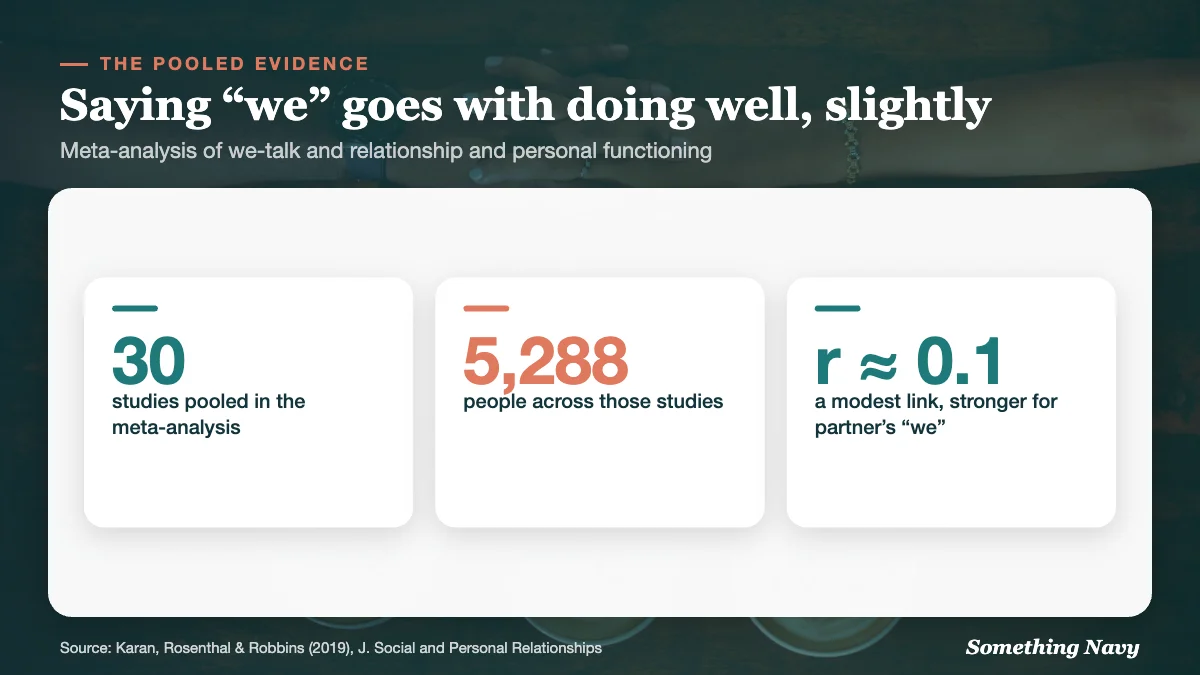
Their meta-analysis in the Journal of Social and Personal Relationships, published online in 2018 and in print in 2019, pooled 30 studies with 5,288 participants. Every study measured we-talk the same basic way: first-person plural pronouns as a share of all the words a person said. The team then looked at five kinds of outcome: how the relationship was going, how partners behaved towards each other, mental health, physical health and health behaviours such as sticking to a treatment.
The overall answer was yes. More we-talk went with better functioning, and the link held across those five areas taken together, for men and women alike in most comparisons. Once again, a partner’s we-talk was generally more strongly tied to how the relationship was doing than a person’s own.
And once again, there was a twist involving illness. In couples coping with a health problem, the spouse’s “we” was generally more predictive than the patient’s. The single strongest association in the whole analysis was between spouses’ we-talk and patients’ health behaviours.
Why “small” is the honest word here
Now the part that rarely makes the headlines. The effects in Karan’s analysis were small. The overall correlation between a person’s own we-talk and how well they were doing was about 0.08. For a partner’s we-talk it was about 0.1. The authors themselves describe the overall link as “modest”.
To put that in everyday terms: if you lined up a thousand couples by how often they say “we”, you would see a faint upward slope in how well they were doing, not a cliff. Plenty of couples who say “we” constantly are miserable. Plenty who say “I” all day are perfectly content.
A few other cautions come straight from the paper. Some outcome categories rested on only four to six studies. Three of the four patient samples came from programmes that deliberately tried to increase we-talk, which may have inflated the health findings. And in the three studies that recorded couples in everyday life rather than in a lab, the link was close to zero.
That last caution matters. Most of the research catches couples in an argument or a structured conversation about a problem. That is exactly where “we” seems to count. Whether it means much when you are deciding what to have for tea is far less clear.
“We” is not a magic word. It is a small window, and what you can see through it is whether two people think they are on the same side.
Which comes first, the “we” or the happiness?
All of this is correlation. Couples who already feel like a team will naturally say “we” more, so it could be that happy relationships produce we-talk, rather than the other way round.
Megan Robbins addressed this directly when the meta-analysis came out. Asked by her university’s news service whether we-talk causes good relationships or simply reflects them, her answer was refreshingly short: “It is likely both.”
She explained the first direction like this: “Hearing yourself or a partner say these words could shift individuals’ ways of thinking to be more interdependent.” The second direction is that a healthy, supportive relationship simply produces more “we” in conversation.
The smoking study hints that the first route is at least possible, because we-talk rose during a programme and that rise went with better results. But a small, uncontrolled finding is not proof, and the meta-analysis explicitly calls for more experiments before anyone claims cause and effect.
So the fair summary is this. “We” is a reliable but faint signal of a relationship that is working as a partnership. It is probably not a lever you can yank to fix one that is not.
“You” in a fight, “you” in a crisis
If “we” is the friendly pronoun, is “you” the villain? It is more complicated than that, and the most careful recent study suggests the answer depends on what the two of you are doing.
Tabea Meier and colleagues at the University of Zurich recorded 365 Swiss German-speaking couples, with partners aged between 19 and 82. Each couple did three eight-minute tasks: one conflict discussion and two conversations in which one partner talked about a personal stress while the other offered support.
Their 2021 study in the Journal of Social and Personal Relationships found that in conflict, couples who used more “you” had a tenser, less warm atmosphere. The authors suggest that in an argument, a focus on the partner may signal blaming or criticism. Think “you always”, “you never”, “you said you’d booked the service”.
But in the support conversations, the picture flipped in places. When the couple’s use of “you” was lopsided, the person giving support behaved more positively, which the authors read as the supporter keeping the focus on the stressed partner. Asking “How are you feeling?” and “What do you need?” is exactly what good support sounds like. The authors describe that kind of partner focus as functional.
Two other findings deserve a mention. More “we” during conflict again went with a better atmosphere, and with more positive behaviour from men. And “I”, so often cast as selfish, was not the problem in conflict: couples who used more of it overall actually saw more positive behaviour from men, against the researchers’ own prediction. Saying “I feel hurt” is a very different act from saying “you hurt me”.
The researchers also note that the effect sizes were rather small. Pronouns are clues, not verdicts.
The “I” paradox in distressed couples
Meier’s team also points back to earlier work, including a 2010 study by Katherine Williams-Baucom and colleagues, suggesting that how satisfied a couple already is changes what pronouns mean. In their reading of that research, heavy “I” talk in conflict has tended to go with poorer functioning in satisfied couples, while the opposite pattern has turned up in distressed ones.
The “we” you say and the “we” you think
One more study adds a quiet complication. Stephanie Wilson, Janice Kiecolt-Glaser and colleagues asked 43 married couples to have a marital problem discussion, and also to write down their private thoughts and feelings before and after it. The whole procedure was repeated about a month later.
Their 2022 paper in the Journal of Social and Personal Relationships found that the “we” people wrote in private was largely unrelated to the “we” they said out loud in the argument. Both kinds were fairly stable across the two visits. More spoken we-talk during conflict went with less hostility. More private we-talk at the start predicted feeling closer, sounding less vocally aroused and using more positive emotion words afterwards.
That is a useful warning against treating this as a script. You can say “we” through gritted teeth, and your partner will hear the teeth.
How to bring more “we” into a disagreement without faking it
So what should a reasonable couple do with all this? Not count pronouns at the dinner table, please. But the research does point to a few gentle habits.
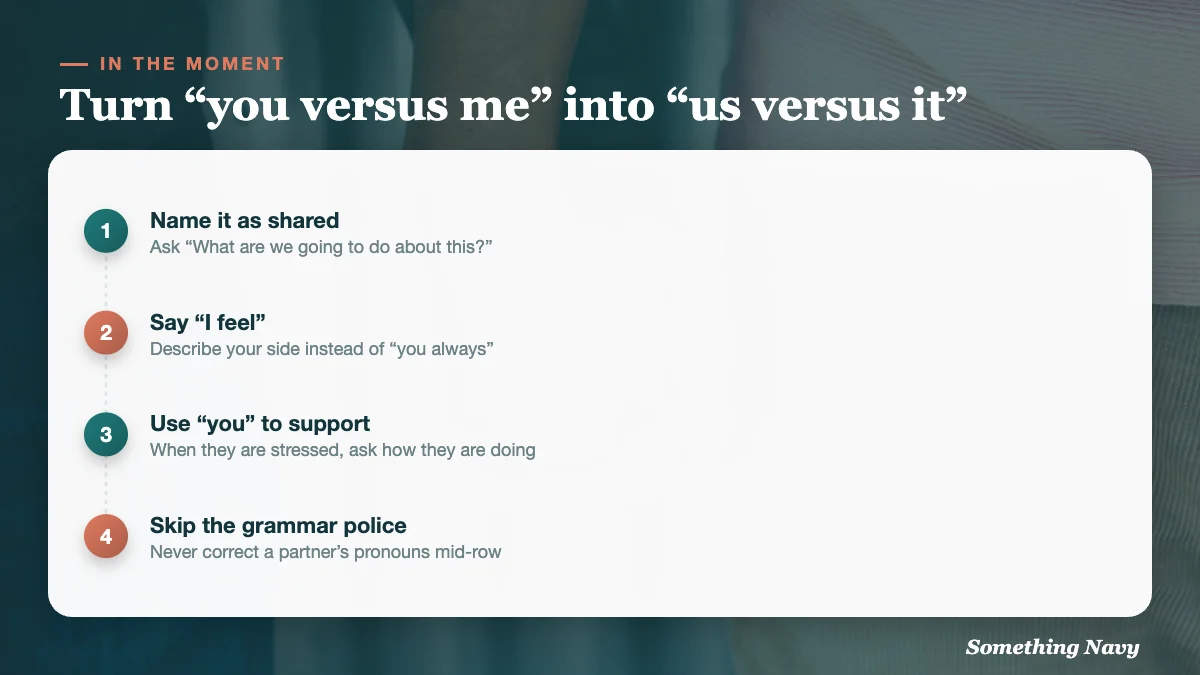
Name the problem as a shared object. The boiler, the overdraft, the in-laws’ visit. “What are we going to do about this?” puts it on the table between you, rather than on one of you. This is the heart of what Rohrbaugh calls communal coping, and of most good advice about arguments over the washing-up.
Swap “you always” for “I feel”. The “I” that describes your own experience is not the enemy. The accusing “you” in a fight is the one that showed up with a tenser atmosphere in Meier’s couples, and it overlaps neatly with the criticism that features in John Gottman’s four horsemen.
Use “you” generously when they are struggling. When your partner is the one who is stressed, focusing on them is support, not blame. “How are you doing with it?” is a good sentence.
Remember who benefits most. Across several studies, it was the listener whose emotions and body seemed to respond most to the speaker’s “we”. Your “we” is a gift to them, not a performance for yourself.
Do not police each other. Correcting a partner’s pronouns mid-row (“Actually, it’s our boiler”) will not end well. If something lands badly, a proper apology will do more than any grammar.
Try this
- Next time a disagreement starts, pause and try one sentence that begins “How do we…”. Notice whether the temperature changes, even slightly.
- Afterwards, ask each other: “Did that feel like you against me, or us against the problem?” No marks, no judging.
- If one of you is facing something stressful this week, the other can practise the supportive kind of “you”: ask, listen, and ask again.
- Keep it light. If it starts to feel like a test, drop it. The research is about a feeling of partnership, not the vocabulary.
Why the smallest word in the hallway matters
Back in the hallway, the boiler is still broken. But one of you has found the number for the emergency line, and the other is reading out the model number from the side of the tank, and you are, briefly, a team again.
No researcher would claim that saying “we” got you there. The studies are too small and too correlational for that, and the effects too modest. What they do suggest is that the word tends to turn up when two people are facing the same way, and that the person who hears it seems to feel it most.
Like laughing at the same moment, it is a tiny, easily missed sign of something larger.
So listen for it. In your own voice, and in theirs. When it comes, it usually means the problem has stopped standing between you, and started standing in front of you both.
Official links and research
- Seider, B. H., Hirschberger, G., Nelson, K. L., & Levenson, R. W. (2009). We can work it out: Age differences in relational pronouns, physiology, and behavior in marital conflict. Psychology and Aging, 24(3), 604–613. Link
- Karan, A., Rosenthal, R., & Robbins, M. L. (2019). Meta-analytic evidence that we-talk predicts relationship and personal functioning in romantic couples. Journal of Social and Personal Relationships, 36(9), 2624–2651. Link
- Rohrbaugh, M. J., Shoham, V., Skoyen, J. A., Jensen, M., & Mehl, M. R. (2012). We-talk, communal coping, and cessation success in a couple-focused intervention for health-compromised smokers. Family Process, 51(1), 107–121. Link
- Rohrbaugh, M. J., Mehl, M. R., Shoham, V., Reilly, E. S., & Ewy, G. A. (2008). Prognostic significance of spouse we talk in couples coping with heart failure. Journal of Consulting and Clinical Psychology, 76(5), 781–789. DOI
- Meier, T., Milek, A., Mehl, M. R., Nussbeck, F. W., Neysari, M., Bodenmann, G., Martin, M., Zemp, M., & Horn, A. B. (2021). “I blame you, I hear you”: Couples’ pronoun use in conflict and dyadic coping. Journal of Social and Personal Relationships, 38(11), 3265–3287. Link
- Wilson, S. J., Jaremka, L. M., Fagundes, C. P., Andridge, R., & Kiecolt-Glaser, J. K. (2022). Does it matter whether we or I talk about us? Distinguishing we-talk in couples’ conflict discussions and partners’ private thoughts before and after conflict. Journal of Social and Personal Relationships, 39(4), 1066–1086. Link
- Warren, J. (2018, October 4). Research affirms the power of “we”. UC Riverside News, University of California, Riverside. Link
- University of California, Berkeley. (2010, February 5). Couples who say “we” do better at resolving conflicts. ScienceDaily. Link
Cover photo: Priscilla Du Preez on Unsplash. Charts and graphics: Something Navy, with photography by Lareised Leneseur and Nandhu Kumar on Unsplash.
How we reported this. Every figure was checked against the 8 sources above. Reviewed by Valentino Adkins, Senior Content Manager. Report an error · How we work