
It is Friday, and you already know how the evening goes. The order went in at half seven: the usual from the usual place, the same two curries, the same extra naan neither of you will finish. You eat on the sofa with the plates balanced on your knees.
Then the remote comes out. You scroll past the series you both abandoned, past three documentaries you agreed to watch “some time”. Twenty minutes later you are still scrolling. Nobody is unhappy, exactly. You like each other. It is just that this is the fourth Friday in a row that looks precisely like this, and you could probably narrate it in your sleep.
At some point one of you says, “Shall we just put something on?” and the other says, “Whatever you want.” It is comfortable. It is also a bit flat.
That flatness has a name in relationship science, and a well-tested remedy. It starts with a lab, a padded floor and two people strapped together with Velcro.
What self-expansion means, and why couples drift into a rut
In 1986, the psychologists Arthur and Elaine Aron set out an idea they called the self-expansion model. The short version: people are driven to grow, and one of the most powerful ways we do that is through the people we love. Early in a relationship, everything about the other person is new. You are learning their jokes, their friends, their opinions about Marmite. Your sense of who you are gets bigger, fast, and that rapid expansion feels exhilarating.
It cannot last at that pace. Once you know someone well, there is less left to discover. Psychologists who study hedonic adaptation will recognise the pattern: we get used to good things, even very good things, and stop noticing them.
The Arons’ insight was that the thrill of a new relationship might come from the newness of the experience rather than of the partner. If so, couples who keep doing unfamiliar, slightly challenging things together should be able to borrow some of that early-days feeling and attach it to each other. That, in short, is the scientific case for novel activities for couples.
The 1993 date-night experiment: exciting beats pleasant
The first proper field test came in 1993, when the psychologists Reissman, Aron and Bergen published a study in the Journal of Social and Personal Relationships. They recruited 53 married couples and randomly assigned them to one of three groups.
Two groups spent an hour and a half a week, for 10 weeks, doing activities together. One group picked activities they themselves rated as exciting; the other picked ones they rated as pleasant. The third group carried on as normal.
Compared with the control group, the two activity groups combined showed only a small, non-significant difference: extra time together did not reliably lift marital satisfaction. Set exciting against pleasant, though, and the exciting group came out ahead, with what the authors described as a moderate effect.
That is worth sitting with. The pleasant group was doing what most of us do when we “make time for each other”: a nice dinner, a favourite walk. It did not seem to help much. What mattered was the kind of time, not the amount.
The Velcro study that tied couples together
Seven years later, Arthur Aron and four colleagues, among them Richard Heyman, published a much larger package of research in the Journal of Personality and Social Psychology. It combined a questionnaire printed in a newspaper, a door-to-door survey and three laboratory experiments.
The surveys found that couples who did more exciting things together were more satisfied, partly because they felt less bored in the relationship.
Surveys cannot show cause and effect, though: happy couples might simply be more adventurous. So the team brought couples into the lab.
How the experiment worked
Couples spent seven minutes on a task together. In the novel, arousing version, as described by KQED’s Future of You, partners were fastened to each other with Velcro at the wrists and ankles and had to get through an obstacle course on their hands and knees, carrying an object without using their hands. Kira Newman, writing in Greater Good magazine, called it “a kind of intertwined gymnastics” across a padded room. It is awkward and faintly ridiculous. The comparison group did a far duller ball-rolling task.
Before and after, couples rated their relationship, and some were filmed in conversation so that observers could rate those discussions too.
What the Velcro couples showed
Across all three experiments, couples who did the novel, arousing task showed bigger gains in relationship quality than couples who did the mundane one. A no-activity control group showed the effect came from the exciting task, not from the dull one making things worse. The pattern also showed up in the observers’ ratings of the filmed conversations, and it held after the researchers allowed for people’s tendency to paint their relationship in a flattering light.
Nobody is claiming a seven-minute crawl across a gym mat will rescue a marriage. The experiment matters because it isolates the ingredient: same lab, same length of time, and the only thing that changed was whether the activity was new and a bit challenging.
It was never the time together that made the difference. It was whether that time felt new.
The 2013 online trial: four weeks of exciting dates
Lab tasks are one thing. Would busy couples at home actually change their habits, and would it help?
Kimberley Coulter and John Malouff of the University of New England in Australia tested that in a randomised controlled trial, published in 2013 in Couple and Family Psychology: Research and Practice. Of 101 couples, 50 were given a four-week online programme; the other 51 were put on a waiting list as a comparison group.
Couples were given ideas for exciting activities and encouraged to do them together for about 90 minutes a week. According to a summary of the instructions on the UNE psychology blog, which Malouff wrote, couples drew up a list of 10 exciting or challenging activities that were realistic in cost and time, picked one, scheduled it, wrote the plan down and both signed it. The aim was at least one a week.
After four weeks, programme couples reported significantly more excitement, positive mood and relationship satisfaction than those on the waiting list. Four months later, the programme group as a whole still scored higher than they had at the start.
There is a catch: only the programme couples were measured at four months, with no control group by then, so that part is weaker evidence. The instructions themselves offered a sensible piece of realism: “Generating excitement takes a bit of time.”
Self-expansion and sexual desire: the 2019 studies
Sexual desire often dips as partners grow familiar. In 2019 a team led by Amy Muise of York University tested whether self-expansion could help. The paper, written with Cheryl Harasymchuk, Lisa Day, Chantal Bacev-Giles, Judith Gere and Emily Impett, appeared in the Journal of Personality and Social Psychology.
What couples recorded every night
In the first two studies, couples in established relationships in Canada and the United States filled in a short survey every night for 21 days. According to York University’s announcement, the first study involved 122 mixed-sex couples who had been together for more than two years. The British Psychological Society’s Research Digest put average relationship length at about eight years in the Canadian sample and five in the American one.
On days when people felt they had done something self-expanding with their partner, they reported more sexual desire, were more likely to have sex and were more satisfied with it. On those days, couples were between 25% and 34% more likely to have sex. The links were stronger for couples who had been together longer. Self-expansion on one day also predicted greater relationship satisfaction the following day, but satisfaction did not predict more self-expansion the next day.
The effects mostly held after accounting for mood, time together and closeness during the activity, so self-expansion was doing something beyond simply having a nice day.
The weekend experiment
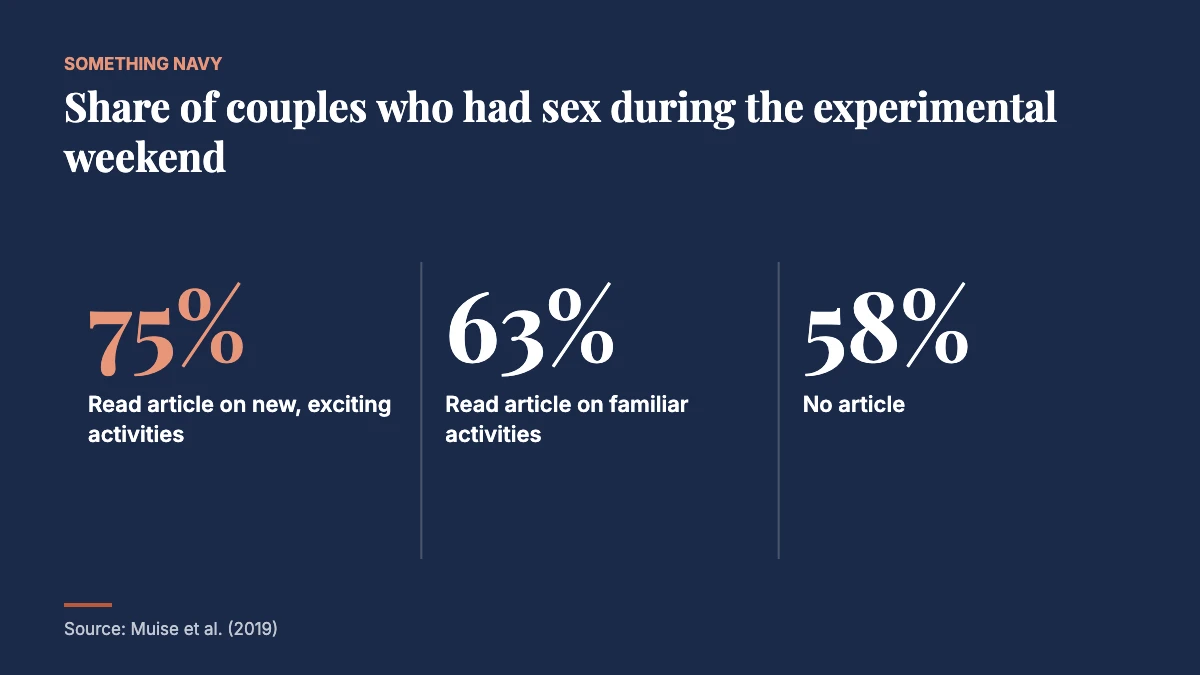
The third study tried to change behaviour. Over one weekend, 198 couples were split into three groups. Fifty-one read a magazine-style article, written for the study, encouraging them to try new and exciting things together. Sixty-five read a similar article about enjoying familiar activities. The remaining 82 got no article at all.
The self-expansion group did more self-expanding things, and they were the only group whose sexual desire rose across the weekend. The honest reading is more modest, though. They reported more desire and satisfaction than the no-article group, not more than the familiar-activities group. And while the share who had sex was higher in the self-expansion group, the difference was a trend rather than a statistically significant result.
One oddity, flagged by the Research Digest: participants sometimes counted ordinary things, such as chores or television, as self-expanding, and how physically arousing an activity was made no difference. The feeling of novelty may matter more than the activity itself, which is good news for anyone who does not fancy skydiving.
The long view: boredom predicts lower satisfaction nine years on
Irene Tsapelas, with Arthur Aron of Stony Brook University and Terri Orbuch of the University of Michigan’s Institute for Social Research, followed 123 Black American and white American married couples in the Detroit area, interviewing them in their seventh year of marriage and again in their sixteenth. The results appeared in Psychological Science in 2009.
Couples who felt more bored in their relationship at year seven were significantly less satisfied at year 16. The reverse did not hold: satisfaction at year seven did not predict lower boredom later. The researchers’ analysis suggested that boredom chipped away at closeness, and that the loss of closeness was what dragged satisfaction down. Orbuch put it plainly in the University of Michigan press release: “simple boredom with the relationship can shape relationships over the long term”.
This is correlational, and 123 couples from one city is a modest sample. But it fits the experiments, and it marks boredom as worth noticing early. It is a quieter threat than the four horsemen that Gottman’s research warns about, but it can wear a relationship down all the same.
| Study | Who took part | What couples did | What happened |
|---|---|---|---|
| Reissman, Aron & Bergen (1993) | 53 married couples | 90 minutes a week of exciting or pleasant activities for 10 weeks | Exciting beat pleasant; extra time alone did not reliably help |
| Aron et al. (2000) | Couples in three lab experiments, plus two surveys | A 7-minute novel, arousing task versus a mundane one | Bigger gains in relationship quality after the novel task |
| Tsapelas, Aron & Orbuch (2009) | 123 married couples over 9 years | No task: boredom measured at year 7, satisfaction at year 16 | More boredom at year 7 predicted lower satisfaction at year 16 |
| Coulter & Malouff (2013) | 101 couples | 4-week online programme, about 90 minutes a week | More excitement, mood and satisfaction than waiting-list couples |
| Muise et al. (2019) | Two 21-day diary studies and a 198-couple experiment | Daily diaries; a weekend nudge to try new things | More desire and satisfaction on self-expanding days; partial experimental support |
What the newest studies add, from virtual reality to holidays
Virtual reality dates: helpful, but not a replacement
In 2025, Rhonda Balzarini, Anya Sharma and Amy Muise published two experiments in the journal Behavioral Sciences asking whether novel activities in virtual reality could deliver the same benefits, a question with obvious appeal for long-distance couples.
In the first, more than 90 couples took the same virtual hot-air balloon ride over a Kenyan safari, either in VR or over a video call. The VR couples felt more present with each other and less bored, but there was no overall difference in self-expansion, satisfaction or closeness. In the second, about 140 couples did either a novel activity in VR (a gondola ride in the Swiss Alps) or a mundane one (sitting on a virtual porch). The novel version lowered boredom and raised closeness, but did not move self-expansion or satisfaction. The authors concluded that virtual activities may be less effective than doing things in person, though still worth studying.
Holidays: it is the novelty, not the number of days
A 2024 paper in Annals of Tourism Research Empirical Insights, by John Coffey of Arizona State University, Moji Shahvali of Breda University of Applied Sciences, Deborah Kerstetter and Arthur Aron, looked at couples’ holidays. In the first study, 238 people reported on their trips; the second followed 102 couples who travelled together.
More self-expanding holidays, meaning novel, interesting or challenging ones, were followed by more passion and satisfaction in the first study and more physical intimacy in the second, but only when partners travelled together. In a Psychology Today post about the work, Coffey and Shahvali reported that the number and length of holidays did not significantly predict relationship quality. What counted was how much the trip stretched them.


How to put self-expansion into practice without a Velcro kit
None of this needs a big budget. The common thread is an activity that feels new to both of you, carries a little challenge, and is done together rather than in parallel.

Arthur Aron seems to take his own advice. In a 2018 interview with Greater Good, he described a walking trip in Japan, painting portraits of each other, a day at the horse races and rafting the Colorado River with Elaine, and said they were thinking about a comedy class next. Not every experiment works, he admitted, but the ones that do are genuinely exciting.
A new activity does not need to go well to count. A cooking class where the soufflé collapses may do more for you than a perfect meal at your usual restaurant, especially if you end up laughing. There is good evidence that shared laughter is its own kind of glue.
Ideas to break the Friday-night loop
- Write a list of 10 activities together, realistic for your budget and time, then book one into the diary this week.
- Take a beginners’ class neither of you has tried: swing dancing, pottery, climbing, improv.
- Cook a cuisine you have never attempted.
- Take a road trip or day trip to a town you have never visited, with only a loose plan.
- Swap the usual walk for a new route, a night walk or a hill you keep saying you will climb.
- Stage a mock “first date” somewhere neither of you has been.
- Pick something one of you is good at and teach the other, then swap.
- Aim for roughly 90 minutes a week, the dose used in two of the main studies, and expect it to take a few weeks to feel natural.
Make novelty a habit, not a one-off
The 1993 and 2013 studies both ran for weeks, not a single evening. The research points to something ordinary: a regular slot for doing something slightly unfamiliar together. Coulter and Malouff’s couples wrote their plans down and signed them, which sounds a bit formal until you remember how easily “we should do something different” turns back into a takeaway menu.
Know the limits
None of this is a cure for serious problems. The effects in these studies were real but modest, and most followed couples for weeks at most. Self-expansion can lift a relationship that has gone flat. It is not built to fix hostility or deep unhappiness, where a qualified couples therapist may be the better call.
So, about this Friday
Takeaway nights are not the enemy. Routine is part of what makes a long relationship feel safe. It just does not seem to be enough on its own, and a small, regular dose of novelty appears to help.
So maybe this week the takeaway can wait. Try the Ethiopian place across town, or the dance class above the bike shop. It might be brilliant. It might be an awkward disaster. Either way, the research suggests you will come home with something the fourth identical Friday never gave you: a story you share.
Frequently asked questions
Anything that feels new and a little challenging to both of you, done together. In the research, couples chose their own exciting activities, and what mattered was that they rated them as exciting rather than just pleasant.
Two of the main studies used about 90 minutes a week, one over four weeks and one over 10. Neither tested other amounts, so treat that as a starting point.
Date nights help if they break the routine. In the 1993 study, pleasant activities did little to lift satisfaction, while exciting ones did, so it is worth making the date different each time.
Diary studies by Amy Muise and colleagues found that on days with more self-expanding activities, people reported more desire and were more likely to have sex. Their weekend experiment gave partial support, so treat it as promising rather than proven.
Official links and research
- Aron, A., Norman, C. C., Aron, E. N., McKenna, C., & Heyman, R. E. (2000). Couples’ shared participation in novel and arousing activities and experienced relationship quality. Journal of Personality and Social Psychology, 78(2), 273-284. DOI
- Balzarini, R. N., Sharma, A., & Muise, A. (2025). Virtually connected: Do shared novel activities in virtual reality enhance self-expansion and relationship quality? Behavioral Sciences, 15(1), Article 67. DOI
- Coffey, J. K., Shahvali, M., Kerstetter, D., & Aron, A. (2024). Couples vacations and romantic passion and intimacy. Annals of Tourism Research Empirical Insights, 5(1), Article 100121. DOI
- Coulter, K., & Malouff, J. M. (2013). Effects of an intervention designed to enhance romantic relationship excitement: A randomized-control trial. Couple and Family Psychology: Research and Practice, 2(1), 34-44. DOI
- Muise, A., Harasymchuk, C., Day, L. C., Bacev-Giles, C., Gere, J., & Impett, E. A. (2019). Broadening your horizons: Self-expanding activities promote desire and satisfaction in established romantic relationships. Journal of Personality and Social Psychology, 116(2), 237-258. DOI
- Newman, K. M. (2018, July 23). How love researcher Art Aron keeps his own relationship strong. Greater Good Magazine. Link
- Reissman, C., Aron, A., & Bergen, M. R. (1993). Shared activities and marital satisfaction: Causal direction and self-expansion versus boredom. Journal of Social and Personal Relationships, 10(2), 243-254. DOI
- Tsapelas, I., Aron, A., & Orbuch, T. (2009). Marital boredom now predicts less satisfaction 9 years later. Psychological Science, 20(5), 543-545. DOI
Cover photo: Courtney Cook on Unsplash. Charts and graphics: Something Navy, with photography by Vitaly Gariev on Unsplash.
How we reported this. Every figure was checked against the 8 sources above. Reviewed by Brooke Hilland, Senior Content Editor. Report an error · How we work