
It is 7.40 on a Tuesday. The wardrobe door is open, the rail is so full the hangers have stopped sliding, and you are holding the same grey jumper you wore yesterday.
Nothing to wear. Again.
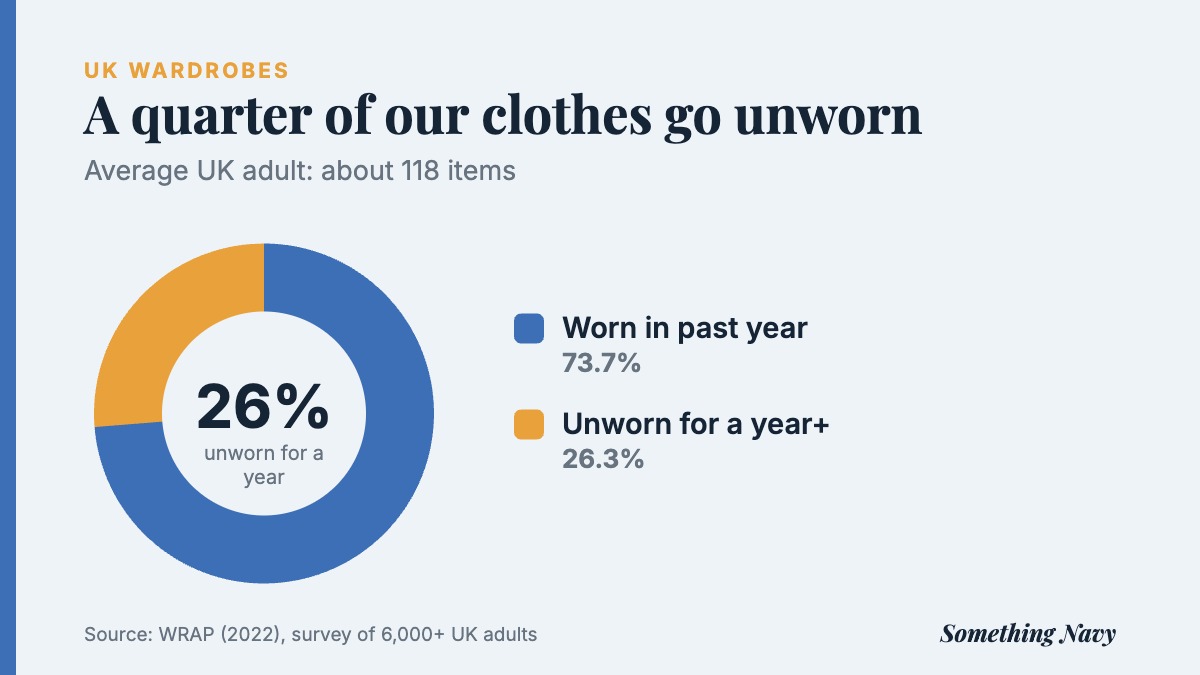
That feeling is not a sign you need more clothes. It is usually a sign you own plenty you never reach for. When the waste charity WRAP surveyed more than 6,000 UK adults about 45,000 garments, it found the average person owned around 118 items and had not worn roughly a quarter of them for at least a year.
A capsule wardrobe is the old, slightly unfashionable answer to that problem: a small set of clothes that all work together. What follows is not a list of “ten essentials” to buy. It is a method, with a history, some honest science and a 30-day plan for making it stick.
A London shop gave the idea its name
The phrase “capsule wardrobe” is usually credited to Susie Faux, who ran a boutique called Wardrobe in London’s West End in the 1970s. Her pitch to busy professional women was simple: buy a handful of good, interchangeable pieces and stop starting from scratch every season.
A decade later, the idea crossed the Atlantic and got a catwalk. In 1985 Donna Karan launched her own label in New York with a collection built around what she called “seven easy pieces”. As Fortune later described it, a bodysuit formed the base, with layers such as a wrap skirt, a tailored jacket and a cashmere jumper swapped on top so one outfit could carry a woman from the office to dinner.
Thirty-three things for three months
The modern revival owes most to Courtney Carver, an American writer who turned the concept into a challenge called Project 333. The rules are blunt: dress with 33 items for three months.
Those 33 include clothes, shoes, outerwear, accessories and jewellery. Underwear, sleepwear, lounge wear you only wear at home and workout clothes you genuinely only exercise in do not count, and neither does a wedding ring or a sentimental piece you never take off. Seasons conventionally start on 1 January, 1 April, 1 July and 1 October, though you can begin any day.
What makes Project 333 useful is not the number 33, which is arbitrary. It is the time limit. Three months is long enough to meet real weather and real deadlines, and short enough to feel like an experiment rather than a vow.
An experiment is much easier to start than a lifestyle.


The quarter of your wardrobe you never touch
Back to that WRAP survey, published in October 2022. Of the average adult’s 118 items, about 31 had not been worn in at least 12 months. Across the UK, the charity estimated, that adds up to 1.6 billion unworn garments.
The reasons people gave are revealing. Some clothes were kept “for occasions”, mostly dresses, skirts, formal trousers and coats. Others no longer fitted or were uncomfortable. A third group were things people liked but simply never prioritised. Dresses and skirts were the categories most likely to be owned but unworn.
None of these are moral failures. They are the residue of buying for an imagined life (the wedding, the smaller body, the person who irons) rather than the one you live. A capsule dresses the second.
What the research says about owning less
The biggest single piece of evidence is a 2014 meta-analysis led by Helga Dittmar at the University of Sussex, with Tim Kasser and colleagues, published in the Journal of Personality and Social Psychology. The team pooled 753 effect sizes from 259 independent samples to ask how materialistic values relate to personal wellbeing.
The answer was consistent: people who placed more weight on wealth, possessions and image tended to report lower wellbeing. The overall link for materialist values and beliefs was a correlation of about −0.19, which is small to moderate. It was strongest for risky health and consumer behaviours and for negative views of oneself, and weakest for life satisfaction.
Two caveats matter. First, these are mostly correlations, so they cannot show that wanting things makes people unhappy; unhappy people may also turn to shopping. The authors themselves called for more experimental and long-term studies. Second, the research is about values, not wardrobe size. Owning 30 garments will not rewire anyone’s priorities on its own.
Where the two connect is in a 2005 study by Kirk Warren Brown and Tim Kasser at the University of Rochester, published in Social Indicators Research. Across a sample of adolescents and a sample of adults, people with higher wellbeing also reported more ecologically responsible behaviour, and intrinsic values (relationships, growth, community) and mindfulness helped explain the link. Adults who followed a “voluntary simplicity” lifestyle reported greener behaviour too.
Read fairly, the research suggests a capsule wardrobe works best as an expression of what you value, not as a cure for unhappiness. That is a more modest promise. It is also one you can keep.
A capsule wardrobe will not make you happier. Caring less about what you own might, and the wardrobe is where you practise.
The planet keeps count of every wear
The environmental case is stronger and simpler. In its 2017 report A New Textiles Economy, the Ellen MacArthur Foundation found that clothing production had roughly doubled over the previous 15 years, while clothing utilisation, the average number of times a garment is worn before it stops being used, had fallen by 36%.
The same report estimated that less than 1% of the material used to make clothing is recycled into new clothing. Some garments, it noted, are discarded after just seven to ten wears.
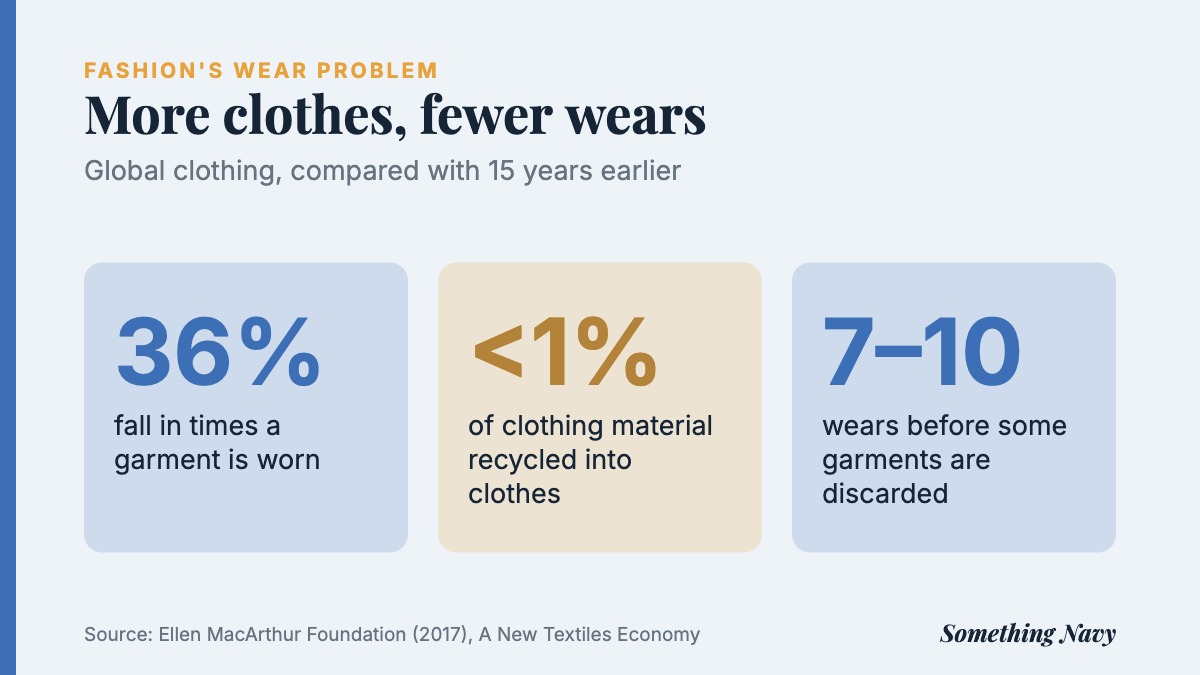
That makes wears per garment the most useful environmental figure you control. A capsule does not need organic labels to be greener. It just needs each piece to be worn a lot.
Build your capsule in seven steps
The method below borrows the time limit from Project 333, the “everything matches” rule from Faux and Karan, and a few ideas from habit research. Allow a free afternoon for steps one to four.
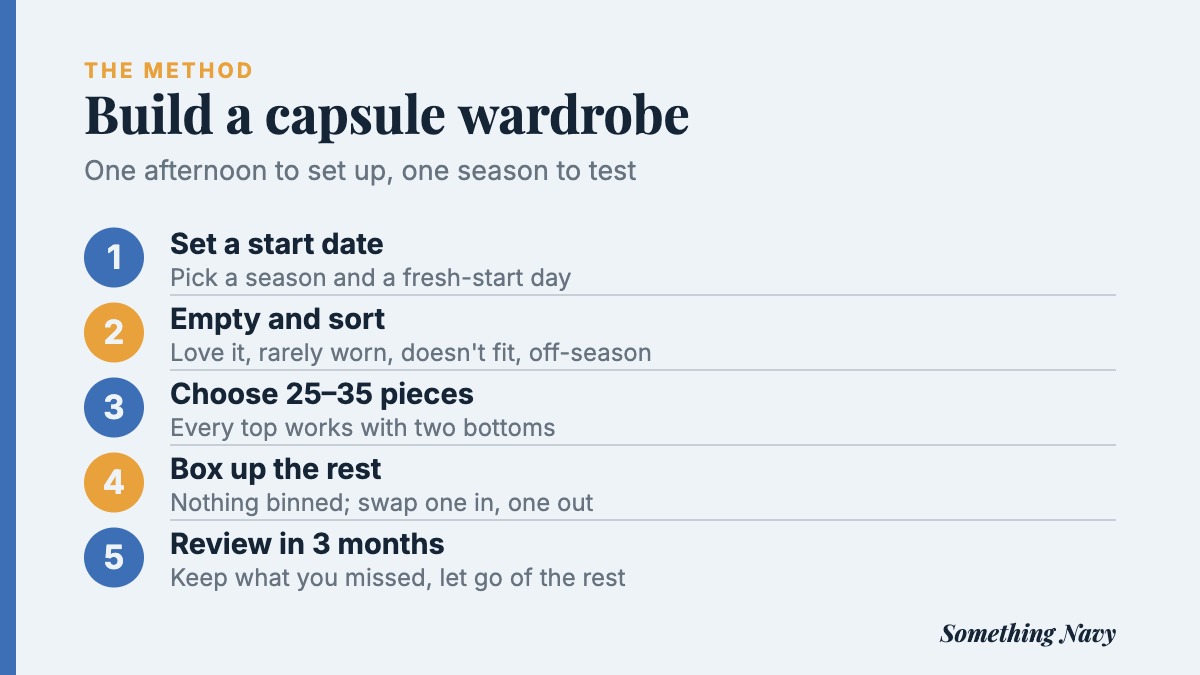
Step 1: Pick a start date and a season
Choose a date within the next fortnight and write it down. A Monday, a new month or the start of a season works well, because fresh-start moments make people more willing to begin new behaviour. Decide the season you are dressing for, since a July capsule and a January capsule are different animals.
Step 2: Empty everything out
Take every item out of the wardrobe, drawers and the chair in the corner, and put it on the bed. Seeing the whole pile at once is uncomfortable and useful.
Step 3: Sort into four piles
Love and wear, fits but rarely worn, does not fit, and out of season. Be honest about the second pile: these are WRAP’s “like it, but not a priority” items. Do not throw anything away yet. You are choosing, not purging.
Step 4: Choose your pieces
From the “love and wear” pile, choose 25 to 35 items that work together. Start with a colour base of two or three neutrals you already own most of, then add one or two accent colours. Every top should go with at least two bottoms. If a piece only works with one other thing, it is a costume, not a capsule item.
| Category | Pieces | What usually works |
|---|---|---|
| Tops and shirts | 9 | Plain tees, a couple of shirts, one smarter top |
| Knitwear | 3 | One crew neck, one cardigan, one warm jumper |
| Trousers, jeans, skirts | 5 | Dark jeans, tailored trousers, one skirt or shorts |
| Dresses or jumpsuits | 2 | One casual, one that works for events |
| Outer layers | 3 | A coat, a light jacket, one blazer |
| Shoes | 4 | Trainers, smart flats or boots, one seasonal pair |
| Bags and accessories | 4 | Everyday bag, belt, scarf, one statement piece |
Step 5: Box up the rest, don’t bin it
Everything not chosen goes into boxes or bags, out of sight. This is the step that makes the method feel safe. Nothing is lost, and if you genuinely miss something during the season you can swap it in, one for one.
Step 6: Set an if-then rule for shopping
Decide in advance what happens when you want to buy something. For example: “If I want a new item, then I wait 30 days and it must replace something in the capsule.” Rules written as if-then plans are easier to follow in the moment than vague intentions to “shop less”.
Step 7: Review at the end of the season
When the three months are up, open the boxes. Note what you missed, what you never wore from the capsule and what you were glad to see again. Some boxed items will go back in. The rest are now easy decisions.
Your first 30 days
The first month is where most capsules quietly collapse, usually in week two, when a rainy day or a party breaks the system. Here is what to do, week by week.
Your first 30 days checklist
- Days 1–3: Wear the outfits you are most confident about. Early wins make the habit feel possible.
- Days 4–7: Keep a note on your phone: every time you reach for something boxed, write it down. Do not swap yet.
- Week 2: Try three combinations you have never worn together. This is where a capsule starts to feel bigger than its count.
- Week 3: Make your first allowed swap if the same missing item has come up three times. One in, one out.
- Week 4: Count which pieces you have not worn at all. They are candidates to leave out next season.
- Day 30: Ask one question: was getting dressed easier or harder than last month? Write the answer down.
Expect it to take longer than a month to feel automatic. Research on how long habits take to form suggests the timeline varies a great deal from person to person and from habit to habit, which is another reason Project 333’s three-month window is sensible.
When the capsule starts to feel like a cage
Some people find a small wardrobe freeing. Others find it boring by week three. Both are normal.
Boredom usually means the capsule is too uniform: too many neutrals, nothing that feels like you. The fix is rarely to buy more. Restyle what you have, or rotate a boxed favourite back in.
The other trap is perfectionism. A capsule is not a test with a pass mark. If you hit 38 pieces, or keep a single dress for weddings outside the count, nothing breaks. The point is a wardrobe where you can see everything you own and you wear what you see.
What actually changes after a season
Finish a first season and something shifts. Mornings get faster, but that is not the main thing. You start to notice what you actually like, which colours you reach for, which fabrics feel good after eight hours and which trends you bought because everybody else did.
That knowledge is the real product of a capsule wardrobe. It quietly changes how you shop, because you start buying for the wardrobe you have rather than the person you imagine being.
The best capsule is not the smallest one. It is the one where every piece earns its hanger.
Frequently asked questions
There is no correct number. Project 333 uses 33 items including shoes and accessories, while many people settle between 25 and 40; the time limit and the rule that pieces mix together matter more than the count.
No. Box up everything outside the capsule and keep it for at least one season. Deciding what to donate is much easier once you know what you genuinely missed.
Yes. Treat uniforms and gym kit as outside the count, and build a separate capsule for each season so you are never forcing a summer dress through a British January.
It can be, mainly because it raises how often each item is worn. Wearing clothes for longer is the simplest way to cut the waste behind the 36% fall in clothing utilisation the Ellen MacArthur Foundation reported.
Sources
- Brown, K. W., & Kasser, T. (2005). Are psychological and ecological well-being compatible? The role of values, mindfulness, and lifestyle. Social Indicators Research, 74(2), 349–368. DOI
- Carver, C. (n.d.). Project 333: The rules. Be More With Less. Link
- Dittmar, H., Bond, R., Hurst, M., & Kasser, T. (2014). The relationship between materialism and personal well-being: A meta-analysis. Journal of Personality and Social Psychology, 107(5), 879–924. DOI
- Ellen MacArthur Foundation. (2017). A new textiles economy: Redesigning fashion’s future. Link
- Fortune. (2015, July 1). How Donna Karan killed the power suit. Link
- WRAP. (2022, October 7). Nation’s wardrobes hold 1.6 billion items of unworn clothes. Link
Updated 17 October 2026: we rewrote this article with new research, figures and sources. Cover photo: Alyssa Strohmann on Unsplash. Charts and graphics: Something Navy.
How we reported this. We went back to the original research for this story, 6 sources in all, listed above, and checked every figure against them. If you think we have got something wrong, tell us and we will look at it. Read more about how we work.