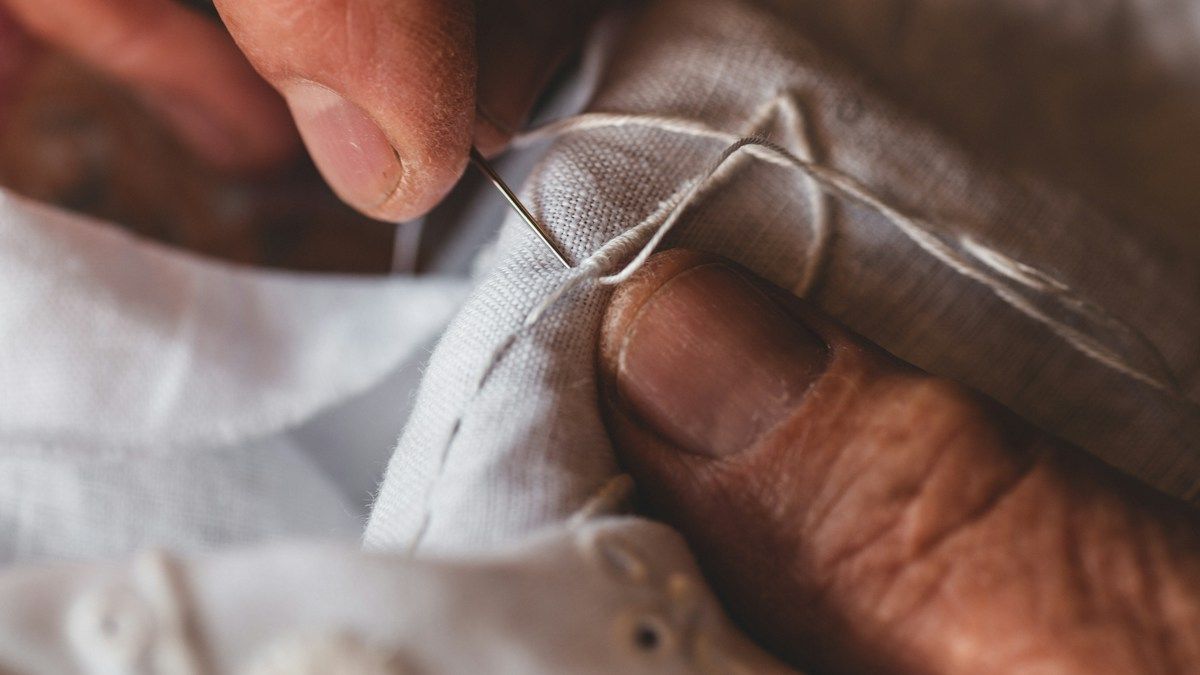
The button has been sitting in the little dish by your bed for three weeks. The shirt it belongs to is hanging in the wardrobe, unworn, quietly judging you.
Then one evening you thread a needle, make eight passes through four holes, wind the thread round the shank and tie it off. Ten minutes. The shirt is back in rotation, and you feel a small, slightly ridiculous glow of pride.
That glow is worth paying attention to. Survey research on people who knit, stitch and make things with their hands keeps finding the same pattern: making is linked with feeling calmer, more capable and more as if life is worthwhile. And keeping clothes in use for longer is one of the most effective things an ordinary household can do about the environmental cost of fashion.
This guide covers both: why mending and customising feels the way it does, why it matters more than it looks, and six projects to try at home, ordered from “I have never held a needle” to “I own a seam ripper and I am not afraid to use it”.
The small glow after a ten-minute fix
The biggest recent study on this comes from Anglia Ruskin University. In 2024, psychologist Helen Keyes and colleagues analysed answers from 7,182 adults in England who took part in the government’s Taking Part survey between April 2019 and March 2020. People were asked whether, in the past year, they had done any creative arts or crafts, including textile crafts, wood crafts, pottery and painting. Just over a third (37.4%) said yes.
After the team controlled for age, health, deprivation, gender and employment, crafters reported higher happiness, higher life satisfaction and a stronger sense that life was worthwhile. That last link was the strongest, and in their model it was bigger than the link with having a job.
That is a striking headline, so here is the honest small print. The study is correlational: happier people may simply be more likely to pick up a hobby. Each wellbeing question was a single item, and the authors themselves describe the effects as small. Crafting did not predict lower anxiety or loneliness at all.
Still, small and consistent is not nothing.

What stitchers say the needle does for them
Earlier studies looked more closely at textile makers. In 2013, Jill Riley of Cardiff University, with Betsan Corkhill and Clare Morris, ran an online survey of 3,545 knitters around the world, published in the British Journal of Occupational Therapy. People knitted mainly to relax, to relieve stress and to be creative. Those who knitted more often were more likely to say they felt calm and happy, and knitting in a group was linked with feeling happier and more socially connected.
Two years earlier, Ann Futterman Collier at Northern Arizona University surveyed 821 women who work with textiles. Most reported high mastery of several techniques. Among their most important reasons for making were aesthetic appeal, feeling grounded and coping. Women who deliberately turned to textile work to shift a difficult mood reported more rejuvenation, engagement and success than those who did not.
Both samples were self-selected enthusiasts recruited through craft networks, so they tell us how keen makers feel, not what would happen if you handed a needle to a random stranger. But the themes line up with long-standing psychology. Repetitive, absorbing handwork with a clear goal and instant feedback is close to what Mihaly Csikszentmihalyi called flow: that state where you look up and an hour has gone. And finishing something tangible feeds a basic need to feel competent.
A mended hole is a tiny, visible proof that you can fix things.
There is a calmer, slower kind of attention involved too. You cannot scroll while you are threading a needle. If you have ever found that a change of setting shifts how your mind works, a lap full of fabric does something similar.
Nine extra months, a much smaller footprint
Now the part that makes a ten-minute button job feel bigger than it is.
The UK charity WRAP has been measuring the clothing economy for well over a decade, and its most striking finding is also its simplest.
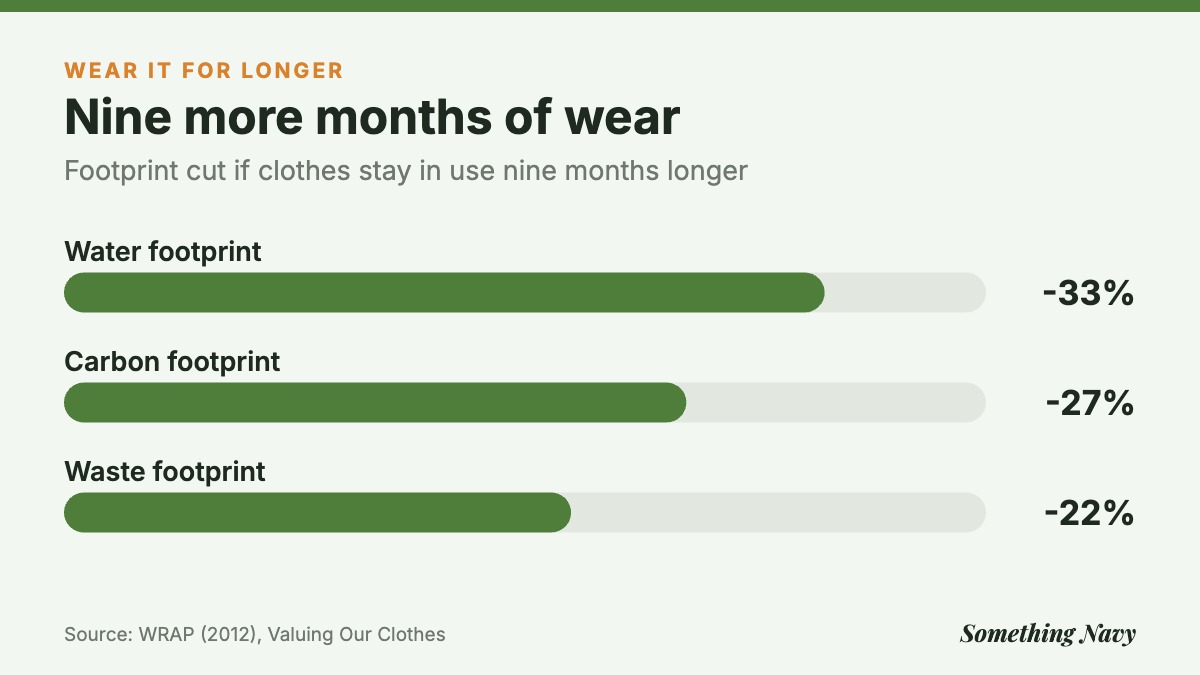
The fix with the biggest payoff is not recycling. It is simply wearing things for longer. The landmark Valuing Our Clothes report modelled what would happen if the average garment stayed in active use for nine months longer, about a third more of its life. The carbon footprint fell by 27%, the water footprint by 33% and the waste footprint by 22%. The report called extending clothing life the single most significant intervention available.
The same report found that around 30% of the clothes in an average UK wardrobe had not been worn for at least a year, mostly because they no longer fitted. That is a lot of garments waiting for a hem, a tuck or a new idea.
Does a repair really stop you buying new?
A fair question. If you mend a jumper and then buy a new one anyway, the planet gains little.
In February 2025, WRAP published Displacement Rates Untangled, which used data from six businesses, including repair services and resale platforms, to estimate how often a repaired or second-hand item replaces a new purchase. For repairs the answer was 82.2%: roughly four in every five repaired items stand in for something you would otherwise have bought. For second-hand purchases it was 64.6%.
WRAP estimated that repairing one cotton T-shirt instead of replacing it saves more than 7.5kg of CO2 equivalent. Fixing a hole in a wool jumper saves over 16kg, and a rip in a waterproof jacket over 45kg.
These are modelled estimates, built on business data rather than tracking individual wardrobes, so treat the exact figures as ballpark. The direction is clear, though. The most sustainable garment is usually the one already hanging in your wardrobe. (If you want the money side of that argument, our guide to wardrobe basics and cost per wear does the maths.)
Before you pick up the scissors
A few habits make home projects far more likely to succeed.
Try this first
- Start with something you like but don’t love. Your favourite jacket is not a practice piece.
- Wash and iron before you cut or stitch. Fabric that shrinks afterwards will pucker your work.
- Read the care label. Natural fibres (cotton, linen, wool) take dye and darning best; synthetics can be fussy.
- Practise on an offcut. Five minutes on a scrap saves an hour of unpicking.
- Stop while it’s still fun. A half-finished patch tomorrow beats a botched one tonight.
Here is the whole line-up at a glance.
| Project | Skill level | Time | Kit |
|---|---|---|---|
| Sew on a button | Beginner | 10 min | Needle, thread, button |
| Visible darn | Beginner | 30–45 min | Darning needle, wool, darning mushroom |
| Sashiko-style patch | Beginner to intermediate | 1–2 hrs | Thick thread, patch fabric, pins, chalk |
| Hem trousers or a skirt | Intermediate | 1–1.5 hrs | Tape measure, pins, iron, thread |
| Kitchen-scrap dye | Intermediate | An afternoon plus overnight | Old pot, onion skins or avocado stones, alum |
| Take in a shirt or blazer | Confident | 2–3 hrs | Seam ripper, pins, machine or hand backstitch |


Six projects to try at home, easiest first
1. Sew a button back on properly
Time: 10 minutes. You need: a sharp needle, thread to match (or deliberately not), the button, and a pin or matchstick.
Double the thread and knot the end. Lay a pin across the top of the button and sew over it, so the stitches have a little slack. Remove the pin, wrap the thread a few times around the stitches under the button to make a shank, then finish on the back with three small stitches. That shank is the difference between a button that lasts a week and one that lasts years.
Want to customise rather than just repair? Swap every button on a tired cardigan for mismatched vintage ones. It is the fastest makeover in this list.
2. Darn a hole so it shows
Time: 30 to 45 minutes. You need: a blunt darning needle, wool in a contrast colour, and a darning mushroom (an orange or a lightbulb-shaped ladle works).
Visible darning turns a moth hole into decoration. You are essentially weaving a tiny patch of new fabric across the gap.
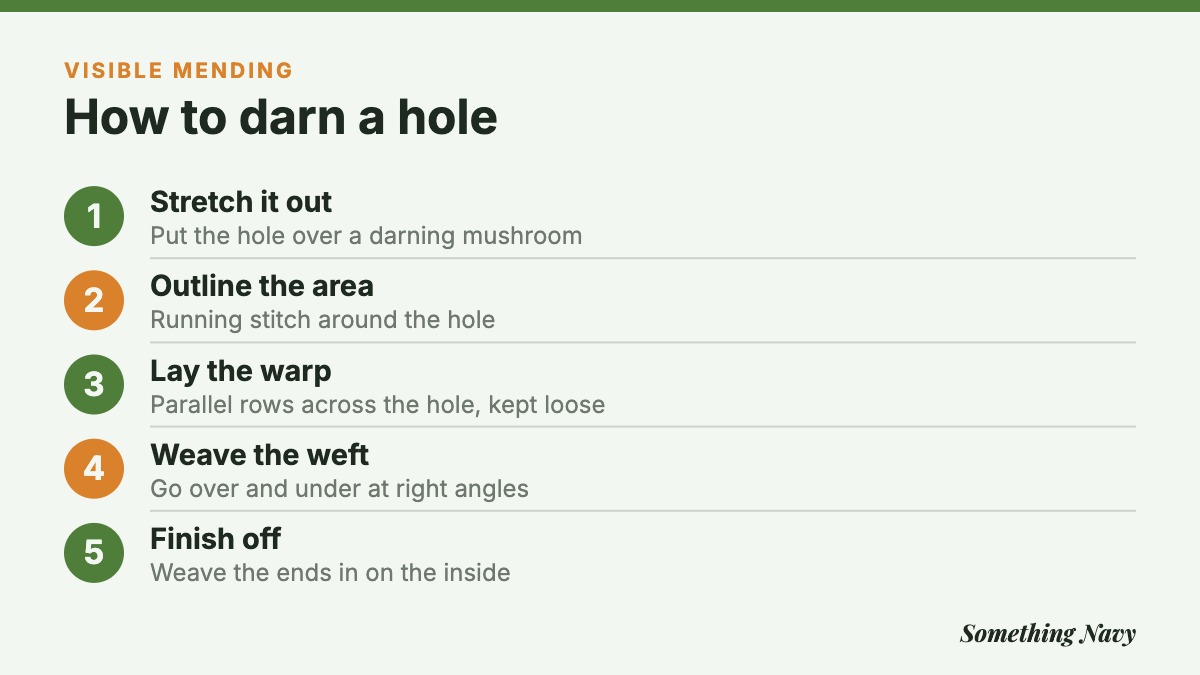
Keep your stitches loose. The commonest beginner mistake is pulling the weave tight, which puckers the knit around the darn. Socks, jumper elbows and cuffs are perfect first targets.
3. Patch jeans with sashiko-style stitching
Time: 1 to 2 hours. You need: thick cotton thread (sashiko or embroidery thread), a long needle, a scrap of sturdy fabric, pins and tailor’s chalk.
Sashiko is a Japanese tradition of running stitch used to reinforce and decorate cloth. For a worn knee or a thin inner thigh, pin a patch on the inside of the jeans, chalk parallel lines about 5mm apart on the outside, and work rows of even running stitch through both layers.
The result is stronger than the original denim and looks deliberate. It also slots neatly into the wider revival of heritage and handcrafted styles, where the visible hand of the maker is the whole point.
4. Hem trousers or a skirt
Time: about an hour. You need: a tape measure, pins, an iron, matching thread and a friend (or a long mirror).
Put on the shoes you will wear with them and pin the new length. Unpick the old hem, trim, leaving 3 to 4cm to fold, press a narrow first fold and then the full hem, and slip-stitch by hand so the stitches barely show on the right side.
Hemming rescues a surprising number of the “doesn’t fit” items WRAP found languishing in wardrobes. It is also the skill that makes a capsule wardrobe work, because a few well-fitting pieces beat a rail of near misses.
5. Refresh a faded top with kitchen-scrap dye
Time: an afternoon, plus soaking overnight. You need: a large pot you will not cook in again, a handful of onion skins or a few cleaned avocado stones, alum (a mordant, sold by craft suppliers), rubber gloves and a natural-fibre garment.
Pre-treat the garment in an alum bath so the colour bonds to the fibre. Simmer the scraps in water for an hour, strain, add the damp garment and keep it at a gentle simmer, then leave it to cool in the dye overnight. Onion skins tend towards warm golds and ambers; avocado stones towards soft, dusty pinks.
Results vary with fibre, water and quantities, which is half the charm. Dye works best on cotton, linen, silk and wool, and it is a forgiving way to hide a stubborn stain.
6. Take in a shirt or blazer for a better fit
Time: 2 to 3 hours. You need: a seam ripper, pins, chalk, and either a sewing machine or patience for hand backstitch.
Turn the garment inside out and put it on. Pin along the side seams until it fits the way you want, chalk a smooth new line, then sew along it, tapering gently into the original seam at the armpit and hem. Try it on before you trim anything.
This is the project that turns a too-big charity-shop find into something that looks made for you. If you are buying second-hand, our guide to ethical fashion and why it matters is a good companion read.
When a garment really is beyond rescue
Some things cannot be saved, and that is fine. What matters is where they go next.
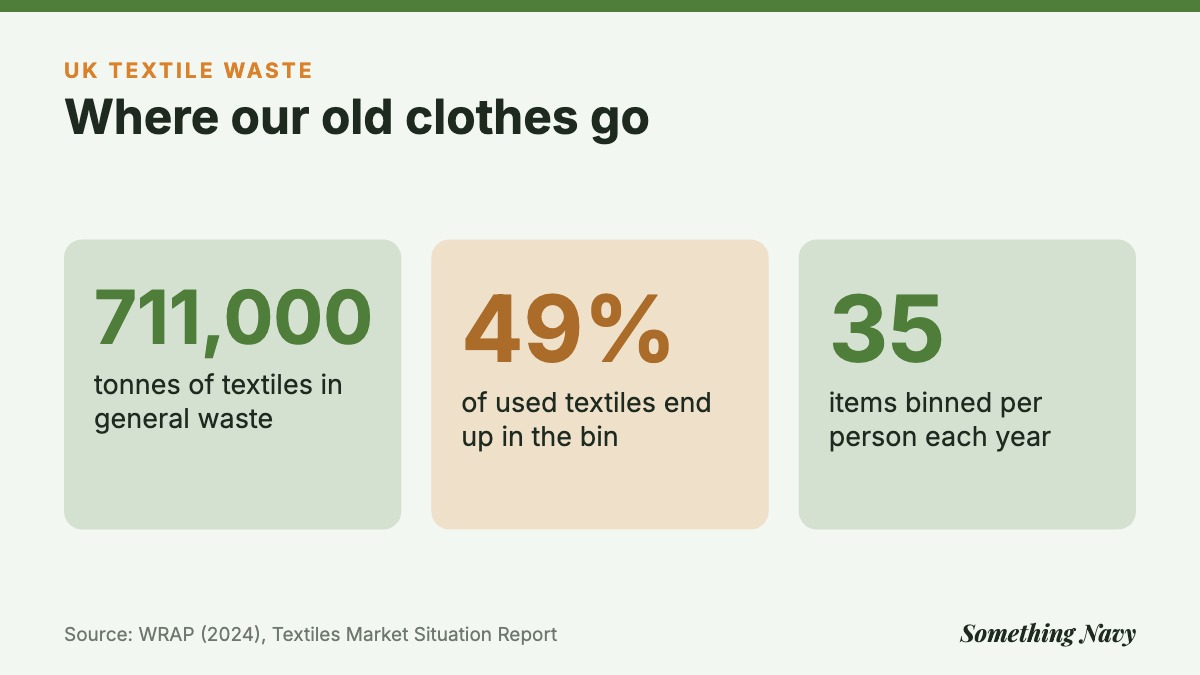
WRAP’s Textiles Market Situation Report 2024 estimated that the UK bought 1.42 million tonnes of new textiles in 2022. In 2021, around 711,000 tonnes of used textiles ended up in general household waste. That is almost half (49%) of everything we discard, roughly 35 items per person per year. Of the textiles binned in England, 84% were incinerated and 11% went to landfill.
So pass wearable pieces on through swaps, resale or charity shops, cut the truly worn-out ones into cleaning rags or patch fabric for your next project, and take the rest to a textile bank rather than the bin.
Make it a habit rather than a heroic weekend
The research hints at something useful here. In the Riley survey it was frequency, not virtuosity, that tracked feeling calm and happy, and group knitting was linked to better social contact. So the best approach is little and often.
- Keep a small mending kit where you sit in the evenings, not in a cupboard.
- Make a “to fix” basket and pull one item out each week.
- Pair it with something you already do, such as one podcast episode, one darn.
- Find a local repair café or sewing group. The social side may be part of the benefit.
You do not need to become a seamstress. You only need to stop treating a loose button as the end of a garment’s life.
Every repair is a small vote for keeping what you already own. And it comes with a quiet bonus: the next time you put that shirt on, you will remember you fixed it yourself.
Frequently asked questions
No. Every project in this guide can be done by hand, and hand stitching is often easier to control for small repairs. A machine mainly saves time on long seams.
Large surveys link crafting with higher happiness and a stronger sense that life is worthwhile, but they show association, not proof of cause. Many makers say it helps them relax and cope with low moods.
Stable woven cottons and denim are the most forgiving. Stretchy knits and slippery synthetics are trickier, so leave them until you have a few projects behind you.
Pass wearable items on through charity shops, swaps or resale, and take worn-out textiles to a textile bank rather than the general bin, where they will almost certainly be burned or buried.
Sources
- Keyes, H., Gradidge, S., Forwood, S. E., Gibson, N., Harvey, A., Kis, E., Mutsatsa, K., Ownsworth, R., Roeloffs, S., & Zawisza, M. (2024). Creating arts and crafting positively predicts subjective wellbeing. Frontiers in Public Health, 12, 1417997. DOI
- Riley, J., Corkhill, B., & Morris, C. (2013). The benefits of knitting for personal and social wellbeing in adulthood: Findings from an international survey. British Journal of Occupational Therapy, 76(2), 50–57. DOI
- Collier, A. F. (2011). The well-being of women who create with textiles: Implications for art therapy. Art Therapy, 28(3), 104–112. DOI
- WRAP. (2012). Valuing our clothes: The true cost of how we design, use and dispose of clothing in the UK. Link
- WRAP. (2024). Textiles Market Situation Report 2024. Link
- WRAP. (2025). Displacement Rates Untangled. Link
Updated 17 October 2026: we rewrote this article with new research, current figures and sources. Cover photo: Elio Santos on Unsplash. Charts and graphics: Something Navy.
How we reported this. We went back to the original research for this story, 6 sources in all, listed above, and checked every figure against them. If you think we have got something wrong, tell us and we will look at it. Read more about how we work.