
It is 11.48pm and the notification has been sitting there all evening: it is their birthday. You have typed “Happy birthday!” and deleted it. You have tried “Happy birthday, hope it’s a good one x” and then agonised over the x.
You broke up two years ago. It was, everyone agreed, very grown-up. You said you would stay friends, and for a while you did, in the loose way of liking each other’s holiday photos. Now the cursor blinks, and you are not sure whether sending this is kindness, habit or something you would rather not name.
Twelve minutes until midnight. Is this a friendship, or a door you keep leaving ajar?
How common is staying friends with an ex?
More common than the agonising suggests. In 2017 Rebecca Griffith, Omri Gillath and colleagues at the University of Kansas published two linked studies in Personal Relationships. In the first, 59% of 288 adults aged 18 to 62 said they had stayed friends with an ex. In the second, with 536 people, the figure was 65%.
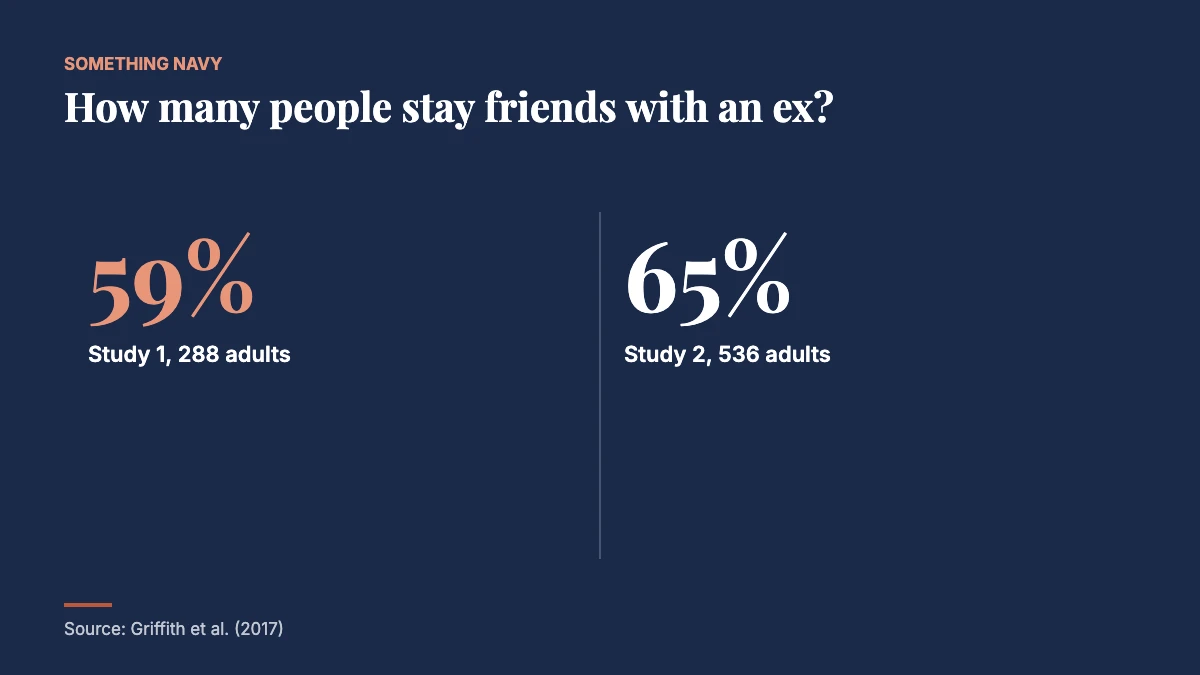
A majority, then. But the first sample was mostly students at a Midwestern university, and “staying friends” covers everything from weekly coffee to an annual birthday message. Being good friends is a much harder claim.
Why people stay friends with an ex: four motives
Griffith’s team asked participants to rate 29 possible reasons for keeping an ex in their lives, then sorted the answers statistically. Four motives emerged.
Security covers the emotional pull: the ex still offers support, advice and trust. Practical reasons are about logistics and resources, such as money, shared friends, a pet or a child. Civility is about politeness and not wanting to hurt the other person’s feelings. The fourth, unresolved romantic desire, is the one people rarely admit out loud: not wanting to be alone, not wanting to lose the sex, or simply still having feelings.
A second study, a similar picture
Justin Mogilski and Lisa Welling of Oakland University in the US came at the question from a different angle in a 2017 paper in Personality and Individual Differences. They first asked 348 volunteers, average age about 21, to list reasons people stay friends with an ex, and grouped the answers into seven themes. A separate group of students then rated how important each reason was on a 1 to 5 scale.
Reliability and sentimentality came out on top: the sense that the ex is dependable, trustworthy and means something to you. Pragmatic reasons, like an ex’s money or connections, were rated least important. Men gave more weight than women to pragmatic reasons and to keeping sexual access, although the gap shrank to a slight one once personality was taken into account. People higher in antagonism, a tendency towards manipulative behaviour, rated practical reasons more highly, as did more extraverted people. People with more negative emotionality leaned towards sentimental reasons and lingering attraction, which the researchers suggested may be a way of easing the distress of a break-up.
The study measured general attitudes rather than real friendships, in mostly young, heterosexual students. Still, the headline is reassuring: most of us say we stay friends because the person was genuinely good to have around.
Are friendships with exes as good as other friendships?
Here the evidence gets less flattering. In a 2000 study, Schneider and Kenny asked people who had two kinds of opposite-sex friend, one an ex and one who had never been a partner, to rate both in the Journal of Social and Personal Relationships. The platonic friendships came out better. The ex friendships carried more negative qualities and more romantic desire. The authors concluded the relationship was “qualitatively different from a platonic cross-sex friendship.”
That does not make it worthless, just different, and it helps to stop expecting it to feel like your oldest school friend.

What makes a post-breakup friendship stronger
Amy Busboom and colleagues surveyed college students about a former partner for a 2002 paper in Personal Relationships. Using social exchange theory, which treats relationships as a running ledger of rewards and costs, they found that students who still received more resources from their ex reported higher-quality friendships, and how satisfied they were with those resources seemed to matter too.
Three barriers dragged quality down: friends or family who disapproved, being in a new romantic relationship, and having ended things by neglect, simply letting the relationship wither.
That last point echoes earlier work. In 1989 Sandra Metts, William Cupach and Richard Bejlovec asked students to recall a romance that had ended or turned into a friendship. Being friends before the romance predicted a friendship after it, whether a person had done the breaking up or been on the receiving end. How you leave mattered too. Initiators who withdrew, or who felt they had been taken advantage of, ended up less friendly. Those on the receiving end stayed friendlier when the break-up had a positive tone and less friendly when it involved manipulation.
A longitudinal study adds a useful twist. Kenneth Tan and colleagues followed 143 young adults who were in relationships at the first survey and had broken up by the second, reporting their findings in 2015. The more committed someone had been before the split, the closer the former partners stayed afterwards.


Who manages to stay friends with an ex?
Griffith’s studies identified several predictors: sex, sexual orientation, attachment style, personality, time since the break-up and the reason for it. Men were more likely to stay friends in the first study, but the difference vanished in the second. More agreeable and less extraverted people were more likely to stay friends, as were LGBTQ participants, who were also more likely to cite security as their reason, something one news report linked to smaller communities.
Attachment style, the pattern of security or worry we bring to close bonds, also mattered, in a counterintuitive direction. People higher in avoidant attachment and lower in anxious attachment were more likely to stay friends. Anxious attachment, by contrast, predicted staying friends out of unresolved romantic desire in both samples. If you recognise yourself in our guide to attachment styles, that is worth sitting with before you hit send.
The shape of the friendship over time matters too. Jody Koenig Kellas and colleagues asked people to chart their post-break-up relationship over time and mark its turning points, publishing the results in 2008. The paths varied, with decline a common pattern, and the shape of the path was linked to how well people adjusted. Those whose relationship with the ex climbed upwards reported more satisfying relationships with their ex than those on flat or declining paths.
A friendship with an ex works best when it is about who they are now, not who they used to be to you.
When staying friends may do more harm than good
The clearest finding is about motive. In Griffith’s work, friendships kept up for security or practical reasons were linked to positive outcomes, such as feeling secure and happy. Friendships driven by unresolved romantic desire were linked to the worst ones: heartbreak, more depression, jealousy, tension in the wider friend group, and greater difficulty making new friends or finding a new partner. According to the paper’s abstract, friendships held together by practical ties or civility were less likely to last in the long run, which makes sense once the shared flat is sold or the politeness wears thin. (A Live Science report on the same research described these friendships as the more durable ones, so treat this detail with some caution.)
A 2026 study points the same way. René Dailey and colleagues followed 272 adults who had broken up within the previous 30 days, surveying them once at the start and then monthly for five months, and reported the results in Personal Relationships. Among the 143 who stayed single throughout, wanting to get back together was one of the most consistent predictors of how distress changed over time, alongside relational anxiety and coping by self-medicating. The authors call it a preliminary test with limited statistical power. It does not look at friendship directly, but it adds weight to the idea that hoping for a reunion keeps a break-up raw.
What about the new partner?
Here the research is thin, because few studies ask the person who arrives later. What exists comes from the other side: Busboom’s team found that being in a new relationship was a barrier to a good friendship with an ex, and in Griffith’s studies, lingering romantic feelings went with finding it harder to start a new romance at all. In practice, a friendship you would be uncomfortable describing to a new partner is probably carrying more than friendship.
If you decide to step back, do it kindly. Fading out without a word may feel easier, but as we explored in why ghosting hurts, silence tends to leave the other person with more questions than a short, honest message would. And if the loss still stings, our piece on friend break-ups looks at why ending any friendship can hurt.
Questions to ask yourself before you hit send
- Would I want this friendship if we had never dated?
- Do I feel calm or unsettled after we talk?
- Am I secretly hoping this leads back to us?
- Could I tell a new partner, honestly, everything about how we keep in touch?
- Were we friends before we were a couple?
- Is this contact for them, for me, or for appearances?
- Has enough time passed that I can hear about their new partner without a jolt?
So, should you send the birthday message?
The research offers no rule, but it does offer a test. If the friendship rests on trust, shared history or a practical tie you both handle well, and especially if you were friends first, it can be a good thing in its own right. If, while your thumb hovers over the screen at 11.58pm, part of you is waiting to see whether they reply with an x, the studies suggest the kinder message, for both of you, might be no message at all.
Frequently asked questions
Yes. In two University of Kansas studies published in 2017, 59% and 65% of participants said they had stayed friends with a former partner, though the quality of those friendships varied.
Studies suggest friendships based on trust, support and genuine enjoyment of each other tend to go best. Friendships kept alive by unresolved romantic feelings are linked to more heartbreak, jealousy and difficulty moving on.
Yes. A 1989 study found that being friends before the romance predicted friendship after the break-up, for both the person who ended things and the person who was left.
Official links and research
- Busboom, A. L., Collins, D. M., Givertz, M. D., & Levin, L. A. (2002). Can we still be friends? Resources and barriers to friendship quality after romantic relationship dissolution. Personal Relationships, 9(2), 215-223. DOI
- Dailey, R. M., Zhang, Z., Zhong, L., Kearns, K., Varga, S., & Lee, S. (2026). A preliminary test of the comprehensive model of post-dissolution distress: Predicting initial and over time changes in distress following romantic dissolution. Personal Relationships, 33(3), e70085. DOI
- Griffith, R. L., Gillath, O., Zhao, X., & Martinez, R. (2017). Staying friends with ex-romantic partners: Predictors, reasons, and outcomes. Personal Relationships, 24(3), 550-584. DOI
- Koenig Kellas, J., Bean, D., Cunningham, C., & Cheng, K. Y. (2008). The ex-files: Trajectories, turning points, and adjustment in the development of post-dissolutional relationships. Journal of Social and Personal Relationships, 25(1), 23-50. DOI
- Metts, S., Cupach, W. R., & Bejlovec, R. A. (1989). “I love you too much to ever start liking you”: Redefining romantic relationships. Journal of Social and Personal Relationships, 6(3), 259-274. DOI
- Mogilski, J. K., & Welling, L. L. M. (2017). Staying friends with an ex: Sex and dark personality traits predict motivations for post-relationship friendship. Personality and Individual Differences, 115, 114-119. DOI
- Schneider, C. S., & Kenny, D. A. (2000). Cross-sex friends who were once romantic partners: Are they platonic friends now? Journal of Social and Personal Relationships, 17(3), 451-466. DOI
- Tan, K., Agnew, C. R., VanderDrift, L. E., & Harvey, S. M. (2015). Committed to us: Predicting relationship closeness following nonmarital romantic relationship breakup. Journal of Social and Personal Relationships, 32(4), 456-471. DOI
Cover photo: Kev Costello on Unsplash. Charts and graphics: Something Navy, with photography by Alinson torres on Unsplash.
How we reported this. Every figure was checked against the 8 sources above. Reviewed by Valentino Adkins, Senior Content Manager. Report an error · How we work