

You are 38, it is ten in the morning in Seville, and you have rehearsed the sentence three times in the queue. Un café con leche, por favor. You say it. The barista replies with something fast and friendly that contains at least four words you have never heard, possibly a question about milk, possibly about the weather.
You nod. You say sí to whatever it was. A glass arrives, which is not what you expected, and you pay with a note far too large because counting out coins in Spanish feels like a second exam.
Walking back to the hotel, a familiar thought arrives with the caffeine. You should have done this at school. Your brain, surely, has had its window and closed it. Children soak languages up; you, apparently, drip-feed them.
It is a common belief, and it is half right. The other half is the interesting part.
Is there a critical period for learning a language?
The idea that language has a deadline is old. Researchers call it the critical period hypothesis: the claim that the brain is primed to acquire language during childhood, and that the door narrows, or slams, somewhere around puberty. For decades the evidence came from fairly small groups of immigrants, compared by the age at which they arrived in a new country.
The 1989 study that set the terms
The most cited of these is a 1989 paper in Cognitive Psychology by the psychologists J. S. Johnson and E. L. Newport. They tested 46 native speakers of Korean and Chinese who had moved to the United States at ages ranging from 3 to 39, asking them to judge whether spoken English sentences were grammatical.
The pattern was stark: the earlier people had arrived, the better they did, with those who came as young children outscoring those who came after puberty. For a generation of linguists, this was the picture. Early arrival, native-like grammar; late arrival, a lifelong set of small, stubborn errors.
Forty-six people, though, is a thin base for a claim about all of humanity, and a 2005 partial replication by Heekyung Seol, published through Columbia University, found only “modest support” for a critical period. The question needed a much bigger sample.
What the 669,498-person grammar quiz found
In 2018 Joshua Hartshorne, Joshua Tenenbaum and Steven Pinker got one, in the most modern way possible. They put an online English grammar quiz in front of people via Facebook and other social media, and ended up with data from 669,498 native and non-native English speakers, which they published in the journal Cognition. Earlier studies of this kind, Hartshorne pointed out, had usually tested no more than 250 people.
Participants also reported their age and when they first met English, which let the researchers build a model that pulled apart three things usually tangled together: current age, starting age and years of practice.
The headline number: 17.4
Their best-fitting model said the ability to learn grammar stays strong for much longer than many had assumed, until about 17.4 years old, and then declines steadily. The decline showed up for difficult grammar and also for the easy structures that children normally master early.
That sounds like bad news for anyone over 18, and in one narrow sense it is. In the data, people who started English after about age 10 or 12 never quite reached the level of earlier starters. Learning takes so long that even young teenagers ran out of runway before the decline set in.
The study measured how close you can get to a native speaker’s grammar, not whether you can order lunch, argue about football or fall in love in a second language.
Notice what the study did not measure. It was a written test of subtle grammatical judgements, and it said nothing about whether late learners can hold a conversation, read a novel or make friends. The researchers also noted that learning seemed to keep inching upward for a very long time: in Bruce Bower’s write-up for Science News Explores, they estimated that English learning tended to take about 30 years to fully level off.
The argument that is still running
Not everyone accepts the sharp cut-off. In 2021, a team led by F. van der Slik reanalysed the same public data in Language Learning and argued that it fitted a steady, gradual decline better than a cliff edge, at least for some types of learners. In 2024, Hartshorne published a rebuttal in Language Development Research, arguing that the reanalysis had tested a different question and contained conceptual and mathematical errors, and that every type of bilingual learner examined still showed a sharp drop in late adolescence.
Other researchers raised gentler caveats at the time. David Barner of the University of California, San Diego, called the paper “a first foray” and questioned whether an online quiz reflects how well people actually speak. Newport, now at Georgetown University, pointed out that because nobody under the age of 7 was tested, the study could not say how long learning English really takes.
For an adult weighing up Spanish lessons, this academic wrestling match is oddly reassuring. Both sides agree that learning ability drops with age and disagree about the shape of the drop. Neither claims it falls to zero.

Adults learn faster at first: the Dutch study that surprised everyone
Here is a finding that rarely makes the dinner-party version of the story. In the first months, adults are often quicker than children.
In 1978 the psychologists C. E. Snow and M. Hoefnagel-Höhle published a study in Child Development that followed English speakers who had moved to the Netherlands and were learning Dutch. They tested children, teenagers and adults, the youngest aged just 3 to 5, three times over their first year in the country, using a range of language tests.
The results upended expectations. The teenagers and the adults made the fastest progress in the first few months. The youngest children, aged 3 to 5, scored lowest on every test. By the end of the year, the 8 to 10 and 12 to 15 year olds had the best command of Dutch, and the authors concluded that their data did not support the critical period hypothesis.
How can both studies be right? Snow’s study tracked a single year; Hartshorne’s model was about where people end up after decades. Adults are good at the first stretch because they bring tools children lack: they can read, use a dictionary and sit through a lesson. Children win the marathon, partly through ability and partly through sheer exposure. An eight-year-old in a Dutch school is surrounded by Dutch all day and cannot switch to English with colleagues.


Accent, grammar and vocabulary are three different races
The “too late” debate goes in circles partly because people rarely say which part of a language they mean. Age weighs on the pieces quite differently.
Accent: the hardest to shift
A 1999 study in the Journal of Memory and Language by Flege, Yeni-Komshian and Liu, from the University of Alabama at Birmingham and the University of Maryland, looked at 240 native Korean speakers who had moved to the United States between the ages of 1 and 23, and had lived there for an average of 15 years. Listeners rated their English for foreign accent, and accent grew stronger the later people had arrived.
You can become fluent, even eloquent, and still be asked within a sentence where you are from. A native-like accent is the least likely prize for an adult starter.
Grammar: more about schooling and use than age alone
The same Flege study had a twist. Grammar scores also dropped as age of arrival rose, but once the researchers accounted for factors bundled up with arrival age, the age effect on grammar was no longer statistically significant. Rule-based grammar (the regular patterns you can learn and apply) tracked how many years of American schooling people had received. Grammar tied to specific words tracked how much people actually used English.
For grammar, then, what you do with the language may matter as much as when you started, which is something adults can act on.
Vocabulary: the open door
None of the big age studies discussed here was designed to test vocabulary, so none of them shows a deadline for learning words. Nothing in this research suggests that the vocabulary of a second language is closed to grown-ups, and it is the part of a language where steady, unglamorous effort is easiest to see.
An adult will probably always sound a little foreign, and that is a far smaller problem than never speaking at all.
Do language apps like Duolingo actually work?
If a green owl on your phone nags you about your streak, you are in large company. The research on these apps is thinner than the marketing suggests, and much of it was paid for by the companies.
The 34-hour claim
The most quoted figure comes from a 2012 report by Roumen Vesselinov, an assistant professor of statistics at Queens College, City University of New York, and his co-author J. Grego. It concluded that, for English speakers learning Spanish, an average of about 34 hours on Duolingo covered the same ground as a first university semester. As VICE reported in 2017, this was an experiment commissioned by Duolingo itself, and it measured progress with WebCAPE, a text-based online quiz. Vesselinov said it would be good to test oral proficiency too, and while beginners appeared to gain far more than advanced learners, the sample was too small for that difference to be statistically significant.
The 2021 study with proper proficiency tests
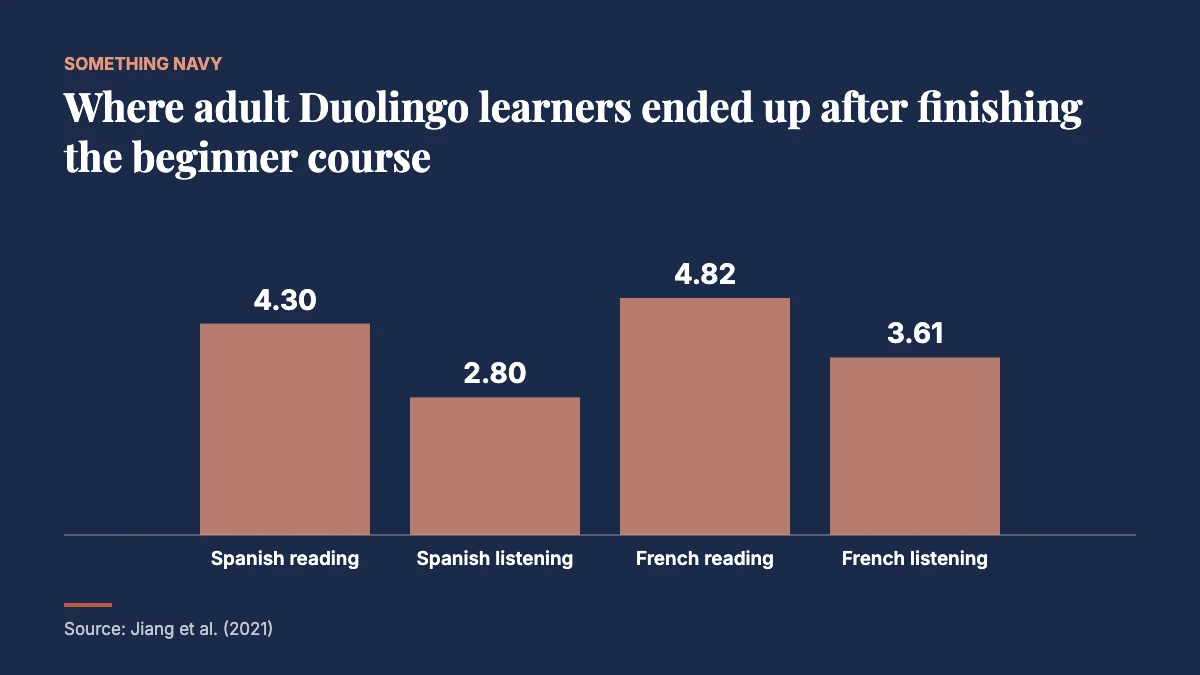
A more rigorous paper appeared in Foreign Language Annals in 2021. Xiangying Jiang and colleagues tested 225 adults in the United States who had little or no prior Spanish or French, used only Duolingo, and had completed the app’s beginner-level course. They sat official ACTFL reading and listening proficiency tests.
On average, the Spanish learners reached Intermediate Low in reading and just short of Novice High in listening; French learners did somewhat better. Those scores were broadly comparable to those of university students at the end of their fourth semester.
Read the small print
Before you cancel your evening class, note the conflicts. Four of the five authors worked for Duolingo, and each participant was paid $100 for completing the tests. The fifth author, Luke Plonsky, was at Northern Arizona University. Only reading and listening were measured, so speaking and writing are unknown. There was no before-and-after test, and the sample was limited to people who had finished the course, which means everyone who gave up halfway is invisible.
The median learner also took 112 hours to get through the beginner course, and the time people spent varied enormously. The team itself listed the missing pre-test and control group among the study’s limitations. On current evidence, an app is a decent way to build reading and vocabulary, not a substitute for talking to humans.
Does learning a language protect the brain?
The other big promise attached to adult language learning is that it will keep your mind sharp, perhaps even delay dementia. This is where the evidence is at its most tangled.
The study that launched the idea
In 2007 Ellen Bialystok, Fergus Craik and Morris Freedman published a paper in Neuropsychologia that drew on the records of a memory clinic at Baycrest in Toronto. Among 184 patients diagnosed with dementia, about half of them bilingual, the bilinguals’ symptoms had begun about four years later than the monolinguals’, even though the groups were otherwise similar on the measures recorded. The idea was that juggling two languages builds “cognitive reserve”, a kind of buffer that lets the brain keep functioning despite damage.
It travelled fast. But it was retrospective: researchers looked back at patients already ill, the age at which symptoms began was estimated from what patients and families recalled, and bilingual and monolingual groups can differ in education, immigration history, occupation and when they tend to seek medical help.
What happened when researchers looked forward
In 2017, Mukadam, Sommerlad and Livingston of University College London pooled the evidence in the Journal of Alzheimer’s Disease. Of 1,156 articles they identified, 13 met their criteria. The retrospective studies mostly found that bilinguals developed symptoms later. The prospective studies, which follow healthy people over time and are better at testing cause and effect, told a different story: across 5,527 bilingual participants, there was no reduction in dementia risk compared with monolinguals.
The 2025 study across 27 countries
The debate did not end there. In 2025, a large international team led by Lucía Amoruso and Agustín Ibáñez published an analysis of 86,149 people aged 51 to 90 from 27 European countries in Nature Aging. They built a measure of whether people were ageing faster or slower than expected for their age. Living in a more multilingual country was linked with lower odds of accelerated ageing, in both the snapshot and the follow-up analyses, and the link held after adjusting for linguistic, physical, social and sociopolitical factors.
It is a big, careful dataset, but there are two catches. Multilingualism was measured country by country, as an aggregate, rather than by asking each person how many languages they spoke. And the study is observational, so it cannot prove that languages cause slower ageing. None of these studies says much about a 38-year-old starting Spanish from scratch. The fair verdict: a possible benefit, worth hoping for, not worth promising.
Learning a language as an adult: what works best
So the window does not slam shut, but it does change shape. The research points to a few ways adults can use what they have.

Make the most of your head start. Snow and Hoefnagel-Höhle’s adults were among the fastest learners in the opening months. That early burst is real, and it fades if you treat a language as a once-a-week hobby. Concentrated stretches beat occasional dabbling, which is also why it helps to think about how long it takes to form a daily habit rather than relying on willpower.
Use the language with people. In Flege’s data, how much people actually used English shaped their command of word-specific grammar, and structured schooling shaped their grasp of the rules. Lessons give you the system; conversation gives you the instincts. You need both.
Expect a long runway, and enjoy it. If learning a language’s grammar can take something like three decades to level off, an adult learner is not behind schedule after three years. It may help to treat ability as something that grows with effort, though it is worth reading the mixed evidence on growth mindset before you buy the poster.
Stop worrying about the accent. It is the area where age bites hardest, and it rarely stops anyone being understood. The people you talk to are also paying much less attention to your mistakes than you think, a bias psychologists call the spotlight effect.
What works for adult learners
- Front-load your effort: adults often learn fastest in the first few months, so start with intensity rather than a trickle.
- Pair a structured course for the rules with regular conversation for everything else.
- Use apps for reading and vocabulary, but do not expect them to teach you to speak or follow fast speech.
- Measure progress in what you can do (order, ask, chat, read), not in how native you sound.
- Plan for years, not weeks: improvement in the big studies kept creeping upward for decades.
So, is it too late?
Back in Seville, the glass of coffee was not a failure. It was the opening of a long, slightly comic negotiation that adults are better equipped for than they think.
If you start as an adult, you will very probably never pass for a native speaker, especially in accent and the finest corners of grammar. A study of more than 669,000 people puts the turning point for grammar learning in the late teens, and Hartshorne’s 2024 rebuttal defended that line. But adults start quickly and keep improving for years, and nothing in this research says they cannot work, read, joke and live in another language. What changes with age is the ceiling for sounding native, not the ability to communicate.
Whether it keeps your brain young is still an open question. Whether it lets you understand what the barista actually said is not.
Frequently asked questions
No. The research suggests you are unlikely to develop fully native-like grammar or accent after your teens, but adults keep improving for many years, and in a 1978 Dutch study adults were among the fastest learners in the first months.
A 2018 study of 669,498 people estimated that grammar learning ability stays strong until about 17.4 years old and then declines steadily. Other researchers argue the decline is more gradual, but nobody claims it drops to zero.
It gets harder the later you start, because accent is closely tied to starting age. A study of 240 Korean speakers in the US found accents grew stronger the later people arrived.
Unlikely. A Duolingo-funded 2021 study found learners who finished the beginner course read and listened at levels similar to fourth-semester university students, but speaking was not tested and people who quit were not counted.
The evidence is mixed. Some studies found bilinguals developed dementia symptoms later, but a 2017 review of prospective studies found no reduced risk, and newer large studies are observational.
Official links and research
- Amoruso, L., Hernandez, H., Santamaría-García, H. A., Moguilner, S., Legaz, A., Prado, P., Cuadros, J., Gonzalez, L., González-Gómez, R., Migeot, J., Coronel-Oliveros, C., Cruzat, J., Carreiras, M., Medel, V., Maito, M., Durán-Aniotz, C., Tagliazucchi, E., Baez, S., García, A. M., & Ibáñez, A. (2025). Multilingualism protects against accelerated aging in cross-sectional and longitudinal analyses of 27 European countries. Nature Aging, 5(11), 2340-2354. DOI
- Bialystok, E., Craik, F. I. M., & Freedman, M. (2007). Bilingualism as a protection against the onset of symptoms of dementia. Neuropsychologia, 45(2), 459-464. DOI
- Bower, B. (2018, June 5). Your window to learn new languages may still be open. Science News Explores. Link
- Flege, J. E., Yeni-Komshian, G. H., & Liu, S. (1999). Age constraints on second-language acquisition. Journal of Memory and Language, 41, 78-104. DOI
- Hartshorne, J. K. (2024). No evidence that age affects different bilingual learner groups differently: Rebuttal to van der Slik, Schepens, Bongaerts, and van Hout (2021). Language Development Research, 4(1), 431-454. DOI
- Hartshorne, J. K., Tenenbaum, J. B., & Pinker, S. (2018). A critical period for second language acquisition: Evidence from 2/3 million English speakers. Cognition, 177, 263-277. DOI
- Jiang, X., Rollinson, J., Plonsky, L., Gustafson, E., & Pajak, B. (2021). Evaluating the reading and listening outcomes of beginning-level Duolingo courses. Foreign Language Annals, 54(4), 974-1002. DOI
- Johnson, J. S., & Newport, E. L. (1989). Critical period effects in second language learning: The influence of maturational state on the acquisition of English as a second language. Cognitive Psychology, 21(1), 60-99. DOI
- Mukadam, N., Sommerlad, A., & Livingston, G. (2017). The relationship of bilingualism compared to monolingualism to the risk of cognitive decline or dementia: A systematic review and meta-analysis. Journal of Alzheimer’s Disease, 58(1), 45-54. DOI
- Snow, C. E., & Hoefnagel-Höhle, M. (1978). The critical period for language acquisition: Evidence from second language learning. Child Development, 49(4), 1114-1128. DOI
Cover photo: Murat Ts. on Unsplash. Charts and graphics: Something Navy, with photography by Blake Wisz and Priscilla Du Preez on Unsplash.
How we reported this. Every figure was checked against the 10 sources above. Reviewed by Brooke Hilland, Senior Content Editor. Report an error · How we work