
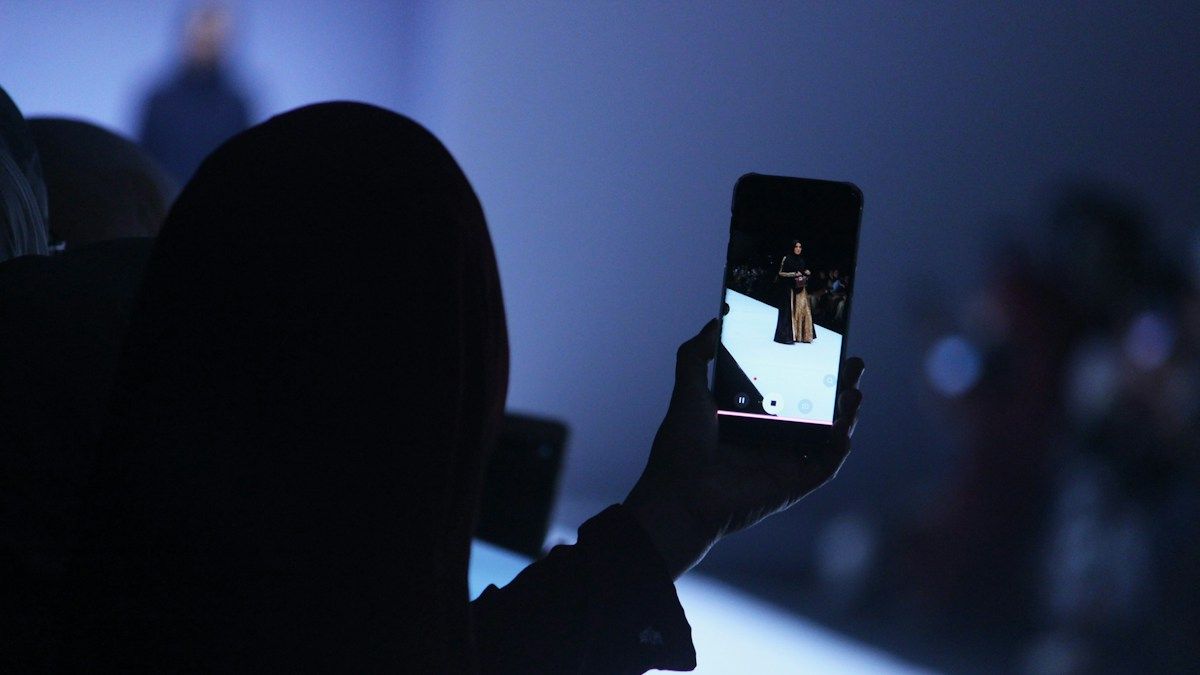
It is late, the room is dark, and you are watching a woman you have never met turn slowly in a mirror. She tugs at the waistband of a pair of wide-leg trousers, says they run a little big, and admits she has been wearing them three days straight.
You believe her. Completely. By the time she has hung them back up, the link is in your basket.
That small act of faith feels personal, even private. But it is one of the most studied moments in modern media psychology, and the researchers who first described it were writing about television presenters in 1956, decades before anyone filmed a try-on haul.
Here is the twist: the trust you feel is not a glitch or a weakness. It is your social brain doing exactly what it evolved to do. The question is what it is being asked to do, and who is checking.
A friendship where only one of you knows the other’s name
In 1956 two sociologists, Donald Horton and R. Richard Wohl, published a paper in the journal Psychiatry with a subtitle that has aged remarkably well: “Observations on intimacy at a distance”.
They had been watching radio and television hosts who spoke straight to camera, used a chatty, informal style and acted as though each viewer were a guest in the room. Audiences, they noticed, responded as if a real relationship existed. Horton and Wohl called this para-social interaction: a bond that feels mutual but runs in one direction only.
Swap the studio for a bedroom ring light and the description fits a fashion creator almost perfectly. She knows her audience as a number. Her audience knows her flat, her dog, her break-up and the fact that her left foot is half a size bigger than her right.
There is one big difference from 1956. A viewer in Horton and Wohl’s day could write a fan letter and wait. Today you can comment, and sometimes the creator replies, likes it or reads it out in the next video. That occasional flicker of recognition makes the relationship feel less one-sided than it really is, and it keeps you coming back for the next one.
A follow feels like a friendship. Only one of you knows the other’s name.

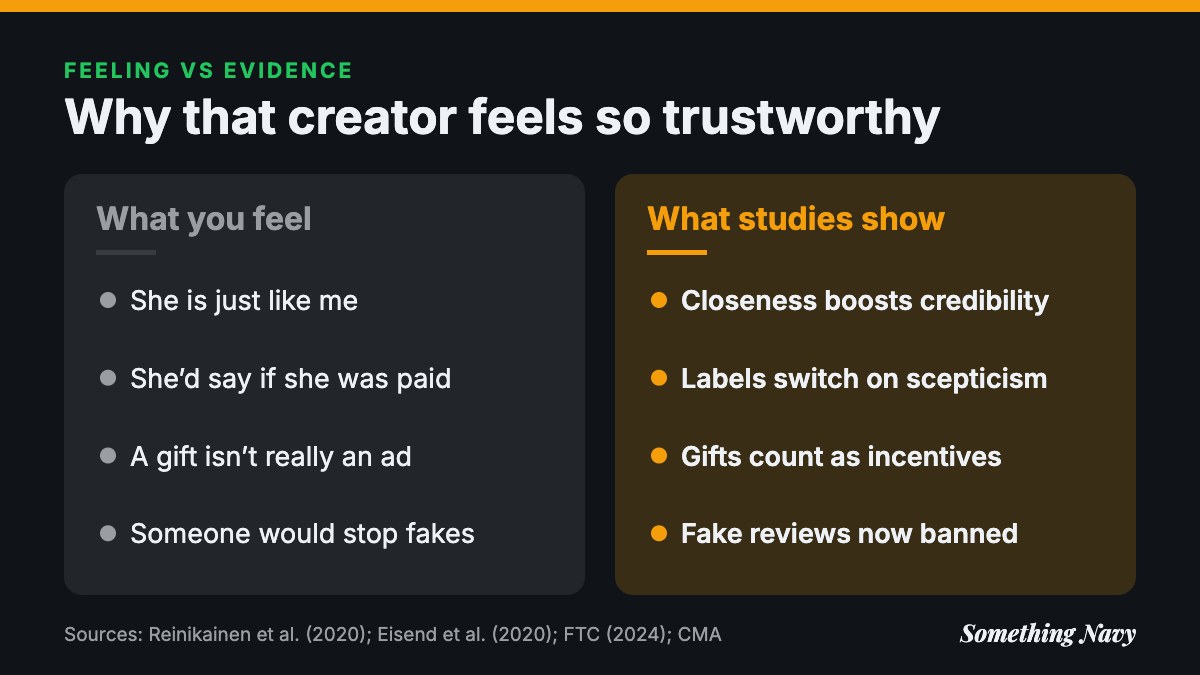
What you feel: she is just like me
The pull of a good creator is not glamour. It is ordinariness. You see the same top on someone with your height or your build, in a kitchen that looks like yours, and it seems far more useful than a model on a runway.
That sense of familiarity grows with repetition. Seeing someone most days quietly makes them more likeable, the same mere exposure effect that makes a song grow on you. Real friendships also build through hours spent together, which is part of why it takes so many hours to make a friend. A daily video habit can clock up those hours without a single conversation.
What the evidence says
The feeling is real, and it measurably changes how persuasive someone is. In a study published in 2020 in the Journal of Marketing Management, Hanna Reinikainen and colleagues at the University of Jyväskylä in Finland showed 302 young people a sponsored YouTube vlog by a lifestyle influencer. Almost all participants were women aged 20 or under.
The stronger someone’s parasocial bond with the vlogger, the more credible they rated her. That credibility, in turn, predicted trust in the brand she was promoting and the intention to buy it. Once credibility was accounted for, the bond itself had no separate effect on brand trust. Feeling close worked by making her seem believable.
One detail is easy to miss. Half the viewers also saw 13 positive comments under the video. The comments did not raise credibility on their own, but they strengthened the link between feeling close and finding her credible. Other fans, in effect, vouched for her.
The limits matter. This was one video, one influencer, a sexual health service rather than clothes, and a narrow group of young Finnish viewers. It shows a pattern, not a law of nature.
Credibility has three ingredients, and fashion leans on one
Marketing researchers have been measuring why we believe endorsers for decades. In 1990 Roobina Ohanian published a scale in the Journal of Advertising that split a spokesperson’s credibility into three parts: expertise, trustworthiness and attractiveness. It became one of the most widely used tools in the field.
Think about which of those a fashion creator usually offers. Expertise, sometimes: a stylist or a tailor, yes; a student with good taste, less so. Attractiveness, usually. Trustworthiness is where creators earn their money, because it is the quality an old-fashioned advert struggles hardest to fake.
That is why the most effective fashion content often looks least like an advert. The honest “this didn’t work on me”, the unflattering angle, the admission that the fabric bobbles after two washes. Each one buys credibility for the next recommendation.
Which raises an awkward question for anyone trying to shop well.
What you feel: she’d tell me if she was paid
Most of us assume we can spot an advert. And because a favourite creator feels like a friend, we half expect her to say so if money changed hands, the way a friend would mention she got the dress free.
Part of the reason is that spotting advertising takes effort. On a magazine page, the glossy full-bleed photo and the brand logo do the work for you. In a chatty video filmed on a sofa, nothing looks like an advert, and the same voice that tells you about her weekend is now telling you about a coat. Without a signal, most of us simply do not switch modes.
What the evidence says
Disclosure does work, though not quite how either side hopes. In 2020 Martin Eisend, Eva van Reijmersdal, Sophie Boerman and Farid Tarrahi pooled 61 papers on sponsorship disclosure covering 57 separate data sets, across blogs, videos, TV and social posts.
Across those studies, a clear label made people more likely to recognise content as sponsored, raised their “persuasion knowledge” (awareness that someone is trying to influence them) and increased resistance. It also nudged down attitudes towards the brand and ratings of the source’s credibility.
In other words, the label does its job: it switches on your critical faculties. The effects depended on things like how the disclosure was worded and when it appeared, which is why regulators care so much about placement.
An #ad doesn’t turn a creator into a liar. It turns you into a sharper listener.


How many of us actually buy
The commercial stakes explain why brands chase this trust so hard. In February 2024 the research firm Cint surveyed 2,000 consumers in the US and the UK for the social media company Sprout Social. 49% said they make purchases daily, weekly or monthly because of influencer posts, and 30% said they trusted influencers more than they had six months earlier.
It is an industry survey with an obvious interest in the answer, so read it as a rough temperature check. More independent data from YouGov points the same way, especially for younger shoppers.
Using rolling surveys of US adults from March 2025 to March 2026, YouGov reported in April 2026 that 49% of Gen Z follow influencers or celebrities, against 29% of older adults. And 40% of Gen Z said they discover new products through influencers, compared with 26% of everyone else.
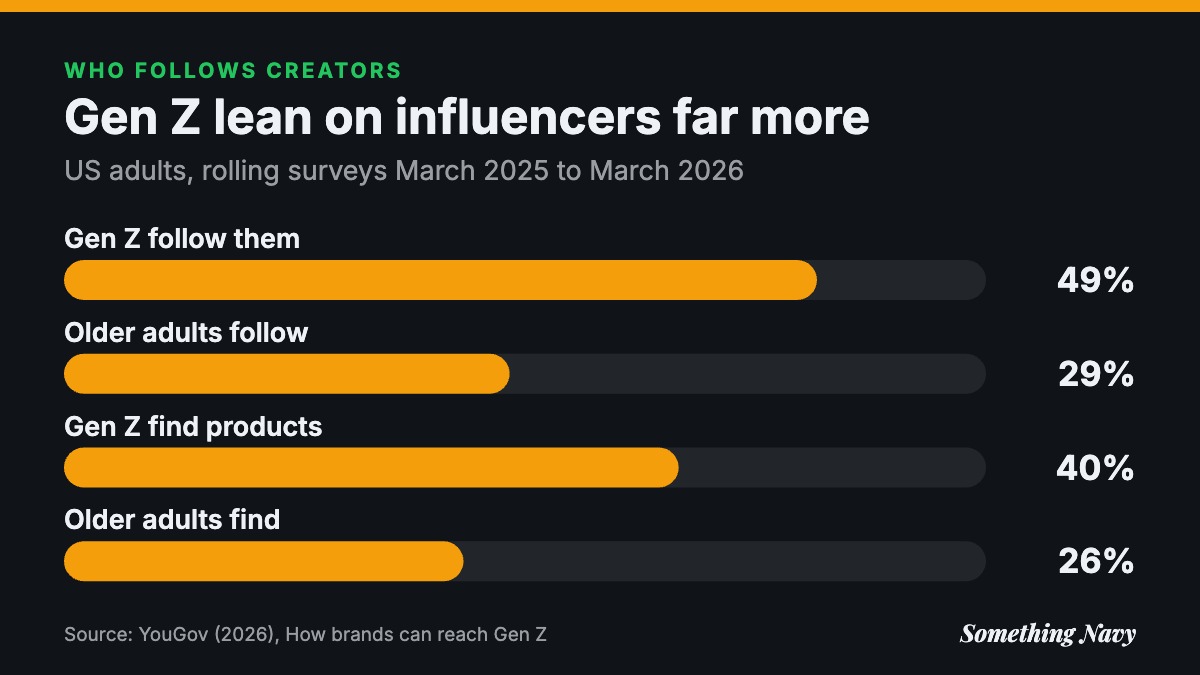
Discovery is not the same as buying, and following is not the same as trusting. But the numbers show where fashion discovery now happens for a large slice of shoppers: in a feed, guided by a face they recognise.
What you feel: if it were fake, someone would stop it
There is a background assumption that a huge, visible industry must be regulated. For years that was only partly true. Rules existed, but enforcement was slow, and a follower count, a glowing review or a “just obsessed with this” caption could be bought with little risk.
What the evidence says: the rules got teeth in 2024 and 2025
In the US, the Federal Trade Commission voted 5-0 in August 2024 to finalise a rule banning fake reviews and testimonials. It took effect on 21 October 2024. It covers reviews and testimonials from people who do not exist, including AI-generated ones, or who never used the product, and lets the FTC seek civil penalties.
For influencer culture, one clause stands out. The rule bans selling or buying fake indicators of social media influence, such as followers or views generated by bots or hijacked accounts, where the buyer knew or should have known they were fake and used them to look more important for commercial purposes.
In the UK, the Advertising Standards Authority and the Competition and Markets Authority publish a joint influencers’ guide to making clear that ads are ads, now in its third edition (2023). The principle is simple: if a brand has paid or otherwise rewarded a creator, the audience must be able to tell it is advertising, upfront.
Then, on 6 April 2025, the consumer protection parts of the Digital Markets, Competition and Consumers Act 2024 came into force. They banned fake reviews and concealed incentivised reviews outright, and gave the CMA power to fine companies up to 10% of global turnover directly, without going through the courts first. CMA guidance makes clear that unrequested gifts count as incentives, and that brands share responsibility for labelling even when they do not control the post.
None of this makes every post honest. It does mean the hidden ad, the bought follower and the paid-for “unbiased” review are now clearly illegal on both sides of the Atlantic, not just frowned upon.
By the numbers
- 1956: Horton and Wohl describe “intimacy at a distance” between viewers and TV hosts.
- 61 papers: the evidence base of the 2020 meta-analysis showing labels raise ad recognition.
- 21 October 2024: the FTC’s rule on fake reviews and fake follower counts takes effect.
- 6 April 2025: UK ban on fake and concealed incentivised reviews begins, with fines of up to 10% of global turnover.
- 40% vs 26%: Gen Z versus older US adults who discover products via influencers (YouGov, 2026).
What you feel: a gift isn’t really an ad
This is the grey zone fashion lives in. A parcel arrives unasked, the creator genuinely likes the jacket, and showing it off feels more like gratitude than marketing.
What the evidence says
Psychologically, a free item is not neutral. Reciprocity is one of the strongest social instincts we have, and receiving something creates a pull to return the favour. That does not make a review insincere, but it does tilt it, which is exactly why UK guidance treats gifts as incentives that need labelling.
It also explains why a gifted haul can feel more trustworthy than a paid post while carrying a similar commercial pull. The obligation is quieter, so it is easier to forget it exists.
Trust isn’t the problem. Unlabelled trust is.


The creators worth trusting leave clues
None of this means you should unfollow everyone and go back to glossy magazines, which had their own advertiser relationships and rarely showed a garment on a body like yours. Creators can be genuinely useful, especially for fit, fabric and how something moves.
The research suggests the trick is to keep the warmth and add a little friction. A parasocial bond is fine as long as you remember it is one-sided, and a recommendation is most useful when you can see the commercial context around it.
It also helps to remember that the cheapest outfit is often the one you did not buy. If a creator’s picks keep landing in your basket, compare them against a capsule wardrobe plan or a quick cost-per-wear check before you commit.
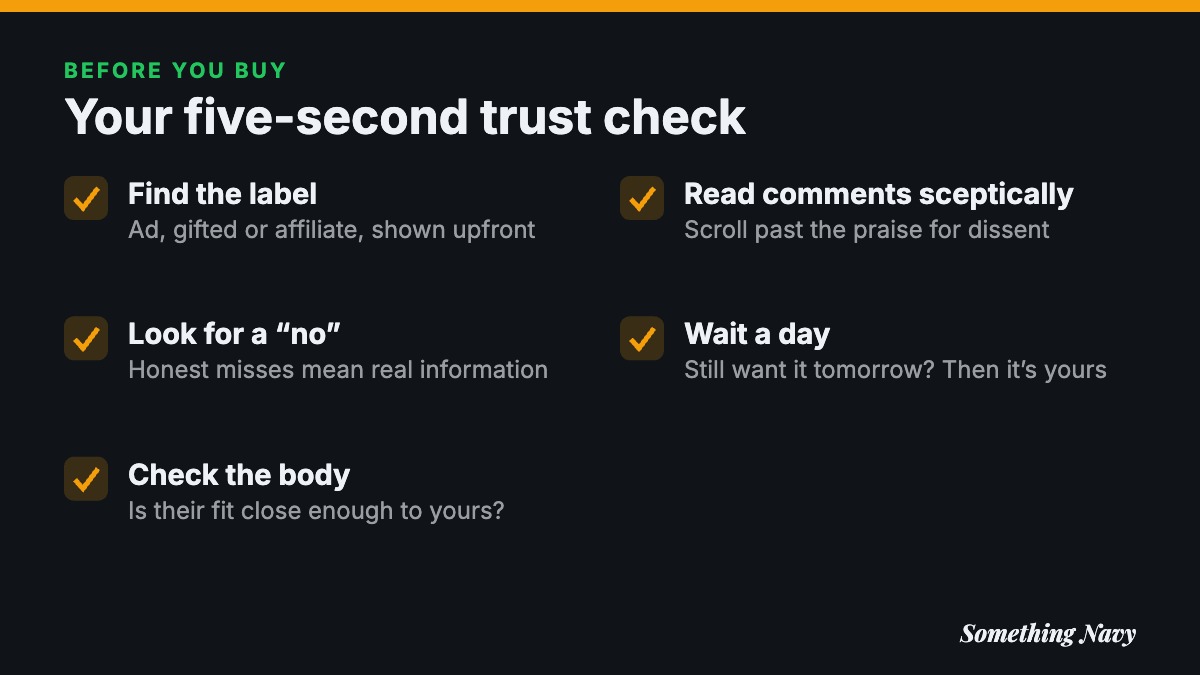
Your five-second trust check
Next time a try-on video has you reaching for your card, run through these:
- Find the label. Is it marked Ad, gifted or affiliate, and was that clear from the start rather than buried in a caption?
- Look for a “no”. Creators who sometimes say a piece did not work for them are giving you information, not just enthusiasm.
- Check the body, not the face. Is their height, build or lifestyle close enough to yours for the fit advice to transfer?
- Read the comments sceptically. Positive comments make a creator seem more credible, so scroll for the dissenters too.
- Wait a day. If you still want it tomorrow, the decision is yours, not the video’s. Ask, too, how and where it was made; our guide to ethical and fair-trade fashion has questions worth carrying with you.
Intimacy at a distance, with the lights on
Horton and Wohl were not sneering at television audiences. They argued that these one-sided bonds could be comforting and even socially useful, a way of feeling part of something.
The same is true of the creator whose videos you fall asleep to. Liking her is not foolish. Trusting her a little is reasonable. What has changed since 1956 is that the person on the screen can now sell you something with a tap, and the law, finally, expects her to tell you when she is being paid to.
So keep the friendship. Just remember who is holding the price tag.
Frequently asked questions
Creators talk to you directly, show everyday life and repeat that contact often, which builds a one-sided sense of friendship. Studies find that feeling makes them seem more credible, and credibility drives trust in what they promote.
A little. A 2020 meta-analysis of 61 papers found disclosures raise ad recognition and resistance and slightly lower brand and source ratings. That is the point: you weigh the review with the full picture.
Yes, according to CMA guidance, unrequested gifts count as incentives, so content featuring them should be clearly labelled. Brands share responsibility for making sure that happens.
In the US, the FTC rule in force since 21 October 2024 bans buying or selling fake followers or views when they are used to misrepresent influence for commercial purposes. The FTC can seek civil penalties for violations.
Sources
- Horton, D., & Wohl, R. R. (1956). Mass communication and para-social interaction: Observations on intimacy at a distance. Psychiatry, 19(3), 215–229. DOI
- Ohanian, R. (1990). Construction and validation of a scale to measure celebrity endorsers’ perceived expertise, trustworthiness, and attractiveness. Journal of Advertising, 19(3), 39–52. DOI
- Reinikainen, H., Munnukka, J., Maity, D., & Luoma-aho, V. (2020). ‘You really are a great big sister’: Parasocial relationships, credibility, and the moderating role of audience comments in influencer marketing. Journal of Marketing Management, 36(3–4), 279–298. DOI
- Eisend, M., van Reijmersdal, E. A., Boerman, S. C., & Tarrahi, F. (2020). A meta-analysis of the effects of disclosing sponsored content. Journal of Advertising, 49(3), 344–366. DOI
- Federal Trade Commission. (2024, August 14). Federal Trade Commission announces final rule banning fake reviews and testimonials [Press release]. Link
- Sprout Social. (2024, April 25). New research reveals influencers significantly drive purchasing decisions [Press release]. Link
- YouGov. (2026, April 6). How brands can reach Gen Z: Where they spend time and what drives discovery. Link
Updated 17 October 2026: we rewrote this article with new research, current figures and sources. Cover photo: Raden Prasetya on Unsplash. Charts and graphics: Something Navy.
How we reported this. We went back to the original research for this story, 7 sources in all, listed above, and checked every figure against them. If you think we have got something wrong, tell us and we will look at it. Read more about how we work.