

It is half past nine on a training day, and the coffee in the conference room is already lukewarm. A facilitator with a lanyard and a lot of energy hands round a stapled sheet: a dozen or so questions, each with four boxes to tick. Would you rather read the instructions, watch someone demonstrate, listen to an explanation or just have a go?
You tick your way down the page, add up your letters and discover you are mostly V. A visual learner. The person beside you is a K, which apparently explains why she fidgets in meetings. By lunchtime the whole team has a colour-coded label, and the facilitator promises that future training will be “tailored to how each of you learns best”.
It feels useful, even flattering. But it rests on an idea that researchers have tested repeatedly for well over two decades without finding much to hold it up.
What the learning styles idea actually claims
The quiz you filled in is one of dozens. The most familiar versions sort people into visual, auditory, reading/writing and kinaesthetic types, often shortened to VAK or VARK. When the education researchers Coffield, Moseley, Hall and Ecclestone reviewed the field for the Learning and Skills Research Centre in 2004, they identified 71 separate models of learning styles, and judged 13 of them important enough to examine in depth.
Strip away the branding, though, and the classroom advice depends on one claim. In a landmark 2008 review in Psychological Science in the Public Interest, the psychologists Pashler, McDaniel, Rohrer and Bjork gave it a name: the meshing hypothesis. It says that instruction works best when it matches, or meshes with, the learner’s preferred style. Visual learners should get diagrams. Auditory learners should get talk. Kinaesthetic learners should get their hands on something.
That is a testable prediction, and a strong one. Showing that people have preferences, or differ in particular abilities, is not enough. The meshing hypothesis says that the same lesson, delivered in a different format, should help one type of person and hurt (or at least help less) another.
The experiment that would settle it
Pashler and his co-authors spelled out what a convincing test would look like. Sort learners by their supposed style, randomly assign people within each group to different teaching methods, then give everyone the same final test. If learning styles are real in the way the quiz implies, the results should cross over: the visual learners should do best with pictures, and the auditory learners should do best with speech.
That crossover pattern is everything. Without it, a quiz result tells you something about what a person enjoys, but nothing about how you should teach them.
What happened when researchers tested learning styles properly
The 2008 review found very few studies that had used the right design at all. Of those that had, several flatly contradicted the meshing hypothesis, and the authors found virtually no evidence for the crossover pattern. Their conclusion: there was “no adequate evidence base to justify incorporating learning-styles assessments into general educational practice.”
They did leave one door open, since many versions had never been tested this way. They also made a practical point that tends to get lost: schools have limited time and money, and spending it on learning-style testing means not spending it on techniques with stronger evidence.
Coffield’s team had reached a similar place four years earlier. Their review found the questionnaires varied widely in quality; independent studies of one, Gregorc’s Style Delineator, found low internal consistency. Matching teaching to sensory preferences had not been shown to beat simply designing good instruction for everybody. They also worried about labelling. Once a student has been told she is a “kinaesthetic learner”, she may start to believe that reading is simply not for her.
Audiobooks, e-books and the people who prefer them
Later experiments kept running into the same wall. In a study published in the Journal of Educational Psychology in 2015, Beth Rogowsky, Barbara Calhoun and Paula Tallal worked with college-educated adults who had identified themselves through a learning styles inventory as either auditory or visual learners. Participants learned material either from a digital audiobook or from on-screen text, and their comprehension was then tested.
If the meshing hypothesis held, the listeners should have done better with the audiobook and the readers with the text. They did not. The researchers found no statistically significant relationship between people’s preferred style and how well they understood material delivered in either format. The one notable difference ran across the board: self-described visual learners scored higher overall, whichever format they got. That is a difference in people, not a benefit of matching.
Hundreds of anatomy students and their study habits
Then there is real-world study. Polly Husmann and Valerie Dean O’Loughlin at Indiana University School of Medicine surveyed 426 undergraduate anatomy students across the autumn terms of 2015 and 2016. Each completed the VARK questionnaire and a survey about how they studied. The results appeared in Anatomical Sciences Education, under the pleasingly direct title “Another nail in the coffin for learning styles?”
Most students did not study in ways that fitted their own VARK result; the British Psychological Society’s Research Digest put the figure at around 67 per cent. If learning styles mattered, that should have hurt their grades. It made no difference. Final course performance did not correlate with students’ scores in any VARK category, and the students who did study in line with their preferred style did no better than those who did not.
What did relate to grades were particular study strategies, used by anyone. Students who made more use of the virtual microscope, for example, tended to do better whatever their VARK profile. This was correlational, so it cannot prove cause. But it points in a direction the rest of this article follows: what you do with the material seems to matter far more than which sense it arrives through.
A learning style tells you how someone likes to be taught; it says almost nothing about how they will learn.
The 2024 meta-analysis: a small effect, rarely seen
The most recent large look at the evidence came in 2024, when Clinton-Lisell and Litzinger published a meta-analysis of the matching hypothesis in Frontiers in Psychology. To their credit, they went in asking whether the “neuromyth” label had been applied too hastily.
They pooled 21 studies, covering 1,712 participants and 101 effect sizes. Overall, matched instruction did show a small positive effect, with a Hedges’ g of 0.31 in their abstract. In plain English, that is a modest nudge. More telling was how rarely the crucial crossover appeared. Only 26 per cent of the learning outcomes they examined (11 of 42) showed matching benefiting at least two different styles, which is what the theory needs. And only five of the 21 studies met the What Works Clearinghouse standards for research design.
Their verdict was careful. The benefits, they wrote, were “too small and too infrequent to warrant widespread adoption.” So the honest summary is not that learning styles have been proven to do nothing at all. It is that after decades of looking, the effect the quizzes promise is small and rarely shows the pattern the theory needs, and few of the studies behind it are well designed.


Why so many teachers still believe in learning styles
If the evidence is this thin, you might expect the idea to have faded from staffrooms. It has not.
In 2012, Sanne Dekker and colleagues at VU University Amsterdam, working with Paul Howard-Jones of the University of Bristol, surveyed 137 teachers in Dorset in England and 105 in the Netherlands about common “neuromyths”, popular beliefs about the brain that research does not support. The statement that individuals learn better when taught in their preferred learning style was endorsed by 93 per cent of the UK teachers and 96 per cent of the Dutch ones. Across all the myths in the survey, the teachers believed just under half (49 per cent).
There was a humbling twist. Teachers who knew more about the brain in general were more likely, not less, to believe the myths, the opposite of what the authors had expected. Perhaps a little brain science makes a neat-sounding claim easier to accept. The same survey found 91 per cent of UK teachers agreeing that differences in “left-brain” or “right-brain” dominance help explain differences between learners, another claim that rests on far less than it seems, as our look at the left brain, right brain myth explains.
Belief has barely shifted
Philip Newton and Atharva Salvi of Swansea University Medical School asked whether things were improving. Their 2020 systematic review in Frontiers in Education gathered 37 studies published between 2009 and early 2020, covering 15,405 educators in 18 countries.
The weighted average was striking: 89.1 per cent of educators believed in matching instruction to learning styles, with individual studies ranging from 58 to 97.6 per cent. Trainee teachers were, if anything, keener than qualified ones, though the difference was not statistically significant. Nor was there any sign of decline over the period studied. In the authors’ words, “there is no evidence that this belief is decreasing.”
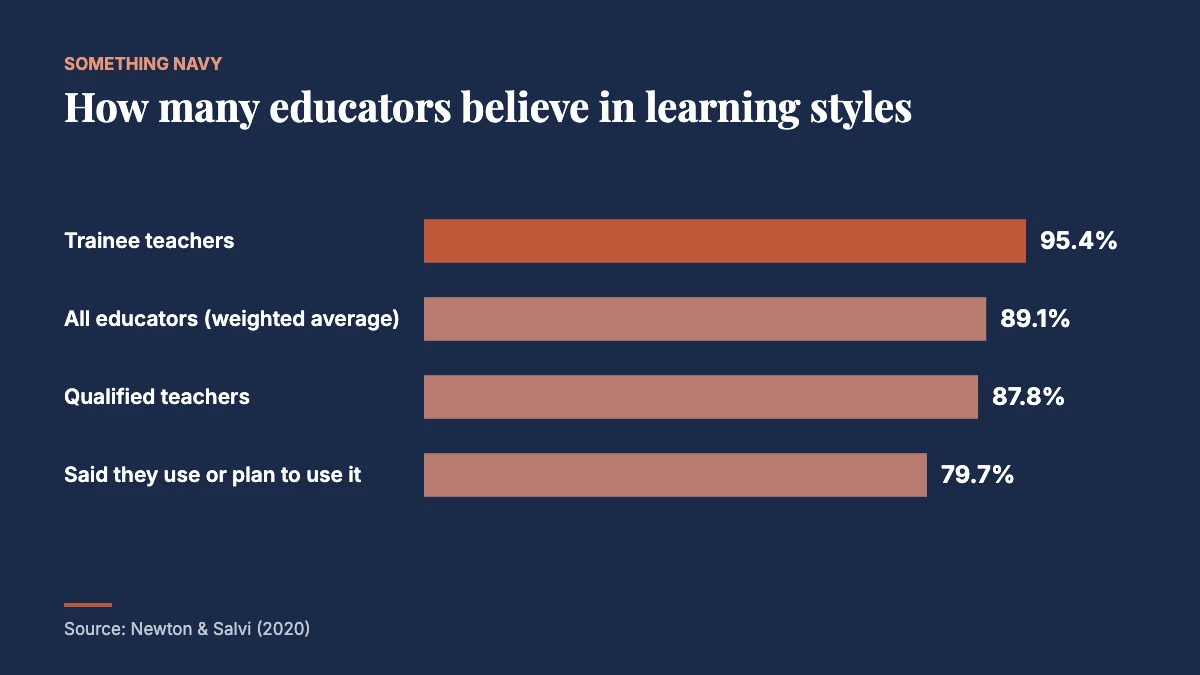
Belief seems to translate into practice: in seven smaller studies that asked, 79.7 per cent of participants said they used, or planned to use, learning-style matching in their teaching.
There is a hopeful note buried in the review. Four studies measured belief before and after training that explained the evidence. Average belief fell from 78.4 per cent to 37.1 per cent. Newton and Salvi were cautious about that drop, pointing out that people may simply give the answer they think the trainer wants. Still, it suggests the myth is not immune to a clear explanation.
Why the idea is so sticky
None of this means teachers are gullible. The idea respects individuality and gives a teacher something concrete to do for the struggling student at the back. It flatters the learner too: being told you are a visual thinker feels like a small, pleasant piece of self-knowledge, the same appeal that drives many personality quizzes.
It also borrows the shape of a true thing. People really do have preferences. The leap from “I prefer diagrams” to “I can only learn properly from diagrams” is small enough to make without noticing. If you have ever felt confident you understood something only to discover otherwise, the Dunning-Kruger effect is a reminder of how unreliable our self-assessments of learning can be.
It shares a family resemblance with power poses and some popular versions of the growth mindset: ideas whose original research was more modest than the version that spread.
What actually helps people learn
If labels are a dead end, what should the training day have handed out instead? Here the research is far more encouraging.
In 2013, Dunlosky, Rawson, Marsh, Nathan and Willingham published a long review in the same journal that had carried the learning styles paper. They rated ten common study techniques on how well their benefits held up across different learners, materials and kinds of test. Only two earned their top rating of “high utility”: practice testing and distributed practice. Several familiar habits, including highlighting, rereading and summarising, were rated low utility.
Retrieval practice: testing yourself beats rereading
Practice testing, often called retrieval practice, means pulling information out of your memory rather than pushing it back in. Past papers, flashcards and simply closing the book to write down what you remember all count.
The best-known demonstration comes from the psychologists Roediger and Karpicke, published in Psychological Science in 2006. In their second experiment, 180 students learned prose passages under one of three conditions. Some read the passage four times. Some read it three times and took one recall test. Others read it once and took three recall tests, writing down everything they could remember each time, without any feedback.
Five minutes later, the repeated readers did best. One week later, the picture had flipped.
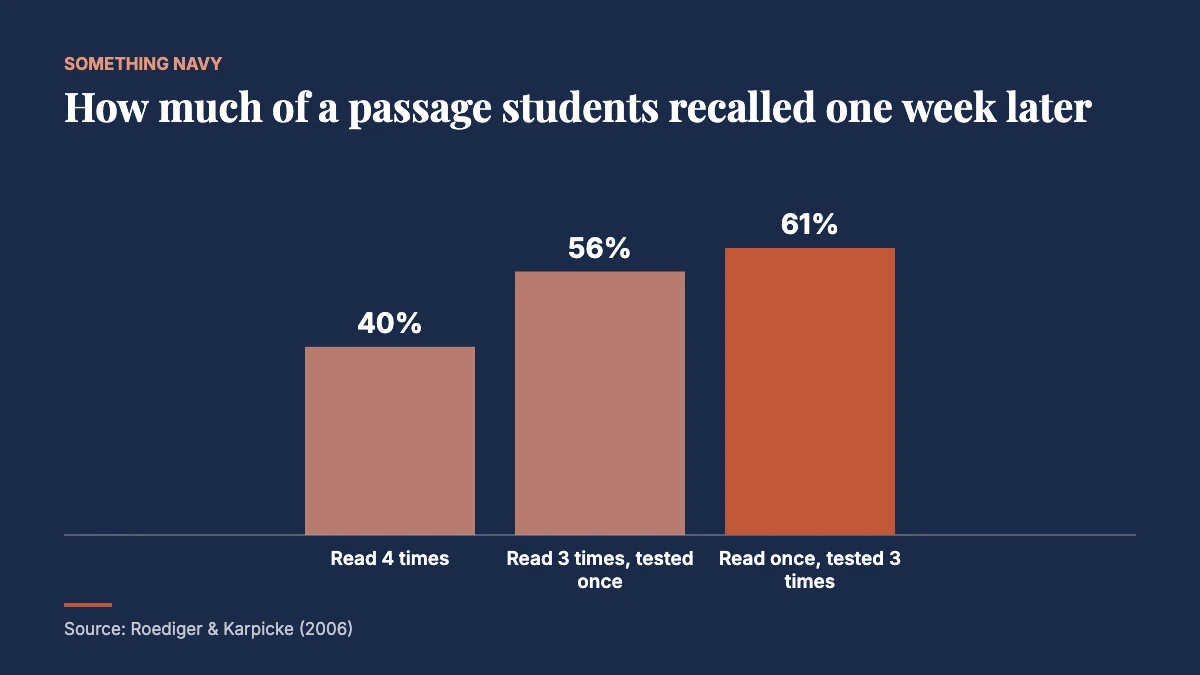
The students who had mostly tested themselves recalled 61 per cent of the material a week on, compared with 40 per cent for those who had only reread it. The rereaders, meanwhile, had predicted they would remember the most. On a seven-point scale, the four-times readers gave themselves an average of 4.8, against 4.0 for the group that had tested itself three times. Rereading feels productive because the material looks familiar, but familiarity is not recall.
One caution from the real world. In the Indiana anatomy study, students who leaned on flashcards tended to get poorer grades, which the Research Digest write-up suggested might reflect rote memorising rather than deeper understanding. That finding was correlational and sits beside many controlled experiments favouring self-testing, but it is a reminder that how you use flashcards matters.
Spacing: the same hours, spread out
Distributed practice, or spacing, is the other technique to earn Dunlosky’s top rating. It means spreading study sessions out over days or weeks rather than cramming them into one sitting. The total time can be identical. What changes is the gap between sessions, and in Dunlosky’s review that simple change held up across a wide range of learners and materials.
Spacing pairs naturally with retrieval practice. A quick self-test on Monday, again on Thursday and once more the following week is likely to serve you better than one long evening of rereading. Give each short session your full attention, too; the evidence on multitasking is not kind to studying with one eye on your phone.
Dual coding: pictures help nearly everyone
Here is the irony at the heart of the story. Pictures really do help learning. They just help nearly everyone, not only those who tick the V box.
Pairing words with visuals, often called dual coding, has been tested extensively by Richard Mayer of the University of California, Santa Barbara. In his book Multimedia Learning, Mayer summarised a series of experiments comparing explanations given in words alone with the same explanations given in words plus relevant pictures. In 11 out of 11 tests, people who got words and pictures did better at applying what they had learned to new problems, with a median effect size of 1.39. That is a large effect by the usual yardsticks.
Notice what those experiments did not do: sort people into visual and verbal learners first. The lesson for teachers and trainers is not to match the format to the person but to match it to the content. A map suits geography, a recording suits pronunciation, and a demonstration suits learning to tie a bowline.
| The learning styles claim | What the research found | Key source |
|---|---|---|
| People learn best when teaching matches their style | Almost no studies show the crossover pattern this requires | Pashler et al. (2008) |
| Matching produces meaningful gains | A small average effect, with crossovers in only 26% of outcomes | Clinton-Lisell & Litzinger (2024) |
| Visual learners learn more from text, auditory learners from audio | No significant link between preferred style and comprehension by format | Rogowsky et al. (2015) |
| Studying in your own style lifts grades | Matched studying made no difference; specific strategies did | Husmann & O’Loughlin (2019) |
| Any learning style questionnaire will do | Quality varied widely across 71 models, so the choice of instrument matters | Coffield et al. (2004) |
| Pictures only help visual learners | Words plus relevant pictures beat words alone in 11 of 11 tests | Mayer (2009) |
How to use this the next time someone hands you a quiz
None of this means you should storm out of the training room. Knowing what you enjoy is not useless: if you love podcasts, you may simply spend more time with the material. The problem is the next step: deciding that because you are a “visual learner”, you cannot learn from a lecture, or that a colleague who prefers to talk things through should be spared the reading.
A better approach is to ask two questions. What does this material need? And how can I make myself retrieve it, more than once, over time?
Study techniques with good evidence
- Close the book and write down everything you can remember before you check. That is retrieval practice, and it beat rereading in Roediger and Karpicke’s experiments.
- Spread your study over several shorter sessions on different days rather than one long cram.
- Pair words with a relevant diagram, chart or sketch, whatever your quiz result says.
- Distrust familiarity: if you can recognise it but not recall it, you have not learned it yet.
- Choose the format that suits the content: maps for places, audio for accents, hands-on practice for physical skills.
The real lesson from the learning styles story
There is something comforting in where this ends up. You do not need to discover your secret type before you can learn properly, and the techniques with the best evidence are cheap and open to anyone.
The learning styles industry sold a flattering idea: that each of us has a special channel, and that struggles at school or work were a failure to tune into it. The research tells a less glamorous but more useful story. The habits that help, such as pulling ideas back out of memory and returning to them after a gap, seem to help almost everyone.
So the next time a facilitator asks whether you are a V, an A or a K, tick the boxes. Then go home, close the notebook and see what you can remember.
Official links and research
- Clinton-Lisell, V., & Litzinger, C. (2024). Is it really a neuromyth? A meta-analysis of the learning styles matching hypothesis. Frontiers in Psychology, 15, Article 1428732. DOI
- Coffield, F., Moseley, D., Hall, E., & Ecclestone, K. (2004). Learning styles and pedagogy in post-16 learning: A systematic and critical review. Learning and Skills Research Centre. PDF
- Dekker, S., Lee, N. C., Howard-Jones, P., & Jolles, J. (2012). Neuromyths in education: Prevalence and predictors of misconceptions among teachers. Frontiers in Psychology, 3, Article 429. DOI
- Dunlosky, J., Rawson, K. A., Marsh, E. J., Nathan, M. J., & Willingham, D. T. (2013). Improving students’ learning with effective learning techniques: Promising directions from cognitive and educational psychology. Psychological Science in the Public Interest, 14(1), 4–58. DOI
- Husmann, P. R., & O’Loughlin, V. D. (2019). Another nail in the coffin for learning styles? Disparities among undergraduate anatomy students’ study strategies, class performance, and reported VARK learning styles. Anatomical Sciences Education, 12(1), 6–19. DOI
- Mayer, R. E. (2009). Multimedia principle. In Multimedia learning (pp. 223–241). Cambridge University Press. DOI
- Newton, P. M., & Salvi, A. (2020). How common is belief in the learning styles neuromyth, and does it matter? A pragmatic systematic review. Frontiers in Education, 5, Article 602451. DOI
- Pashler, H., McDaniel, M., Rohrer, D., & Bjork, R. (2008). Learning styles: Concepts and evidence. Psychological Science in the Public Interest, 9(3), 105–119. DOI
- Roediger, H. L., & Karpicke, J. D. (2006). Test-enhanced learning: Taking memory tests improves long-term retention. Psychological Science, 17(3), 249–255. DOI
- Rogowsky, B. A., Calhoun, B. M., & Tallal, P. (2015). Matching learning style to instructional method: Effects on comprehension. Journal of Educational Psychology, 107(1), 64–78. DOI
Cover photo: Centre for Ageing Better on Unsplash. Charts and graphics: Something Navy, with photography by Solstice Hannan on Unsplash.
How we reported this. Every figure was checked against the 10 sources above. Reviewed by Brooke Hilland, Senior Content Editor. Report an error · How we work