
You are standing in front of the hallway cupboard with a bin bag in one hand and a phone in the other. On the screen, a woman in an oatmeal jumper is folding three T-shirts into a drawer that holds nothing else. She looks calm. You look at the cupboard, which holds a yoga mat you used twice, four tote bags from events, a bread maker still in its box and a jacket you keep “for best”.
You fill the bag. It feels good, in a sharp, clean way. Then, half an hour later, you catch yourself browsing for a set of linen storage baskets, because the shelf looks a bit bare now and the woman in the video had such nice ones.
That moment, where getting rid of things slides straight back into buying things, is the whole puzzle of minimalism in one cupboard. Does having less actually make people happier? Or does it just give us a new aesthetic to shop for?
What researchers mean by minimalism and voluntary simplicity
The word “minimalism” does a lot of jobs: an interior style, a fashion look, a TikTok identity, a quiet decision to stop buying so much. Researchers have mostly studied the last under an older name, voluntary simplicity, the choice to consume less so you have more time and attention for what you value.
In 2022, Anne Wilson of the Wharton School and Silvia Bellezza of Columbia Business School tried to pin the consumer version down. Writing in the Journal of Consumer Research, they built a 12-item scale and tested it across studies with 3,735 participants. They found that consumer minimalism has three separate strands: owning relatively few things, preferring a “sparse and uncluttered aesthetic”, and choosing what you own carefully and deliberately.
Those strands do not always travel together. You can have the look without the restraint. The Columbia press release on the study notes that one brand can sell minimalism as a pricey pared-back look while another sells it as durable things bought once.
Minimalism is not the same as being broke
The paper also contains an awkward detail. Across Wilson and Bellezza’s datasets, the background factor most linked with minimalism was having grown up better off, measured as childhood socioeconomic status, though the association was small (a correlation of about 0.14). The authors suggest that having plenty may be what makes having less feel like a choice. They also describe “minimalist luxury”, where wealthy shoppers buy fewer, pricier things.
Choosing to own a few beautiful objects is a different experience from not being able to afford many, and the research on simplicity and happiness is largely about the chosen kind.
Does minimalism make you happier? The systematic reviews
The most useful single paper here is a systematic review by the psychologist Joshua Hook and colleagues Adam Hodge, Hansong Zhang, Daryl Van Tongeren and Don Davis. It appeared online in The Journal of Positive Psychology in 2021 and in print in 2023. The team went looking for every empirical study they could find on voluntary simplicity and wellbeing, and turned up 23.
Their headline was encouraging. In the authors’ words, “a consistent positive relationship was found between voluntary simplicity and well-being.” A Psychology Today write-up of the review adds that more than 80% of the studies with a quantitative element, and more than 85% of those with a qualitative element, found that link.
But look at what kind of evidence that is. Twenty-three studies is a small literature. The review also flagged things that seemed to change the strength of the relationship: income, age, and whether people had chosen simplicity themselves or had it pushed on them. Living with less because you lost your job is not the same as living with less because you decided to.
An earlier review, by Stacey Ann Rich and colleagues at La Trobe University in the International Journal of Wellbeing in 2017, was even more cautious. It found only four peer-reviewed studies that met its criteria, with 3,233 participants between them. The link existed, the authors concluded, but basic questions remained open.
The problem of who chooses to be a minimalist
Most of this work compares people who already live simply with people who do not, at one point in time, so it cannot tell you which way the arrow points. Perhaps simplicity makes people happier. Perhaps happier, more settled people find it easier to stop shopping. Perhaps a third thing, such as a secure income, a stable home or a personality that enjoys order, drives both.
There is also self-selection. People who call themselves minimalists and volunteer to talk about it are, almost by definition, people for whom it is working. The ones who tried a 30-day declutter, hated it and drifted back to normal life are much harder to find.
What minimalists say they get out of it
In 2020, the researchers K. Lloyd and W. Pennington published a qualitative study in the International Journal of Applied Positive Psychology titled “Towards a Theory of Minimalism and Wellbeing”. They interviewed ten self-identified minimalists, seven women and three men aged 24 to 52, living in the UK, Australia, the US, Canada and Germany.
Every one of the ten said minimalism had improved their wellbeing. When the researchers coded the interviews, five themes came out:
- Autonomy: feeling free of possessions and of other people’s expectations, and living in line with their own values.
- Competence: a sense of control over their surroundings, and less stress and anxiety.
- Mental space: a feeling that a calmer outer environment freed up inner energy.
- Awareness: more reflection, mindfulness and savouring.
- Positive emotions, especially joy and a sense of peace.
The most revealing detail is the motivation the authors identified. For most of their interviewees, the main pull was competence, the feeling of being on top of things, rather than a grand philosophy of freedom. That chimes with the older research on home environments. Darby Saxbe and Rena Repetti’s 2010 study of 60 dual-income spouses, which we have covered in detail in our piece on clutter and stress, found that wives who described their homes in cluttered, unfinished terms had flatter daily cortisol patterns, a profile linked with poorer health.
Ten interviews cannot prove anything about minimalists in general. What the study does well is show the mechanism people themselves describe. It is less about objects than attention: fewer things to look after, decide about and feel guilty over.
The stronger evidence: decades of research on materialism
Here is where the story gets more solid. If research on minimalism is young, research on its opposite, materialism, is not. Psychologists have been measuring how much people prize money, possessions and image since at least the 1980s.
In 2014, Helga Dittmar, Rod Bond, Megan Hurst and Tim Kasser, working across the University of Sussex, the University of Brighton and Knox College in Illinois, pulled that work together in a meta-analysis in the Journal of Personality and Social Psychology. They gathered 175 studies from 151 reports, covering 258 independent samples and 753 effect sizes. Around 90% of the reports came from 2000 to 2013.
The overall result was clear and consistent: the more materialistic people are, the lower their wellbeing tends to be. The average correlation was about −0.15, rising to about −0.19 once the researchers corrected for measurement error.
How big is a correlation of −0.15?
In plain English, small. If you lined up a thousand people by how materialistic they are, you would see a reliable tilt towards lower wellbeing at the materialistic end, but with enormous overlap. Plenty of keen shoppers are content, and plenty of ascetics are miserable. A correlation this size describes a population trend, not your neighbour.
What makes it worth taking seriously is its consistency across hundreds of samples. The link was also stronger when materialism was measured as a whole set of values and beliefs than when it was measured as simply caring about money.
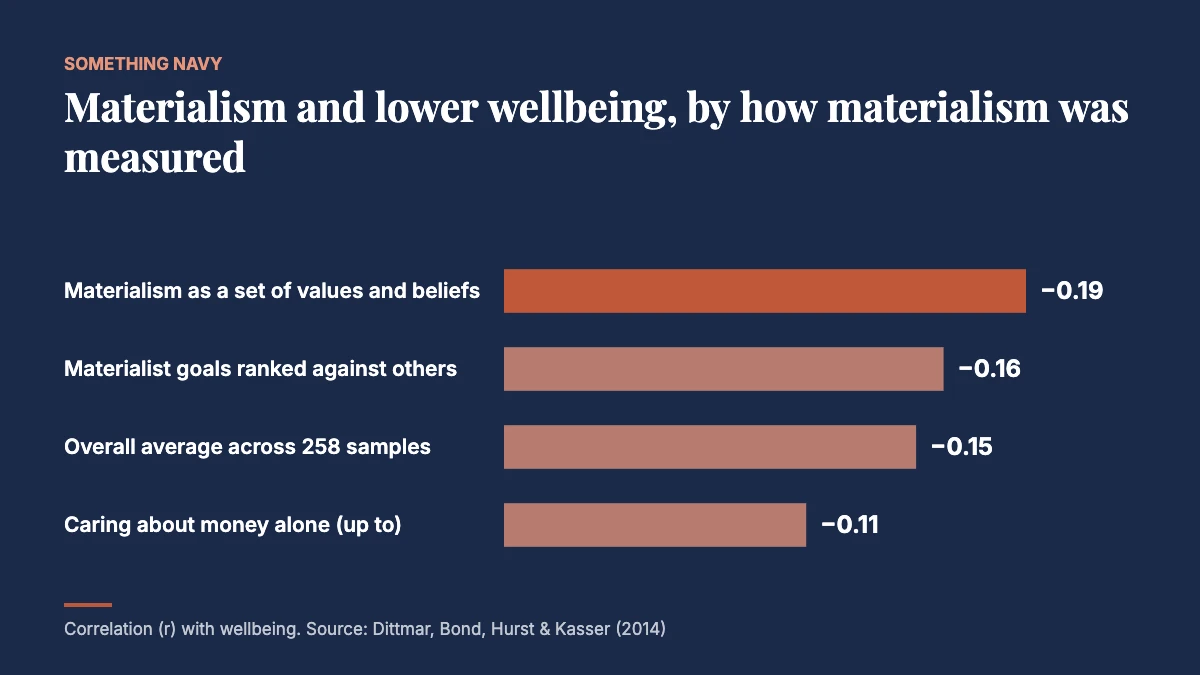
The outcomes mattered too. The weakest links were with life satisfaction and negative mood, at roughly −0.13 to −0.15. The strongest were with risky health and consumer behaviours, such as compulsive buying, and with negative views of the self, at roughly −0.28 to −0.44. Materialism seems to show up less in people’s overall verdict on life than in how they treat themselves and their bank balance.
The authors also tested why. Their mediation analyses pointed to poorly met psychological needs, the sense of choosing your own path and feeling capable, among others. Notice how close that is to the themes Lloyd and Pennington’s minimalists described, seen from the other direction.
The research is less a case for owning fewer things than a case for needing fewer things to feel all right.
Can becoming less materialistic change how you feel?
Snapshots across people are the weakest form of this evidence. The better question is what happens when the same person changes. Tim Kasser led an 11-author paper in Motivation and Emotion, published online in 2013 and in print in 2014, that tried to answer it with three longitudinal studies and one experiment.
The longitudinal studies followed young adults in the US and adults in Iceland over periods of 12 years, two years and six months. Across all three, wellbeing rose when people came to put relatively less importance on materialistic goals, and fell when they came to put more. In one study, changes in how well people’s psychological needs were met appeared to carry that link.
The fourth study was the closest thing to a test. As a Psychology Today summary of the paper explains, 71 adolescents aged 10 to 17 were randomly assigned either to three sessions of financial education or to no programme. The sessions covered advertising and consumer culture, tracking their own spending, and building sharing and saving into a plan. The education group became less materialistic. Among teenagers who had started out highly materialistic, self-esteem rose over the following months in the education group, while the control group’s fell.
This is a useful result, and also a small one: 71 young people, one programme, one main outcome. It suggests values can shift and wellbeing can follow, but it was about how teenagers think about money, not about emptying their bedrooms.
Experiences, possessions and the hedonic treadmill
There is a related strand of research that minimalism content quotes constantly, usually without the fine print. In 2003, Leaf Van Boven of the University of Colorado at Boulder and Thomas Gilovich of Cornell University published “To Do or to Have? That Is the Question” in the Journal of Personality and Social Psychology.
In one of their four studies, a telephone survey of 1,279 Americans aged 21 to 69, people were asked to think of a purchase made mainly to have an experience and one made mainly to own an object, then say which made them happier. Some 57% picked the experience, against 34% who picked the possession.
The fine print is income. The preference for experiences grew with income and education, and the lowest-income group in the national survey was about equally likely to pick either. When money is tight, a reliable washing machine can matter more than a weekend away.
Objects also lose their shine as we adapt to them, a process we explore in our piece on hedonic adaptation. The new sofa is thrilling for a fortnight and then it is just where you sit. Experiences may hold up better partly because we replay them: in a small follow-up, 83% of 40 students said they mentally revisited their experiential purchases more often.
Key studies on minimalism, materialism and wellbeing
| Study | Who | What they found | Limits |
|---|---|---|---|
| Hook et al. (2021/2023), Journal of Positive Psychology | Systematic review of 23 empirical studies | A consistent positive link between voluntary simplicity and wellbeing; income, age and whether simplicity was chosen may matter | Small, mostly correlational literature; self-selection hard to rule out |
| Rich et al. (2017), International Journal of Wellbeing | Review of 4 studies, 3,233 participants | The association between voluntary simplicity and wellbeing exists | Very few qualifying studies at the time |
| Lloyd & Pennington (2020), International Journal of Applied Positive Psychology | Interviews with 10 self-identified minimalists in 5 countries | All reported benefits; themes of autonomy, competence, mental space, awareness and positive emotion | Tiny, self-selected sample; describes experiences rather than testing effects |
| Dittmar et al. (2014), Journal of Personality and Social Psychology | Meta-analysis of 175 studies, 258 samples | Materialism linked to lower wellbeing, average r of about −0.15; strongest for risky buying and negative self-views | Correlational; small average effect |
| Kasser et al. (2014), Motivation and Emotion | Three longitudinal studies (US, Iceland) and an experiment with 71 adolescents | Wellbeing improved as materialism fell; teens’ self-esteem rose after a three-session programme | Experiment was small and focused on adolescents |
| Malik & Ishaq (2023), Journal of Retailing and Consumer Services | Survey of 343 consumers in Pakistan | Minimalist practices linked to greater happiness, partly via better financial wellbeing | Convenience sample, single time point |
Minimalism and money: the newer research
One of the more recent studies adds a practical angle. In 2023, Faiza Malik and Muhammad Ishtiaq Ishaq surveyed 343 consumers in Pakistan for the Journal of Retailing and Consumer Services. People who reported more minimalist practices also reported greater happiness, and part of that link ran through financial wellbeing: minimalism went with healthier-feeling finances, and those in turn went with feeling happier. Age and spirituality weakened the direct link between minimalism and happiness.
It fits the “competence” theme from the interviews: buying less can mean less money stress. But it is a convenience sample surveyed at one moment, so it shows that these things go together, not that cutting back caused the calm.
Underconsumption core and the trend cycle
In 2024, “underconsumption core” spread on TikTok: instead of shopping hauls, creators posted thrift finds, modest wardrobes and well-used everyday items. Writing in The Conversation, Omar Fares and Seung Hwan (Mark) Lee of Toronto Metropolitan University linked the trend to student debt, inflation and environmental worry, especially among Gen Z and younger millennials.
They also noted a familiar twist: some of the restraint on show is itself about image, about appearing thoughtful and different online. We could not find any published evidence on whether joining in makes anyone happier. But it captures the tension at the centre of this research. Wanting less seems to help. Performing wanting less for an audience edges back towards the image-focused motivation that the materialism studies link with lower wellbeing.
How to try owning less without buying a new lifestyle
Put the studies together and a fairly clear picture forms. Lower materialism and chosen simplicity go with higher wellbeing, the effect is modest, and the benefits seem to come through feeling in control and living by your own values rather than through a particular number of objects or a shade of beige. That suggests some experiments that do not involve a shopping list.
Start with the wanting, not the cupboard
Kasser’s teenagers did not declutter. They learned to notice advertising, tracked what they spent and planned for sharing and saving. You can run a lighter version: for a month, note each non-essential purchase and what prompted it. A notification? A bad day? A colleague’s new trainers? You are not trying to stop yet, only to see the pattern.
Watch for the replacement purchase
The bare-shelf moment from the opening has a well-known cousin. The Diderot effect describes how one new thing can make everything around it look shabby, so you buy more to match. Decluttering can trigger the same chain in reverse, creating gaps that seem to need new, nicer, more “minimal” things. Try waiting a few weeks after a clear-out before buying any storage or replacement items. Often the gap stops looking like a gap.
Choose it, and keep it proportionate
Hook’s review suggested that whether simplicity is self-chosen may matter. So the goal is not to hit someone else’s target of 100 items. It is to decide which areas of your life feel heavy and lighten those. For some people that is the wardrobe, and our piece on unworn clothes explains why we hold on to the things we never wear. For others it is subscriptions, gadgets or kitchen kit.
Spend on doing, if you can
If your basics are covered, Van Boven and Gilovich’s work suggests that shifting some discretionary spending towards experiences is a reasonable bet. If money is tight, ignore this part with a clear conscience: in their survey, the experience advantage all but vanished at the lowest incomes.
Be honest about why you are doing it
Finally, ask who the minimalism is for. If it is mostly for photographs or an online identity, it may simply be materialism in a neutral colour palette. The version the research supports is quieter: fewer things to manage, less money worry, more attention left for what you care about.
So, does owning less make you happier? The honest answer is that wanting less probably does, a little, for many people, and that owning less can help when it comes from that. The bin bag is optional. The pause before the next purchase is the part that seems to count.
Frequently asked questions
Not proof in the strict sense. Reviews of the evidence find a consistent positive link between voluntary simplicity and wellbeing, but most studies are correlational and many recruit people who already identify as minimalists, so cause and effect is unclear.
There is some evidence that how people feel about their home is linked to stress. In one study of 60 dual-income spouses, wives who described their homes as cluttered had flatter daily cortisol patterns, but that study measured perceptions of clutter rather than testing a clear-out.
Not necessarily, but research suggests it is easier to experience as a free choice when you have enough. One study found minimalism was linked with having grown up better off, and the happiness advantage of experiences over possessions shrinks at lower incomes.
Official links and research
- Dittmar, H., Bond, R., Hurst, M., & Kasser, T. (2014). The relationship between materialism and personal well-being: A meta-analysis. Journal of Personality and Social Psychology, 107(5), 879–924. DOI
- Fares, O. H., & Lee, S. H. (2024, July). Understanding “underconsumption core”: How a new trend is challenging consumer culture. The Conversation, republished by Phys.org. Link
- Hook, J. N., Hodge, A. S., Zhang, H., Van Tongeren, D. R., & Davis, D. E. (2023). Minimalism, voluntary simplicity, and well-being: A systematic review of the empirical literature. The Journal of Positive Psychology, 18(1), 130–141. DOI
- Kasser, T., Rosenblum, K. L., Sameroff, A. J., Deci, E. L., Niemiec, C. P., Ryan, R. M., Árnadóttir, O., Bond, R., Dittmar, H., Dungan, N., & Hawks, S. (2014). Changes in materialism, changes in psychological well-being: Evidence from three longitudinal studies and an intervention experiment. Motivation and Emotion, 38(1), 1–22. DOI
- Lloyd, K., & Pennington, W. (2020). Towards a theory of minimalism and wellbeing. International Journal of Applied Positive Psychology, 5, 121–136. DOI
- Malik, F., & Ishaq, M. I. (2023). Impact of minimalist practices on consumer happiness and financial well-being. Journal of Retailing and Consumer Services, 73, 103333. DOI
- Rich, S. A., Hanna, S., Wright, B. J., & Bennett, P. C. (2017). Fact or fable: Increased wellbeing in voluntary simplicity. International Journal of Wellbeing, 7(2). DOI
- Saxbe, D. E., & Repetti, R. (2010). No place like home: Home tours correlate with daily patterns of mood and cortisol. Personality and Social Psychology Bulletin, 36(1), 71–81. DOI
- Van Boven, L., & Gilovich, T. (2003). To do or to have? That is the question. Journal of Personality and Social Psychology, 85(6), 1193–1202. DOI
- Wilson, A. V., & Bellezza, S. (2022). Consumer minimalism. Journal of Consumer Research, 48(5), 796–816. DOI
Cover photo: Alex Tyson on Unsplash. Charts and graphics: Something Navy, with photography by Franco Debartolo and Joseph Sharp on Unsplash.
How we reported this. Every figure was checked against the 10 sources above. Reviewed by Valentino Adkins, Senior Content Manager. Report an error · How we work