
Close your eyes for a moment and imagine an apple. Take your time. Is it red or green? Is there a leaf still clinging to the stalk, a bruise on one side, a shine where the light from a window catches it?
Now open your eyes and be honest about what happened. Perhaps you saw something close to a photograph. Perhaps you got a faint, flickering sketch that kept slipping away. Or perhaps you saw nothing at all, just darkness and the knowledge that you were thinking about an apple, the way you might think about the number seven.
If it was the last one, you are not doing it wrong, and you are not alone. You may have aphantasia, and until a decade ago there was barely a word for it.
What aphantasia means, and where the word came from
Aphantasia is the term scientists use for a reduced or absent ability to call up pictures in the mind on purpose. People with it know perfectly well what their kitchen looks like. They just do not see it when they close their eyes.
The idea is not new. A University of Exeter press release from August 2015 points out that Sir Francis Galton first described people who could not visualise in 1880. After that, it received little attention for well over a century.
The modern story starts with a single patient. In 2010, Adam Zeman, a neurologist then at the University of Exeter, published a case report about a man who lost his visual imagery in his sixties after a cardiac procedure. The science writer Carl Zimmer wrote about the case in the March 2010 issue of Discover magazine. Then the letters arrived. Twenty-one readers got in touch to say, in effect, that they recognised the description, except that they had never had a mind’s eye to lose.
In 2015, Zeman and his colleagues Michaela Dewar and Sergio Della Sala wrote up those 21 people in a short paper in the journal Cortex, titled “Lives without imagery: Congenital aphantasia”. They proposed the name aphantasia, built from the Greek phantasia, the word Aristotle used for the faculty that presents images to the mind. A later paper from the group thanks David Mitchell for philological advice on the choice.
The small group in that first paper had some striking features. Nineteen of the 21 were men. Most had realised they were different only in their teens or twenties. On the Vividness of Visual Imagery Questionnaire, their ratings were far lower than those of 121 comparison volunteers. Yet 17 of the 21 said they did see images in their dreams, and 10 reported occasional involuntary flashes while awake. Whatever was missing, it seemed to be the voluntary switch, not every last trace of imagery.
How common is aphantasia? The prevalence numbers
After the 2015 paper, the messages kept coming. By the time they published a follow-up in Cortex in 2020, they reported being contacted by more than 14,000 people (the same paper’s acknowledgements give a figure of 12,000, a small inconsistency worth knowing about).
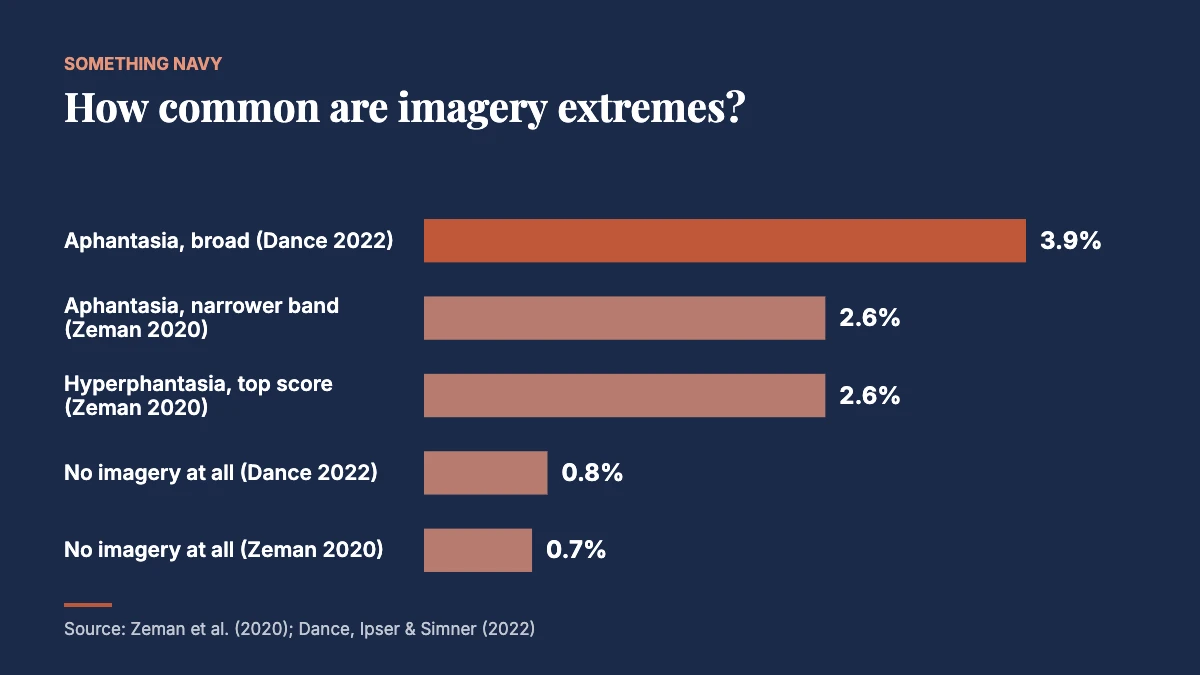
Volunteers who write in are not a fair sample of the population, so the 2020 study also looked at 1,288 members of a general research cohort known as EXTEND. Each completed the imagery questionnaire. In that group, 0.7% gave the lowest possible score, meaning no imagery at all for any of the scenes. A wider band of 2.6% scored in the range the team now uses for aphantasia, which takes in people with very faint images as well as none.
A separate team at the University of Sussex, led by Carla Dance with colleagues Ipser and Simner, set out to pin the number down in 2022. They tested 1,004 people across two samples: 502 Sussex undergraduates and 502 adults in the UK and US recruited through Amazon’s Mechanical Turk. Using a slightly broader cut-off that counts dim and vague imagery, they found that 3.9% had aphantasia. Only 0.8% reported a complete absence of images. The two samples agreed closely, and women and men did not reliably differ.
So depending on where you draw the line, somewhere between 1 in 25 and 1 in 40 people have weak or absent visual imagery, and fewer than 1 in 100 have none at all. Dance’s team also noted that the often-quoted “2%” figure comes from older work (one source dates back to 1909) and refers to complete absence only, so it is not really measuring the same thing.
The other end of the scale: hyperphantasia
The same numbers reveal a mirror-image group. In the EXTEND sample, 2.6% gave the highest possible score, describing every imagined scene as being as vivid as real sight. Zeman’s team called this hyperphantasia.
The 2020 paper gathered detailed questionnaires from 2,000 people with aphantasia, 200 with hyperphantasia and 200 controls with mid-range imagery. People with hyperphantasia were more likely to report synaesthesia, the blending of senses where, for example, a letter carries a colour. And 98.5% of them said they dreamed in pictures.
Most of us assume our inner world is standard issue. It turns out to be closer to a custom build.
How scientists measure the mind’s eye
The obvious problem is that nobody can look inside someone else’s head. Your “fairly clear” might be my “barely there”.
The VVIQ questionnaire
The most widely used tool is the Vividness of Visual Imagery Questionnaire, or VVIQ, published by the psychologist David Marks in the British Journal of Psychology in 1973. It asks people to picture 16 scenes and rate each on a five-point scale, from an image as clear as normal vision down to no image at all. In the version Zeman’s group uses, scores run from 16 (no imagery whatsoever) to 80 (vivid as life), and the team counts 16 to 23 as aphantasia and 75 to 80 as hyperphantasia.
It is quick to complete, which makes it ideal for large online surveys. Its weakness is that it depends entirely on self-report.
How people check themselves
- Bring to mind someone you see often, and try to make out the shape of their face, their outline and the clothes they tend to wear.
- Watch the sun come up in your imagination, from a pale sky through to a coloured glow and passing clouds.
- Picture a shop front you know well, then imagine walking up to the window and reading what is on display.
- Build a countryside view in your head with trees, hills and water, and notice whether the weather can change.
- For each one, ask whether you see something as sharp as real life, something dimmer, or simply know what you are thinking about with no picture at all.
These four themes are the backbone of the VVIQ. Running through them gives a feel for where you sit, though it is not a diagnosis, and nobody needs one.
An objective test: binocular rivalry
In 2018, Rebecca Keogh and Joel Pearson of the University of New South Wales in Sydney published a paper in Cortex titled “The blind mind: No sensory visual imagery in aphantasia”. They wanted a measure that did not rely on people’s descriptions.
Their method used a quirk of vision called binocular rivalry. When each eye is shown a different picture, the brain cannot merge them, so what you consciously see flips between the two. In people with typical imagery, spending a few seconds imagining one of the pictures beforehand makes it more likely to win the contest.
Volunteers imagined either a red circle with horizontal stripes or a green circle with vertical stripes for six seconds, then looked at a display that showed one pattern to each eye. They reported which one dominated, over two or three blocks of 40 trials.
The researchers compared 15 people who described themselves as aphantasic with a general population sample of 209. In the general sample, imagining a pattern nudged perception towards it. In the aphantasic group, it made essentially no difference: their results were no better than chance. So they were not simply poor at describing their imagery: the sensory image was not there to do its job. Fifteen people is a small group, though, so the finding is strong evidence of a difference rather than a precise measure of its size.
Pearson’s team followed this up in 2022 with a second physical test, reported in eLife by Kay and colleagues. In people with typical imagery, the pupils respond not only to real light but also to light that is merely imagined. People with aphantasia showed no significant sign of that imagery response, even though their pupils reacted normally to actual light and widened as usual when a task got harder. Bodies, it seems, can testify where words fall short.

What aphantasia changes: memory, dreams and the other senses
Remembering your own life
In 2020, Alexei Dawes, Keogh, Andrillon and Pearson published a large comparison in Scientific Reports. They surveyed 267 people with aphantasia, 203 controls matched for age and a further 193 psychology undergraduates as a check. People with aphantasia reported less vivid memories of their own past and a weaker ability to imagine the future. They also said they dreamed less often, and that their dreams contained fewer sensory details.
Zeman’s 2020 study found something similar: people with aphantasia were more likely to rate their autobiographical memory as poor. They also reported more difficulty recognising faces. For anyone who has ever replayed an embarrassing moment on a loop at 3am, there is an odd upside here. Some people simply do not get the full-colour rerun.
Dreams still happen for most
The dream findings are subtle. In the Zeman study, 63.4% of people with aphantasia said they did dream visually, compared with 89% of the mid-range group. About a fifth (20.7%) said they dreamed without images. So the machinery for imagery seems to exist in many aphantasic brains; it just will not answer when called on deliberately while awake.
Beyond sight
Can you hear a song in your head? Smell coffee that is not there? For a good share of people with aphantasia, the answer is no. Dawes’s team found that about 26% of their aphantasic group reported a broader absence of imagery across sound, touch, taste, smell, movement and emotion. Pearson called it “the first scientific data” showing that subtypes of aphantasia may exist.
Zeman’s group put the figure higher, at 54.2%. The gap probably reflects different questions and different ways of recruiting volunteers, and it is a useful reminder that these numbers are still rough.
One ability stood out as untouched. In the Dawes study, spatial imagery, knowing where things are and how to get between them, was on par with controls. That held for navigation, spatial memory and even dreams.
You can know exactly where the sofa is without being able to see it in your head.
Families and genes
Aphantasia appears to run in families more often than chance would predict. Among people with the most extreme form in Zeman’s 2020 study, 21% said they had a relative with it. The team calculated that siblings were roughly ten times more likely than the general population to share it. That points towards some inherited component, though the study relied on what participants knew of their relatives, not on genetic testing.
Aphantasia and careers: scientists, mathematicians and an animator
Zeman’s 2020 data showed a pattern in jobs. People with aphantasia were more likely to work in science, computing and mathematics, while those with hyperphantasia leaned towards the arts and media. This is a correlation from self-selected volunteers, so it says nothing about what anyone is capable of. It may reflect how people choose fields that suit their way of thinking.
And there are notable exceptions. Ed Catmull, co-founder and former president of Pixar and of Walt Disney Animation, discovered he had aphantasia when a friend asked him to picture a sphere. According to the University of Exeter’s account of his talk at the first Extreme Imagination conference in April 2019, he spent a week trying, despite a physics degree and a strong feel for three dimensions, but no sphere ever appeared.
That conference, held in Exeter, drew more than 100 people with aphantasia, which the university described as the largest known gathering of its kind. The man who helped build Pixar is a fair rebuttal to the idea that a blank mind’s eye means a blank imagination. If you are curious where ideas come from more broadly, the research on walking and creative thinking is a good companion read.
Not a disorder: why researchers call it a variation
It is tempting to read “absent imagery” as a deficit. Zeman’s team argue otherwise. Their 2020 paper concludes that both aphantasia and hyperphantasia are common, little-recognised variations in human experience with real psychological correlates, not conditions to be treated.
Imagine learning, at 25, that when friends said they could “see” their wedding day, they meant it literally. It is a textbook case of the curse of knowledge: we assume other minds work like ours, because ours is the only one we have ever been inside.
There is one important distinction. A small number of people lose their imagery later in life, after a stroke, a brain injury or, as in Zeman’s original 2010 case, a medical procedure. That acquired form is different from the lifelong kind, and a sudden change in how you think or see is worth discussing with a doctor.
The latest aphantasia research, 2025 to 2026
The visual cortex is still working
In January 2025, a team from the University of New South Wales and South China Normal University, including Shuai Chang, Ming Meng and Joel Pearson, published a brain-scanning study in Current Biology. They put 14 people with aphantasia and 18 controls into an fMRI scanner and asked them to view and then imagine simple striped patterns.
The surprise was that the primary visual cortex, the first stop for visual information in the brain, still produced distinct patterns of activity when aphantasic volunteers tried to imagine. A computer could decode which pattern they were attempting to picture from that activity alone. But the signals did not resemble the patterns produced by actually seeing, as they did in controls. In aphantasia, imagery activity was also stronger on the “wrong” side of the brain, the same side as the imagined pattern rather than the opposite side. Pearson compared it to a brain “doing the math but skipping the final step”.
The authors also found more activity in language and auditory areas during attempted imagery, which hints that some aphantasic people may lean on words or concepts instead. The study was small, most participants were women, and only simple patterns were tested, so faces and scenes remain an open question.
Where imagination may live
In March 2026, researchers at Brigham and Women’s Hospital, part of Mass General Brigham, led by Julian Kutsche with senior author Isaiah Kletenik, published a study in Cortex on the rare cases where people lose their imagery after brain damage. The lesions themselves were scattered across many parts of the brain. Yet when the team mapped how each injured spot was wired to the rest of the brain, every case connected to one region: the fusiform imagery node, an area that lights up when healthy people picture things. It does not explain lifelong aphantasia, but it gives researchers a strong candidate for a hub the mind’s eye depends on.
Meanwhile, Zeman’s Eye’s Mind project, whose work is now hosted by the University of Edinburgh, continues to study people at both ends of the imagery spectrum, a decade after the 2015 paper gave the experience a name.
So what did you see?
Go back to that apple. Whatever you saw, or did not, says something about how your particular brain stores the world. A decade after the word was coined, the clearest finding is that people at both extremes remember, dream and build careers. What differs is what imagining feels like from the inside.
Frequently asked questions
No. The researchers who named it describe it as a variation in human experience rather than an illness. In the first 2015 study, most people only realised they were different in their teens or twenties.
A 2022 Sussex study of 1,004 people put weak or absent imagery at 3.9%, with 0.8% reporting none at all. A 2020 Exeter study found 0.7% with no imagery whatsoever.
Many can. In Zeman’s 2020 study, 63.4% of people with aphantasia said they dreamed visually, although the Dawes 2020 study found they dreamed less often and with fewer sensory details.
It is the opposite extreme, where imagined images feel as vivid as real sight. About 2.6% of a general population sample gave the top score on the VVIQ in Zeman’s 2020 research.
For some people, yes. About 26% of aphantasic volunteers in a 2020 UNSW study reported weak or absent imagery across senses such as sound, smell and touch, while Zeman’s 2020 study put the share at just over half.
Official links and research
- Chang, S., Zhang, X., Cao, Y., Pearson, J., & Meng, M. (2025). Imageless imagery in aphantasia revealed by early visual cortex decoding. Current Biology, 35(3), 591–599.e4. DOI
- Dance, C. J., Ipser, A., & Simner, J. (2022). The prevalence of aphantasia (imagery weakness) in the general population. Consciousness and Cognition, 97, 103243. DOI
- Dawes, A. J., Keogh, R., Andrillon, T., & Pearson, J. (2020). A cognitive profile of multi-sensory imagery, memory and dreaming in aphantasia. Scientific Reports, 10, 10022. DOI
- Kay, L., Keogh, R., Andrillon, T., & Pearson, J. (2022). The pupillary light response as a physiological index of aphantasia, sensory and phenomenological imagery strength. eLife, 11, e72484. DOI
- Keogh, R., & Pearson, J. (2018). The blind mind: No sensory visual imagery in aphantasia. Cortex, 105, 53–60. DOI
- Kutsche, J., Howard, C., Drew, W., Cohen, A. L., Castro Palacin, A., Michel, M., Fox, M. D., & Kletenik, I. (2026). Lesions causing aphantasia are connected to the fusiform imagery node. Cortex. DOI
- Marks, D. F. (1973). Visual imagery differences in the recall of pictures. British Journal of Psychology, 64(1), 17–24. Vividness of Visual Imagery Questionnaire, David Marks
- Zeman, A., Dewar, M., & Della Sala, S. (2015). Lives without imagery: Congenital aphantasia. Cortex, 73, 378–380. DOI
- Zeman, A., Milton, F., Della Sala, S., Dewar, M., Frayling, T., Gaddum, J., Hattersley, A., Heuerman-Williamson, B., Jones, K., MacKisack, M., & Winlove, C. (2020). Phantasia: The psychological significance of lifelong visual imagery vividness extremes. Cortex, 130, 426–440. DOI
- University of Exeter. (2019, April 18). Extreme Imagination conference and Ed Catmull on aphantasia [News release]. https://news-archive.exeter.ac.uk/2019/april/title_712815_en.html
Cover photo: Richard Jaimes on Unsplash. Charts and graphics: Something Navy, with photography by Thiva on Unsplash.
How we reported this. Every figure was checked against the 10 sources above. Reviewed by Brooke Hilland, Senior Content Editor. Report an error · How we work