
It starts as an irritation. A track you would never choose plays in the coffee shop, then in a friend’s car, then in the background of every third video on your phone. The chorus feels cheap. The hook is too obvious. You say so, out loud, to anyone who will listen.
Then, some weeks later, you catch yourself humming it in the shower. A few days after that, you look it up. By the summer it is in your most-played list, and you have quietly stopped telling people you hated it.
Nothing about the song changed. You did. And the thing that changed you was not a review, an argument or a sudden flash of insight. It was simply hearing it again, and again, and again.
Psychologists have a plain name for this: the mere exposure effect. It describes the tendency to warm to things simply because we have encountered them before. More than half a century of research suggests it shapes far more than playlists. It also has limits that are just as interesting as the effect itself.
Twelve fake Turkish words in Michigan
The modern story begins with Robert Zajonc, a social psychologist at the University of Michigan. In 1968 he published a long monograph in the Journal of Personality and Social Psychology with a deliberately modest title: “Attitudinal effects of mere exposure”.
His central experiment used words that meant nothing at all. Zajonc took twelve seven-letter nonsense words and told volunteers they were Turkish. Each word was shown on a card for about two seconds while the experimenter pronounced it and the volunteer repeated it. Some words appeared once, some twice, some five, ten or 25 times, and some never. Which word got which frequency was rotated across groups, so no word was favoured by its sound alone.
Afterwards, the 72 participants were told the words were Turkish adjectives, and asked to guess whether each one meant something good or bad. There was no right answer. Yet the more often a word had been seen, the more likely people were to rate its meaning as good.
Zajonc repeated the trick with Chinese-like characters, which volunteers were simply asked to pay close attention to, and with yearbook photographs of men’s faces. The pattern held each time. Familiar shapes were judged more pleasant. Familiar strangers were judged more likeable.
His conclusion was bold for its time: repeated exposure, he wrote, is “a sufficient condition of attitude enhancement”. You do not need a reward, an explanation or a persuasive message. Just making something available to the senses, repeatedly, can tilt us towards it.
The language was already keeping score
Zajonc also went looking for the effect in everyday English. Using standard counts of how often words appear in print, he compared pairs of opposites. “Good” turned up 5,122 times in the word count he used; “bad” just 1,001. “Beautiful” appeared 987 times; “ugly” only 178.
Across 154 pairs of antonyms, the word people rated as more positive was also the more frequent one in 126 cases, or 82%.
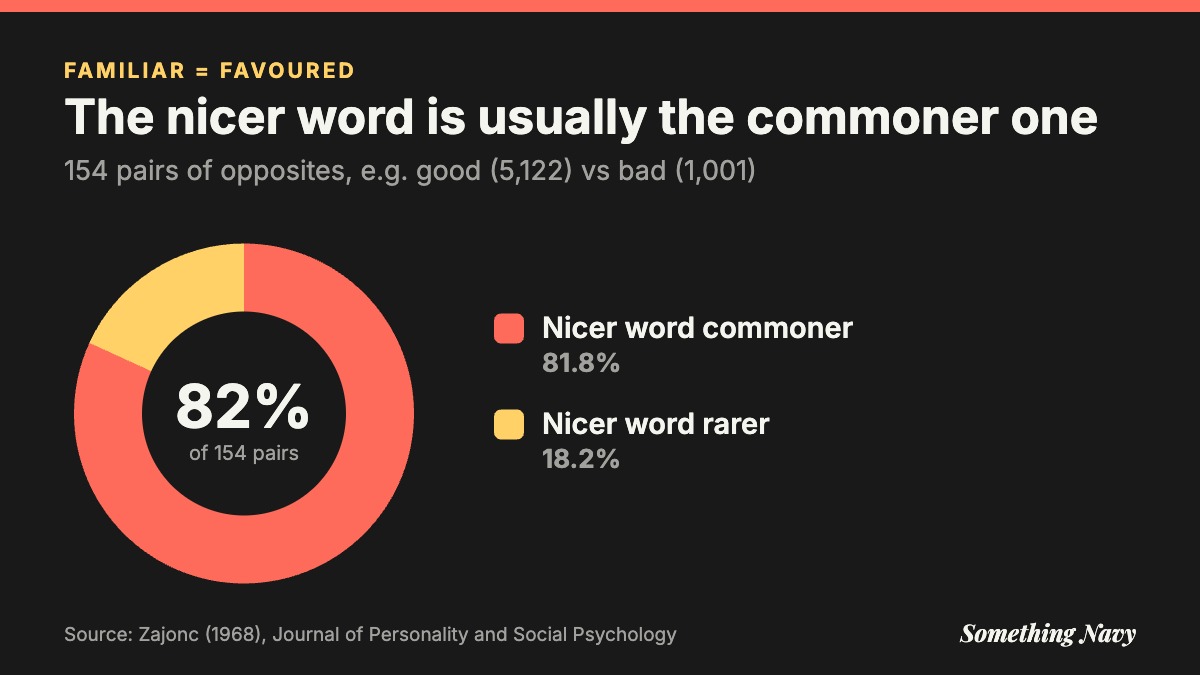
He was careful about what this meant, and we should be too. The word data are correlational. It is just as plausible that we talk about good things more because we prefer them, rather than preferring them because we talk about them. The experiments, in which frequency was assigned at random, were what gave the idea its teeth.
The quiet classmates experiment
Laboratory nonsense words are one thing. Does the effect survive in a real room full of real people? In 1992 Richard Moreland and Scott Beach tested it in a university lecture hall.
They recruited four young women who looked broadly similar to one another and sent them to sit in on a large university lecture course over a semester. One woman never attended. The others came to 5, 10 and 15 classes respectively. They did not talk to anyone. They simply walked in, sat where the students could see them, and left.
At the end of term, around 130 students were shown photographs of the four women and asked to rate them on traits including attractiveness, how familiar they seemed, and how similar to the students themselves.
The ratings climbed with attendance. The woman who had come to 15 classes was rated most attractive, and the one who never came was rated lowest. The women had never spoken to anyone; they had simply been there.
It is a small study with only four “targets”, so any difference between the women themselves could muddy the picture. But it captured something many of us recognise: the person you sit near every week starts to feel like someone you might get along with, long before you have exchanged a word. That slow accumulation is part of why friendships take so many shared hours to form.
Two hundred experiments and a surprise
By the late 1980s there were enough studies to ask how reliable the effect really was. The psychologist Robert Bornstein gathered 208 experiments published between 1968 and 1987 and combined them in a meta-analysis in Psychological Bulletin.
The effect was real and consistent. But two details stood out.
First, it was stronger when people could not properly see what they were being shown. Images flashed too briefly to register consciously produced bigger shifts in liking than images people could inspect at leisure. Whatever repetition was doing, it did not seem to depend on knowing that you had seen something before. If anything, awareness got in the way.
Second, it did not keep growing. Studies that piled on dozens of exposures tended to see gains level off, and long blocks of the same stimulus shown over and over produced weaker effects than exposures mixed in among other things. Repetition helps, but there is a ceiling, and monotony seems to drag it down.
One leading explanation for all this is “processing fluency”. Each time we meet something, our brains get a little faster at taking it in. That ease feels mildly pleasant, and we misattribute the pleasant feeling to the thing itself: not “I have seen this before”, but “I like this”. It would explain why the effect thrives when we are not paying attention, because there is no conscious memory to correct the mistake.


The curve that bends back down
In 2017 a team led by the psychologist Montoya, with Robert Horton of Wabash College, Jack Vevea of the University of California, Merced, and colleagues, revisited the whole field in a new meta-analysis, also in Psychological Bulletin. This time they did not just ask whether exposure increases liking. They asked what shape the relationship takes.
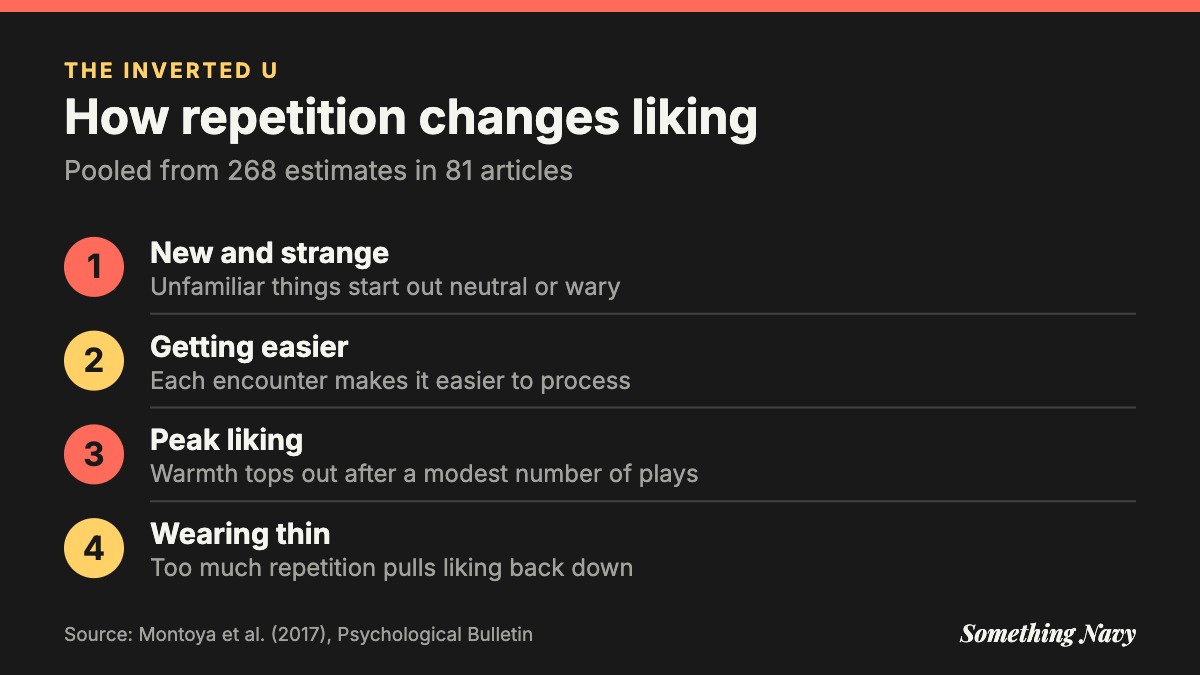
Pooling 268 estimates from 81 articles, they found the line was not straight. Liking rose with early exposures, then curved over and fell: an inverted U. The first encounters warm us up. Too many wear us out.
There was a twist that matters for music fans. In their data, the inverted U showed up clearly for things people looked at, but not for things they heard. The authors also found that existing theories could not fully account for the patterns, and they called for better models rather than claiming the case was closed.
That should not be read as proof that songs escape the curve. Auditory studies were a smaller slice of the evidence, and many used too few repetitions to reach the downturn. For that, we need researchers who studied music directly.
What happened when the music kept playing
In 2004 Karl Szpunar, Glenn Schellenberg and Patricia Pliner at the University of Toronto ran three experiments that pushed the number of plays much higher than earlier music studies. Undergraduates heard simple tone sequences or 15-second excerpts of orchestral music anywhere from two to 64 times.
The key manipulation was attention. Some participants listened carefully, for example by naming the lead instrument. Others heard the music only incidentally, while busy with a different task.
For the careful listeners, liking for the orchestral excerpts rose up to about eight plays and then sank back to where it started by 32. For the distracted listeners, there was no such fall. Their liking kept climbing, roughly in a straight line, as the plays added up.
That finding goes a long way to explaining the coffee-shop song. You never sat down to study it. It reached you in fragments, while you were ordering, scrolling or chatting. That is precisely the kind of half-heard exposure that, in the Toronto experiments, built liking without wearing it out.
It also explains the opposite experience: the album you loved so much that you played it on repeat with headphones, giving it your full attention, until one day it felt flat. Focused listening seems to reach the top of the curve faster, and to come down the other side.
Why music is built on repetition
The music theorist Elizabeth Hellmuth Margulis has argued that repetition is not a side effect of how we consume music; it is close to the heart of what music is. Her book On Repeat: How Music Plays the Mind, written while she was at the University of Arkansas, explores why we return so readily to the same choruses, riffs and songs.
Repetition inside a track lets us anticipate what is coming, and anticipation that is fulfilled feels good. Repetition across listens turns a song into shared property. In a university interview about the book, Margulis argued that being repeatable is what lets a song belong to a whole crowd rather than a single listener.
Repeatability is how songs come to be the property of a group or a community instead of an individual.
Elizabeth Hellmuth Margulis
Think of a football crowd, a wedding dance floor or a nursery tidy-up song. None of those moments works with a tune nobody knows. Mere exposure, in other words, is not only a private quirk of taste. It is part of how groups come to feel like groups.
Where you meet it every day
- Radio and streaming rotation. Heavy play of a new single is not just about reach. Each extra hearing nudges listeners a little further along the curve.
- Adverts and jingles. Brands pay to be seen often, not just once, partly because familiarity reads as trustworthiness.
- Faces at work and on your commute. The colleague you pass daily but barely know can start to feel friendlier than a stranger with a better CV.
- Food and home. Dishes you grew up with, the smell of your own house, the route you always walk: comfort often turns out to be familiarity wearing a nicer coat.
When more exposure makes it worse
It would be tidy if repetition always pushed us towards liking. It does not.
In 2013, philosophers and psychologists Aaron Meskin of the University of Leeds, Matthew Kieran, Mark Phelan and Margaret Moore published a study pointedly titled “Mere exposure to bad art”. Students were shown paintings by the Pre-Raphaelite John Everett Millais and by Thomas Kinkade, the American painter of glowing cottages often derided by critics. Some images were shown once, others several times.
More exposure did not help Kinkade. Students liked his paintings less after seeing them repeatedly, while the Millais works held up or improved. As Kieran put it in the university’s announcement, “quality, and not just familiarity, remains in the picture.”
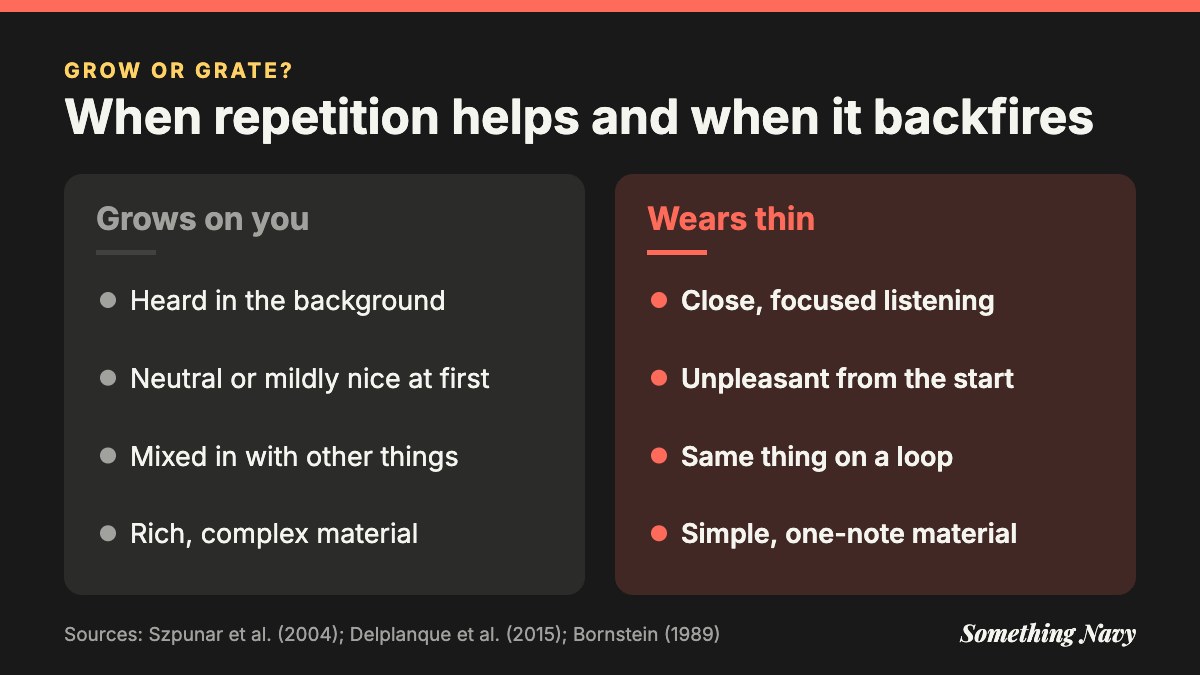
Smell research tells a similar story. In a 2015 study at the University of Geneva, Delplanque and colleagues had 40 people rate six odours across six sessions spread over several weeks. Every smell became more familiar. But only the neutral and mildly pleasant ones, such as lilac and shampoo, became more pleasant. Smells of pungent cheese and faeces did not improve with acquaintance, however familiar they became.
The researchers concluded that a stimulus’s starting point shapes what repetition can do to it. Neutral or mildly appealing things have the most room to grow. Things we find genuinely unpleasant tend to stay that way, and, as the Kinkade paintings showed, liking can even fall with repeated exposure.
Boredom is the other half of the story
Then there is simple tiredness. Anyone who has worked in a shop during the weeks when the same seasonal songs play on a loop knows the feeling. What delighted customers in November can, by late December, feel like a mild form of punishment to the staff who hear it all day.
The research fits this. Exposure seems to do two things at once: it makes something easier to process, which we enjoy, and it drains away novelty, which we also enjoy. Early on, the first force wins. Eventually, the second takes over. Where the tipping point falls depends on how complex the thing is, how closely we are paying attention and how bunched together the repetitions are.
That is why a richly layered song often has a longer life than a simple novelty hit. There is more to process, so fluency keeps building for longer before boredom overtakes it. It is also why spacing matters. A song heard now and then, mixed in with others, tends to age better than one played twenty times in an afternoon.
Using the effect without being used by it
Knowing about mere exposure can make you a little more sceptical of your own sense of comfort. Some of what feels “right” about a brand, a politician’s slogan or a familiar face may be nothing more than repetition. It is worth asking, now and then, whether you like something or have simply met it often.
It can also be quietly useful. If a new genre, a challenging writer or a colleague you misjudged has not clicked at first, the research suggests giving it a few more relaxed, low-pressure encounters before deciding. Background listening, not forced study, seems to be the gentlest route in, much as new habits need repetition before they settle.
And if a beloved song has started to grate, the answer is probably not to abandon it. Let it rest. Play other things. The curve that took it down can, with enough space, give some of it back.
The song you hated in March did not trick you. It just kept turning up, softly, at the edge of your attention, until your brain decided that something so easy to hear must be worth hearing. Most of the time, that is a kindly instinct. It is how strangers become neighbours and noise becomes a soundtrack. It is just worth remembering that the instinct is listening to frequency, not quality, and that only you can tell the difference.
Sources
- Bornstein, R. F. (1989). Exposure and affect: Overview and meta-analysis of research, 1968–1987. Psychological Bulletin, 106(2), 265–289. DOI
- Delplanque, S., Coppin, G., Bloesch, L., Cayeux, I., & Sander, D. (2015). The mere exposure effect depends on an odor’s initial pleasantness. Frontiers in Psychology, 6, 920. DOI
- Meskin, A., Phelan, M., Moore, M., & Kieran, M. (2013). Mere exposure to bad art. British Journal of Aesthetics, 53(2), 139–164. DOI
- Montoya, R. M., Horton, R. S., Vevea, J. L., Citkowicz, M., & Lauber, E. A. (2017). A re-examination of the mere exposure effect: The influence of repeated exposure on recognition, familiarity, and liking. Psychological Bulletin, 143(5), 459–498. DOI
- Moreland, R. L., & Beach, S. R. (1992). Exposure effects in the classroom: The development of affinity among students. Journal of Experimental Social Psychology, 28(3), 255–276. DOI
- Szpunar, K. K., Schellenberg, E. G., & Pliner, P. (2004). Liking and memory for musical stimuli as a function of exposure. Journal of Experimental Psychology: Learning, Memory, and Cognition, 30(2), 370–381. DOI
- Zajonc, R. B. (1968). Attitudinal effects of mere exposure. Journal of Personality and Social Psychology, 9(2, Pt. 2), 1–27. DOI
How we reported this. We went back to the original research for this story, 7 sources in all, listed above, and checked every figure against them. If you think we have got something wrong, tell us and we will look at it. Read more about how we work.
Cover photo: Ilias Chebbi on Unsplash. Charts and graphics: Something Navy.