

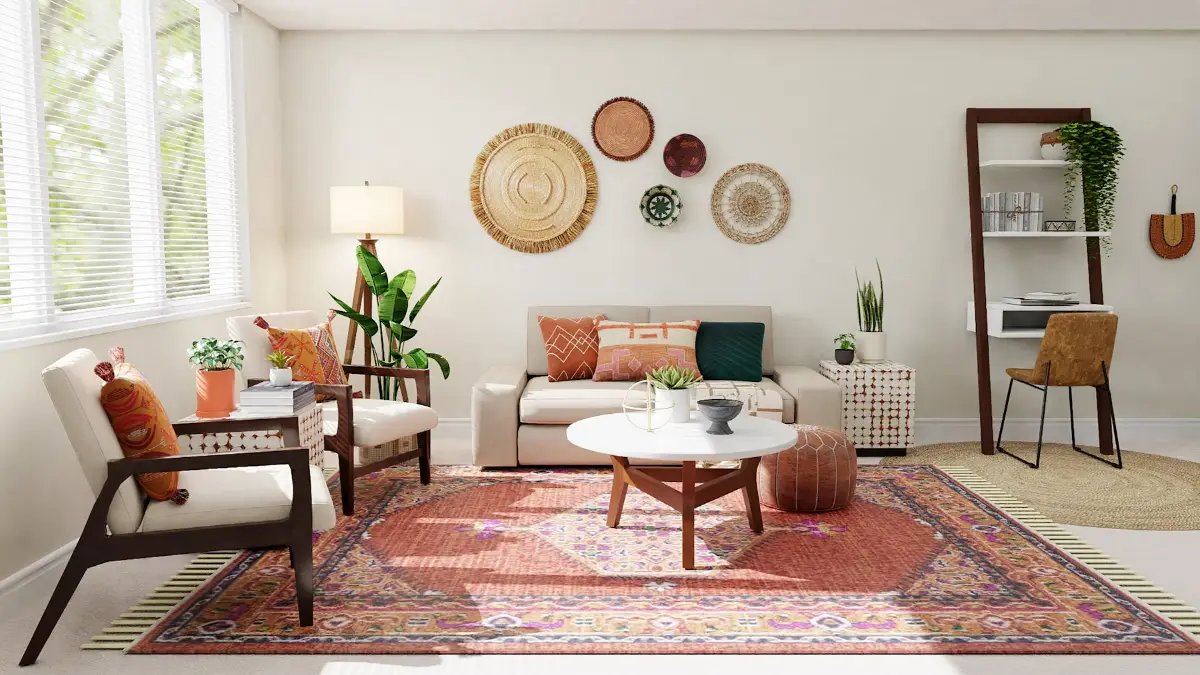
The sofa arrives on a Saturday. Two men carry it up the stairs, peel off the plastic, and suddenly your living room has a deep green velvet centrepiece that looks exactly like the photo.
By Sunday evening, you have noticed the rug.
It was fine last week. Now it looks flat and faded next to all that velvet. The cushions seem wrong too. And that side table you bought in your first flat? It has never looked so tired.
If you have ever opened a browser tab for “rug, green sofa” within 48 hours of a delivery, you have met the Diderot effect. It is named after an 18th-century French philosopher who received a beautiful new dressing gown and then, piece by piece, redecorated his entire study around it. He was not pleased about it.
Here is the surprising part: the effect is real enough to show up in experiments, but it has a very particular trigger. It is not every new thing that sets off the spiral. It is the striking ones.
In brief
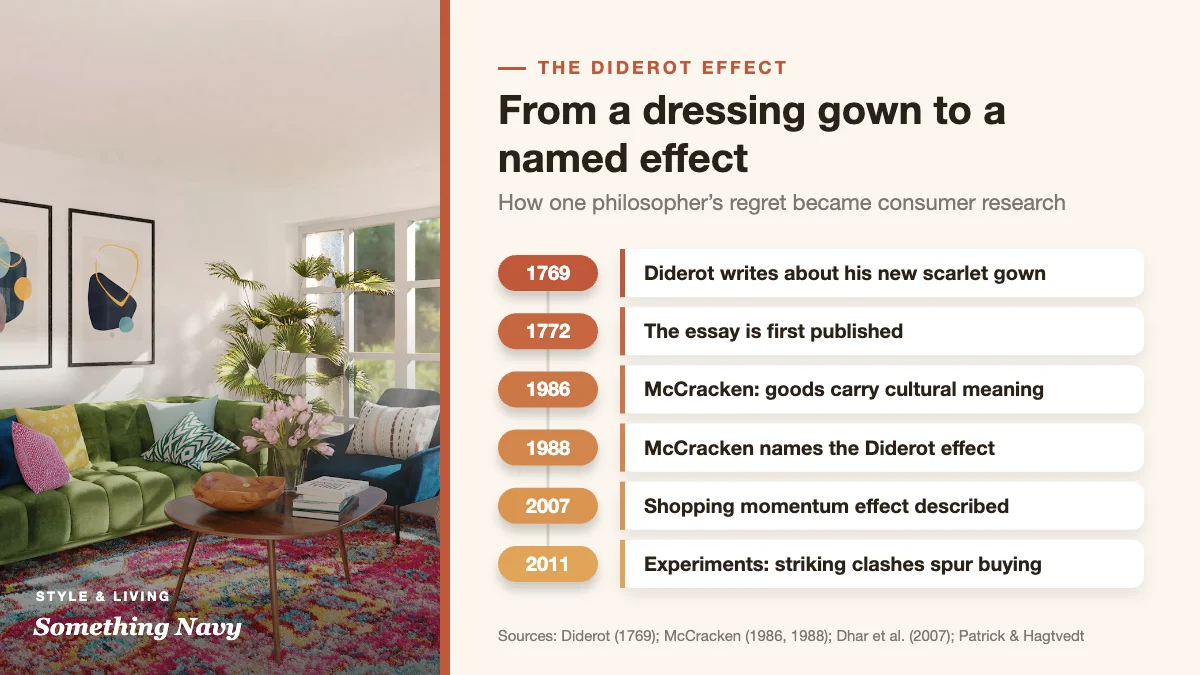
- In an essay written in 1769, Denis Diderot described how a new scarlet dressing gown made the rest of his study look shabby, so he replaced almost everything.
- The anthropologist Grant McCracken named this the “Diderot effect” in his 1988 book Culture and Consumption, along with the idea of “Diderot unities”: sets of things that feel as if they belong together.
- A 2011 set of experiments found that a striking, design-led item that clashed with what people owned made them more likely to buy matching items rather than return it.
- Separate research on “shopping momentum” shows that one purchase can make the next one easier, even when the two are unrelated.
- Most of the evidence is small and short-term. The good news is that the same research points to simple ways of breaking the chain.
What Diderot’s scarlet dressing gown did to his study
Denis Diderot was one of the great writers of the French Enlightenment, and in 1769 he wrote a short, funny, rather rueful essay usually translated as “Regrets on Parting with My Old Dressing Gown”. According to the Encyclopedia of Consumer Culture, it was first published in 1772.
The old gown was shabby, comfortable and entirely his. It suited him, and it marked him out as a working writer. The new one was scarlet, expensive and, as he saw it, made him look like a wealthy idler.
Then the trouble spread. In Mitchell Abidor’s English translation, the Bergamo rug that had hung on his wall for years gave way to a damascene hanging. A straw chair was banished to the antechamber and replaced with leather. His books moved from a flimsy fir shelf to an inlaid cabinet. His plain wooden table became a costly desk. A large mirror appeared over the mantelpiece, along with new paintings, a gold clock and a statue of Venus.
Only one thing survived from his simpler days: a worn old rug on the floor. Each morning, he writes, he walks in wrapped in scarlet, lowers his gaze, and sees it.
His verdict on the whole affair is the line everyone quotes: “I was the absolute master of my old robe. I have become the slave of the new one.”
It is worth noticing what he is actually complaining about. Not the price, exactly. He is mourning a sense of fit. His old things matched each other and matched him. The scarlet gown broke that, and every replacement was an attempt to put it back together.
The new thing is rarely the problem. The problem is that it makes everything around it look like a mistake.
How Grant McCracken turned a robe into the Diderot effect
For more than two centuries the essay was a charming curiosity. Then, in the 1980s, Grant McCracken, an anthropologist who studied the meaning of consumer goods, picked it up.
In 1986 McCracken published a much-cited paper in the Journal of Consumer Research arguing that objects carry cultural meaning. Advertising and fashion move that meaning from the wider culture into goods, he argued, and from goods into the people who buy them. Your sofa is not just somewhere to sit. It says something about who you are, or would like to be.
Two years later, his book Culture and Consumption (Indiana University Press, 1988) included a chapter called “Diderot Unities and the Diderot Effect”. That is where the term was born.


Diderot unities: why the things you own are meant to match
McCracken’s key idea was the “Diderot unity”. It describes a group of goods that a culture treats as belonging together. Think of the linen shirt, the leather loafers and the straw tote.
None of these items has to match in colour. They match in meaning. Together they tell one coherent story about a person, and we feel it when one of them is wrong, even if we struggle to explain why.
The Diderot effect is what happens when that story is interrupted. A new object arrives that does not fit the unity, and you feel pressure to either reject it or rebuild everything else around it.
Here is the twist that most retellings leave out. As the Encyclopedia of Consumer Culture summarises McCracken’s argument, the usual pull of a Diderot unity is conservative. Most of the time it stops us buying things that would not fit. By McCracken’s own logic, the entry notes, Diderot should never have worn the gown at all.
So the effect works in two directions. Usually it keeps your home and wardrobe steady. Occasionally, when something new gets past the guard, it does the opposite and drives a whole run of upgrades.
The obvious question is: what gets past the guard?
The 2011 experiments: striking design makes you buy more, not return it
Vanessa Patrick of the University of Houston and Henrik Hagtvedt of Boston College set out to answer exactly that. Their paper, “Aesthetic Incongruity Resolution”, appeared in the Journal of Marketing Research in 2011, and it opens with Diderot’s gown.
Their starting point was simple. When something you have bought does not go with what you own, you have two options. Take it back, or buy more things so that it fits. Which one do people choose?
The pendant and the earrings
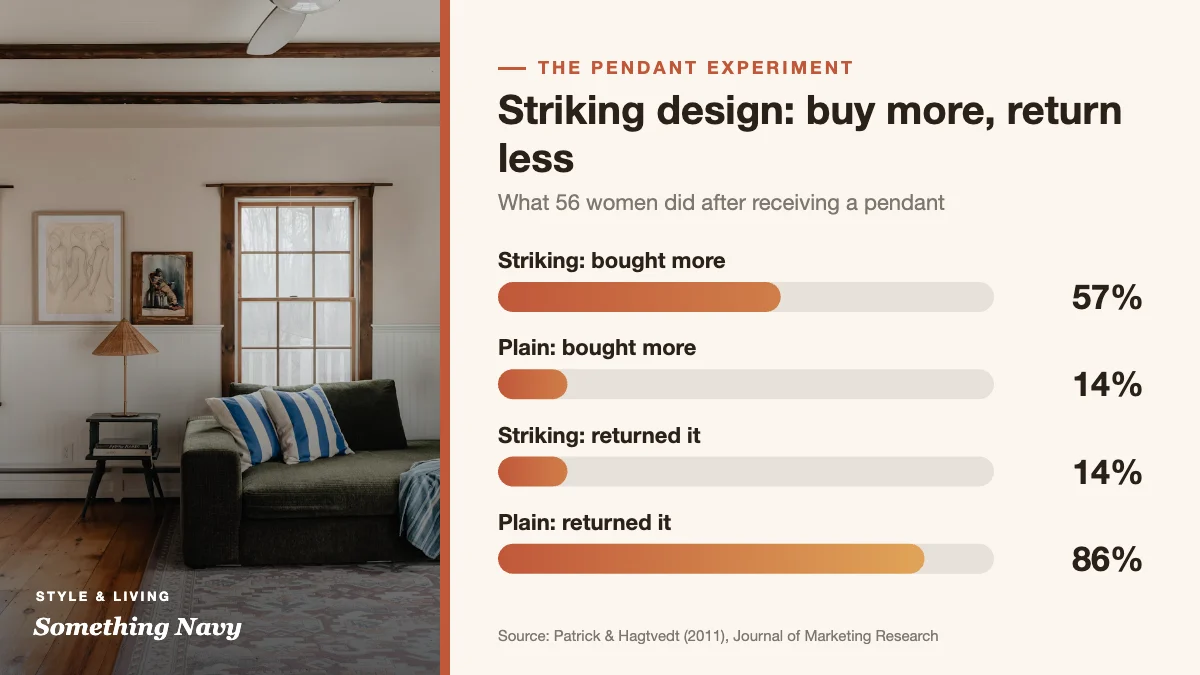
In their first experiment, 56 working women with an average age of 37 were each given a pendant as a welcome gift, plus $5. Half received a pendant with a distinctive, eye-catching design. The other half got a plainer one.
Then each woman chose: spend the money on a pair of matching earrings, return the pendant for $5, or simply keep the pendant and the cash.
The difference was stark. Among women given the striking pendant, 57% bought the matching earrings and only 14% returned it. Among those given the plain one, just 14% bought earrings and 86% returned the pendant.
The armchair that did not fit
The second study is the one that will feel familiar if you have ever bought furniture. Sixty-five undergraduates imagined buying an armchair that clashed with a photo of their living room. For some, the chair had high design appeal. For others, it did not.
Asked in their own words what they would do, 60.6% of those with the striking chair said they would buy more things to make it work. With the ordinary chair, only 18.8% said so, and most would take it back.
A third study, also with 65 students, found the same pattern with shoes that clashed with a person’s wardrobe.
Frustration, not regret
The most interesting part is why. Patrick and Hagtvedt measured how people felt about the mismatch. When a plain item did not fit, people mostly felt regret: I made a mistake, it goes back. When a beautiful item did not fit, they felt frustration instead. The item was right; the surroundings were wrong.
And frustration, unlike regret, pushed people towards buying more. In their statistical analysis, the balance between those two feelings accounted for the extra buying.
That is the green velvet sofa in a sentence. You do not regret it. You love it. You are frustrated with the rug.
Regret sends things back to the shop. Frustration sends you back to the shop.
Shopping momentum: why one purchase makes the next one easier
Patrick and Hagtvedt explain why a mismatch leads to matching purchases. A separate line of research suggests the very act of buying can loosen your grip on the next decision, even when the next item has nothing to do with the first.
In a 2007 paper in the Journal of Marketing Research, Ravi Dhar of Yale, Joel Huber of Duke and Uzma Khan of Stanford called this the “shopping momentum effect”.
In their first study, 180 students at a university in South Asia were paid a small sum and offered small items to buy, with 60 people in each group. When the only thing on offer was a key chain, 46.6% bought it. When they were first offered an educational CD, which 72% bought, 65% went on to buy the key chain too.
The researchers argued that a first purchase shifts you from a deliberating frame of mind (“should I buy anything?”) into an implementing one (“what shall I get?”). As Khan put it in a Stanford write-up of the work: “The cart takes over.”
People do not see it coming. According to the Stanford summary, when asked hypothetically, shoppers predicted they would be less likely to buy a second item after spending money. And the momentum broke when people paid for the two items from separate sources. In one study, 70% bought the key chain when everything came out of one pot, against 42.5% when the second purchase required a fresh payment.
Shopping momentum is not the Diderot effect exactly. Diderot was chasing harmony, not riding a mood. But in a real home makeover, they reinforce each other. The striking new piece creates the mismatch, and the act of buying makes fixing it feel effortless.
What is and is not proven about the Diderot effect
Stories about money spread fast (we looked at another in our piece on the lipstick effect), so it is worth being honest about the evidence.
The core experiments are small. Patrick and Hagtvedt’s studies had 56 and 65 people, and two of the three asked students to imagine purchases rather than make them. Dhar and colleagues used real purchases, but of cheap items such as key chains, pens and snacks.
Other work is more exploratory. In 2003, Teresa Davis of the University of Sydney and Gary Gregory of the University of New South Wales interviewed consumers in depth and suggested that impulse buys can become the starting point for a new Diderot unity, possibly tied to the person we hope to become. It is an interesting idea, built from conversations rather than measurements, and it does not show cause and effect.
| Claim | What the evidence shows | How solid |
|---|---|---|
| One new item can make your other things look worse | Described vividly by Diderot and theorised by McCracken | Strong as an idea, rarely measured directly |
| A striking mismatch makes you buy more | Patrick & Hagtvedt (2011): more matching purchases, fewer returns | Consistent, but small samples |
| One purchase makes the next easier | Dhar, Huber & Khan (2007): shopping momentum | Real purchases, but cheap items |
| Impulse buys start new lifestyles | Davis & Gregory (2003): in-depth interviews | Exploratory only |
| The Diderot effect drives long-term debt | No study we found tracks this over time | Not evidenced |
That last row matters. You will often read that Diderot was ruined by his gown, or that the effect drives household debt. We could not find research that tracks a single upgrade turning into years of overspending. It is plausible, but it is not proven.
What does seem robust is the moment itself: a lovely new thing, a flash of dissatisfaction with everything around it, and a strong pull to put that right with your card. That is a moment you can plan for.


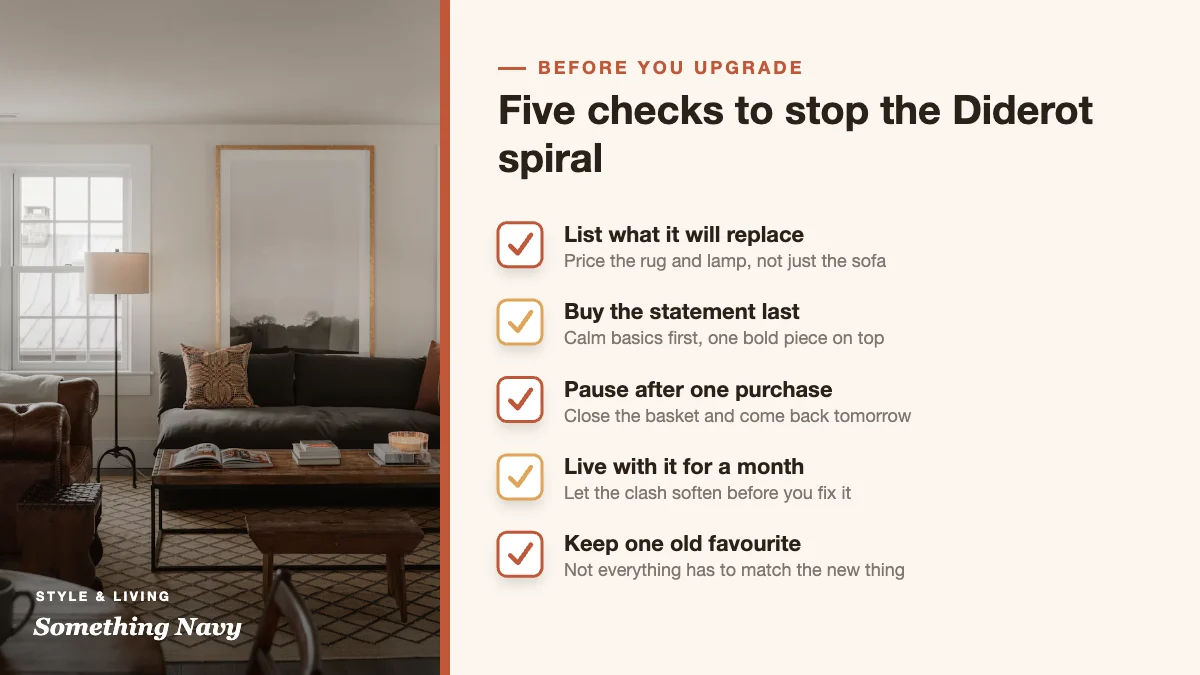
1. Ask “what will this make me replace?” before you buy
Patrick and Hagtvedt’s advice, according to the Boston College release, was to ask two questions before buying a striking item: is it beautiful, and does it go with what I already own?
Add a third. Picture the new piece in place and list everything that will suddenly look wrong next to it. The rug. The curtains. The lamp. Price the whole list. If the true cost is the sofa plus £600 of matching extras, you want to know that in the shop, not on Sunday night.
The same works for clothes. A statement coat is rarely one purchase. It wants boots, a bag and possibly a scarf. A capsule wardrobe approach helps because it makes your unity explicit: you know what a new piece has to work with before you fall for it.
2. Buy the statement piece last, not first
The research suggests the striking item is the one that starts the chain. So reverse the order.
Get the room or wardrobe right with quieter pieces, then add the one dramatic thing on top. A bold rug laid on a calm floor with plain furniture is a finished room. A bold sofa in a room of tired basics is the beginning of a renovation.
Uzma Khan offered a related tip in the Stanford write-up: buy the indulgent item first, because the guilt around luxury purchases tends to slow further spending. Either way, the principle is the same. Decide which item is the anchor before you walk into the shop.
3. Break the shopping momentum on purpose
The momentum studies found that a fresh payment step interrupted the chain. You can build those interruptions into your own habits.
- Check out after the first item, then close the tab. Come back to the basket tomorrow.
- Pay for “matching” purchases from a separate pot of money, so each one requires its own decision.
- In a shop, put the main item through the till before you browse anything else.
Each pause moves you back from “what shall I get?” to “should I get anything?”. That second question is the one that saves money.
4. Let the new thing live with the old things for a month
The frustration Patrick and Hagtvedt measured is a reaction to a mismatch, and we tend to adjust to our surroundings surprisingly fast. Psychologists call this hedonic adaptation, and here it can work in your favour.
Give the new sofa four weeks with the old rug before you replace anything. Move things around. Quite often the clash softens, or you discover that what bothered you was one small thing, a colour or a texture, that a £20 throw can fix.
With clothes, wear the new piece with what you already have at least three times before buying anything to go with it. It is also a good way to avoid the drawer of clothes that never get worn.
If you still want the rug after a month, buy the rug. If you do not, you have saved more than its price.
5. Use the Diderot effect in your favour
Diderot unities are not only a trap. They also explain why a well-chosen set of belongings feels so calm. A home where things belong together is easier to live in, and research on clutter and stress suggests that a chaotic space can wear on you.
So point the effect somewhere useful. One good kitchen knife can make you want to cook more. A single properly made pair of shoes can raise the bar for everything else you buy, so you buy less but better. The upgrade that leads to another can lead to a habit rather than a spree.
And keep one old rug. Diderot did. In all that new splendour, the worn piece on his floor was the thing he looked down at every morning.
Back to the green velvet sofa. It is beautiful, and you were right to buy it. The rug is not a problem that needs solving tonight.
It is just the last piece of the room that still remembers who you were before Saturday.
Frequently asked questions
It is the tendency for one new possession to make your existing things look worse, which can lead to a chain of further purchases. It is named after Denis Diderot’s 1769 essay about a new dressing gown.
The anthropologist Grant McCracken, in his 1988 book Culture and Consumption. He also coined “Diderot unity” for a set of goods that feel as if they belong together.
They overlap but are not identical. Lifestyle creep usually describes spending rising with income over time, while the Diderot effect is about one specific item prompting others to match it.
No. Research by Patrick and Hagtvedt suggests it is mostly striking, design-led items that clash with what you own. Plain items that do not fit are more likely to be returned.
Official links and research
- Diderot, D. (1769). Regrets for my old dressing gown (M. Abidor, Trans.). Marxists Internet Archive. Link
- McCracken, G. (1986). Culture and consumption: A theoretical account of the structure and movement of the cultural meaning of consumer goods. Journal of Consumer Research, 13(1), 71–84. DOI
- Southerton, D. (Ed.). (2011). Diderot effect. In Encyclopedia of Consumer Culture (pp. 450–451). SAGE Publications. Link
- Patrick, V. M., & Hagtvedt, H. (2011). Aesthetic incongruity resolution. Journal of Marketing Research, 48(2), 393–402. Link
- ScienceDaily. (2010, December 14). Anatomy of a shopping spree: Pretty things make us buy more [Boston College press release]. Link
- Dhar, R., Huber, J., & Khan, U. (2007). The shopping momentum effect. Journal of Marketing Research, 44(3), 370–378. Link
- Rigoglioso, M. (2007, September 1). Buyer beware: Shopping can lead to more … well … shopping. Stanford Graduate School of Business Insights. Link
- Davis, T., & Gregory, G. (2003). Creating Diderot unities: Quest for possible selves? Journal of Consumer Marketing, 20(1), 44–54. DOI
Cover photo: Phillip Goldsberry on Unsplash. Charts and graphics: Something Navy, with photography by Spacejoy and Clay Banks on Unsplash.
How we reported this. Every figure was checked against the 8 sources above. Reviewed by Valentino Adkins, Senior Content Manager. Report an error · How we work