
Picture two purchases. An £18 top, snapped up because it was cheap, worn twice before it stopped feeling right. And a £95 coat you dithered over for a week, then wore through three winters.
Do the maths per wear and the bargain is the expensive one. Most of us own more of the first kind than we realise: a 2022 survey of more than 6,000 UK adults by the waste charity WRAP put the average wardrobe at about 118 items, with 31 of them unworn for at least a year.
So the problem is rarely a lack of clothes. It is a surplus of the wrong ones.
That is the quiet case for what fashion writers call elevated minimalism: a smaller set of plain, well-made, properly fitting basics that you actually reach for. Not a monastic capsule of 33 grey things, just fewer misses. The psychology behind it is more interesting, and more honest, than the Instagram version suggests.
We buy more and wear it less
The big picture comes from the Ellen MacArthur Foundation’s 2017 report A New Textiles Economy. It measured “clothing utilisation”, the average number of times a garment is worn before it stops being used. The findings were blunt:
- Global clothing production roughly doubled in the 15 years before the report.
- Over the same period, utilisation fell by 36%. Each garment was worn about a third fewer times.
- In China, utilisation fell by 70%. In the United States, clothes are worn for around a quarter of the global average.
- Shoppers lose an estimated USD 460 billion of value a year by throwing away clothes they could keep wearing.
- Less than 1% of the material used to make clothing is recycled into new clothing.
British habits fit the pattern. WRAP’s Textiles Market Situation Report 2024 found that 49% of used textiles in the UK go into general waste bins, around 35 items per person each year.
A garment you wear twice and bin is the most expensive thing you own.

Too many options: what the evidence really says
The minimalist pitch usually leans on two famous ideas. Both deserve a closer look before you clear out your drawers in their name.
The first is choice overload. In a well-known 2000 study, Sheena Iyengar and Mark Lepper set up a tasting stand in an upmarket Californian supermarket. Shoppers who saw six jams were far more likely to buy (30%) than those who saw 24 (3%). The story spread everywhere.
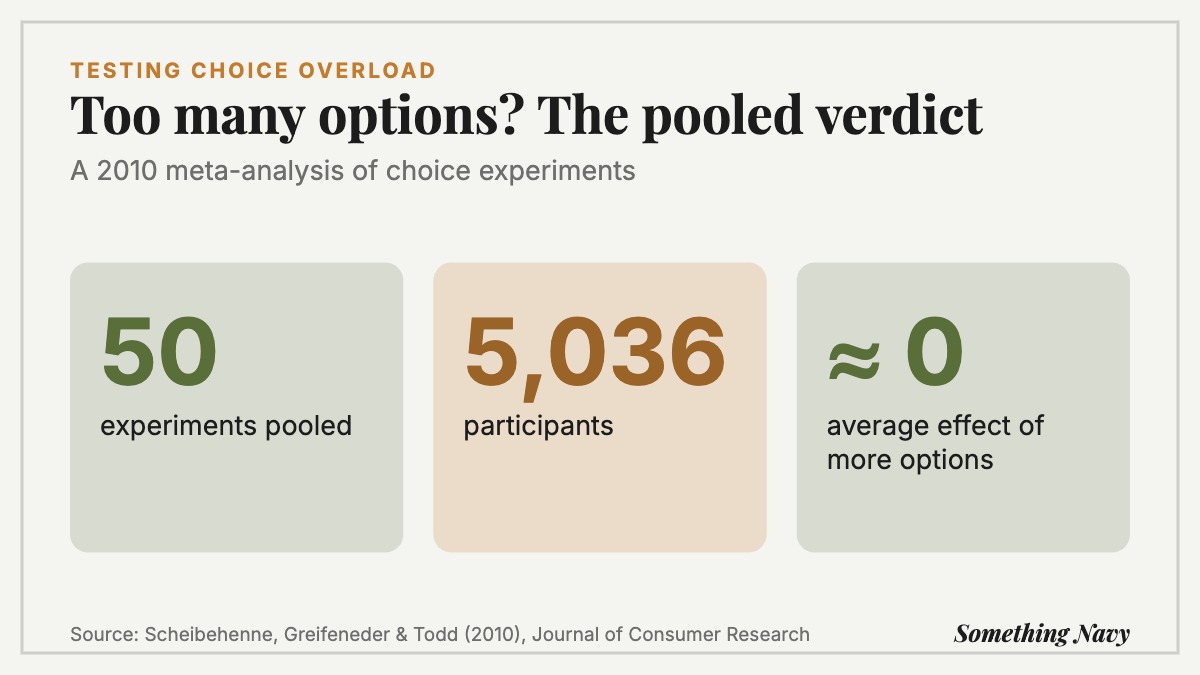
Then people tried to repeat it. In 2010 Benjamin Scheibehenne, Rainer Greifeneder and Peter Todd pooled 63 conditions from 50 experiments with 5,036 participants. The average effect of having more options was “virtually zero”, although results varied a lot from study to study.
That variation turned out to matter. A 2015 meta-analysis led by Alexander Chernev at Northwestern University analysed 99 observations from 7,202 people and found choice overload does appear under particular conditions:
- The options are complex and hard to compare side by side.
- The task is difficult, for instance you are short of time.
- You are unsure what you want, with no clear preference to anchor on.
- You just want it over with, aiming to minimise effort rather than find the best option.
Read that list again with a weekday morning in mind. Lots of half-matching pieces, a deadline, no settled sense of your own style, and a strong wish to get out of the door. A crowded wardrobe is close to a textbook case.
Decision fatigue is shakier than you have heard
The second idea is decision fatigue: the claim that willpower is a fuel tank, and every small choice drains it. Barack Obama gave it a famous wardrobe twist when he told Vanity Fair in 2012, “I’m trying to pare down decisions.”
The science underneath, known as ego depletion, has had a rough decade. In 2016 a preregistered replication across 23 laboratories, led by Martin Hagger, tested 2,141 people and found an effect of d = 0.04, statistically indistinguishable from zero. A second multisite test, led by Kathleen Vohs and published in 2021, ran in 36 labs with 3,531 participants and found d = 0.06, again not significant.
We go through the wider debate in our piece on whether decision fatigue is real. The short version: the “limited tank” theory is in trouble, so be wary of anyone promising a capsule wardrobe will restore your willpower.
What survives is more modest and more practical. Choosing among many hard-to-compare options under time pressure is unpleasant, and you can make it easier by changing the options.
Your wardrobe, by the numbers
WRAP’s 2022 survey also asked people why particular items sat untouched. Three reasons came up again and again:
- Occasion only. Dresses, skirts, formal trousers and smart shirts bought for one wedding or one interview.
- It no longer fits well or comfortably. Jeans, formal trousers, skirts, shorts and T-shirts led here.
- Liked, but never the first choice. Knitwear, hoodies and coats that lose out to an old favourite.
Skirts and dresses were the pieces most likely to be owned but unworn. The hard workers were the boring ones: underwear, socks, bras, hoodies and jeans.
Notice that fit sits right in the middle of that list. It is the reason a perfectly nice pair of trousers becomes furniture.
The maths that changes how you shop
Cost per wear is the simplest tool in this whole piece. Divide what you paid by the number of times you will realistically wear it. Add any alteration costs to the price.
The table below uses round, illustrative prices and wear counts, not survey data. The point is the shape of the result, not the exact pence.
| Item | Price paid | Times worn | Cost per wear |
|---|---|---|---|
| Trend top, bought on a whim | £12 | 4 | £3.00 |
| Occasion dress, worn once | £45 | 1 | £45.00 |
| Merino crew-neck jumper | £35 | 60 | £0.58 |
| Jeans plus £15 hemming | £75 | 150 | £0.50 |
| Plain wool-blend coat | £90 | 200 | £0.45 |
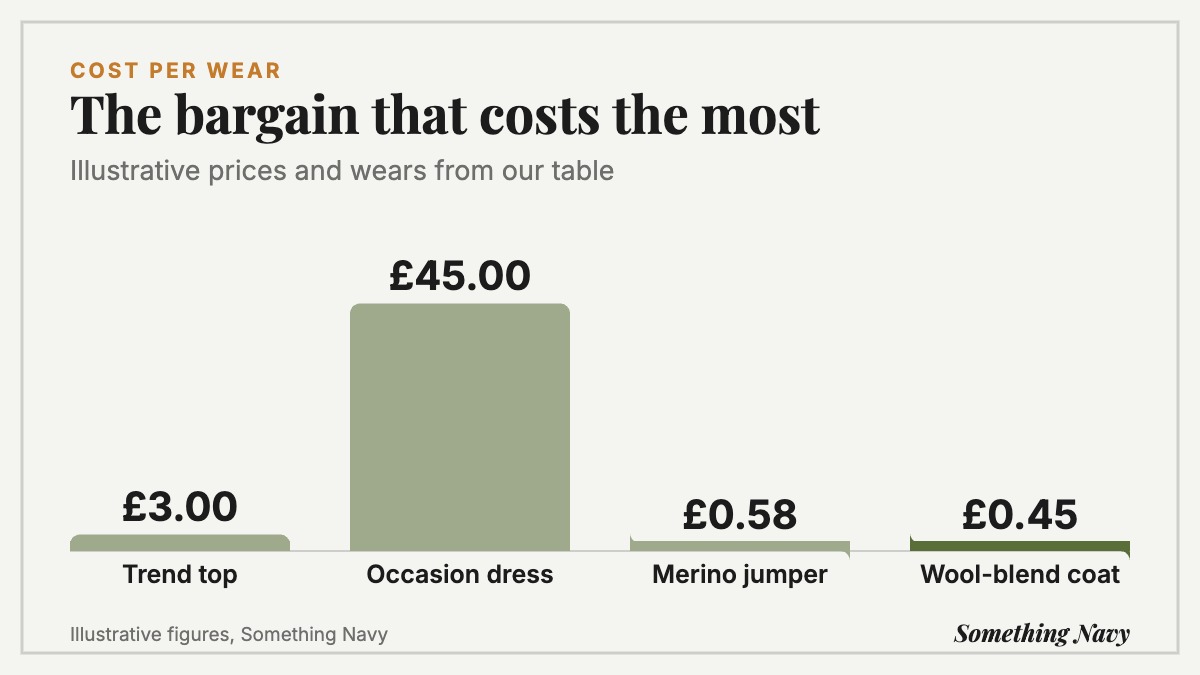
The cheapest thing on the receipt is often the dearest thing in the wardrobe. And the £15 spent on hemming is what turns a pair of jeans you tolerate into a pair you live in.
Try this before your next purchase
- Name three things you already own that it goes with. If you cannot, walk away.
- Guess honestly how many times you will wear it in a year. Divide the price by that number.
- Check the fit at the shoulders and waist first. Those are the hardest areas to alter.
- Sleep on anything over £30. If you still want it in 48 hours, it is probably not an impulse.
- One in, one out: if it comes home, something else goes to a charity shop.

Fit is the cheapest upgrade going
Fashion editors love the phrase “tailored basics”, which sounds expensive. In practice it mostly means a high-street piece that has been taken to a local alterations shop for one small fix.
The changes that make the biggest visual difference tend to be the simplest:
- Trouser and jeans hems. Pooling fabric at the ankle makes anything look cheaper.
- Sleeve length. Shirt and coat cuffs that cover half your hand read as borrowed.
- Taking in a waist. Usually straightforward, and it ends the belt-and-bunch problem.
- Tapering a trouser leg. Turns a dated cut into something current.
Shoulders are the exception. They are fiddly and costly to change, so buy for your shoulders and alter everything else.
There is a psychological angle too. Research on enclothed cognition suggests what we wear can colour how we feel and act, although the strongest early claims have proved hard to replicate. The more grounded point is simpler. Clothes that fit stop demanding attention. You stop tugging, adjusting and checking reflections, and get on with your day.
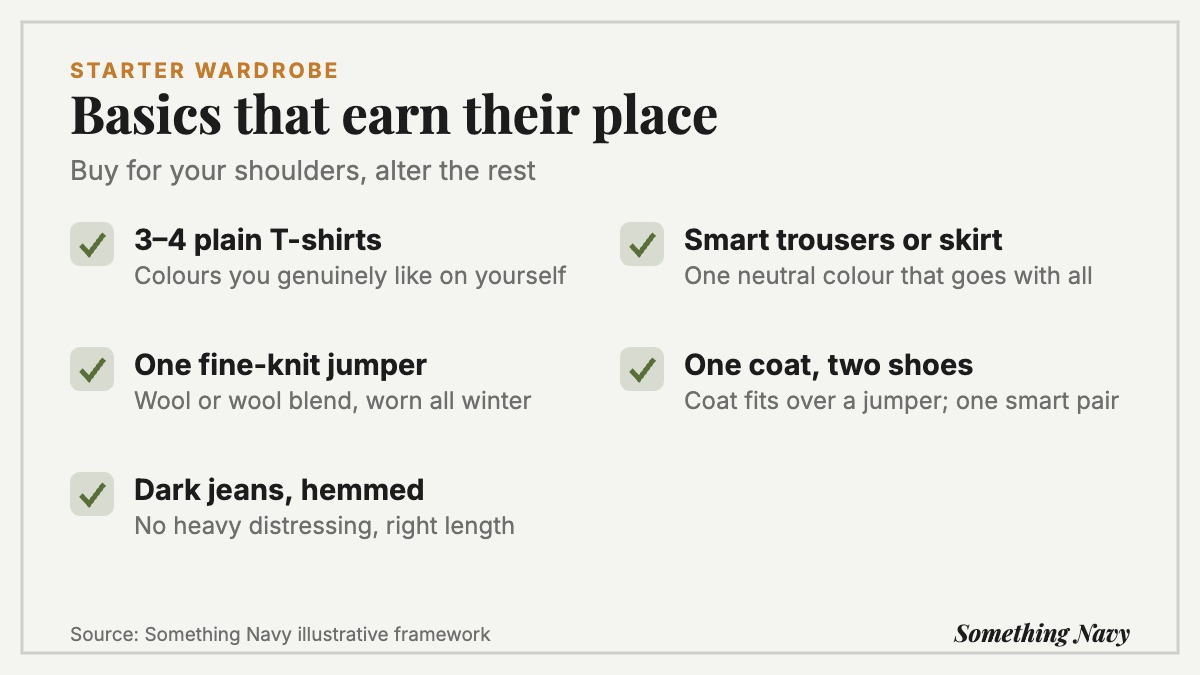
An affordable starter list
This is a framework, not a shopping list. Swap anything that does not suit your life, climate or job. Most people already own half of it.
The everyday core
- Three or four plain T-shirts in colours you genuinely like on yourself.
- Two shirts or blouses that can be worn tucked or loose.
- One fine-knit jumper in wool or a wool blend, and one cardigan or sweatshirt.
- One pair of dark jeans with no heavy distressing.
- One pair of smart trousers or a skirt in a neutral colour.
The layers and finishers
- One coat that works over both a jumper and a shirt.
- One light jacket or blazer for in-between weather.
- Two pairs of shoes: one comfortable everyday pair, one smarter pair.
- One bag big enough for daily life and simple enough for an evening.
How to build it without a big spend
The worst way to adopt minimalism is to buy an entire new minimalist wardrobe. A few cheaper and kinder routes:
- Audit first. Lay everything out and sort into “wear weekly”, “wear sometimes” and “never”. The gaps become obvious.
- Shop second-hand for the expensive pieces. Coats and wool knitwear turn up in charity shops and resale apps for a fraction of the new price.
- Spend on the most-worn items. Your jeans and everyday shoes deserve more budget than an occasion outfit.
- Borrow or hire for one-offs. Weddings and parties are where the 1-wear pieces in that table come from.
- Keep a simple palette. Two or three base colours that all go together multiply your outfits without adding items.
If a cluttered rail also makes the bedroom feel chaotic, our look at what clutter does to stress levels is worth a read before you start sorting.
What a smaller wardrobe will not do
It is worth being clear about the limits. No study shows that owning 30 items rather than 118 makes you happier, sharper or more productive. The willpower story is weak, and the choice overload evidence says the effect depends heavily on circumstances.
What the evidence does support is narrower and more useful:
- Clothes are being worn far fewer times than they used to be, and that is wasted money.
- Choosing becomes harder when options are complex and you are short of time, which describes most mornings.
- Poor fit is one of the main reasons good clothes go unworn.
Fewer, better basics tackle all three at once. That is reason enough.
Getting dressed, the slimmer way
Now open a wardrobe built this way. The rail has space between the hangers. Everything on it fits, most of it goes with most of the rest, and the jeans you reach for have been hemmed to the right length.
You still have to choose. It just takes a minute, and nothing you pick will make you tug at it all day.
The goal was never to own less for its own sake. It was to wear what you own.
Sources
- Ellen MacArthur Foundation. (2017). A new textiles economy: Redesigning fashion’s future (Summary of findings). Link
- WRAP. (2022, October 7). Nation’s wardrobes hold 1.6 billion items of unworn clothes [Press release]. Link
- Circular Online. (2024, May 1). 49% of used textiles end up in residual waste, WRAP report finds. Link
- Scheibehenne, B., Greifeneder, R., & Todd, P. M. (2010). Can there ever be too many options? A meta-analytic review of choice overload. Journal of Consumer Research, 37(3), 409–425. DOI
- Chernev, A., Böckenholt, U., & Goodman, J. (2015). Choice overload: A conceptual review and meta-analysis. Journal of Consumer Psychology, 25(2), 333–358. DOI
- Hagger, M. S., Chatzisarantis, N. L. D., et al. (2016). A multilab preregistered replication of the ego-depletion effect. Perspectives on Psychological Science, 11(4), 546–573. DOI
- Vohs, K. D., Schmeichel, B. J., et al. (2021). A multisite preregistered paradigmatic test of the ego-depletion effect. Psychological Science, 32(10), 1566–1581. DOI
Updated 17 October 2026: we rewrote this article with new research, figures and sources. Cover photo: Mnz on Unsplash. Charts and graphics: Something Navy.
How we reported this. We went back to the original research for this story, 7 sources in all, listed above, and checked every figure against them. If you think we have got something wrong, tell us and we will look at it. Read more about how we work.