
The email has been sitting there since Tuesday. It would take ten minutes to answer. Instead you have cleaned the fridge, reorganised a drawer of cables and read about a shipwreck you had never heard of. None of that was lazy. You were busy the whole time.
That is the clue. Most people who procrastinate are not short of energy. They are short of something else: a tolerable way to sit with the task in front of them. Over the past three decades psychologists have built a fairly consistent picture of what goes on in those moments, and it has less to do with willpower or time management than with feelings.
This piece is in two halves. The first explains what the research has found. The second turns that research into a practical toolkit, with each tool tied to the evidence behind it.
A habit almost everyone admits to
In 2007 Piers Steel, an organisational psychologist at the University of Calgary, published what is still the most cited review of the subject, a meta-analysis in Psychological Bulletin. He pooled 691 correlations from earlier studies to see which traits and situations reliably went with putting things off.
His opening summary of the prevalence figures is striking. Estimates suggested that 80–95% of college students procrastinate, around 75% consider themselves procrastinators, and almost 50% do so “consistently and problematically”. Among adults, it was chronic for some 15–20%.
Those numbers come from a mix of surveys with different definitions, so treat them as a rough range rather than a precise count. But the direction is hard to argue with. Delay is not a quirk of a careless minority.
What actually predicts delay
The more revealing part of Steel’s analysis is what did and did not predict procrastination. Neuroticism, the general tendency to feel anxious or low, turned out to have only a weak link. So did rebelliousness and sensation seeking.
The strong, consistent predictors were different. People delayed more when a task was aversive, when its reward was a long way off, when they doubted their ability to do it, and when they were impulsive or easily distracted. Low conscientiousness, especially poor self-control and organisation, also mattered.
Put simply, it is not that procrastinators are anxious people. It is that certain tasks make almost anyone feel bad, and some of us are quicker to reach for relief.
The student study that found a hidden payoff
If delay feels so bad later, why do we keep choosing it? A neat answer came from Dianne Tice and Roy Baumeister, then at Case Western Reserve University. In a 1997 paper in Psychological Science they followed students in their own health psychology classes across a semester.
Students completed a standard procrastination scale, then logged their stress and physical symptoms as the term went on. The researchers also tracked when papers were handed in and what grades they earned.
Early in the semester, the procrastinators were doing better. They reported less stress and fewer symptoms than their more diligent classmates. By the end of term the picture flipped: they reported more stress and more illness, and across the whole semester they were sicker overall. They also got lower grades on their assignments.
The authors concluded that procrastination looks like a self-defeating pattern: short-term benefits, long-term costs. The benefit is real, which is exactly why it is so tempting.
Feeling better now, paying later
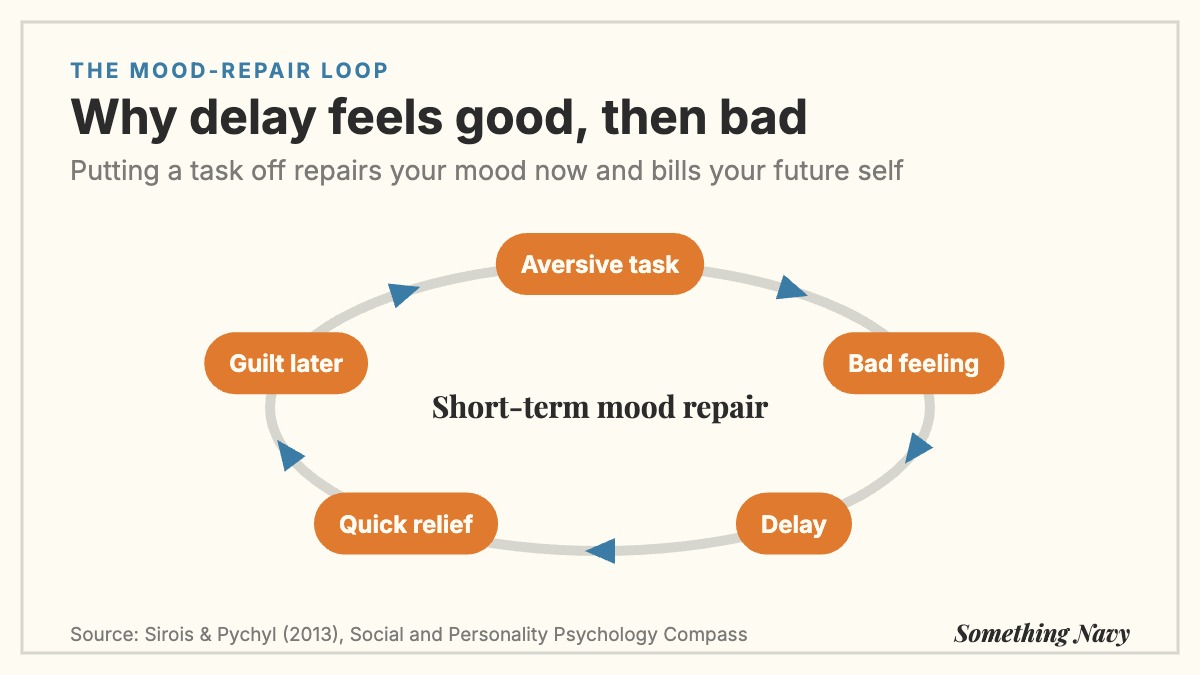
In 2013 the psychologists Fuschia Sirois and Timothy Pychyl, the latter of Carleton University in Ottawa, drew these threads together in a review in Social and Personality Psychology Compass. Their argument was that procrastination is closely tied to “short-term mood repair”. When a task stirs up boredom, anxiety, self-doubt or resentment, putting it off makes the feeling go away. Instantly.
The cost lands somewhere else. As they put it, the consequences are usually borne by the “future self”. Sirois and Pychyl suggested that people who procrastinate tend to feel a gap between the person they are now and the person who will face the deadline, which makes it easier to hand that person the bill.
This also explains why the delay is so often filled with busy, slightly useful activity. Cleaning the fridge feels productive enough to quieten the guilt, while keeping the dreaded task out of view.
Unfinished tasks do not stay quietly in the background, either. As anyone familiar with the Zeigarnik effect will recognise, an open loop tends to tug at attention, so the relief is often thinner than it feels in the moment.


Why being hard on yourself backfires
If procrastination is partly about escaping bad feelings, then scolding yourself for it should make things worse, not better. In 2010 Michael Wohl and Timothy Pychyl at Carleton, with a colleague, tested a version of this idea, published in Personality and Individual Differences.
They followed first-year psychology students across two midterm exams; 119 were included in the final analysis. Before the first exam students rated how much they had procrastinated and how far they had forgiven themselves for it. Between exams they reported their mood, and before the second exam they rated their procrastination again.
Students who had forgiven themselves for delaying the first time procrastinated less before the second exam. Part of the link ran through mood: more self-forgiveness went with less negative feeling about the first exam, which in turn went with less delay. The effect showed up mainly among those who had procrastinated heavily to begin with.
It was a single course, self-reported and observational, so it cannot prove that forgiving yourself causes better behaviour. But it fits the wider model neatly. Guilt is one more bad feeling to escape.
The long tail: health, sleep and money
The most rigorous recent look at the costs comes from Sweden. Fred Johansson and colleagues reported in JAMA Network Open in 2023 on 3,525 students from eight universities in and around Stockholm and Örebro.
They measured procrastination at the start, then checked a wide range of health outcomes nine months later, adjusting for a range of background factors and for each person’s earlier health. Higher procrastination was linked to slightly more depression, anxiety and stress at follow-up.
It was also linked to a higher risk of several practical problems. For each step up in procrastination (one standard deviation), the risk of disabling pain in the upper body (arms, shoulders and hands) was 1.27 times higher, economic difficulties 1.15 times, poor sleep 1.09 times, and both loneliness and physical inactivity 1.07 times.
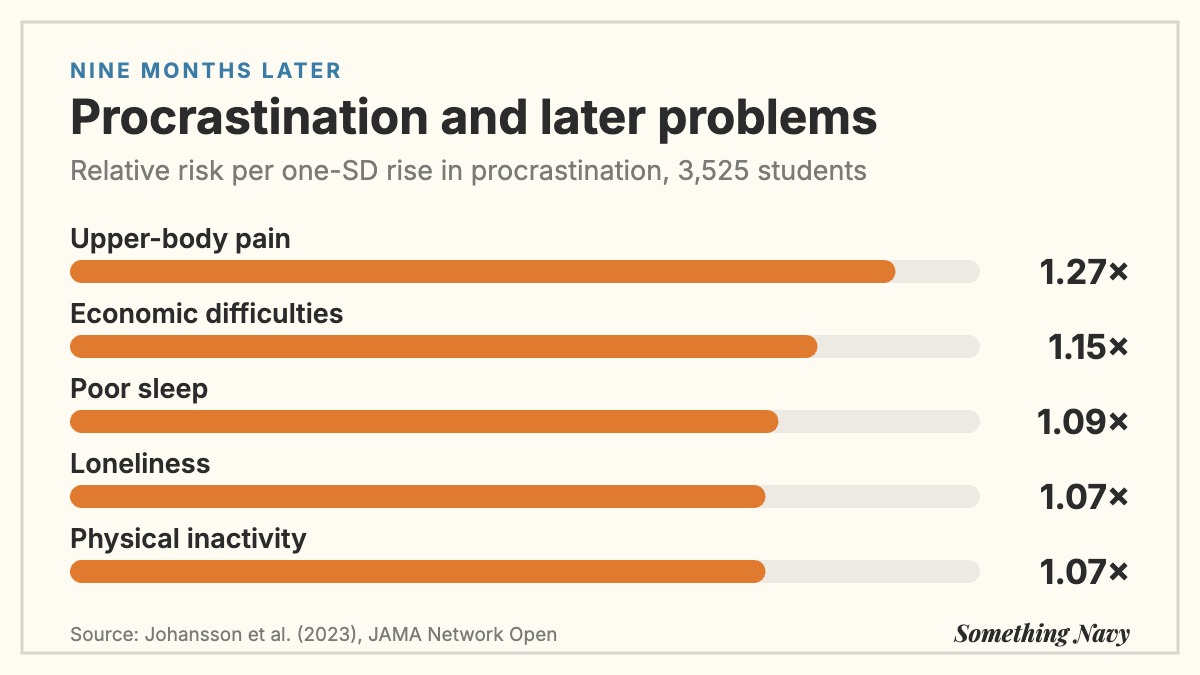
These are small associations, and the authors are careful about them. The study was observational, data were collected during the pandemic, and they note that the arrows could run both ways. Feeling unwell makes it harder to start things, too. Still, the pattern echoes Tice and Baumeister’s students a quarter of a century earlier: relief now, cost later.
The toolkit: six moves that follow from the evidence
If procrastination is mostly a way of managing a bad feeling, the most useful tools are ones that make the feeling smaller, make starting easier, or make the future cost feel real. None is a cure. Each has a reason to work.
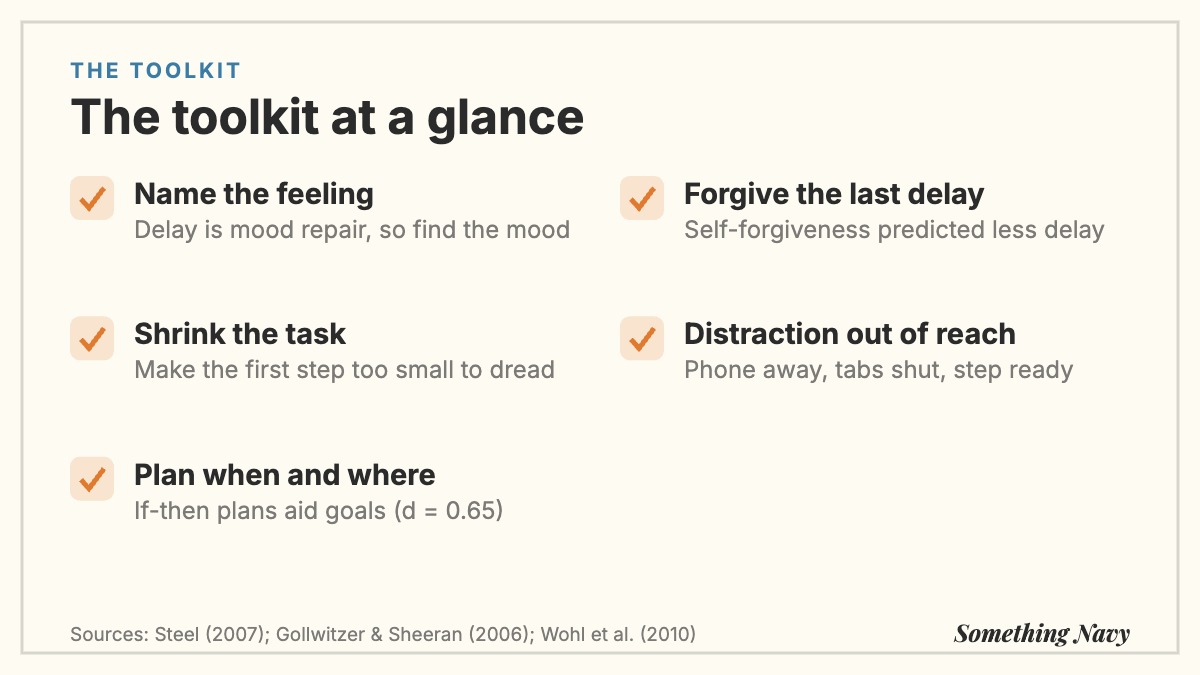
1. Name the feeling, not the failing
Before you open another tab, ask what the task is making you feel. Bored? Exposed? Afraid of getting it wrong? Sirois and Pychyl’s work suggests that delay is a response to exactly these feelings, so naming them points to what needs fixing. “I can’t face this report” is a character verdict. “I’m worried the numbers are wrong” is a problem you can work on.
2. Shrink the task until it stops being aversive
Task aversiveness was one of Steel’s strongest predictors of delay. So change the task, not yourself. “Write the report” is unpleasant; “open the document and type three bullet points” is barely anything. The smaller the first step, the less mood there is to repair.
The five-minute rule, explained
- What it is: agree to work on the dreaded task for five minutes only, with full permission to stop when the timer ends.
- Why it might work: it shrinks an aversive task to something tolerable, which targets the feeling Steel identified as a key trigger. Once started, the task often feels less unpleasant than it did in your head.
- What the evidence does not say: the five-minute rule itself has not, to our knowledge, been tested in a controlled trial. It is a practical application of the research on task aversiveness, not a proven technique in its own right.
- The catch: the permission to stop has to be real. If it is a trick, your brain learns that quickly.
3. Decide when and where in advance
Vague intentions (“I’ll do it this week”) leave the decision to a future moment when the feeling will be at its worst. Peter Gollwitzer and Paschal Sheeran’s 2006 meta-analysis of 94 tests found that “if-then” plans, which link a specific situation to a specific action, had a medium-to-large effect on reaching goals (d = 0.65).
For procrastination, that might be: “When I sit down after lunch on Thursday, I will open the tax form before I check email.” There is more on how to write these in our guide to if-then planning.
4. Forgive the last delay
The Wohl study suggests that beating yourself up over past procrastination may simply add one more feeling to escape. When you slip, acknowledge it plainly, accept that it cost you something, and move on to the next attempt. This is not letting yourself off; it is removing a reason to keep avoiding the task.
5. Introduce yourself to your future self
Sirois and Pychyl argued that procrastinators feel disconnected from the person who will pay for the delay. You can close that gap deliberately. Picture Thursday evening in some detail: the deadline, the tiredness, what you would rather be doing. Or leave a short note for that person describing what you have already done for them. This tool follows from their theory rather than a direct trial, so treat it as an experiment.
6. Make distraction harder than starting
Impulsiveness and distractibility were among Steel’s reliable predictors, which means your surroundings matter as much as your intentions. Put the phone in another room (there is good reason to think even a nearby phone drains attention), close the tabs, and lay out what you need for the first small step before you stop for the day.
When putting things off is a signal
For most people, procrastination is an occasional and manageable habit. But the Swedish data are a reminder that a persistent pattern can travel alongside low mood, poor sleep and stress, and that the direction of cause is not always clear. If delay has become chronic, or if it sits on top of feeling flat or anxious most of the time, that is worth raising with a GP or a psychologist rather than treating as a time-management failure.
It also helps to notice when the timing is on your side. People often find it easier to begin at natural turning points, such as a Monday or the start of a month, an idea explored in our piece on the fresh start effect.
The email, again
Go back to that unanswered message. The research suggests the problem was never that you lacked discipline. Something about replying felt uncomfortable, and every other task offered a small, reliable escape.
So the question is not how to force yourself. It is how to make the first minute of the task feel a little less bad than the alternative. Name the feeling. Shrink the step. Decide the moment. Forgive the last time.
Then open the email, and write one line.
Frequently asked questions
Generally not. Laziness implies an unwillingness to make any effort, whereas procrastinators are often busy with other things. Research points instead to difficulty tolerating the unpleasant feelings a particular task brings up.
It can be part of both, and impulsiveness and distractibility are strong predictors of delay. But in Steel’s meta-analysis general anxiety (neuroticism) had only a weak link, so procrastination on its own is not evidence of either. If you are concerned, speak to a GP.
Tice and Baumeister’s students who procrastinated felt better early in term but earned lower grades and reported more stress and illness by the end. The pressure may feel productive, but the overall record is worse.
Small tools such as if-then plans and shrinking the first step can help with a single task straight away. Changing a long-standing pattern takes longer, and it tends to go better when you respond to setbacks with self-forgiveness rather than self-criticism.
Sources
- Gollwitzer, P. M., & Sheeran, P. (2006). Implementation intentions and goal achievement: A meta-analysis of effects and processes. Advances in Experimental Social Psychology, 38, 69–119. DOI
- Johansson, F., Rozental, A., Edlund, K., Côté, P., Sundberg, T., Onell, C., Rudman, A., & Skillgate, E. (2023). Associations between procrastination and subsequent health outcomes among university students in Sweden. JAMA Network Open, 6(1), e2249346. DOI
- Sirois, F., & Pychyl, T. (2013). Procrastination and the priority of short-term mood regulation: Consequences for future self. Social and Personality Psychology Compass, 7(2), 115–127. DOI
- Steel, P. (2007). The nature of procrastination: A meta-analytic and theoretical review of quintessential self-regulatory failure. Psychological Bulletin, 133(1), 65–94. DOI
- Tice, D. M., & Baumeister, R. F. (1997). Longitudinal study of procrastination, performance, stress, and health: The costs and benefits of dawdling. Psychological Science, 8(6), 454–458. DOI
- Wohl, M. J. A., Pychyl, T. A., & Bennett, S. H. (2010). I forgive myself, now I can study: How self-forgiveness for procrastinating can reduce future procrastination. Personality and Individual Differences, 48(7), 803–808. DOI
How we reported this. We went back to the original research for this story, 6 sources in all, listed above, and checked every figure against them. If you think we have got something wrong, tell us and we will look at it. Read more about how we work.
Cover photo: Ferenc Horvath on Unsplash. Charts and graphics: Something Navy.