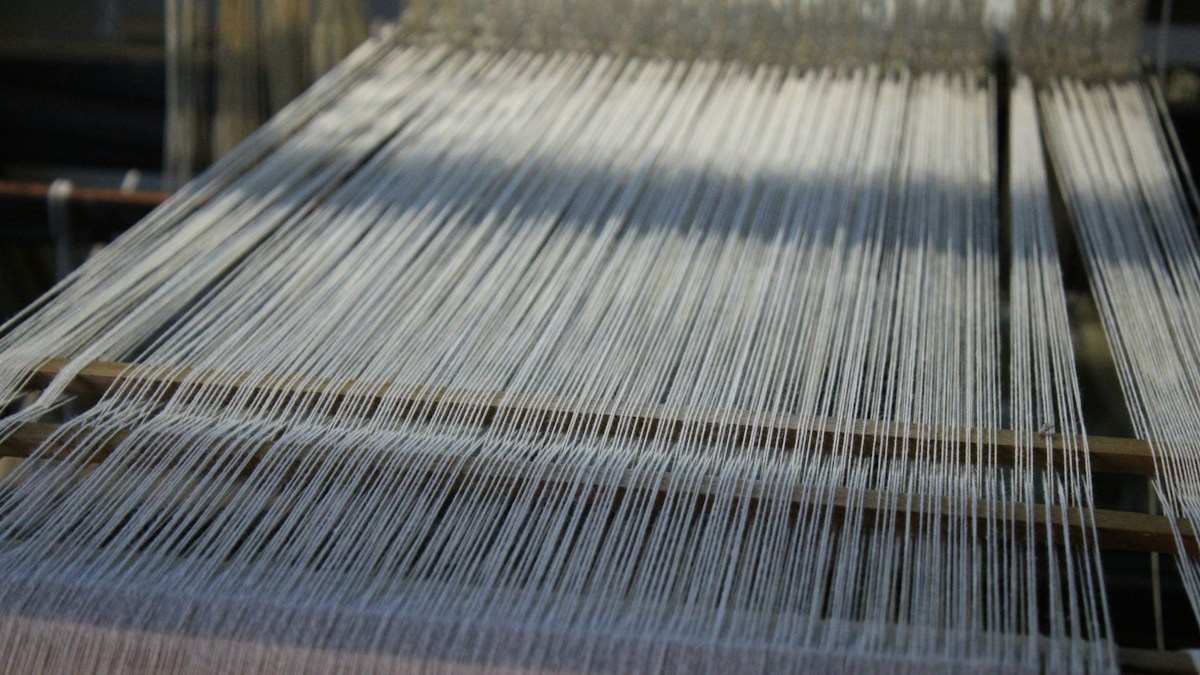
Run your thumb across a length of Harris Tweed and it does not feel smooth. It feels like weather. Little flecks of colour sit in the weave like heather on a hillside, and somewhere in the label is a tiny orb stamp that tells you a person on a Scottish island sat at a loom and made this.
You probably paid more for it than for the high-street jacket next to it. And you probably did not mind.
That small shrug at the till is one of the more interesting things in modern shopping. Surrounded by cheap, flawless, machine-made goods, we keep buying handloom saris, darned jumpers and island tweed. The fabric is only part of the story. The rest is happening in our heads.
Psychologists have spent two decades taking that feeling apart, and the short version is surprising: we do not just value the object. We value the hours we imagine inside it.
An island where the law says “at home”
Start on the Isle of Lewis, in the Outer Hebrides. Harris Tweed is protected by its own piece of legislation, the Harris Tweed Act 1993, which set up the Harris Tweed Authority to guard the name. The cloth must be pure virgin wool dyed and spun in the Outer Hebrides and, in the Act’s words, “handwoven by the islanders at their homes”.
The industry has had a rough century. After decades of decline, things have turned. In 2025, the Authority told AFP that more than 580,000 metres were produced in 2024, woven by about 140 weavers, and that a recruitment drive launched in 2023 after a wave of retirements was bringing in younger people. One of them, 38-year-old weaver Alexander MacLeod, told the agency it was “a good thing to keep the tradition going.”
Kelly MacDonald, the Authority’s director of operations, put the pitch in five words: “We are the epitome of slow fashion.” She also said it was nice to own something “where you can actually look on a map to a tiny island.”
That second line is worth holding on to. It is not about warmth or durability. It is about a place, and a person, being inside the thing you wear.

A poem that took 18 hours
In 2004, the psychologist Justin Kruger and colleagues ran a set of experiments that now sit at the root of this whole field. They showed people the same poem but told some that the poet spent 4 hours on it and others that it took 18 hours. The 18-hour poem was liked more, rated as better and judged to be worth more money.
They then did it with paintings and with a photo of a suit of medieval armour, which participants were told had taken either 15 or 110 hours to make. Same result each time: more effort, higher marks. Published in the Journal of Experimental Social Psychology, the work named this shortcut the effort heuristic.
Two details make it more than a party trick. Self-described art experts were swayed as much as novices in the painting study. And the effect was strongest when people had less to go on: when the armour image was blurry, the stated hours did more of the work.
That is the situation of most shoppers in front of a handwoven scarf. We cannot judge the weave, so we judge the labour we can imagine.
Effort is the quality signal we fall back on when we cannot see quality.
The box you built yourself
Now move from the weaver’s shed to your own living room, and an allen key.
In 2012, Michael Norton of Harvard Business School, Daniel Mochon and Dan Ariely published “The IKEA effect: When labor leads to love” in the Journal of Consumer Psychology. In the first study, 52 students either assembled a plain black IKEA storage box or simply inspected one that was already built. The builders were willing to pay about 63% more for it.
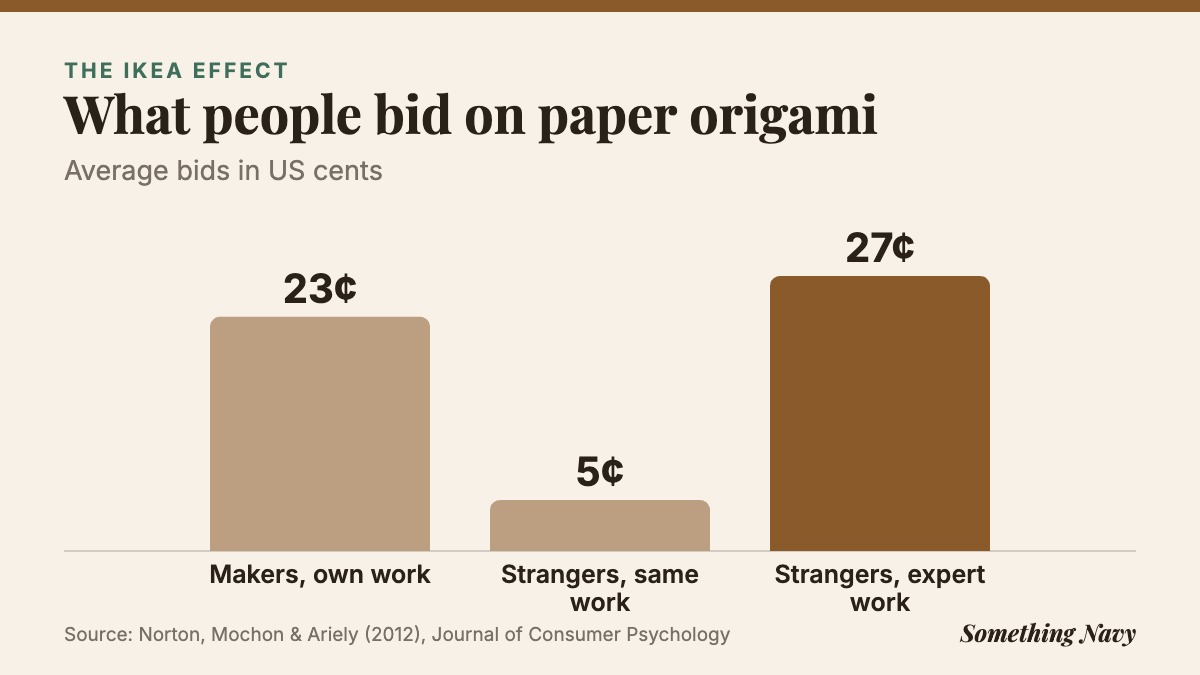
The origami study is the one people remember. Volunteers folded paper frogs and cranes, then bid on them. On average, makers offered 23 cents for their own creation. Strangers bidding on the same amateur folds offered 5 cents. Origami made by experienced folders drew bids of 27 cents.
In other words, people valued their own crumpled cranes nearly five times more than anyone else did, and almost as much as an expert’s work.
There was a catch, and it matters for craft. When people built a Lego model and then took it apart, or stopped an IKEA box two steps short of finishing, most of the extra love vanished. In the paper’s phrase, “labor leads to love only when labor results in successful completion.”
This is the quiet engine behind visible mending, knitting circles and the boom in learn-to-weave workshops. A jumper you patched with bright sashiko stitches is no longer just a jumper. It carries a small, finished act of your own work, and your brain prices it accordingly. If you have ever felt oddly smarter or bolder in a particular coat, the research on how clothes change the way we think is a good companion read.
Love, apparently, is an ingredient
But a handwoven sari is not something the buyer made. So why does it still feel special?
Christoph Fuchs, Martin Schreier and Stijn van Osselaer tackled that in a 2015 paper in the Journal of Marketing, titled “The handmade effect: What’s love got to do with it?” Across several experiments they compared reactions to handmade and machine-made versions of everyday goods. People tended to see the handmade version as literally containing something of the maker: love, care, a trace of the artisan.
The effect was most powerful in one context. When people were choosing gifts for someone close to them, handmade pulled ahead. For more distant recipients, the advantage shrank. A press summary of the work at the time reported that participants were willing to pay up to 17% more for handmade items.
It sounds sentimental, and it is: the same instinct that makes a grandparent’s handwritten recipe card feel more precious than a printed copy.
We do not just value the object. We value the hours we imagine inside it.
Thirty-five lakh people and a loom
Travel next to India, where handloom is still a way of life for millions. The Fourth All India Handloom Census (2019–20), summarised by the Government of India for National Handloom Day 2026, counted 35.22 lakh weavers and allied workers (about 3.5 million people). Of these, 25.46 lakh, more than 72%, are women; men account for the remaining 9.76 lakh.
The same census recorded 28.20 lakh looms, and 25.30 lakh of them are in villages. Handloom here is not a boutique trend. It is a rural livelihood, much of it carried by women working from home, in a tradition that stretches back long before the Swadeshi movement of 1905 made homespun cloth a political statement. National Handloom Day, held each year on 7 August since 2015, marks that 1905 launch.
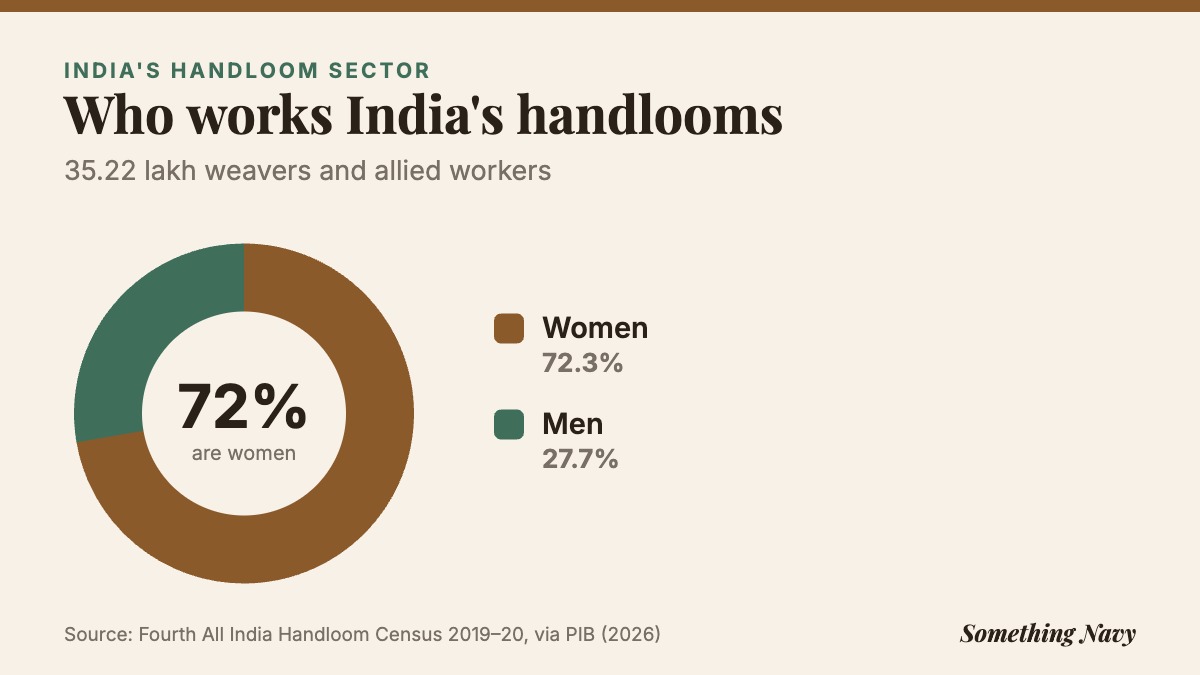
This is where the psychology meets something solid. Behind a genuine handloom dupatta there really is a person, very often a woman in a village, whose hours sit in the cloth. When the label is honest, the warm feeling is pointing at something true.

The backlash nobody puts on the swing tag
Before this turns into a love letter, some honesty about the research.
The classic studies are small, mostly run on American students bidding cents on paper cranes and storage boxes. The effects are real but depend heavily on context.
In fact, a 2025 study from Queensland University of Technology, published in the Journal of Consumer Behaviour, found a twist. Tuba Degirmenci, Gary Mortimer and Frank Mathmann showed people the same mug labelled “handmade”, “machine-made” or with no label at all. Shoppers who like to take their time warmed to the handmade story and would pay more. Shoppers in a hurry did not; for them, the handmade label actually backfired.
So the handmade effect is not magic dust. It works best on people with the time to imagine the maker, which is exactly the mood heritage brands try to create.
Where nostalgia meets a supply chain
The effort heuristic has a darker side. If we reward perceived hours rather than quality, the word “artisan” is worth money whether or not any hands were involved.
This is why protections like the Harris Tweed orb or geographical indications matter more than they first appear. They turn a feeling into a checkable fact. Without them, your brain’s generous instinct to pay for love and labour is easy to exploit.
A useful test: are you paying for the craft or for the costume of craft? A distressed finish and a sepia workshop photo are cheap to produce. Real handwork usually leaves small irregularities, a named place, and someone willing to tell you how long it took.
Mending is the craft you already own
Not everyone can afford island tweed or hand-blocked cotton, and the good news from the IKEA studies is that you do not need to. The love transfers to the things you finish yourself.
That is why visible mending has spread so quickly. Darning a heel, patching a knee with a contrast fabric or stitching sashiko lines across a worn elbow is cheap, slow and finished in an evening. Each repair is a small completed task, the precise condition under which Norton and colleagues found effort turns into attachment.
If a crowded wardrobe has been bothering you, our piece on clutter and stress explains why owning less, but caring for it more, can feel like relief.
Try this: buying and keeping handmade well
- Ask for the hours. A genuine maker can usually tell you roughly how long a piece took and where it was made.
- Look for a certification mark. The Harris Tweed orb, India’s Handloom Mark or a geographical indication turns a story into something you can check.
- Notice your mood. The handmade effect is strongest when you are relaxed and browsing. If you feel rushed, wait before paying a premium.
- Finish one repair. Mend a single garment this month. Completion, not perfection, is what makes the object feel like yours.
- Gift it to someone close. The research suggests handmade means most when it passes between people who care about each other.
What the weaver’s hours are really worth
Put together, the heritage revival looks less like nostalgia and more like a sensible reaction to abundance. When almost everything can be made faster and cheaper, the things that cannot become a way of saying what we are prepared to wait for.
Our brains overrate effort, sometimes foolishly. We prize our own lopsided origami and pay extra for words like “artisan”. But the same bias, pointed in the right direction, keeps 140 weavers working on a Hebridean island and millions of looms clacking in Indian villages.
The tweed on your shoulders is not perfect. That is the point.
Somebody spent hours making it, and somewhere in your head, you can feel them.
Sources
- Kruger, J., Wirtz, D., Van Boven, L., & Altermatt, T. W. (2004). The effort heuristic. Journal of Experimental Social Psychology, 40(1), 91–98. DOI
- Norton, M. I., Mochon, D., & Ariely, D. (2012). The IKEA effect: When labor leads to love. Journal of Consumer Psychology, 22(3), 453–460. DOI
- Fuchs, C., Schreier, M., & van Osselaer, S. M. J. (2015). The handmade effect: What’s love got to do with it? Journal of Marketing, 79(2), 98–110. DOI
- Queensland University of Technology. (2025). Made with love: QUT researchers question how much shoppers care [Press release on Degirmenci, Mortimer & Mathmann, Journal of Consumer Behaviour]. Link
- Press Information Bureau, Government of India. (2026). National Handloom Day 2026 [Backgrounder citing the Fourth All India Handloom Census 2019–20]. Link
- FashionUnited / AFP. (2025, May 28). From banker to weaver: A Scottish island Harris Tweed industry experiences a renaissance. Link
- Harris Tweed Act 1993, c. xi. Link
Updated 17 October 2026: we rewrote this article with new research, figures and sources. Cover photo: Katie Currier on Unsplash. Charts and graphics: Something Navy.
How we reported this. We went back to the original research for this story, 7 sources in all, listed above, and checked every figure against them. If you think we have got something wrong, tell us and we will look at it. Read more about how we work.