You trip on the stairs at work. Halfway through a meeting you notice a coffee stain on your shirt. You fumble a word in front of a room full of people. For the rest of the day it feels as though everyone saw, and everyone is still thinking about it.
They almost certainly are not. Psychologists call this feeling the spotlight effect, and a long run of experiments suggests that other people notice far less about us than we assume. They also judge us less harshly than we fear.
The Barry Manilow T-shirt experiment
The best-known test of the idea was run by the Cornell psychologist Thomas Gilovich with Victoria Husted Medvec and Kenneth Savitsky, and published in 2000 in the Journal of Personality and Social Psychology.
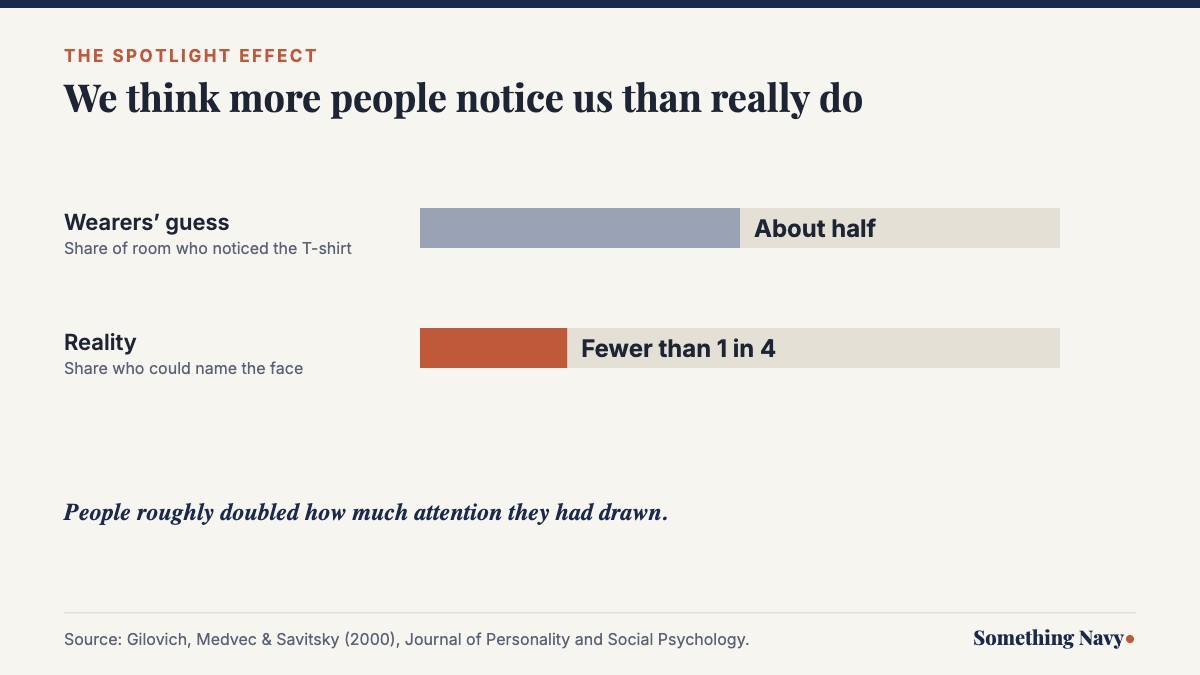
Students were asked to put on a T-shirt printed with a large picture of Barry Manilow, a singer most of them considered deeply uncool, and walk into a room where other students were already sitting. A short while later, the shirt-wearer was taken out and asked to guess how many people had noticed who was on it.
They guessed about half. In reality, fewer than a quarter of the people in the room could say whose face was on the shirt. Even dressed in something chosen to be embarrassing, the participants roughly doubled the attention they had drawn.


Why we overestimate how visible we are
The explanation is fairly simple. You are at the center of your own experience. You know exactly what you are wearing, what you just said and what went wrong, and because that information is so vivid to you, it is hard to step outside it and judge how little of it reaches anyone else.
Gilovich and his colleagues describe this as anchoring on your own perspective. We start from how things look to us and adjust toward how they look to others, but we do not adjust nearly far enough. Meanwhile, everyone else in the room is doing exactly the same thing, absorbed in their own appearance and their own worries.
The same researchers found that the effect is not limited to embarrassing moments. People also overestimate how much others notice their good contributions, such as a sharp point made in a group discussion. Your slip-ups are less memorable than you fear, and your best moments may need more than one airing to register.
We also overestimate how harshly we are judged
Being noticed is one thing. Being judged is another, and here too the research is reassuring. In a 2001 series of studies, Savitsky, Nicholas Epley and Gilovich looked at how people think others will react to their public failures, shortcomings and mishaps. Across their experiments, people consistently expected observers to judge them more harshly than the observers actually did.
One reason is that when we are the one who slipped up, we focus on the mistake itself. Observers, by contrast, see it in a wider context: they consider the circumstances, remember their own similar moments and take into account everything else they know about you. A single fumble is a small part of a much bigger picture to them.
In practice, that might mean the presentation where your slides froze, the email you sent with a typo in the subject line, or the moment you called a new colleague by the wrong name. Each feels like a defining event from the inside. From the outside, most people barely register it, and those who do tend to file it under “happens to everyone.”
A close cousin: the illusion of transparency
A related bias, also studied by Gilovich, Savitsky and Medvec, is the illusion of transparency: the sense that our inner feelings are written across our faces. In one of their experiments, people told lies or truths to a small group. About half of the liars believed they had been found out. Only around a quarter actually were.
This goes a long way toward explaining why public speaking is so nerve-racking. Speakers assume their nerves are obvious, when audiences often cannot see them at all. In later work, Savitsky and Gilovich found that simply telling speakers about the illusion helped them feel calmer, and observers rated their talks more favorably.
When the spotlight feels brightest
Almost everyone experiences the spotlight effect, but some people feel it more intensely. Adolescence is a classic example: psychologists have long described teenagers as feeling watched by an “imaginary audience,” which helps explain the agonies of a bad haircut at fourteen.
Researchers have also found that people with high social anxiety tend to overestimate how much others notice their nervousness and appearance. If self-consciousness regularly stops you from doing things you want to do, that is worth raising with a GP or a mental health professional, because there are effective treatments.
Stepping out of the spotlight
Try a quick reality check. How much do you remember about what your colleagues wore yesterday, or the small mistakes they made in last week’s meeting? Probably very little. They are paying you about the same amount of attention.
It can also help to picture the scene from the outside, as one of the other people in the room. From there, a stain on a shirt or a stumbled word looks like what it is: an ordinary moment in a busy day.
Time helps too. The moment that feels enormous now has usually faded for everyone else by the next day. If something really did go wrong, deal with the practical fix and let it go. Replaying it in your head does not change what anyone else remembers.
There is an upside to all this. If people notice less than you think, and judge more kindly than you expect, then speaking up, trying something new or wearing what you actually like costs less than it feels. That applies to your wardrobe too; we look at the research on clothes and confidence in our piece on enclothed cognition.
Frequently asked questions
It is the tendency to overestimate how much other people notice our appearance and behavior. The term was coined by psychologists Thomas Gilovich, Victoria Husted Medvec and Kenneth Savitsky.
Students wore an embarrassing Barry Manilow T-shirt into a room of peers. They guessed about half the room noticed it; fewer than a quarter actually did.
No. The spotlight effect is a normal bias that almost everyone shows. People with social anxiety tend to experience it more strongly, along with other worries about being judged.
Remind yourself how little you notice about others, picture the scene from an observer’s point of view, and give it time. If self-consciousness is holding you back, a professional can help.
For more on why some moments stick in the mind and others do not, see our piece on the Zeigarnik effect, or browse the Psychology section.
Sources
- Gilovich, T., Medvec, V. H., & Savitsky, K. (2000). The spotlight effect in social judgment: An egocentric bias in estimates of the salience of one’s own actions and appearance. Journal of Personality and Social Psychology, 78(2), 211–222. doi.org/10.1037/0022-3514.78.2.211
- Savitsky, K., Epley, N., & Gilovich, T. (2001). Do others judge us as harshly as we think? Overestimating the impact of our failures, shortcomings, and mishaps. Journal of Personality and Social Psychology, 81(1), 44–56. doi.org/10.1037/0022-3514.81.1.44
- Gilovich, T., Savitsky, K., & Medvec, V. H. (1998). The illusion of transparency: Biased assessments of others’ ability to read one’s emotional states. Journal of Personality and Social Psychology, 75(2), 332–346. doi.org/10.1037/0022-3514.75.2.332
- Savitsky, K., & Gilovich, T. (2003). The illusion of transparency and the alleviation of speech anxiety. Journal of Experimental Social Psychology, 39(6), 618–625.
- Brown, M. A., & Stopa, L. (2007). The spotlight effect and the illusion of transparency in social anxiety. Journal of Anxiety Disorders. PubMed
How we reported this. We went back to the original research for this story, five sources in all, listed above, and checked every figure against them. If you think we have got something wrong, tell us and we will look at it. Read more about how we work.
Cover photo: Daoud Abismail on Unsplash. Charts and graphics: Something Navy.