Somewhere along the way, most of us were told that a new habit takes 21 days to stick. Three weeks of flossing, journaling or early runs, and the thing is supposed to run on autopilot. Then week four arrives and getting out of bed for that run feels exactly as hard as it did on day one.
If that sounds familiar, you have not failed. The 21-day figure was never based on a study of habits in the first place. When researchers finally measured how long it takes to form a habit in everyday life, the number came out quite a bit longer, and far more variable from person to person.
Here is what the evidence actually says, why some habits form faster than others, and what you can do to give a new routine the best chance of sticking.
Where the 21-day rule came from
The figure is usually traced to Psycho-Cybernetics, a 1960 self-help book by the plastic surgeon Maxwell Maltz. Maltz noticed that his patients seemed to need a minimum of about 21 days to get used to a change, such as a new face after surgery or the loss of a limb. It was an observation about adjusting to change, not a measurement of how long it takes to build a new behavior.
Over decades of retelling in motivational talks and self-help books, the word “minimum” quietly fell away. What was left was a neat, memorable number that sounded scientific and promised a quick result. It is easy to see why it spread. It is also easy to see why so many people feel like failures when it does not work for them.


What researchers found when they actually measured it
In 2010, health psychologist Phillippa Lally and colleagues at University College London published one of the first studies to track habit formation outside the lab. Ninety-six volunteers each chose one new eating, drinking or exercise behavior to do once a day, in the same situation. Some picked something easy, like drinking a bottle of water with lunch. Others went for something harder, like a 15-minute run before dinner.
For 12 weeks, the volunteers logged whether they had done it and how automatic it felt, rating statements such as “I do it without thinking” and “I would find it hard not to do.” The team then modeled how that sense of automaticity climbed over time for each person.
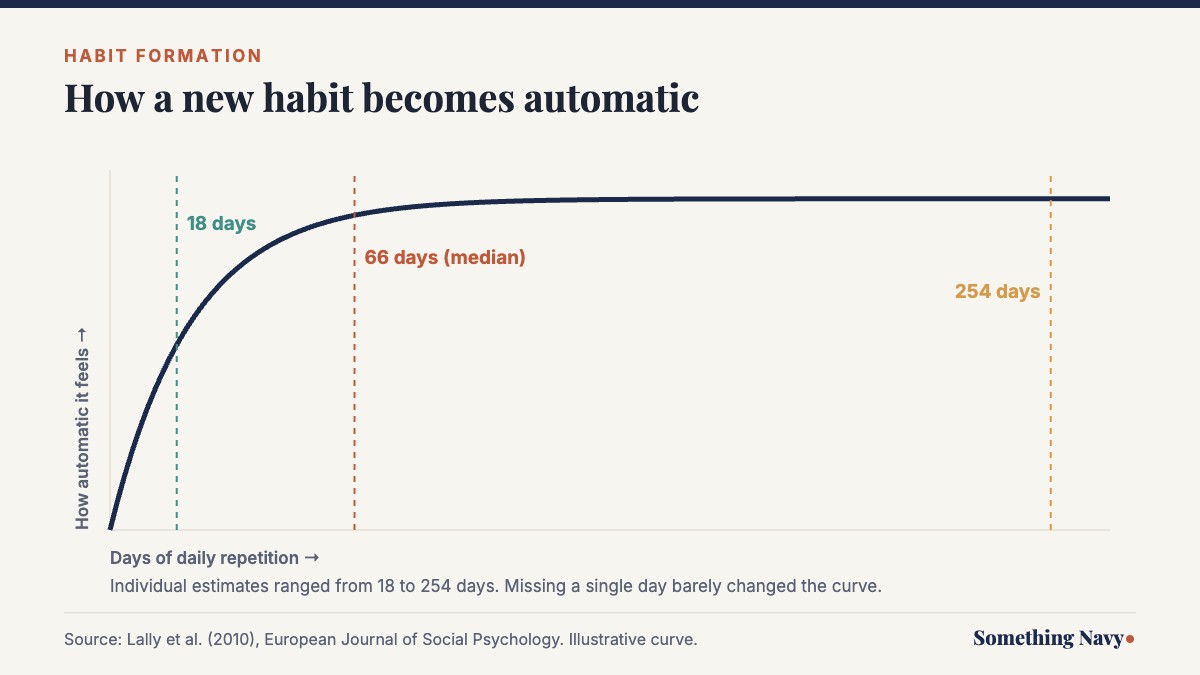
The median time to reach a plateau was 66 days. The individual estimates ranged from 18 days to 254 days. Drinking a glass of water became second nature quickly. Fifty sit-ups after morning coffee did not. Some participants’ habits had not leveled off by the end of the study at all, which is why some of the longer estimates are projections from the shape of their curve.
A larger look at the evidence lands in a similar place. A 2024 systematic review in the journal Healthcare pooled 20 studies with more than 2,600 participants. It found median times of roughly 59 to 66 days, with individual results ranging from 4 days to 335. The authors also found that the average was pulled upward by a minority of people who took a very long time, which is a useful reminder that “average” and “typical” are not the same thing here.
How much of daily life is habit anyway?
More than most of us realize. In a diary study published in 2002, psychologists Wendy Wood, Jeffrey Quinn and Deborah Kashy gave students watches that chimed every hour, prompting them to write down what they were doing and thinking. Roughly 35 to 43 percent of the behaviors they recorded were done almost every day in the same setting, the hallmark of a habit.
Tellingly, during those habitual behaviors people’s thoughts often had nothing to do with what their hands were doing. They were brushing their teeth and thinking about an exam, or making coffee while planning the day. That is what a well-formed habit looks like: the behavior runs in the background, freeing the mind for other things. It is also why bad habits are so hard to catch in the act.
Why a habit takes longer than you expect
A habit is more than something you do often. It is a behavior that has become tied so tightly to a cue, a time, a place or something you have just done, that the cue sets it off with very little thought. Building that link takes repetition in a stable setting, and the more effort or decision-making a behavior involves, the more repetitions it needs.
Progress is also front-loaded. In Lally’s data, automaticity rose fastest in the first few weeks and then flattened out. That is why the second month can feel like a plateau even while the habit is still settling in. People often give up just as the hardest part is behind them.
Missing a day is less damaging than it feels
One of the more reassuring results from the 2010 study was that missing a single opportunity did not meaningfully change the overall curve. What mattered was showing up again the next time the cue came round.
This matters because of what psychologists sometimes call the “what the hell” effect: the tendency, after one slip, to abandon a goal entirely. Skipping a single run does very little harm. Deciding that the skipped run proves you are not a runner does a great deal. A simple rule many people find useful is never to miss twice in a row.
Changing your surroundings can make or break a habit
Because habits are tied to context, a change of scene can disrupt them. In a 2005 study, Wendy Wood and colleagues followed 115 students who were transferring to a new university and looked at their exercise, newspaper reading and TV watching before and after the move. When the important features of the setting changed, such as where they exercised or who they were with, old habits were disrupted and people’s behavior followed their intentions more closely.
That has a practical upside. A new job, a house move, a new term or even rearranging a room can be a window for change, because the cues that kept old habits running are temporarily gone. It is a good moment to set up the routine you actually want, before a new automatic pattern fills the gap.
Making the next habit stick
The research points to a handful of practical moves.
- Attach it to an existing routine. After you pour your first coffee, you write three lines in a notebook. The coffee becomes the cue.
- Keep the time and place consistent. The 2024 review found that people who repeated a behavior in a stable context built stronger habits.
- Choose something you want to do. Habits people chose for themselves, and enjoyed, tended to form more readily than ones that were assigned.
- Consider the morning. Several studies in the review found morning routines became habits more readily, possibly because mornings are more predictable.
- Start smaller than feels necessary. A two-minute version you will do on a bad day beats an ambitious plan you skip.
It also helps to decide exactly when and where you will act. Psychologists call this an if–then plan, and it is one of the better-tested tools for turning intentions into routine.
If you are three weeks into something new and it still feels like work, you are not behind. On the evidence, you are right about on schedule.
Frequently asked questions
No. It comes from a 1960 self-help book that described a minimum of about 21 days to adjust to change. Studies that tracked real people found a median of around two months, with a very wide range.
In the best-known study, the median was 66 days. A 2024 review of 20 studies found medians of roughly 59 to 66 days, with individual results from 4 to 335 days.
Not according to the research. In Lally and colleagues’ study, missing a single opportunity did not meaningfully affect how automatic the behavior eventually became. Getting back on track the next day matters more.
Simple behaviors tied to a clear, consistent cue form fastest. Effortful behaviors, or ones done at varying times and places, take longer.
More on building better routines in our Self-Growth section.
Sources
- Lally, P., van Jaarsveld, C. H. M., Potts, H. W. W., & Wardle, J. (2010). How are habits formed: Modelling habit formation in the real world. European Journal of Social Psychology, 40(6), 998–1009. Wiley Online Library
- Singh, B., Murphy, A., Maher, C., & Smith, A. E. (2024). Time to form a habit: A systematic review and meta-analysis of health behaviour habit formation and its determinants. Healthcare, 12(23), 2488. MDPI
- Wood, W., Quinn, J. M., & Kashy, D. A. (2002). Habits in everyday life: Thought, emotion, and action. Journal of Personality and Social Psychology, 83(6), 1281–1297. PDF
- Wood, W., Tam, L., & Guerrero Witt, M. (2005). Changing circumstances, disrupting habits. Journal of Personality and Social Psychology, 88(6), 918–933. PDF
- Maltz, M. (1960). Psycho-Cybernetics. Prentice-Hall.
How we reported this. We went back to the original research for this story, five sources in all, listed above, and checked every figure against them. If you think we have got something wrong, tell us and we will look at it. Read more about how we work.
Cover photo: Ngo Ngoc Khai Huyen on Unsplash. Charts and graphics: Something Navy.