

It is a Sunday in January and you have the good scissors out. Magazines cover the floor, the glue stick has rolled under the sofa, and you have just found the picture: a pale wooden beach house with a deck, a hammock and a strip of turquoise sea behind it.
You trim the edges and pin it dead centre on the cork board, above the running shoes and the passport. You stand back. It looks good. More than that, it feels good, as though some small part of the beach house now belongs to you.
That warm feeling is the interesting part. Since the early 1990s a psychologist named Gabriele Oettingen has been measuring it, and her findings are awkward for anyone who owns a cork board. The pleasure of picturing the finish line, she argues, can be paid for out of the energy you would have spent getting there.
There is better news, and it comes with a four-letter acronym. But first, the awkward part.
What the research on positive fantasies actually found
Oettingen, a professor of psychology at New York University and the University of Hamburg, did not set out to debunk positive thinking. Her work rests on a distinction most self-help books blur. An expectation is a judgement about what is likely, based on your past: I have passed exams like this before, so I will probably pass this one. A fantasy is a free-floating image of the future you want, with no reality check attached: I see myself opening the results envelope and grinning.
Both feel like optimism. In her studies they behaved like opposites.
Weight loss: the first clue
In 1991 Oettingen and Thomas Wadden published a small study in Cognitive Therapy and Research that followed 25 women with obesity through a year-long weight-loss programme of weekly group sessions. Before treatment, the researchers measured two things: how likely each woman thought she was to succeed, and how positively she fantasised about her weight-loss future.
The women with the most glowing fantasies tended to lose less weight. The link was clearest at week 17 and weaker, though in the same direction, by the end of the year, when only 20 women were left in the analysis. Their expectations, by contrast, did not track weight loss in any systematic way, though women with higher expectations turned up to more sessions.
It was a tiny sample and a correlation, not an experiment. What made it interesting was what came next.
Job hunting, crushes, exams and new hips
In 2002 she and Doris Mayer published four studies in the Journal of Personality and Social Psychology testing the same pattern in very different corners of life.
In the first, 83 graduate students in Munich who were about to finish their degrees described their fantasies about moving into work and rated their expectations of finding a job. Two years later the researchers tracked down 40 of them. Those with more positive fantasies had received fewer job offers, were earning less, and had sent out fewer applications. Those with higher expectations had more offers and higher pay.
In the second, 103 American students with a crush were followed for about four and a half months. The more rosily they had fantasised, the less likely they were to have started a relationship.
In the third, 117 psychology students who daydreamed most positively about acing a course put in less study effort and fared worse on how much their grades improved over the following six weeks.
The fourth is the one people remember. Before hip-replacement surgery, 51 patients with an average age of about 66 described how they pictured their recovery. Two weeks after the operation, physical therapists rated how well each one could bend the joint, manage stairs and recover generally. Patients who had imagined the smoothest recovery were doing worse on all three. Again, the patients who simply expected to recover well did better.
These were still correlational studies: perhaps people who fantasise a lot differ in some other way. That is why the next step mattered.
Why daydreaming about the finish line drains your energy
If fantasies really do sap effort, you should be able to watch it happen in the lab. In 2011 Heather Kappes and Oettingen reported four experiments in the Journal of Experimental Social Psychology under a title that does not hedge: “Positive fantasies about idealized futures sap energy”.
In one, 164 female students were asked to imagine wearing a pair of high heels and being admired for it, or to imagine the same scene while questioning whether it would really be so glamorous. The researchers measured systolic blood pressure before and after, a rough physical marker of how energised someone is. In the purely positive group it fell by an average of about 1.7 points. In the questioning group it barely moved.
In another, 40 students who completed the study either fantasised about an ideal week ahead or simply thought about the coming week. The fantasisers felt less energised on the spot and, a week later, reported getting less done. Statistically, the drop in energy explained the drop in accomplishment.
The fourth is quietly clever. Some students were first made thirsty with salty crackers. Among students who were not thirsty, imagining a top exam grade lowered blood pressure more than imagining a glass of water. Among the thirsty ones, the water fantasy showed the bigger drop, though that difference fell short of statistical significance. A fantasy, it seems, deflates you most when it is about something you actually need.
One way to read these results is that the mind partly treats a vivid fantasy as a down payment on the real thing. You get a sip of the reward now, so the urgency to go and get it fades. The fantasy relaxes you at exactly the moment you need to get up.
The beach house on the board is not a promise. For your nervous system, it can feel like a receipt.
To be clear about scale: these were modest student samples and small effects. They show a mechanism at work in the lab, not that one daydream will wreck your career.

Mental contrasting: dream first, then find the obstacle
None of this means you should stop wanting things. Oettingen’s answer is a technique she calls mental contrasting, and the order of operations is the whole trick.
First you picture the future you want, properly and pleasurably. Then, straight afterwards, you picture the main thing in your current reality that stands in the way. The wish comes first and the obstacle second, so the obstacle registers as the thing between you and something you care about, rather than as one more worry.
Oettingen and her colleagues Pak and Schnetter tested this in four experiments published in 2001, again in the Journal of Personality and Social Psychology. Participants were assigned to one of three conditions: indulge in the positive future, dwell on the negative reality, or contrast the two. The goals ranged from an interpersonal problem to studying abroad to improving at maths, the last tested with 90 male vocational students whose teachers rated them two weeks later.
The finding was subtle. Indulging and dwelling both produced a middling, one-size-fits-all level of commitment. Only mental contrasting made people’s commitment track their actual chances. When success looked likely, contrasters planned more, felt more energised, acted sooner and, in the maths study, achieved more. When success looked unlikely, contrasters tended to commit less.
That second half may be the most useful thing about the technique. It is less a motivational sledgehammer than a sorting machine, pushing you towards wishes you can realistically reach and loosening your grip on the ones you probably cannot. In one experiment, the researchers found it only worked in the right order: thinking about the obstacle first and the wish second did nothing special.
How WOOP works: Wish, Outcome, Obstacle, Plan
Mental contrasting tells you what to commit to, not what to do when the obstacle shows up on a wet Tuesday. For that, Oettingen added a tool from the motivation psychologist Peter Gollwitzer: implementation intentions, better known as if-then plans.
An if-then plan links a specific situation to a specific response in advance: if it is 6pm and I feel like skipping the gym, then I put my trainers on before I decide anything. We have covered the evidence for these on their own in our piece on if-then planning. Put the two together and you get what researchers call mental contrasting with implementation intentions, or MCII. Oettingen’s public-facing version is WOOP.
The steps, as the official WOOP site lays them out, go like this:
- Wish. Choose something that matters to you, challenging but achievable, within a time frame that suits it.
- Outcome. Imagine the best result as vividly as you can. If it leaves you cold, pick a different wish.
- Obstacle. Find the main obstacle inside you, such as a habit, an emotion or a belief, rather than an outside force you cannot change. Picture when and where it is likely to appear next.
- Plan. Write one if-then sentence: if that obstacle appears, then I will do this specific thing.
The site says a WOOP for a small, immediate problem can take about 30 seconds, while bigger life decisions need more time and repeat attempts. Oettingen set out the approach for general readers in her 2014 book Rethinking Positive Thinking.
A worked WOOP: the beach house, revisited
- Wish: Save a deposit towards a small place near the sea within three years. Hard, but not fantasy-land on my salary.
- Outcome: Picture it for a minute: the first morning on the deck, coffee going cold because I keep looking at the water, no landlord, no flatmate’s bike in the hall. It still gives me a jolt, so it is the right wish.
- Obstacle: Not the housing market, which I cannot fix. The real obstacle is me on a Friday evening, tired, opening a delivery app because I “deserve it” and quietly spending what I meant to save.
- Plan: If it is Friday after 7pm and I reach for the delivery app, then I first move £20 into the savings account and cook the emergency pasta in the cupboard.
- The test: If the plan feels silly but doable, it is probably about right. If the obstacle feels impossible to get round, that is useful information too. It may be time to change the wish, not just try harder.
How strong is the evidence for mental contrasting and WOOP?
The honest answer is that the evidence is real, moderate in size and shrinks under some kinds of scrutiny.
The meta-analyses
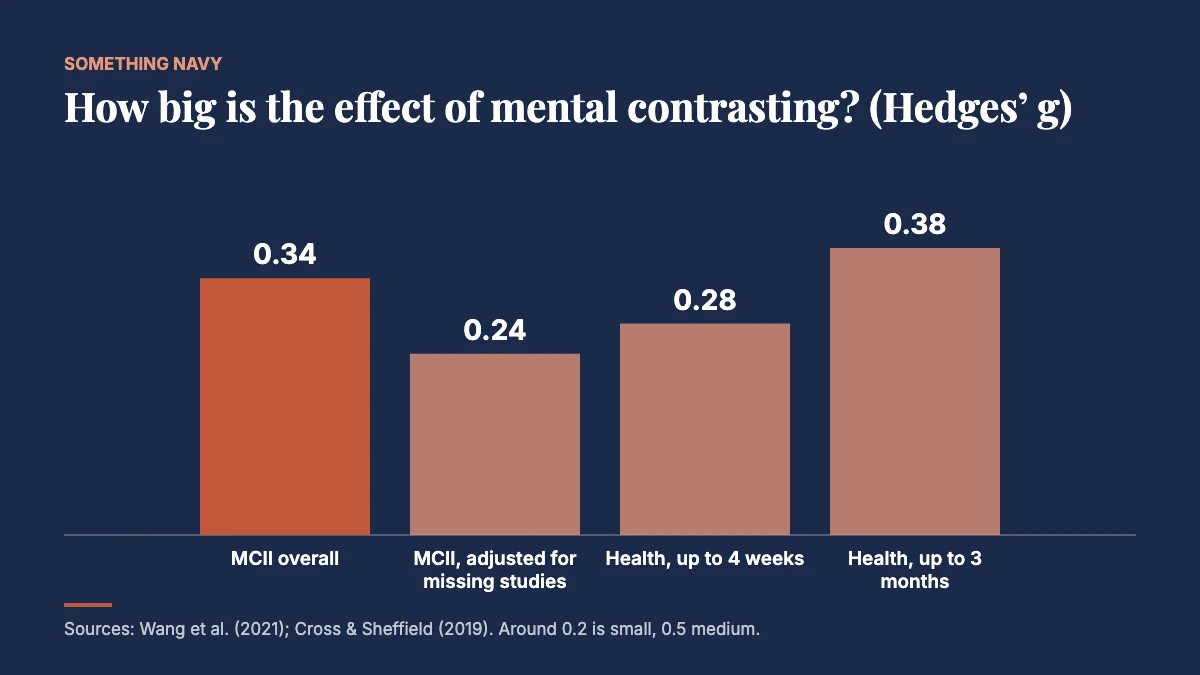
Two reviews are often run together here, so it helps to separate them. Ainslea Cross and David Sheffield published theirs in Health Psychology Review in 2019, pooling studies of mental contrasting aimed at health behaviour with 1,528 participants in all. They found a small to moderate effect: an adjusted Hedges’ g of 0.28 for outcomes measured up to four weeks later, and 0.38 for the five studies that followed people for up to three months. In plain terms: somewhat better, not transformed. Intriguingly, in the seven studies that added if-then plans, the effect was no bigger, though the authors stress that this rests on too few studies to settle.
The 2021 review is by Guoxia Wang, Yi Wang and Xiaosong Gai of Northeast Normal University in China, published in Frontiers in Psychology. It looked specifically at MCII and goal attainment across 21 articles, 24 effect sizes and 15,907 participants. The overall effect was a g of about 0.34, which the authors call “a small to medium significant effect”.
The authors flag real caveats. Their data suggested publication bias, meaning smaller studies with disappointing results may be missing. A standard correction, which estimates the missing studies, pulled the effect down to about 0.24. Sessions run face to face by an experimenter did better than versions delivered as written documents, 0.47 against 0.28, which matters if your WOOP lives in an app. And two large online studies made up about 87% of all the participants, so the headline figure leans heavily on them.
The results that did not go to plan
Those two large studies are a story in themselves. In a 2017 paper in the Proceedings of the National Academy of Sciences, Rene Kizilcec, then a doctoral candidate at Stanford, and the Stanford psychologist Geoffrey Cohen ran two randomised experiments with 17,963 learners in online courses. Across everyone, the exercise made little measurable difference. Split by background, though, a short written MCII exercise made learners from individualist cultures 32% more likely to finish their course in the first experiment and 15% more likely in the second. For learners from collectivist cultures, including India and China, it made no difference at all.
Then came the scale-up. In 2020 Kizilcec, now at Cornell, Justin Reich of MIT, Michael Yeomans of Imperial College London and colleagues tested several nudges across 247 online courses with about 250,000 learners over two and a half years. One intervention asked students to reflect on the benefits and barriers of finishing and plan how to respond to setbacks, close cousins of the WOOP steps. Like the other planning exercises, it lifted engagement in the first few weeks and then faded, without raising final completion rates. The team concluded that spreading such interventions across varied settings could shrink their average effect by roughly a factor of ten.
That is not a refutation of mental contrasting. It is a reminder that a technique which works in a careful study can thin out when it becomes a pop-up box in a course nobody quite meant to finish.
WOOP is a decent tool, not a magic one. The surprise is that a sentence written in two minutes does anything at all.
What 2025 research adds
Newer work points in the same, modest direction. A registered report published in Psychology & Health in April 2025, by Berke Sezer, Nikos Ntoumanis, Hugh Riddell and Daniel Gucciardi of Curtin University in Perth, tackled a very modern problem: staying up later than you meant to. Registered reports are accepted before the results are known, which makes them harder to spin.
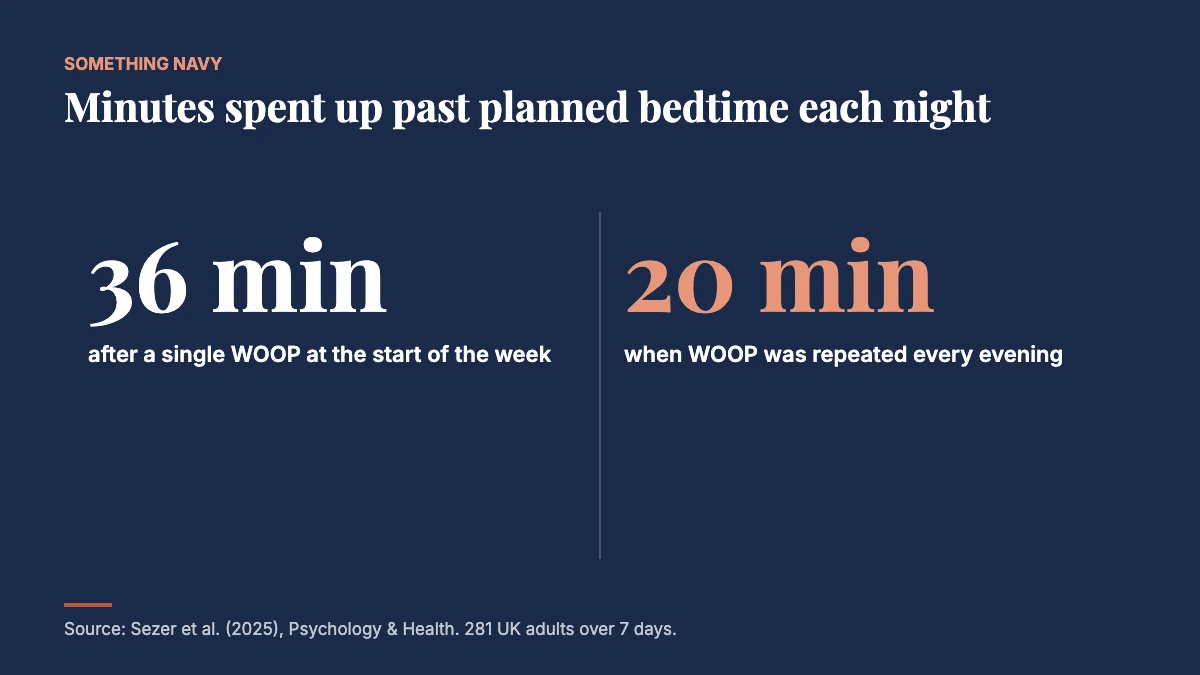
The team recruited 297 adults in the UK and analysed 281. Everyone learned MCII at the start of the week. Half then repeated it every evening for seven days, while the other half did it only once. The daily group’s gap between their intended and actual bedtime averaged about 20 minutes, against about 36 minutes for the one-off group. If you recognise yourself in our piece on revenge bedtime procrastination, that is a meaningful slice of a night.
There are limits. The study lasted a week, there was no group who did nothing, and the authors had to change the statistical method they had preregistered when their model would not converge. Still, it fits a wider theme: WOOP seems to work best as a habit you return to, not a ceremony you perform once in January.
Vision boards, manifesting and a fair reading of the evidence
So should you take down the cork board? Not necessarily.
None of the studies above tested vision boards directly. They tested a mental habit: lingering in a pleasurable image of the future without connecting it to what stands in the way. A vision board can encourage that habit, but need not. If the beach house on your board prompts you to ask what is stopping you, it is doing something closer to mental contrasting than to fantasy.
Oettingen’s own work also contains a point in manifesting’s favour. In the job, crush and hip studies, confident expectations predicted better outcomes. Believing you can do something, on real evidence, is useful. The problem is the effortless image of the finish line that feels like enough.
Manifesting, as usually sold, tends to treat that feeling as the active ingredient. Here the research is less kind. A study by Lucas Dixon, Matthew Hornsey and Nicole Hartley of the University of Queensland, first published online in 2023 in Personality and Social Psychology Bulletin, surveyed 1,023 people across three studies and built a scale to measure belief in manifestation. More than a third endorsed it. Higher scorers saw themselves as more successful and expected more success, but they were also more drawn to risky investments, more likely to have been through bankruptcy, and more likely to believe an unlikely level of success could arrive quickly. In a university release Dixon said, “we didn’t find objective proof to support the effectiveness of manifestation.”
As a survey, it cannot show that manifesting causes bankruptcy; people in financial trouble may simply be drawn to promises of a quick turnaround. But belief in the method and actual results are clearly two different things.


How to use mental contrasting without overthinking it
If you want to try this, keep the wish genuinely yours and within reach; mental contrasting is designed to tell you when a goal is unrealistic, and that is a feature. Look for the obstacle in your own behaviour, not in the economy or your boss. Make the plan small enough that you could do it while tired. And come back to it: the bedtime study hints that repeating it beats a single session, and the 2021 review that a guided session beats a leaflet.
Accept, too, what it will not do. A 0.3 effect size is not a life makeover. The technique looks most useful where effort is the bottleneck and least useful where the real barrier is outside your control. It sits comfortably next to a healthy respect for the planning fallacy, our habit of underestimating how long things take.
And the beach house? Leave it up if you like it. Just give it a caption, in your own handwriting, naming the Friday-night version of you who stands between here and there.
Frequently asked questions
It is a short exercise developed by Gabriele Oettingen in which you first imagine a future you want and then imagine the main obstacle in your present reality. Studies suggest it boosts commitment to goals you can realistically reach and loosens commitment to ones you probably cannot.
Wish, Outcome, Obstacle, Plan. The first three steps are mental contrasting, and the final step is an if-then plan for handling the obstacle when it appears.
Not exactly. In Oettingen’s studies, confident expectations based on past experience predicted better outcomes. It was free-floating fantasies about an ideal future that were linked to less effort and worse results.
The studies discussed here did not test vision boards directly. They suggest that dwelling on images of success may sap energy, so a board is more likely to help if it prompts you to identify and plan for what stands in your way.
The official WOOP site says a quick one can take about 30 seconds, while larger decisions need longer and may need several attempts. One 2025 study found that repeating it nightly worked better than doing it once.
Official links and research
- Official WOOP website and free resources: woopmylife.org
- Cross, A., & Sheffield, D. (2019). Mental contrasting for health behaviour change: A systematic review and meta-analysis of effects and moderator variables. Health Psychology Review, 13(2), 209–225. DOI
- Dixon, L., Hornsey, M. J., & Hartley, N. (2025). “The Secret” to success? The psychology of belief in manifestation. Personality and Social Psychology Bulletin, 51(1), 49–65. DOI
- Kappes, H. B., & Oettingen, G. (2011). Positive fantasies about idealized futures sap energy. Journal of Experimental Social Psychology, 47, 719–729. DOI
- Kizilcec, R. F., & Cohen, G. L. (2017). Eight-minute self-regulation intervention raises educational attainment at scale in individualist but not collectivist cultures. Proceedings of the National Academy of Sciences, 114, 4348–4353. DOI
- Kizilcec, R. F., Reich, J., Yeomans, M., Dann, C., Brunskill, E., Lopez, G., Turkay, S., Williams, J. J., & Tingley, D. (2020). Scaling up behavioral science interventions in online education. Proceedings of the National Academy of Sciences. DOI
- Oettingen, G., & Mayer, D. (2002). The motivating function of thinking about the future: Expectations versus fantasies. Journal of Personality and Social Psychology, 83(5), 1198–1212. DOI
- Oettingen, G., Pak, H., & Schnetter, K. (2001). Self-regulation of goal setting: Turning free fantasies about the future into binding goals. Journal of Personality and Social Psychology, 80(5), 736–753. DOI
- Oettingen, G., & Wadden, T. A. (1991). Expectation, fantasy, and weight loss: Is the impact of positive thinking always positive? Cognitive Therapy and Research, 15(2), 167–175. DOI
- Sezer, B., Ntoumanis, N., Riddell, H., & Gucciardi, D. F. (2025). An experimental investigation of daily mental contrasting with implementation intentions and goal motives in reducing bedtime procrastination: A registered report. Psychology & Health. Advance online publication. DOI
- Wang, G., Wang, Y., & Gai, X. (2021). A meta-analysis of the effects of mental contrasting with implementation intentions on goal attainment. Frontiers in Psychology, 12, 565202. DOI
Cover photo: Margo Evardson on Unsplash. Charts and graphics: Something Navy, with photography by QingYu on Unsplash.
How we reported this. Every figure was checked against the 11 sources above. Reviewed by Valentino Adkins, Senior Content Manager. Report an error · How we work