
It is 9.47pm and your watch is buzzing. You are 1,800 steps short, so you do what millions of people do every night: you pace the hallway, loop the kitchen island, march on the spot while the kettle boils. Somewhere around 10,000 the watch rewards you with a small burst of digital confetti.
It feels like science. A round, authoritative number, built into apps, phones and wearables. But the number was not handed down by a laboratory. It was, by most accounts, the name of a gadget.
Over the past seven years, though, researchers have finally done what nobody did in the 1960s: strapped step counters on to tens of thousands of people, followed them for years and counted who stayed healthy. The answer is more interesting, and more forgiving, than the confetti suggests.
By the numbers
- 1965: the year Harvard Health dates the Japanese manpo-kei, or “10,000 steps meter”
- ~4,400: daily steps linked to 41% lower mortality in older women, versus about 2,700
- 6,000–8,000: where the mortality benefit flattened for adults aged 60 and over
- 2,517: the lowest daily count linked to a significant drop in mortality risk in one meta-analysis
- 7,000: roughly where most benefits begin to level off, in a 2025 review of 57 studies
- 100: steps per minute, a rough marker of moderate-intensity walking for younger adults
A number born in a shop window
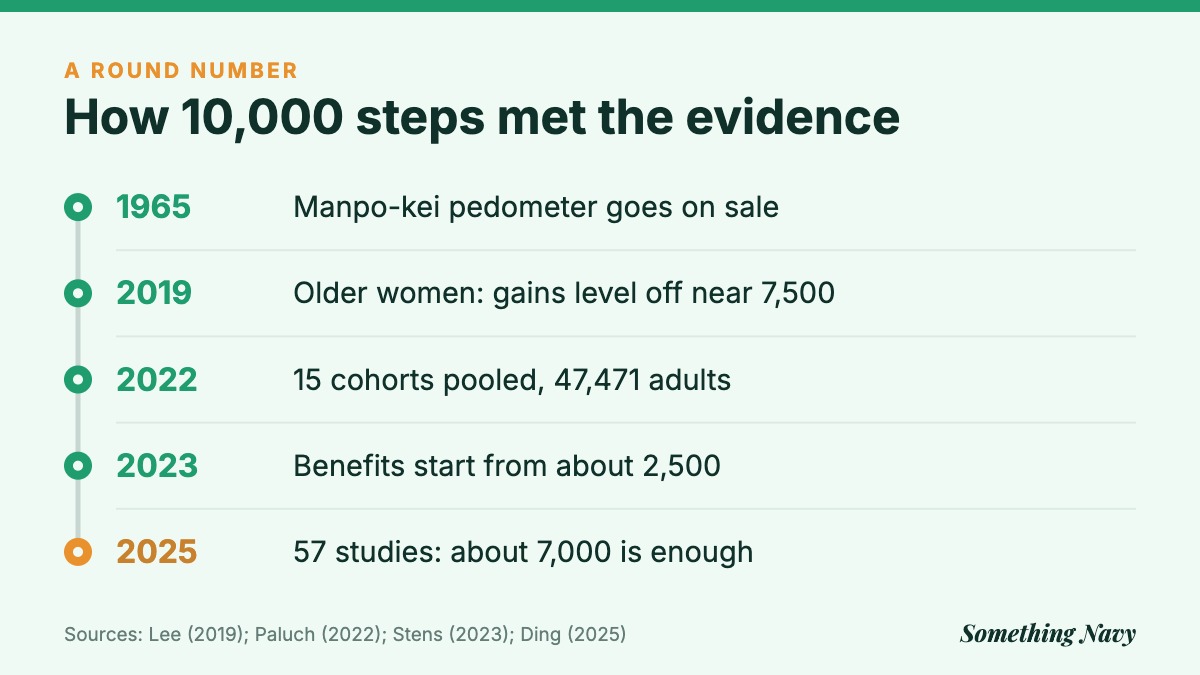
The most widely told origin story goes like this. In the 1960s, as Japan rode the fitness enthusiasm surrounding the 1964 Tokyo Olympics, a Japanese company sold a pedometer called the manpo-kei. Man means 10,000, po means steps and kei means meter. The name stuck, and so did the goal.
The details shift depending on who is telling it. A Harvard Health Publishing article from 2019 dates the device to 1965 and calls the name “a marketing tool”. Other popular accounts name the manufacturer and tie it directly to the Olympic year. What is not in dispute is the part that matters: no large study had tested whether 10,000 was the right target before it became one.
Even the researchers who now study steps say as much. When Amanda Paluch and the international Steps for Health Collaborative pooled data in 2022, their paper noted plainly that the 10,000 figure was not evidence-based and traced it to a Japanese marketing campaign.
That does not make it a bad number. Round numbers are easy to remember, and a stretching goal can be motivating. It simply means the question “how many steps do I need?” went unanswered for half a century, while the answer was assumed.
What 16,741 older women’s step counts revealed
The first study to land hard on the 10,000 myth came from I-Min Lee, an epidemiologist at Brigham and Women’s Hospital and Harvard Medical School. Her team drew on the long-running Women’s Health Study in the United States. Between 2011 and 2015, 16,741 women with an average age of 72 wore an accelerometer for a week, and the researchers then tracked who died over an average of 4.3 years.
The least active quarter of women took a median of about 2,700 steps a day. Women averaging roughly 4,400 steps had a 41% lower risk of death over the follow-up period. Risk kept falling as steps rose, then flattened out at around 7,500 steps a day. Beyond that, extra steps made little measurable difference to mortality.
The team also looked at how briskly the women walked. Faster stepping looked protective at first, but once total daily steps were taken into account, most of those associations disappeared. Volume seemed to be doing the work.
There were limits. These were older American women, and the study measured death, not quality of life, mood or mobility. A week of wear is also a snapshot, not a lifetime. But it was the first clear sign that the benefits arrive well before five figures.
Fifteen cohorts, two curves
One study of older women could be a quirk. So in 2022, Amanda Paluch, a physical activity epidemiologist at the University of Massachusetts Amherst, led a collaboration that pooled raw data from 15 international cohorts. Altogether, 47,471 adults had worn step counters, and 3,013 of them died over a median follow-up of 7.1 years.
The researchers split everyone into quarters by daily steps. The lowest group took a median of 3,553 steps a day; the highest, 10,901. Compared with the lowest group, the highest had a 47% lower risk of death after adjusting for other factors. Even the second quarter, at around 5,800 steps, had a 40% lower risk.
The striking finding was about age. For adults aged 60 and over, the benefit levelled off at roughly 6,000–8,000 steps a day. For those under 60, it carried on until roughly 8,000–10,000. In other words, 10,000 is not wrong for everybody. It is closer to a ceiling than a floor, and that ceiling sits lower as you get older.
It is worth being clear about what “levelled off” means. It does not mean more steps are harmful, or useless for fitness, weight or mood. It means that, in these data, extra steps beyond that point were not linked to a further drop in the risk of dying.


The cardiologists’ count
In 2023, a team led by Niels Stens at Radboud University Medical Center in the Netherlands asked a sharper question: what is the smallest number of steps that makes a difference? Their meta-analysis in the Journal of the American College of Cardiology combined 12 studies covering 111,309 people, and used 2,000 steps a day as the baseline.
Mortality risk dropped significantly from about 2,517 steps a day, and the risk of cardiovascular disease from about 2,735. The biggest gains came at around 8,763 steps for mortality (a 60% lower risk than at 2,000) and around 7,126 for cardiovascular disease (51% lower). The pattern held for both men and women.
That first number deserves a moment. Five hundred extra steps above a very sedentary baseline is a few minutes of walking. For anyone who has written off step counting because 10,000 seems absurd, this is the encouraging end of the curve.
| Study | Who was counted | Headline finding |
|---|---|---|
| Lee et al. (2019), JAMA Internal Medicine | 16,741 US women, average age 72 | ~4,400 steps linked to 41% lower mortality; levelled off ~7,500 |
| Paluch et al. (2022), Lancet Public Health | 47,471 adults, 15 cohorts | Plateau at 6,000–8,000 (60+) and 8,000–10,000 (under 60) |
| Stens et al. (2023), JACC | 111,309 adults, 12 studies | Benefit from ~2,500; largest gains near 7,100–8,800 |
| Ding et al. (2025), Lancet Public Health | 57 studies, 160,000+ adults | ~7,000 steps: 47% lower mortality vs 2,000 |
Seven thousand, and why it stuck
The most comprehensive look so far arrived in July 2025. Melody Ding, a professor of public health at the University of Sydney, led a systematic review that gathered 57 studies drawn from 35 cohorts, covering more than 160,000 adults. Rather than looking only at death, the team examined eight outcomes, including heart disease, cancer, type 2 diabetes, dementia, depressive symptoms and falls.
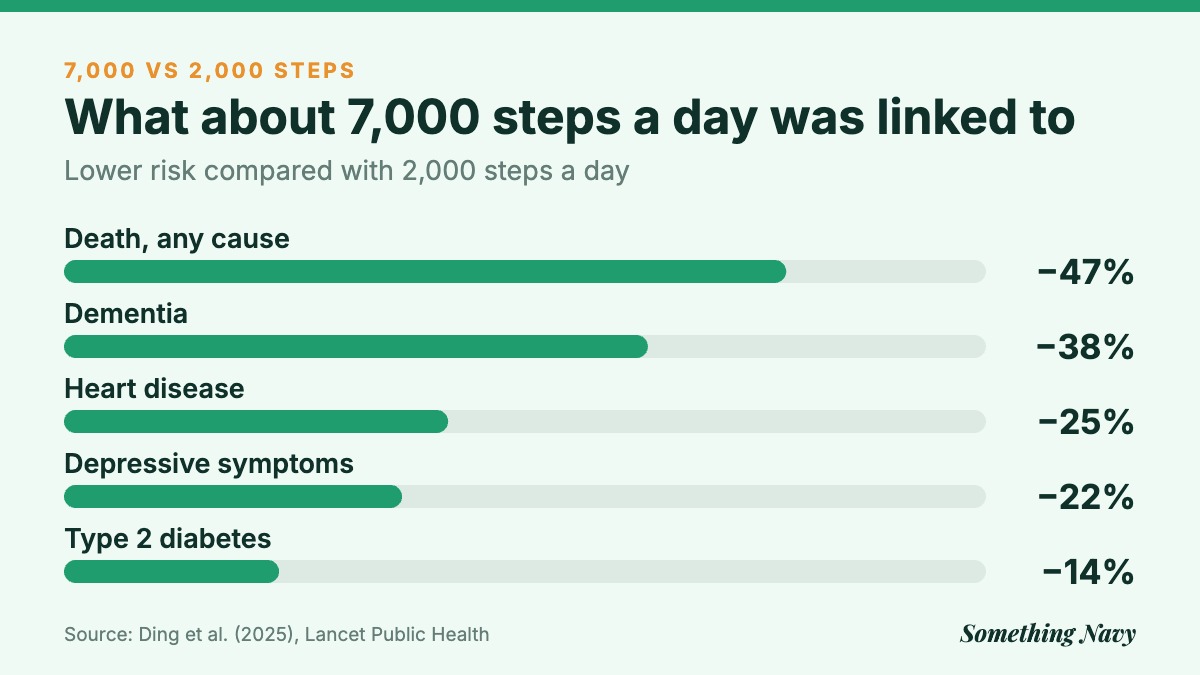
Compared with 2,000 steps a day, around 7,000 steps was linked to a 47% lower risk of death from any cause, 38% lower risk of dementia, 25% lower risk of cardiovascular disease and 22% fewer depressive symptoms. For type 2 diabetes, the reduction was 14%.
For most outcomes, the curve flattened after about 7,000. Going on to 10,000 added only a small extra reduction for dementia, for example. The exceptions were heart disease, where benefits kept accruing beyond 7,000 in this review, and diabetes, where higher counts still helped.
“Aiming for 7000 steps is a realistic goal based on our findings,” Ding said in the University of Sydney’s announcement. She was equally clear that 10,000 remains a fine target for people who are already active. There is no reason to stop.
Ding also flagged the weak spots. Some outcomes, including cancer, depression and dementia, rested on only a handful of studies, a caveat she raised in an interview with NPR. Paluch, speaking to the same outlet, called those particular results preliminary. The mortality and heart findings stand on firmer ground.
Does pace matter, or only the count?
Fitness culture loves intensity. The step research is more ambivalent, and honest reporting means admitting that.
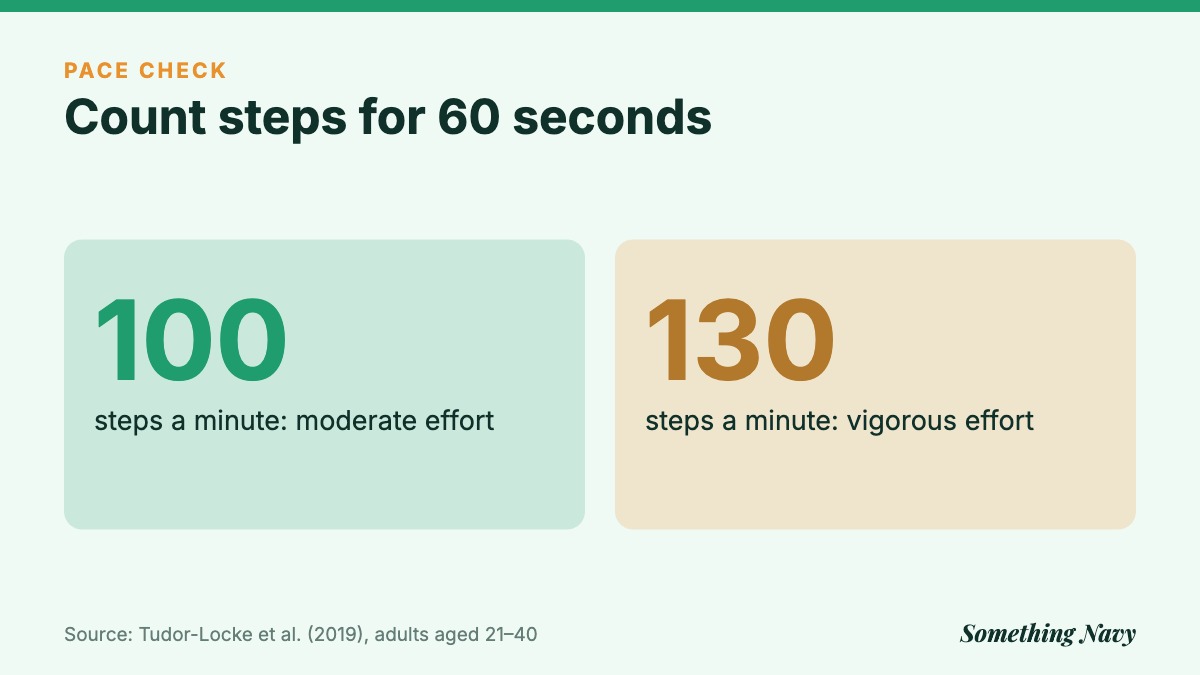
First, a useful benchmark. In a 2019 laboratory study, Catrine Tudor-Locke and colleagues put 76 adults aged 21 to 40 on a treadmill and measured their energy use at different walking speeds. About 100 steps a minute marked the threshold for moderate intensity, and about 130 for vigorous. If you can count roughly 25 steps in 15 seconds, you are in moderate territory.
Whether that pace adds health benefits beyond the total count is less settled. In Lee’s study of older women, intensity mostly stopped mattering once total steps were accounted for. Paluch’s pooled analysis found the evidence inconclusive. “We actually don’t see an association once we consider the total number of steps,” she told NPR, referring to speed.
Stens’s cardiology meta-analysis pointed the other way: people with intermediate or higher stepping rates had about a 20% lower mortality risk than those with the lowest cadence, on top of the benefit of volume. The authors described volume and intensity as independently linked to health.
The fair reading is that total steps are the strongest, most consistent signal. A brisker pace probably does not hurt and may help, especially for fitness. But you do not need to power-walk for your steps to count.
What the numbers cannot tell you
Every study here is observational. Researchers counted steps and then watched what happened; they did not randomly assign some people to walk 7,000 steps and others 2,000 for a decade. That matters.
The most obvious problem is reverse causation. People who are already unwell, in pain or frail tend to walk less, and they are also more likely to die or develop disease. Studies try to deal with this by adjusting for existing illness or excluding early deaths, but no statistical method fully removes it.
There are also measurement quirks. Hip-worn research accelerometers, wrist trackers and phones all count steps a little differently, and Stens’s team found the risk reductions looked larger in studies using hip-worn devices than in those using pedometers or wrist-worn ones. Your watch’s 7,000 may not be the same as a study’s 7,000.
And step counts are usually measured over a single week, then linked to health years later. People change. A week in 2013 says something about a person’s habits, but not everything.
None of this undoes the findings. The consistency across countries, devices and teams is striking, and the direction (more movement, better outcomes) fits decades of other evidence. But the precise thresholds are best treated as useful landmarks, not finishing lines.
Where 10,000 still earns its place
It would be easy to swing too far and declare 10,000 steps a waste of effort. The data do not say that.
For adults under 60, Paluch’s analysis found mortality benefits continuing up to roughly 8,000–10,000 steps. Ding’s review found heart benefits still building beyond 7,000. And step counts capture only part of what walking does. Fitness, mood, sleep, joint health and simply getting outside are not all reflected in mortality curves.
Official guidance also tends not to deal in steps at all. Current US physical activity guidelines, as NPR noted, set targets of 150–300 minutes a week of moderate activity rather than a daily step number. Steps are a convenient proxy, not the whole picture.
So if 10,000 is your normal, keep going. The problem with the number is not that it is too high. It is that, for years, it made people who managed 4,000 or 5,000 feel like failures, when the research suggests they were already collecting a meaningful share of the benefit.
Turning the curve into a habit
The shape of the evidence suggests a practical strategy: the biggest gains are at the bottom. Moving from very little to a moderate amount matters more than pushing from a lot to a bit more.
- Find your real baseline. Look at a typical week, not your best day. If you average 3,000, aim for 4,000 before you think about 7,000.
- Add in blocks of 1,000. That is roughly ten minutes of walking for many people. Attach it to something you already do, using the kind of “if X, then Y” plan that makes intentions stick.
- Treat brisk minutes as a bonus. A stretch at around 100 steps a minute is easy to check and may add fitness benefits, but the total is what most studies reward.
- Expect it to take time. New routines take weeks or months to feel automatic, as the research on how long habits really take to form shows.
It also helps to notice what the tracker itself is doing to you. A buzzing wrist can nudge you off the sofa, but it can just as easily turn a pleasant evening into an anxious audit of numbers. If the count stops motivating and starts nagging, it may be worth checking how often you glance at it, much as the research on a phone sitting nearby suggests our devices take more of our attention than we think.
The best evidence we have says that a steady few thousand steps more than you take now is worth far more than a number chosen to sell a pedometer. Somewhere around 7,000, most of the benefit is in the bag.
The rest of the walk is yours to enjoy, and it does not need confetti.
Frequently asked questions
No. It is simply higher than most people need for the main health benefits seen in studies. If you already reach it comfortably, there is no evidence it does harm.
In pooled data from 15 cohorts, the mortality benefit for people aged 60 and over levelled off at roughly 6,000–8,000 steps a day. Smaller increases from a low starting point still mattered.
In these studies, devices counted all steps across the day, not just deliberate walks. A step in the supermarket was counted the same as a step in the park.
Not much. Different devices count steps differently, so treat your number as a personal trend line rather than a precise match to research thresholds.
Sources
- Lee, I.-M., Shiroma, E. J., Kamada, M., Bassett, D. R., Matthews, C. E., & Buring, J. E. (2019). Association of step volume and intensity with all-cause mortality in older women. JAMA Internal Medicine, 179(8), 1105–1112. DOI
- Paluch, A. E., Bajpai, S., Bassett, D. R., Carnethon, M. R., Ekelund, U., Evenson, K. R., et al. (2022). Daily steps and all-cause mortality: a meta-analysis of 15 international cohorts. The Lancet Public Health, 7(3), e219–e228. DOI
- Stens, N. A., Bakker, E. A., Mañas, A., Buffart, L. M., Ortega, F. B., Lee, D.-C., Thompson, P. D., Thijssen, D. H. J., & Eijsvogels, T. M. H. (2023). Relationship of daily step counts to all-cause mortality and cardiovascular events. Journal of the American College of Cardiology, 82(15), 1483–1494. DOI
- Ding, D., Nguyen, B., Nau, T., Luo, M., del Pozo Cruz, B., Dempsey, P. C., et al. (2025). Daily steps and health outcomes in adults: a systematic review and dose-response meta-analysis. The Lancet Public Health, 10(8), e668–e681. DOI
- Tudor-Locke, C., Aguiar, E. J., Han, H., Ducharme, S. W., Schuna, J. M., Barreira, T. V., et al. (2019). Walking cadence (steps/min) and intensity in 21–40 year olds: CADENCE-adults. International Journal of Behavioral Nutrition and Physical Activity, 16(1). DOI
- Calechman, S. (2019, July 11). 10,000 steps a day, or fewer? Harvard Health Publishing. Link
- Stone, W. (2025, August 14). Counting steps for health? Here’s how many you really need. NPR. Link
How we reported this. We went back to the original research for this story, 7 sources in all, listed above, and checked every figure against them. If you think we have got something wrong, tell us and we will look at it. Read more about how we work.
Cover photo: Ira Komornik on Unsplash. Charts and graphics: Something Navy.