You stop at the crossing and, for once, look up. The late sun has turned the top floor of an ordinary office block gold, and a flock of starlings is pouring itself across the sky like smoke.
For a few seconds you forget the email you were composing in your head. You feel slightly smaller. Oddly, you feel better.
That flicker has a name, and psychologists have spent two decades measuring it. It is awe. One of the most charming experiments on it involved a group of people in their 60s, 70s and 80s, a weekly 15-minute walk, and a phone camera.
Over eight weeks, the people who were asked to look for awe on their walks began to take selfies in which they filled less and less of the frame. Their smiles, meanwhile, got bigger.
Smaller self, bigger smile. It turns out the two belong together.
Fifty-two walkers, eight weeks and a lot of selfies
The study was led by neurologist Virginia Sturm at the University of California, San Francisco (UCSF) Memory and Aging Center, with awe researcher Dacher Keltner of UC Berkeley among her co-authors. It appeared online in the journal Emotion in 2020 and was formally published in 2022.
The team enrolled 60 healthy adults aged 60 to 90 and randomly split them into two groups. Everyone was asked to take a 15-minute outdoor walk at least once a week for eight weeks. Fifty-two people completed enough walks and questionnaires to be analysed: 24 in the awe group and 28 in the control group.
Only one detail differed. The awe group was given a short briefing on what awe is and how to find it. Awe, they were told, tends to show up in places with two features: physical vastness and novelty. So they were encouraged to tap into their sense of wonder and, if they could, visit somewhere new each week.
The control group simply walked.
At the start, middle and end of every walk, participants took a selfie. They also filled in a short survey after each walk and a daily emotion questionnaire throughout the eight weeks.
What the photos gave away
Researchers traced each walker’s silhouette and used software to calculate how much of the picture was taken up by the person rather than the scenery. Over the eight weeks, the awe walkers shrank in their own photos. More sky, more trees, more street. Less of themselves.
Separately, trained coders who did not know which group anyone was in rated the strength of each smile using the Facial Action Coding System, a standard method for scoring facial muscle movements. The awe walkers’ smiles grew measurably more intense over the course of the study.
The daily questionnaires told a similar story. The awe group reported feeling more awe on their walks as the weeks went on, along with rising levels of prosocial emotions such as compassion and gratitude, and less day-to-day distress.
Sturm called it, in the UCSF announcement, “the simplest intervention in the world”.
The control group walked more. It didn’t matter
Here is the twist that makes the study more interesting than a nice-walks-are-nice story.
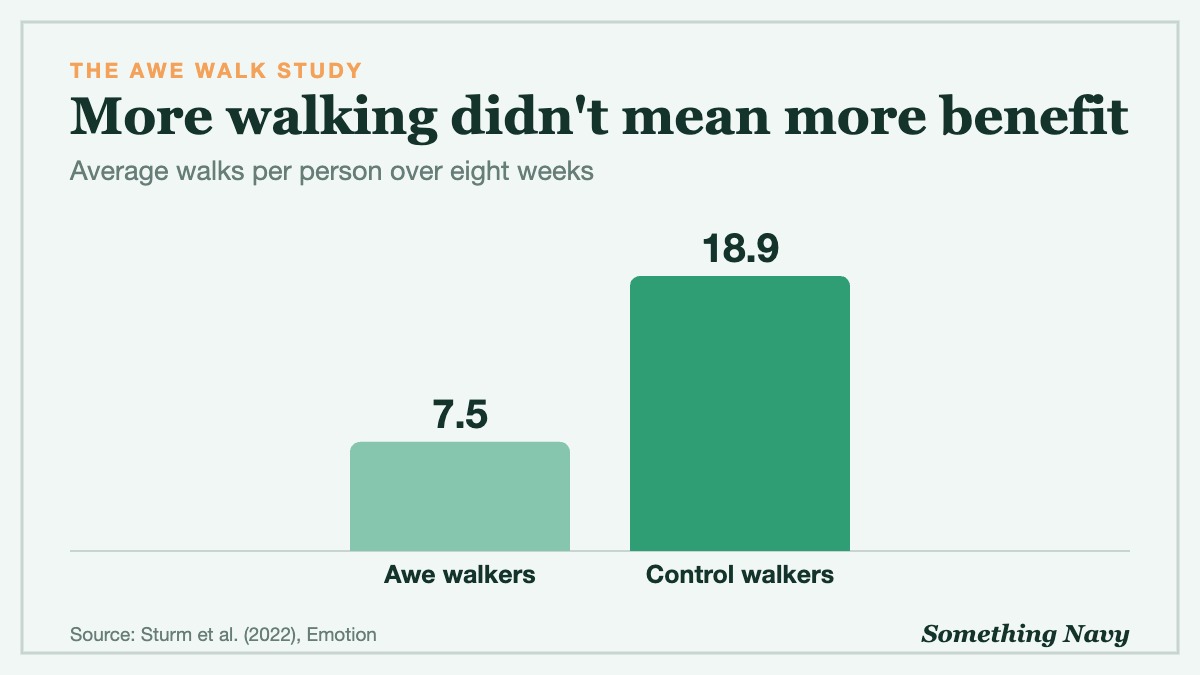
The control group was unexpectedly keen. Over the eight weeks they averaged 18.9 walks each, compared with 7.5 for the awe group. If fresh air and exercise alone explained the results, the control walkers should have pulled ahead.
They didn’t. Their selfies and emotions did not shift in the same way. What seemed to matter was not how much people walked but where they put their attention while doing it.
What the awe walk study did and did not show
- Who: 52 healthy, mostly white, highly educated adults aged 60 to 90 in the San Francisco area.
- What changed: more awe on walks, more compassion and gratitude day to day, less daily distress, smaller selves and bigger smiles in selfies.
- What did not: anxiety, depression and life satisfaction measured before and after did not change in either group.
- Caveats: a small sample, effects tracked only for eight weeks, and the awe group started with slightly higher daily distress, which may have flattered that result.
Those caveats matter. This was a modest pilot-sized trial, not proof that wonder cures low mood. But the effects were consistent, cheap to produce and grew stronger as the weeks went by, which is more than most wellbeing advice can claim.
So what exactly is awe?
Psychology largely ignored it until 2003, when Dacher Keltner and Jonathan Haidt published a paper called “Approaching awe, a moral, spiritual, and aesthetic emotion” in Cognition and Emotion. They argued that awe rests on two ingredients.
The first is vastness: something that seems much bigger than you or your usual frame of reference. That can be physical, like a cathedral ceiling, or conceptual, like the idea that the light from a star left it thousands of years ago.
The second is a need for accommodation. The experience does not fit your existing mental map, so your mind has to stretch to take it in.
That second ingredient explains why awe sits so close to confusion, and sometimes fear. Keltner and Haidt noted that awe is not always pleasant. A thunderstorm or a news event can produce it too. Keltner has since said in an interview with Behavioral Scientist that this darker, threat-tinged awe makes up about a quarter of awe experiences.
Awe is the feeling of your mental map being redrawn while you watch.
The “small self”, and why shrinking feels good
The phrase researchers use for that shrinking sensation is the “small self”. You are still there, but no longer the centre of the picture. Worries get rescaled, and the commentary in your head goes quiet.
The selfies in Sturm’s study were a literal version of this. People were not told to frame themselves smaller. They just did, as if the world in the background had become more worth showing.
If you have ever noticed how much lighter you feel after a walk that loosens a stuck idea, part of the answer may be this: for a few minutes, the problem is no longer the biggest thing in view.
Sixty seconds under very tall trees
If awe makes the self feel smaller, does it change how we treat other people? Paul Piff, then at the University of California, Irvine, set out to test it with Keltner and colleagues. Their five-part series appeared in the Journal of Personality and Social Psychology in 2015.
The most memorable experiment involved 90 students and a grove of Tasmanian eucalyptus trees on a university campus, some more than 200 feet tall.
Students were told it was a study of visual perception. Half spent one minute looking up into the trees. The other half stood a few yards away and spent one minute looking up at a tall building.
Then an experimenter walked over with a questionnaire and a box of 11 pens, and “accidentally” spilled them.
Those who had gazed at the trees picked up more pens: an average of 7.70, compared with 7.02 for those who had looked at the building. They also reported feeling less entitled.
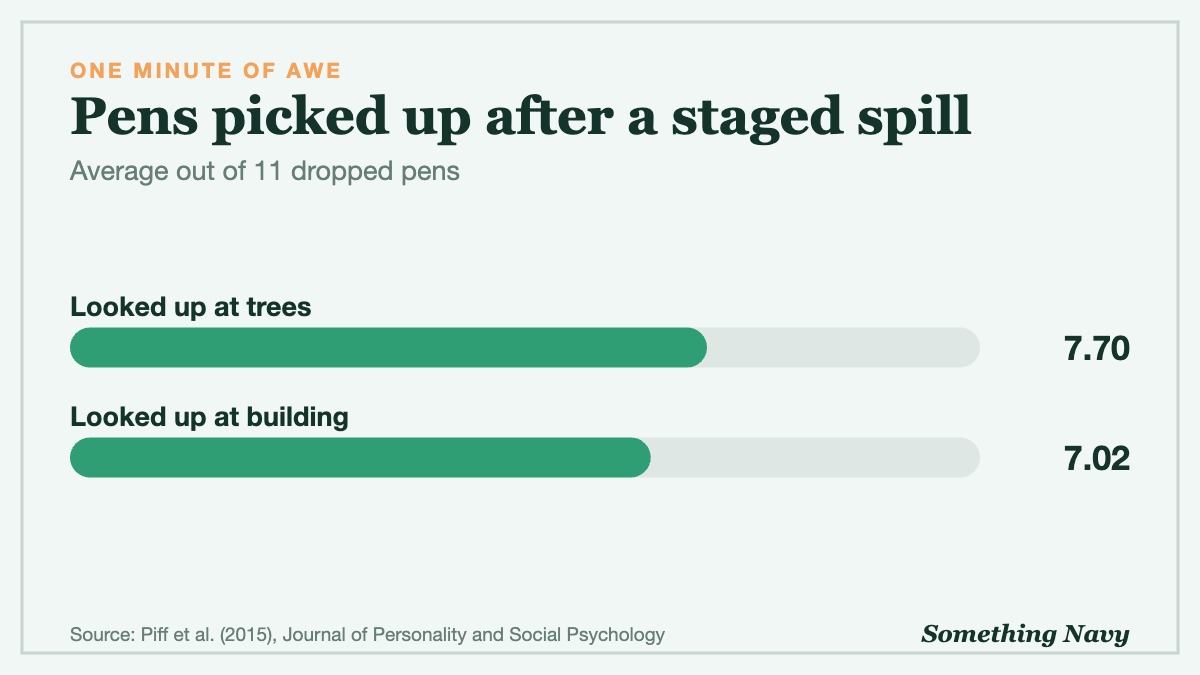
A difference of less than one pen is not exactly heroic. But it came from a single minute of looking up, and it fitted the pattern across the series. In earlier experiments in the series, people who recalled an awe-inspiring scene or watched awe-inducing videos felt smaller and less self-important, and that sense of a smaller self partly explained why they then behaved more generously and ethically.
One minute of looking up was enough to tip people, slightly, towards kindness.
A possible link to your body
There is also intriguing, if early, evidence that awe shows up below the neck.
In 2015, Jennifer Stellar, working with Keltner at UC Berkeley, published two studies in Emotion involving more than 200 young adults. Participants reported how often they felt various positive emotions, such as amusement, joy, love, pride, compassion and awe. The researchers then measured interleukin-6 (IL-6), a marker of inflammation, from samples of gum and cheek tissue.
People who reported more positive emotions generally had lower IL-6. Of all the emotions measured, awe was the strongest predictor of lower levels.
Before you swap your medication for sunsets, note the limits. This was a correlation in healthy students, not an experiment. As the Berkeley press release pointed out, it is possible that lower inflammation makes people more open to awe, rather than the other way round. It is a promising lead, nothing more.
You don’t need a mountain
The easiest way to talk yourself out of awe is to assume it requires the Grand Canyon. It doesn’t.
For his 2023 book Awe: The New Science of Everyday Wonder and How It Can Transform Your Life, Keltner and colleagues gathered about 2,600 personal accounts of awe from people in 26 countries. They sorted them into what he calls the “eight wonders of life”.
The most common source was not nature, music or religion. According to an excerpt published by the Greater Good Science Center, it was other people’s “moral beauty”: acts of courage, kindness, talent or people overcoming obstacles. More than 95% of those moral beauty stories described someone acting on behalf of others.
So the bus driver who waits for a running pensioner counts. So does the stranger who helps a parent carry a buggy up the Tube steps.
Cities, it turns out, are full of awe. They are also full of reasons to miss it. A phone within reach pulls your attention down and inward, which is the exact opposite of what awe asks of you.
How to take an awe walk in a city in 15 minutes
You don’t need special kit, a park or a free afternoon. You need 15 minutes, a bit of curiosity and your phone in your pocket. This loosely follows the spirit of the instructions in Sturm’s study, adapted for streets.
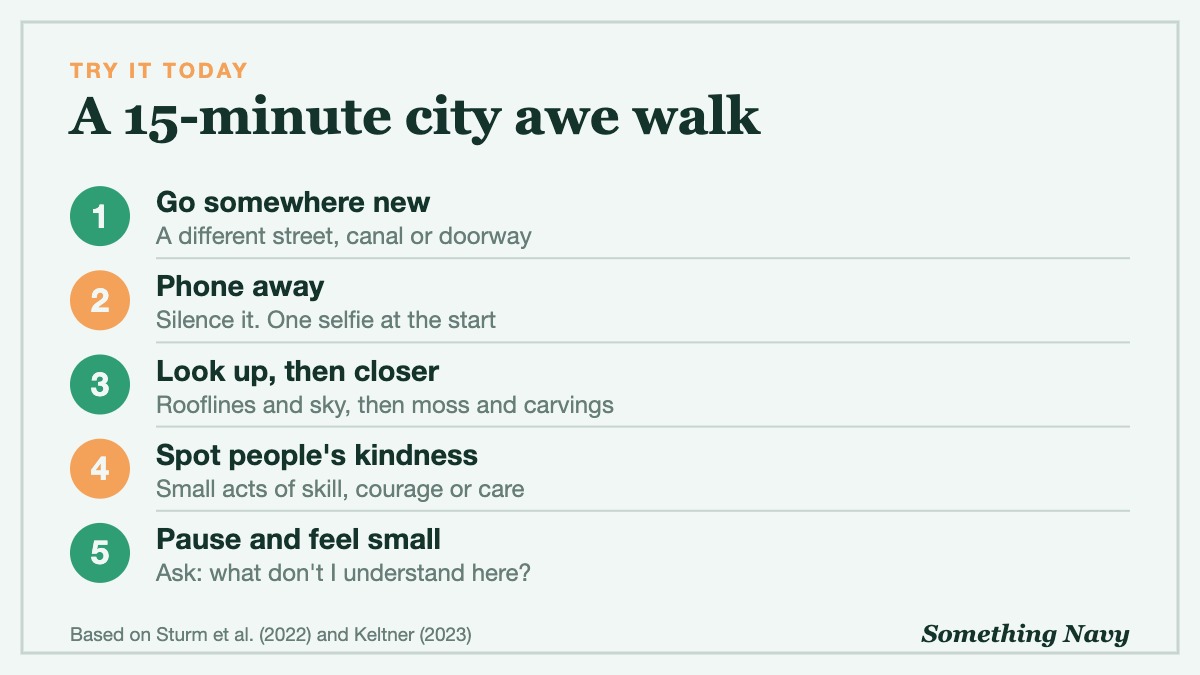
1. Pick somewhere slightly new
Sturm’s walkers were encouraged to visit a new place each week, because novelty is half of the awe recipe. In a city that can be tiny: the parallel street, the other side of the canal, a building you have walked past for years but never entered.
2. Put the phone away for the first five minutes
Silence notifications. If you want to copy the study, take one selfie at the start, then leave the camera alone until the end.
3. Look up, then look closer
Vastness is easiest to find above eye level: rooflines, cranes, a big sky over a railway cutting, the inside of a station roof. Then switch scale. Look closely at moss in a wall crack, the carving above a doorway, light on a puddle. Both stretch your sense of what is there.
4. Notice people being good at things, or good to each other
Given what Keltner’s collection of stories found, keep an eye out for small moral beauty. Someone holding a door, a kid mastering a scooter, a chef working fast behind a window. If you are feeling brave, a quick chat with a stranger can open its own kind of wonder.
5. Breathe out and let yourself feel small
When something catches you, stop for a few breaths. Let it be bigger than you. Ask yourself one question: what don’t I understand about this? That is accommodation, the second ingredient, in action.
6. Take a closing selfie, and compare
At the end, take another photo. Not for posting. Just notice how much of the frame you chose to give to the world, and how much to yourself.
Do it once a week. Sturm’s walkers needed time; the shift in their selfies and smiles built gradually over the eight weeks rather than appearing after one stroll.
And if you like the idea of writing down what you saw afterwards, it pairs naturally with a gratitude habit. Gratitude was one of the emotions that rose most in the awe group.
The world is bigger than your to-do list
It is tempting to treat wonder as a luxury, something for holidays and documentaries. The research suggests something humbler and more useful.
Awe is available on a Tuesday. It is in the starlings over the high street and the stranger who stops to help. It costs nothing, takes a quarter of an hour, and appears to make people a little warmer towards one another.
You won’t solve your problems by looking up at a tall building or a tall tree. But for a minute, they might fit back inside the frame, and you might find yourself smiling at the edge of the picture.
Sources
- Keltner, D., & Haidt, J. (2003). Approaching awe, a moral, spiritual, and aesthetic emotion. Cognition and Emotion, 17(2), 297–314. DOI
- Keltner, D. (2023). Awe: The new science of everyday wonder and how it can transform your life. Penguin Press. Excerpt via Greater Good Science Center. Link
- Piff, P. K., Dietze, P., Feinberg, M., Stancato, D. M., & Keltner, D. (2015). Awe, the small self, and prosocial behavior. Journal of Personality and Social Psychology, 108(6), 883–899. DOI
- Stellar, J. E., John-Henderson, N., Anderson, C. L., Gordon, A. M., McNeil, G. D., & Keltner, D. (2015). Positive affect and markers of inflammation: Discrete positive emotions predict lower levels of inflammatory cytokines. Emotion, 15(2), 129–133. DOI
- Sturm, V. E., Datta, S., Roy, A. R. K., Sible, I. J., Kosik, E. L., Veziris, C. R., Chow, T. E., Morris, N., Neuhaus, J., Kramer, J. H., Miller, B. L., Holley, S. R., & Keltner, D. (2022). Big smile, small self: Awe walks promote prosocial positive emotions in older adults. Emotion, 22(5), 1044–1058. DOI
- University of California, San Francisco. (2020, September 21). ‘Awe walks’ boost emotional well-being. Link
Cover photo: Arnaud Mesureur on Unsplash. Charts and graphics: Something Navy.
How we reported this. We went back to the original research for this story, 6 sources in all, listed above, and checked every figure against them. If you think we have got something wrong, tell us and we will look at it. Read more about how we work.