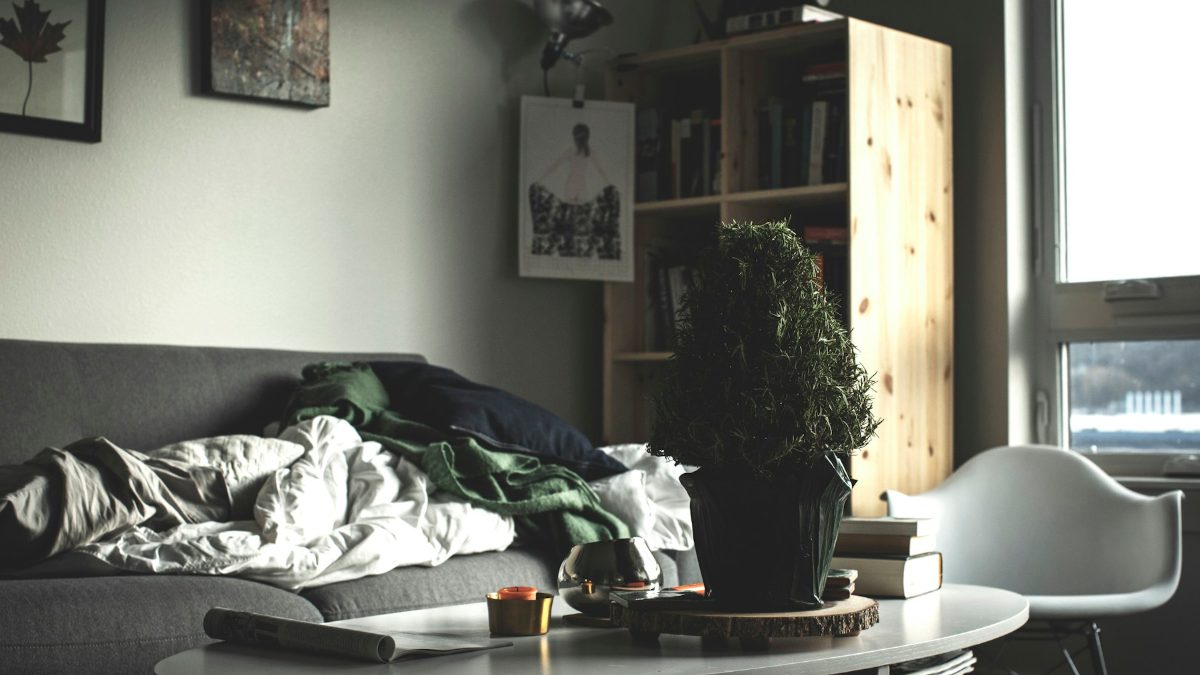
You come home after a long day, push the door open, and it catches on something. A shoe. A bag for life full of other bags for life. The post you meant to sort on Monday is still on the radiator shelf, and the coat hooks have given up.
Nothing is wrong, exactly. Nobody is hurt and nothing is on fire. Yet many people will recognise the small, tight feeling that arrives in that moment, a sense that the house is quietly listing jobs at you before you have taken your coat off.
Is that feeling real, in any measurable sense? Does living among clutter actually stress the body, or do stressed people simply let things pile up? Psychologists have been poking at the question for about 15 years, and the honest answer is more interesting than either “tidy home, tidy mind” or “mess is a sign of genius”.
The best way to look at the evidence is the way you would look at a house: one room at a time.
The hallway: what your home sounds like when you describe it
The most quoted study in this area began, in effect, at the front door. In 2010 Darby Saxbe and Rena Repetti, psychologists at the University of California, Los Angeles, asked 30 dual-income couples (60 spouses in all) to give a self-guided tour of their homes, describing each space in their own words.
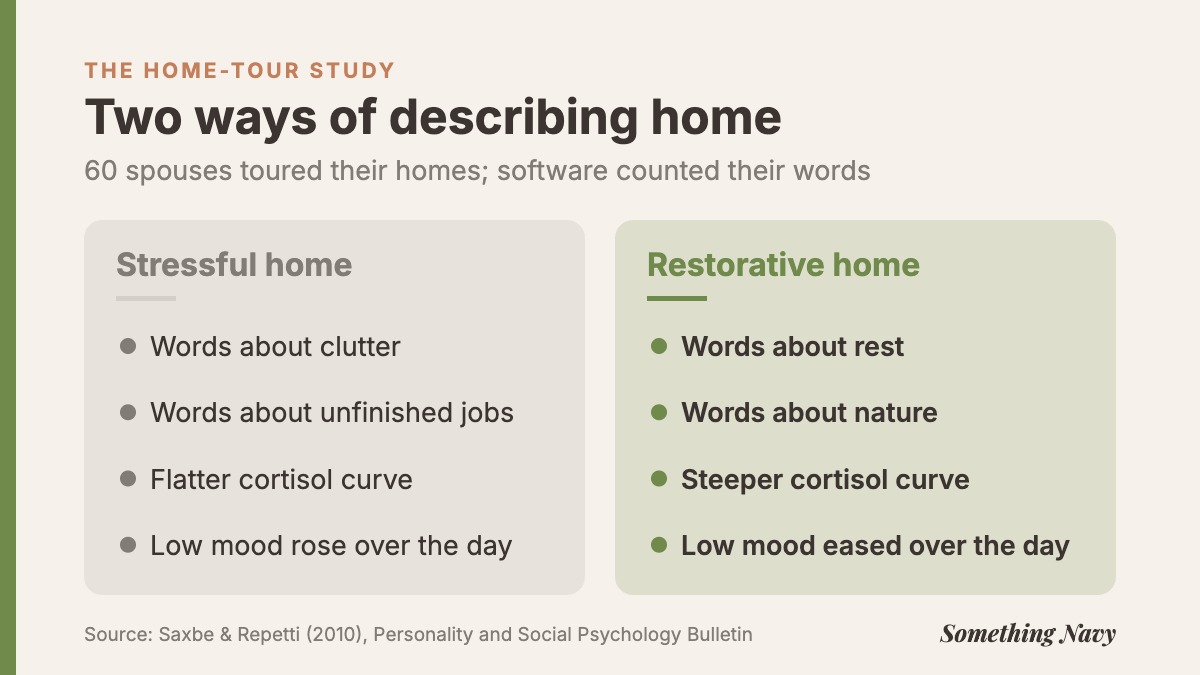
The researchers then did something clever. Rather than judging the homes themselves, they ran the transcripts through linguistic analysis software and counted particular kinds of words. Words about clutter and about an unfinished home (the half-done renovation, the room still full of boxes) were combined into a “stressful home” score. Words about rest and about nature went into a “restorative home” score.
Over three weekdays, the couples also provided samples of cortisol, a hormone that normally peaks soon after waking and falls steadily through the day. A steep fall is the healthy pattern. A flatter curve, where cortisol stays relatively high into the evening, has been linked in other research to poorer health.
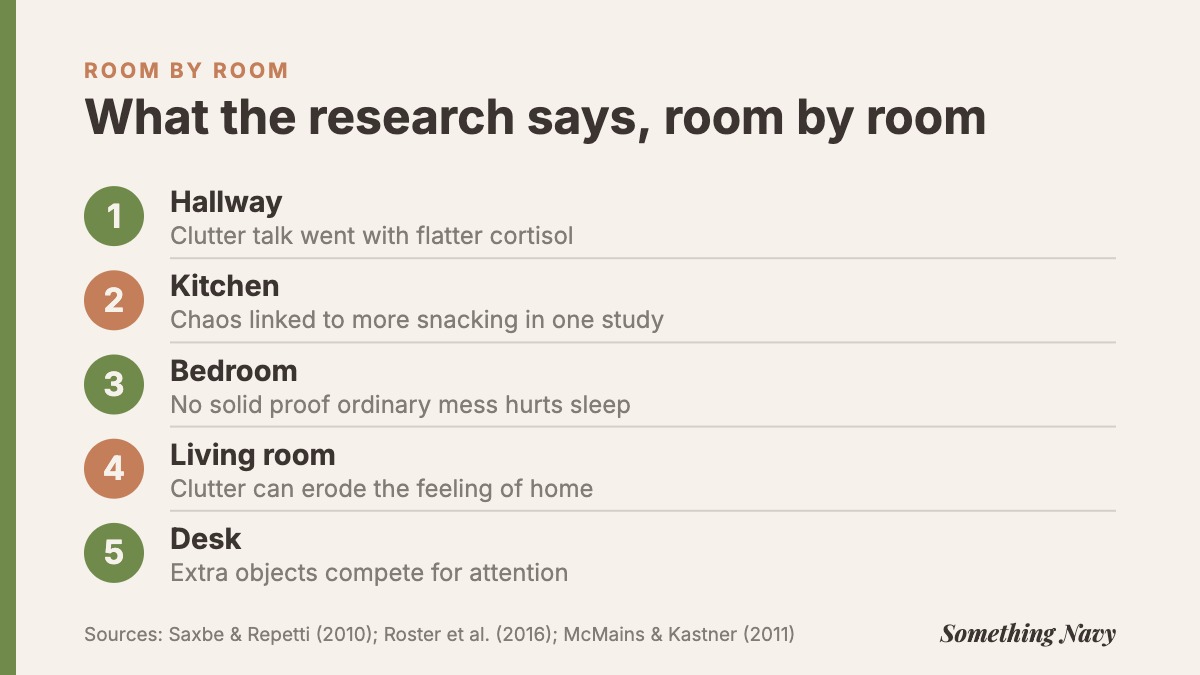
The results, published in Personality and Social Psychology Bulletin, were striking. Wives whose tours scored high on the stressful-home measure had flatter cortisol curves and reported more depressed mood as the day went on. Wives with high restorative-home scores showed steeper, healthier slopes and their low mood eased over the day. The links held even after the researchers accounted for marital satisfaction and neuroticism, two obvious rival explanations.
Two caveats matter. First, the associations were reported for wives, not husbands, which may say as much about who carries the household’s mental load as it does about clutter. Second, this is a small, correlational study of how people talk about their homes. It cannot show that a pile of laundry raised anyone’s cortisol. A person who is already worn down may simply notice, and mention, the mess more.
Still, the “unfinished home” finding rings true. A room that is not quite done is a standing reminder of an open task, the sort of thing the Zeigarnik effect describes: unfinished business has a way of staying on the mind.
The kitchen: chaos, mood and the biscuit tin
Walk through to the kitchen, where the evidence becomes experimental rather than observational. In a study published in Environment and Behavior, Lenny Vartanian of the University of New South Wales and colleagues at Cornell University’s Food and Brand Lab built two versions of the same kitchen.
One was tidy and quiet. The other was what the researchers called chaotic: newspapers strewn on the table, papers everywhere, dirty dishes in view. According to Cornell’s account of the work, 98 women took part. Before entering, each spent a few minutes writing about a time they had felt either in control or out of control, or completed a neutral writing task.
They were then left with bowls of cookies, crackers and carrots, and told to eat as much as they liked. Women who had been primed to feel out of control and sat in the messy kitchen ate more cookies than those in the tidy one, roughly twice as many cookie calories according to NPR’s report. In the same messy kitchen, women who had written about feeling in control averaged 38 calories of cookies, compared with 103 for those who had written about feeling out of control.
The crackers and carrots were not affected. The mess seemed to matter for sweets, and mostly for people who already felt rattled. The authors’ own conclusion was that mindset can moderate the effect of a chaotic environment, which is a more modest and more useful idea than “clutter makes you eat”.
There is a further reason for caution. Brian Wansink, the lab’s director and a co-author here, resigned from Cornell in 2018 after a university investigation found academic misconduct, and a number of his papers have been retracted. This particular paper, led by Vartanian, carries no retraction or correction notice. But it is a single study, and it deserves to be treated as an intriguing result rather than a settled fact.
Kitchens are also where clutter becomes a relationship issue. Whose mug is that, and whose turn was it? If that sounds familiar, our piece on why couples fight about the dishes picks up the thread.
The bedroom: where the evidence gets murky
Upstairs, the claims get louder and the data get thinner. You will often read that a cluttered bedroom ruins sleep. The study usually cited is a 2015 piece of work by Pamela Thacher, a psychologist at St. Lawrence University in New York, with her student Alexis Reinheimer.
They recruited adults online through Amazon’s Mechanical Turk and gave them standard questionnaires on sleep quality and on clutter and hoarding. People at risk of hoarding disorder reported more trouble falling asleep, more sleep disturbance and more daytime problems. It is a real finding, but it was presented as a conference poster and published as an abstract, not a full peer-reviewed paper, and it concerned hoarding risk rather than the ordinary untidy bedroom.
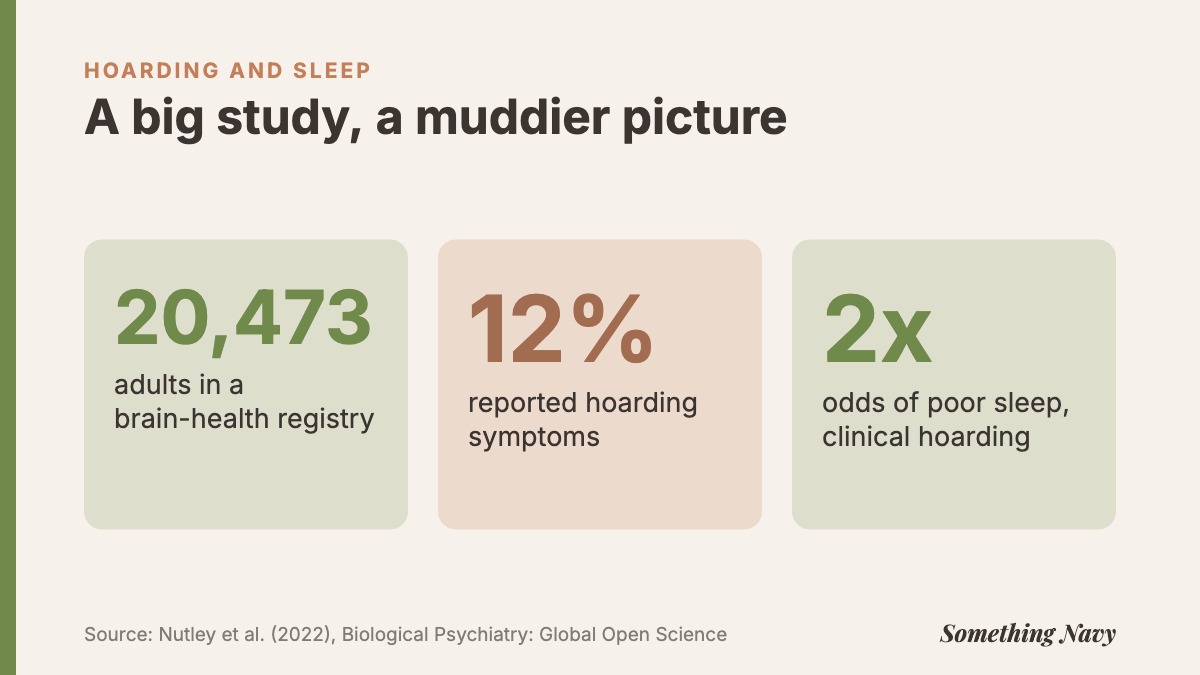
A much larger study complicates the story. In 2022 a team led by Sara Nutley, publishing in Biological Psychiatry: Global Open Science, analysed data from 20,473 adults in an online brain-health registry. About 12% reported clinically relevant or subclinical hoarding symptoms.
People with clinically relevant hoarding had roughly twice the odds of poor sleep quality. But when the team looked at which part of hoarding was doing the work, they found no evidence that clutter itself was the key ingredient. Difficulty discarding, distress and impairment seemed to matter as much or more. The design was cross-sectional, so it cannot say whether poor sleep feeds hoarding, the reverse, or both.
So the fair verdict on the bedroom is “not proven”. A tidy room may well help you wind down, and it costs nothing to try. But nobody has yet shown, in a well-controlled study of ordinary households, that a chair piled with clothes is stealing your sleep.


The living room: when the house stops feeling like home
The living room is where the idea of home matters most, and it is the focus of the most thoughtful study in the field. In 2016 Catherine Roster and M. Peter Jurkat of the University of New Mexico and Joseph Ferrari of DePaul University in Chicago surveyed just under 1,400 adults in the US and Canada about their homes, their possessions and their wellbeing.
Their key concept was “psychological home”: the sense that a place is yours, that it expresses who you are and gives you security. Attachment to your home and identification with your possessions both fed that feeling. That is the bright side. Their paper in the Journal of Environmental Psychology was titled “The dark side of home” because of what happened when possessions tipped into clutter, which they defined as an overabundance that creates chaotic and disorderly living spaces.
Clutter undermined the sense of psychological home, and through it, people’s sense of wellbeing. In other words, the objects that once made a house feel like yours can, in sufficient quantity, start to make it feel like it belongs to them.
Again, the limits are important and the authors were upfront about them. Participants were recruited through the Institute for Challenging Disorganization, a nonprofit for people who seek professional organising help. Most were women, the median age was 54, and the researchers stated plainly that the sample was not representative of the general population. It is a survey, measured at one point in time, so it shows a pattern of associations rather than cause and effect.
Ferrari was also clear that possessions themselves are not the problem. A collection you love and can manage is part of your identity. The trouble starts when the stuff stops serving the life and the life starts serving the stuff.
The desk: what clutter does, and doesn’t, do to the brain
Finally, the desk, home of the most overstretched claim in the clutter literature. Countless articles state that “neuroscientists at Princeton” proved clutter limits your ability to focus. The study they mean is real, but it was not about desks.
In 2011 Stephanie McMains and Sabine Kastner of Princeton University scanned the brains of ten volunteers with functional MRI while they looked at arrangements of simple shapes on a screen. The question was a basic one in vision science: when several objects sit in view at once, they compete for representation in the visual cortex. How does the brain settle the contest?
The answer, published in the Journal of Neuroscience, was that two mechanisms share the work. When items grouped neatly into a single perceived object, much of the competition was resolved automatically. When they did not, attention had to do more of the lifting, and its effect in the brain was largest precisely when grouping was weakest.
It is reasonable to draw a gentle inference from this. A field of unrelated objects gives your visual system more to sort, and attention is a limited resource. A desk where things are grouped (pens in a pot, papers in one stack) may ask less of you than one where everything is scattered. But the study used ten people and abstract shapes. It did not measure stress, productivity or anyone’s actual desk.
The more convincing evidence about workspace distraction comes from studies of specific objects rather than general mess. Even a silent smartphone within reach, for instance, seems to tug at attention, as we explored in our piece on the brain drain of a nearby phone.
Chicken, egg or both?
Step back into the hallway and the pattern across rooms is clear. Clutter goes with higher stress, lower mood, worse sleep and a weaker sense of home. What the research mostly cannot tell us is which comes first.
The causal arrow almost certainly points both ways. Stress, illness, grief, a new baby or a punishing job all leave less energy for putting things away. The resulting mess then becomes one more visible, nagging demand. The only experimental study in this tour, the kitchen one, suggests something subtler still: a chaotic room seemed to matter most for people who already felt out of control.
That is useful to know. It suggests clutter acts less like a poison and more like an amplifier.
It also means that guilt is the wrong response. A messy home is often a symptom of a hard season, not a character flaw, and the people who feel worst about it are frequently those with the least slack to fix it.
Small, visible wins beat the grand clear-out
If clutter does its damage partly by advertising unfinished jobs, the remedy may be less about minimalism and more about closing loops. A weekend-long purge can be satisfying, but it is also the sort of plan that collapses under a busy week.
A smaller habit, attached to something you already do, tends to last longer. Pairing it with a specific cue, the approach described in our guide to if-then planning, makes it far more likely to happen on a tired Tuesday.
A ten-minute reset
- Minutes 1–2, the landing strip. Clear the hallway surface or the spot by the door where things land first. It is the first thing you see coming home.
- Minutes 3–5, the kitchen counter. Dishes into the sink or dishwasher, post into one pile. One clear surface changes the feel of the room.
- Minutes 6–7, one unfinished job. Pick a single half-done task and either finish it or write it down with a date.
- Minutes 8–9, group, don’t purge. Gather loose items on your desk or table into one tray or stack. Grouped things compete less for attention.
- Minute 10, stop. Set a timer and keep to it. The aim is a calmer room tonight, not a perfect house.
What a calm room is really for
The researchers in this tour were rarely asking whether tidiness is a virtue. They were asking whether a home can do its job: to be a place where the body’s stress response gets to switch off.
Saxbe and Repetti’s restorative homes were described in words of rest and nature. Roster and colleagues’ happiest participants felt their homes expressed who they were. Neither of those is about owning less for its own sake.
So the better question to ask, standing in your own hallway, may not be “Is this tidy?” but “Does this room let me put the day down?” If the answer is no, ten minutes is a reasonable place to start.
Frequently asked questions
Not necessarily. Clutter and low mood are linked in several studies, but mess has many causes, from a busy job to a small flat. If clutter comes with persistent low mood, loss of interest or trouble functioning, it is worth talking to a GP.
No. Hoarding disorder is a recognised mental health condition involving persistent difficulty discarding things and distress at the thought of doing so. Everyday clutter is far more common and usually reflects time, space and energy rather than a disorder.
Possibly. In the home-tour study the cortisol and mood links were reported for wives, not husbands, which may reflect who shoulders more of the household’s work. Most clutter studies have mainly female samples, so the question is still open.
There are few controlled trials testing this directly. Small, regular resets are a low-cost experiment, and many people find a clearer space easier to relax in, but the evidence is suggestive rather than proven.
Sources
- McMains, S., & Kastner, S. (2011). Interactions of top-down and bottom-up mechanisms in human visual cortex. Journal of Neuroscience, 31(2), 587–597. DOI
- Nutley, S. K., Read, M., Eichenbaum, J., Nosheny, R. L., Weiner, M. W., Mackin, R. S., & Mathews, C. A. (2022). Poor sleep quality and daytime fatigue are associated with subjective but not objective cognitive functioning in clinically relevant hoarding. Biological Psychiatry: Global Open Science, 2(4), 480–488. DOI
- Roster, C. A., Ferrari, J. R., & Jurkat, M. P. (2016). The dark side of home: Assessing possession ‘clutter’ on subjective well-being. Journal of Environmental Psychology, 46, 32–41. DOI
- Saxbe, D. E., & Repetti, R. (2010). No place like home: Home tours correlate with daily patterns of mood and cortisol. Personality and Social Psychology Bulletin, 36(1), 71–81. DOI
- Thacher, P., & Reinheimer, A. (2015). Sleep quality and sleep disturbance in those at risk for hoarding disorder [Abstract 0920]. SLEEP 2015, Seattle. American Academy of Sleep Medicine press release. Link
- Vartanian, L. R., Kernan, K. M., & Wansink, B. (2017). Clutter, chaos, and overconsumption: The role of mind-set in stressful and chaotic food environments. Environment and Behavior, 49(2), 215–223. DOI
How we reported this. We went back to the original research for this story, 6 sources in all, listed above, and checked every figure against them. If you think we have got something wrong, tell us and we will look at it. Read more about how we work.
Cover photo: Jason Abdilla on Unsplash. Charts and graphics: Something Navy.