
Put two bar magnets on a kitchen table and you can feel the rule in your fingertips. North snaps to south. North pushes north away. It is one of the first pieces of physics most of us learn, and somewhere along the way it slipped out of the science classroom and into the way we talk about love.
The romantic comedy runs on it. The buttoned-up lawyer falls for the chaotic artist; the homebody falls for the adventurer; the cynic falls for the optimist. Friends describe a couple as “chalk and cheese” in a tone that suggests this is why it works. In 1990 Paula Abdul topped the US charts with “Opposites Attract”, a duet with a cartoon cat.
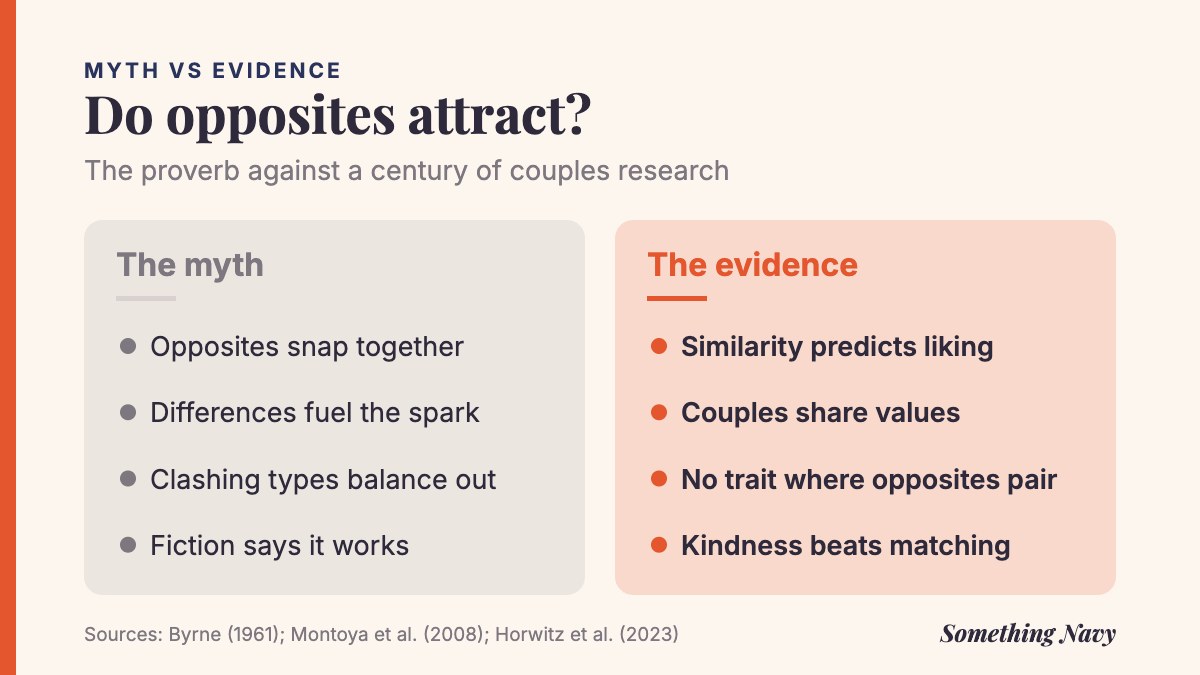
It is a satisfying story. It also happens to be one of the most thoroughly tested ideas in social psychology, and the results run almost entirely the other way.
The myth has a respectable pedigree
The idea is not just folk wisdom. In 1958 the American sociologist Robert Winch published Mate-Selection: A Study of Complementary Needs, based on interviews with 25 married couples. He argued that people choose partners whose psychological needs fit theirs like a key in a lock: the nurturing with the dependent, the dominant with the deferential.
It was an elegant theory with a small sample, and it did not hold up well. Later researchers found that couples matched each other on social characteristics such as religion and education, while the neat interlocking of needs that Winch described proved hard to find. The magnet metaphor survived anyway, because it makes a better plot than the alternative.
The alternative is that birds of a feather flock together. Psychologists have been trying to pit the two proverbs against each other for more than 60 years.
A stranger who agrees with you
The man who did most to settle the question was Donn Byrne. In 1961 he published a short paper in the Journal of Abnormal and Social Psychology that would launch a whole research programme. His method was cunning. Students filled in an opinion survey early in term. Weeks later they were shown a survey supposedly completed by another student and asked for their first impressions.
There was no other student. The experimenter had filled in the form, tuning the answers so that the “stranger” agreed with the participant on anywhere from none to all of the issues. Participants then rated how much they would like this person and whether they would enjoy working with them.
The pattern was stark. The more the stranger agreed, the more they were liked, and across many later studies the relationship looked close to a straight line: as the proportion of shared attitudes rose, liking rose steadily with it. Byrne gathered this work in his 1971 book The Attraction Paradigm, and the “bogus stranger” method became one of the most copied set-ups in the field.
It had an obvious weakness. Nobody falls in love with a questionnaire. Critics pointed out that a fictional stranger on paper tells you about first impressions in a laboratory, not about who people actually date, marry or stay with. The next 50 years of research were, in large part, an attempt to answer that objection.
What 313 studies say, and the twist inside them
By 2008 there was enough material for a full reckoning. The psychologists Montoya, Horton and Kirchner pooled 313 laboratory and field studies, containing 460 separate effects, in the Journal of Social and Personal Relationships.
Their headline finding confirmed Byrne. Similarity was strongly linked to attraction, with an average correlation of 0.47 for actual similarity and 0.39 for perceived similarity. In psychology, effects that size are large.
The interesting part was how those two kinds of similarity behaved over time. Actual similarity (whether two people really do share attitudes and traits, as measured independently) mattered most when people had never met or had only interacted briefly. In established relationships its effect was no longer significant.
Perceived similarity did not fade. Whether people believed they were alike predicted attraction at every stage, including in existing relationships.
That is a subtle and slightly unsettling result. It suggests that once we like someone, we tend to see ourselves in them, whether or not the overlap is objectively there. Similarity may draw us in, but the sense of similarity is partly something a relationship produces.
Newlyweds put it to the test
Laboratory attraction is one thing. Choosing someone to share a mortgage with is another. In 2005, Shanhong Luo and Eva Klohnen at the University of Iowa studied 291 newlywed couples from the Iowa Marital Assessment Project, published in the Journal of Personality and Social Psychology. The couples had been married for less than a year and had dated for an average of about three and a half years.
Both partners answered detailed questionnaires on attitudes, values, religiosity and personality, including attachment style, extraversion, conscientiousness and emotional tendencies. They also reported on the quality of their marriage.
Two clear findings emerged. Spouses were strikingly similar in their attitudes and values. In personality, they were barely more alike than two people paired at random. Crucially, there was no sign of the opposite pattern either: the authors found no evidence that opposites attract.
Then came the twist. When the researchers looked at which kind of similarity went with a happier marriage, it was personality, not attitudes. Their explanation is intuitive once you hear it. Attitudes are visible early, so couples sort on them before they commit; whatever differences remain have been knowingly accepted. Personality takes longer to see clearly, and it is personality that collides with your partner every day, over plans, chores and moods. Anyone who has read our piece on why couples fight about the dishes will recognise the territory.


Eighty thousand couples and a century of data
The most comprehensive answer arrived in 2023. Tanya Horwitz, Jared Balbona, Katie Paulich and Matthew Keller at the University of Colorado Boulder published a two-part analysis in Nature Human Behaviour.
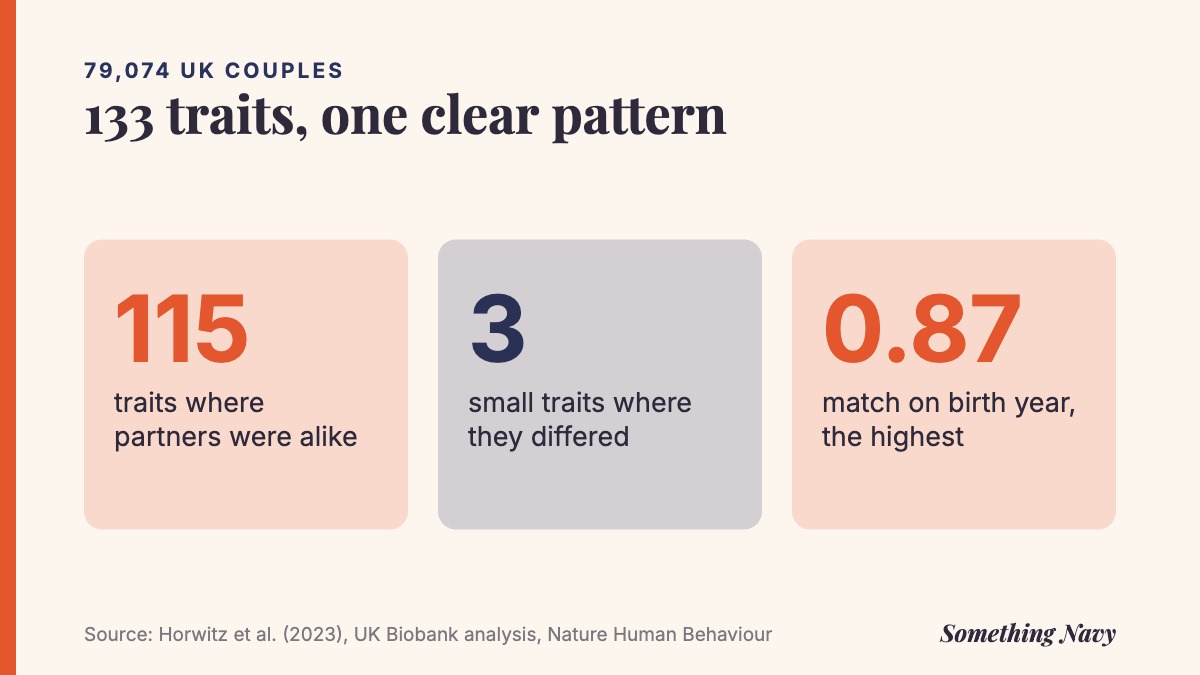
First, they gathered every study they could find on how similar male and female partners are on 22 traits: 480 correlations from 199 studies, the oldest dating from 1903. Second, they analysed 133 traits in up to 79,074 opposite-sex couples in the UK Biobank, a large health study of middle-aged and older Britons.
On no trait in the meta-analysis did opposites reliably pair up. The strongest similarities were for political values (a correlation of 0.58), religious attitudes (0.56) and educational attainment (0.55). IQ scores came in at 0.44, and smoking and drinking habits were also notably shared. Physical and psychological traits were matched less strongly but still positively: height at 0.24, neuroticism at 0.11, and extraversion lowest of all at 0.08.
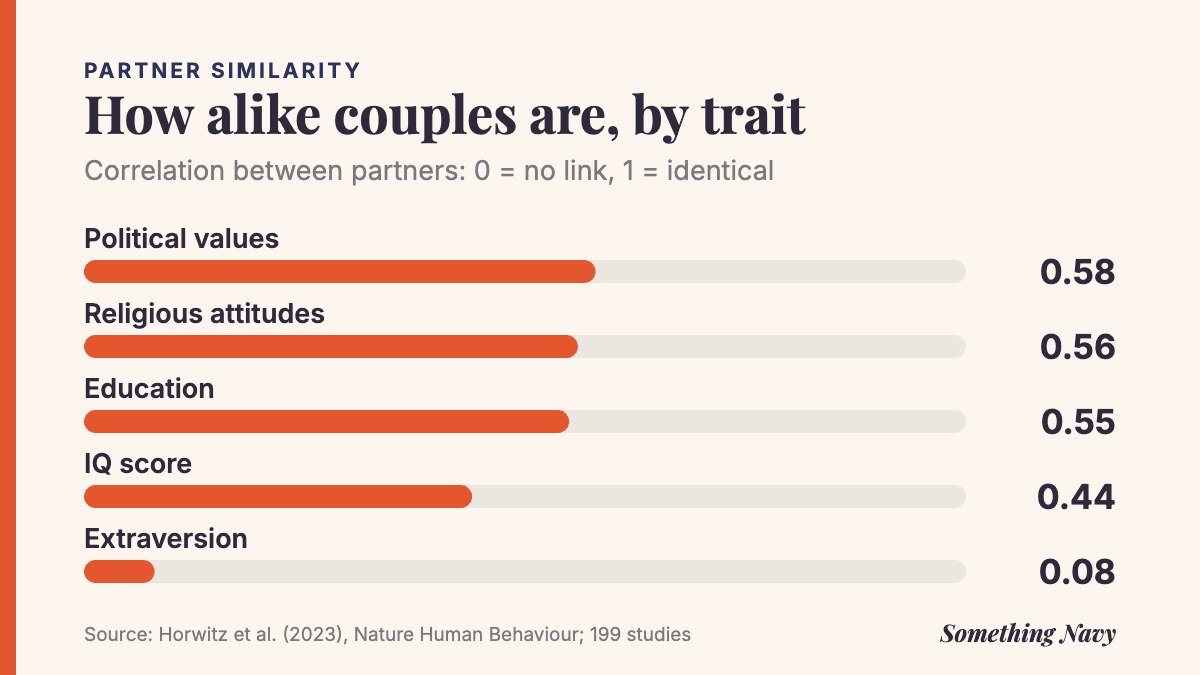
A correlation of 0.58 does not mean 58% of couples agree on politics. It means partners’ positions line up far more often than chance would predict. A score of 0.08 for extraversion means that, as Horwitz put it, extraverts are about as likely to end up with introverts as with fellow extraverts. On that one trait, the proverbs simply cancel out.
The UK Biobank half of the study was even more lopsided. Of 133 traits, 118 showed a statistically significant correlation between partners. Of those, 115 were positive. Only three were negative, and all three were small: chronotype (whether you are a morning or an evening person), a tendency to worry, and hearing difficulty. The most similar “trait” of all was birth year, at 0.87, which mostly tells you that people tend to marry within their own generation.
The authors were careful about what their data cannot show. Partner similarity can arise because people seek out the like-minded, because social circles, schools and workplaces already sort people by background, or because couples grow more alike over time. A correlation in married couples does not reveal which of these is doing the work. The pooled studies also varied a great deal from sample to sample.
Matching is not the same as happiness
If similar couples are more common, are they also happier? Here the evidence becomes more modest, and it is worth being honest about that.
In 2010, Portia Dyrenforth, Deborah Kashy, Brent Donnellan and Richard Lucas examined large, nationally representative samples of married couples in Australia, the UK and Germany. They asked how much of each person’s relationship satisfaction could be predicted by their own personality, their partner’s personality, and how similar the two were.
Your own personality explained roughly 6% of your relationship satisfaction. Your partner’s personality explained 1–3%, mostly through how agreeable, conscientious and emotionally stable they were. Similarity, once those were accounted for, consistently explained less than 0.5%.
In other words, having a kind, reliable, even-tempered partner matters far more than having one who resembles you. Similarity helps people find each other. It is a weak guarantee of what happens next, where habits of conflict, the kind described in the Gottman “four horsemen”, carry far more weight.
The one place opposites do fit
There is, however, one domain where the magnet metaphor earns its keep, and it concerns not who you are but how you behave in the moment.
Psychologists describe social behaviour along two broad axes: warmth (friendly versus cold) and dominance (taking charge versus deferring). Interpersonal theory predicts that warmth invites warmth, but dominance invites its opposite. If one person leads, things run smoothly when the other follows.
In 1997, D. Christopher Dryer and Leonard Horowitz tested this in two experiments. In the first, participants who described themselves as either dominant or submissive spent time with a confederate trained to act one way or the other. People in complementary pairings, a dominant participant with a submissive partner or vice versa, were more satisfied with the interaction than people paired with someone like themselves. In the second, satisfaction was highest when a partner’s behaviour met the participant’s own interpersonal goals.
And then, a detail that ties everything together. In both studies, satisfied participants tended to rate their partners as similar to themselves. The fit felt like likeness.
Larissa Tiedens and Alison Fragale found something similar in body language. In a 2003 study of posture, participants met a confederate who either sprawled expansively or sat hunched and small. People tended to do the reverse: shrinking beside a sprawler, expanding beside someone who made themselves small. Those whose posture complemented the confederate’s liked them more and felt more comfortable than those who mirrored them.
Where difference can help
- Who leads, who follows. In moment-to-moment interaction, one person taking charge while the other defers tends to feel smoother than two people competing for the wheel (Dryer and Horowitz, 1997).
- Body language. Meeting an expansive posture with a smaller one, and vice versa, was linked to more liking than simple mimicry (Tiedens and Fragale, 2003).
- Turn-taking, not fixed roles. These studies measured single encounters. The plausible lesson for couples is flexible complementarity, taking turns to lead, rather than a permanent boss.
- Small, tolerated differences. In the UK Biobank, morning and evening people were slightly more likely to pair up than to match. Nobody yet knows why.
Notice what this complementarity is not. It is not about deep values, background or life goals, where the evidence for similarity is overwhelming. It is about a dance step: who speaks, who listens, who decides where dinner is tonight. And because both studies captured brief encounters between strangers, they say more about the rhythm of interaction than about whether a dominant spouse makes for a lasting marriage.
Why the myth refuses to die
If the data are this consistent, why does “opposites attract” still feel true? A few reasons stand out.
First, differences are more noticeable than similarities. You do not remark that your partner also speaks English, also wants children, also votes the same way and also grew up two towns away. You do remark that they alphabetise the spice rack while you leave the lids off. The shared foundation is invisible precisely because it is shared.
Second, within a pair that is already well matched on the big things, the remaining differences really can feel like a draw. Someone who shares your values but is louder, braver or tidier than you can seem like a welcome expansion of your life rather than a threat to it.
Third, there is a dark mirror to Byrne’s finding. In 1986 Milton Rosenbaum proposed the “repulsion hypothesis”: that we are driven less by attraction to similar people than by an aversion to dissimilar ones. On this view, the couples we see are what remains once the obvious mismatches have been filtered out early, perhaps after a single date. Either way, the result is the same: the pairs who last tend to agree on the things that matter.
And fourth, stories need friction. Two compatible people who agree about most things and get on well makes for a short film.
Same values, different rhythms
Pulled together, the research suggests a more useful picture than either proverb. On politics, religion, education, habits and generation, birds of a feather really do flock together, and they seem to do so from the first conversation. On personality, couples are only loosely matched, and how kind and steady your partner is matters much more than whether they mirror you.
Then there is the small, specific space where difference works: the give and take of who leads and who follows, which may be as much about moment-to-moment timing as about character. Friendships, as our piece on how many hours it takes to make a friend shows, are built through repeated time together, and couples are no different.
Perhaps the magnet is the wrong image altogether. A better one might be two people carrying a sofa up a narrow staircase. They need to agree completely on where it is going. They do not want to be doing the same thing at the same moment: one has to lift while the other steers.
Sources
- Byrne, D. (1961). Interpersonal attraction and attitude similarity. Journal of Abnormal and Social Psychology, 62(3), 713–715. DOI
- Dryer, D. C., & Horowitz, L. M. (1997). When do opposites attract? Interpersonal complementarity versus similarity. Journal of Personality and Social Psychology, 72(3), 592–603. DOI
- Dyrenforth, P. S., Kashy, D. A., Donnellan, M. B., & Lucas, R. E. (2010). Predicting relationship and life satisfaction from personality in nationally representative samples from three countries: The relative importance of actor, partner, and similarity effects. Journal of Personality and Social Psychology, 99(4), 690–702. DOI
- Horwitz, T. B., Balbona, J. V., Paulich, K. N., & Keller, M. C. (2023). Evidence of correlations between human partners based on systematic reviews and meta-analyses of 22 traits and UK Biobank analysis of 133 traits. Nature Human Behaviour, 7(9), 1568–1583. DOI
- Luo, S., & Klohnen, E. C. (2005). Assortative mating and marital quality in newlyweds: A couple-centered approach. Journal of Personality and Social Psychology, 88(2), 304–326. DOI
- Montoya, R. M., Horton, R. S., & Kirchner, J. (2008). Is actual similarity necessary for attraction? A meta-analysis of actual and perceived similarity. Journal of Social and Personal Relationships, 25(6), 889–922. DOI
- Tiedens, L. Z., & Fragale, A. R. (2003). Power moves: Complementarity in dominant and submissive nonverbal behavior. Journal of Personality and Social Psychology, 84(3), 558–568. DOI
How we reported this. We went back to the original research for this story, 7 sources in all, listed above, and checked every figure against them. If you think we have got something wrong, tell us and we will look at it. Read more about how we work.
Cover photo: Samuel Yongbo Kwon on Unsplash. Charts and graphics: Something Navy.