You have been staring at the same paragraph for twenty minutes. The cursor blinks. You get up to make a cup of tea, and somewhere between the desk and the kettle, the sentence you needed simply turns up.
Most of us have had that moment and filed it under luck.
It may not be luck. In 2014 two researchers at Stanford University put the hunch through four separate experiments, and the result was strikingly consistent: when people walked, the flow of original ideas went up. Not for everyone, not for every kind of thinking, but for most people and for one very particular kind of thinking.
The surprise is what did not matter. The walkers did not need a park, a view or fresh air. Some of them were on a treadmill pointed at a blank wall.
A blank wall, a treadmill and a button
Marily Oppezzo, then a doctoral researcher at Stanford’s Graduate School of Education, and her supervisor Daniel Schwartz published their findings in the Journal of Experimental Psychology: Learning, Memory, and Cognition under a title that does most of the explaining: “Give your ideas some legs”.
Their tools were deliberately simple. The main one was a classic test of divergent thinking called the alternate uses task. You are given an everyday object and a few minutes to list as many uses for it as you can. A button, for instance, could become a doorknob for a doll’s house or a tiny strainer. Answers count as creative when they are both unusual and actually workable.
Across the studies, 176 people took part, mostly university and community college students. Here is what each experiment did, one by one.
Experiment 1: the same people, sitting then walking
Forty-eight students first sat at a desk and did the alternate uses task, speaking their answers aloud to be recorded. Then they stepped on to a treadmill facing a blank wall, found a comfortable pace, and did it again with new objects.
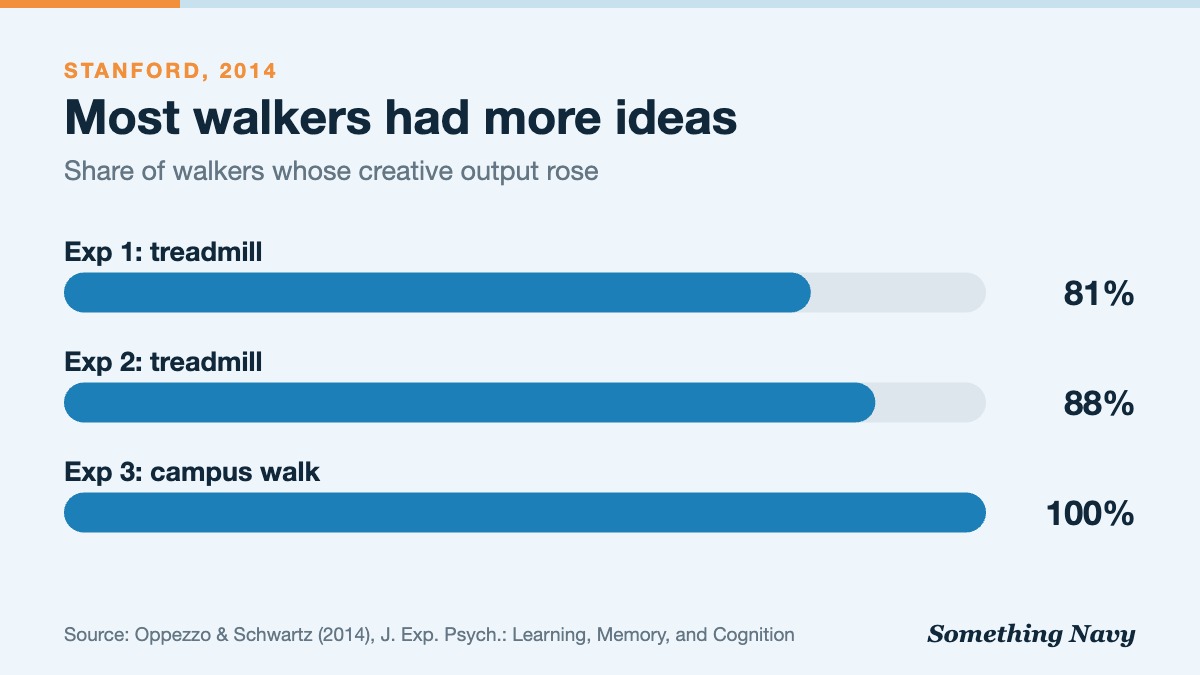
Walking raised creative output for 81% of them. Total ideas jumped from an average of 22.2 while sitting to 33.1 while walking, and the authors put the average rise in creative output at around 60%.
It was not just more noise, either. The share of answers that were genuinely novel crept up too, from about 2.5 in every 10 ideas to 3.0.
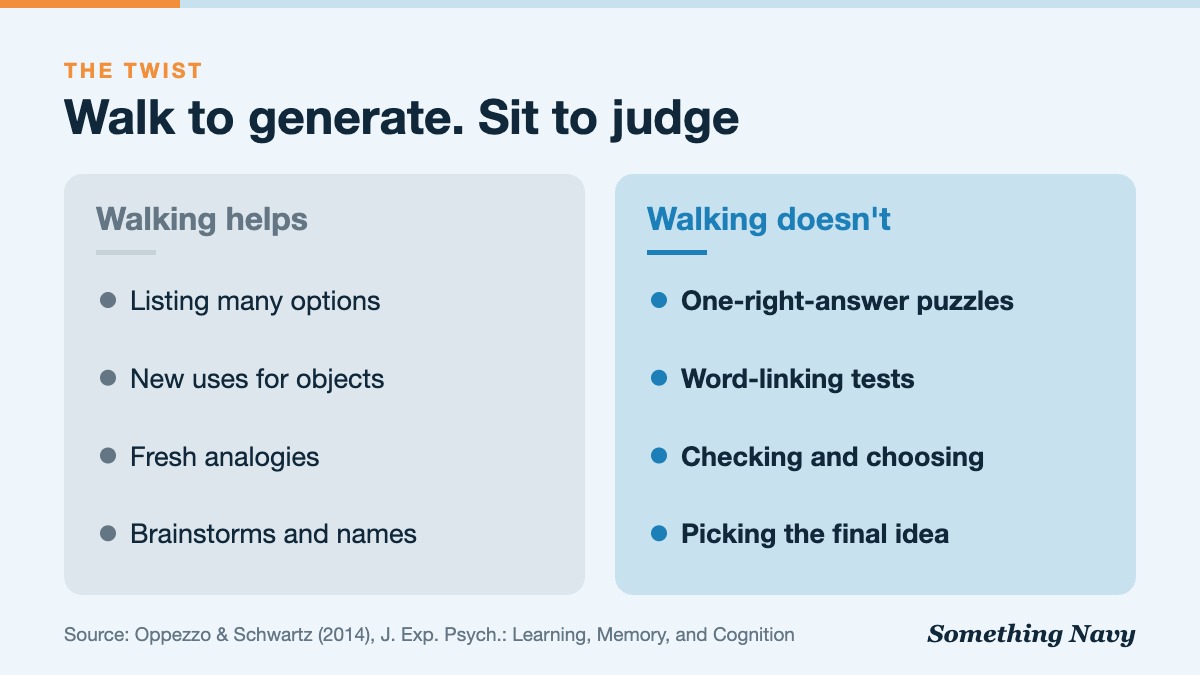
But the same students also took a different test, the compound remote associates task, where you see three words and must find the single word that links them (think “cottage”, “swiss” and “cake”, which all pair with “cheese”). That is convergent thinking: one right answer, found by narrowing down. Here walking did not help. Only 23% improved on the treadmill, and average scores dipped slightly.
Hold on to that detail. It turns out to be the most useful part of the whole study.
Experiment 2: does the boost linger once you sit down?
A sceptic could point out that walking always came second in the first experiment, so maybe people were simply warmed up. The second study fixed that. Another 48 community college students were split into three groups: sit then sit, sit then walk, and walk then sit.
The sit-then-sit group got slightly worse the second time round, so practice was not the explanation. In the sit-then-walk group, 88% came up with more novel ideas on the treadmill.
The intriguing result came from the walk-then-sit group. Having walked first, they stayed just as creative once they sat back down, matching the people who were walking at that moment. The authors describe this as a short-term residual benefit.
In other words, you do not have to carry a notebook on the march. The walk can come first and the desk second.


Experiment 3: out on to the campus
Treadmills are odd things, so the third study took people outside. Forty-nine students began, but nine had to be dropped because of distractions on the route, leaving 40. They walked a set path around a university campus, or sat, in four combinations.
Every single person in the sit-then-walk group, 100% of them, produced more novel ideas while walking. Across the walking conditions, people averaged 8.7 novel responses compared with 4.3 when sitting. That is roughly double.
Once again, walking first and sitting second kept most of the gain. And people who walked for both rounds did not run out of steam over time.
One thing did not show up as hoped. Outdoor walkers did not produce significantly more appropriate novel ideas than the treadmill walkers had indoors. The bustle of a campus was not, by itself, the magic ingredient.
Experiment 4: walking against a wheelchair ride
So was it the movement or the moving scenery? To pull those apart, the final study randomly assigned 40 adults to one of four conditions: sitting indoors, walking on an indoor treadmill, walking outdoors, or being pushed around outdoors in a wheelchair. The wheelchair group got the changing view without using their legs.
This time the task was to generate analogies for prompts such as “a budding cocoon” or “a light bulb burning out”. Of everyone who walked, 95% came up with at least one novel, high-quality analogy, against 50% of those who sat. Among the outdoor walkers it was 100%.
Walking, not the location, drove the quality of the ideas. Being outside nudged novelty in general, but legs beat scenery.
While being outdoors has many cognitive benefits, walking appears to have a very specific benefit of improving creativity.
Marily Oppezzo, in the APA’s 2014 press release
The four studies side by side
Lined up together, the pattern is hard to miss, and so is the one exception.
| Experiment | Who and where | What walking did |
|---|---|---|
| 1 | 48 students, treadmill indoors | 81% more creative on alternate uses; no help on word-linking puzzles |
| 2 | 48 students, treadmill indoors | 88% improved; benefit carried over to sitting afterwards |
| 3 | 40 students, campus path | 100% improved in sit-then-walk group; about double the novel ideas |
| 4 | 40 adults, indoors vs outdoors | 95% of walkers made a strong new analogy vs 50% of sitters |
Great for ideas, useless for the answer
Here is the twist worth remembering. Walking seems to open the tap, not sharpen the aim.
Divergent thinking, the skill of spreading out and generating options, got a clear lift. Convergent thinking, the skill of narrowing down to the single best solution, did not, and may even have suffered a little. That fits with what the authors observed: walkers talked more freely and filtered less.
That makes the practical rule unusually clean. Walk to generate. Sit to judge.
A brainstorm for a birthday plan, a headline, a business name or a way round a tricky conversation is walking territory. Checking a spreadsheet, solving a logic puzzle or picking the final wording is desk territory. The same goes for any job that needs a single correct answer, which is also why walking while firing off replies on your phone rarely ends well (more on that in our piece on why multitasking is mostly a myth).
Darwin’s thinking path and Nietzsche’s jab
None of this would have surprised some famously restless minds.
At Down House in Kent, Charles Darwin walked a gravel loop he called the Sandwalk, also known as his “thinking path”, every day until the last weeks of his life, according to English Heritage. To keep count of his laps, he set a flint down on the path at each circuit. His children reportedly hid in the bushes and moved the flints to scramble his count.
Friedrich Nietzsche went further. In Twilight of the Idols (1889), he mocked Gustave Flaubert’s claim that one can only think and write while seated. In Anthony Ludovici’s translation, his reply reads: “Only those thoughts that come by walking have any value.”
That is a philosopher’s overstatement, and Stanford’s own data contradict it for convergent problems. But for the messy, generative stage of thinking, the 19th-century walkers were on to something.
Four days without a screen, and a 50% jump
If a short walk helps, what about a long one? Two years before the Stanford paper, psychologists Ruth Ann Atchley and Paul Atchley of the University of Kansas and David Strayer of the University of Utah tested 56 people on Outward Bound backpacking trips in Alaska, Colorado, Maine and Washington. Electronic devices were not allowed.
Some groups took a 10-item creative word puzzle, the Remote Associates Test, the morning before setting off. Others took it on the morning of their fourth day in the wild. The in-hike groups scored an average of 6.08 against 4.14 for the pre-hike groups, a gain the authors, writing in PLOS ONE, describe as 50%. (Strictly, those averages work out at about 47%.)
Notice that this was a convergent, one-answer test, the very kind that a quick treadmill walk did not help. So the backpackers’ gain is probably about something other than leg movement.
The authors are frank that they cannot say what. It could be immersion in nature, the absence of phones and screens, or something else about days spent outdoors. The before and after groups were also different people, not the same hikers tested twice. If you suspect your phone is quietly taxing your attention, our piece on how a phone nearby drains your brain is worth a read.
What these studies can’t tell you yet
- The samples were small: 40 to 56 people per study, mostly students in their twenties.
- In the Stanford work, people spoke their ideas aloud to a researcher. A silent solo stroll may work differently.
- Nobody has pinned down the mechanism. Mood, arousal and freer, less filtered talk are all candidates.
- The nature study cannot separate fresh air from screen-free days or the exercise itself.
What walking meetings add
The idea has inevitably reached the office. In 2015, management researchers Russell Clayton, Christopher Thomas and Jack Smothers reported in Harvard Business Review on an exploratory survey of about 150 working adults in the US. Those who took part in walking meetings were 5.25% more likely to report being creative at work and 8.5% more likely to report high engagement.
Those are modest, self-reported differences, and people who choose walking meetings may simply be different from those who do not. Treat it as a hint rather than proof.
Still, the Stanford results suggest a sensible division of labour: walk the part of the meeting where you want options, then sit down to choose between them. Nor does it take a marathon: the lab walks lasted minutes, not hours. If you are wondering how much walking counts for your health, our look at whether you really need 10,000 steps covers that.
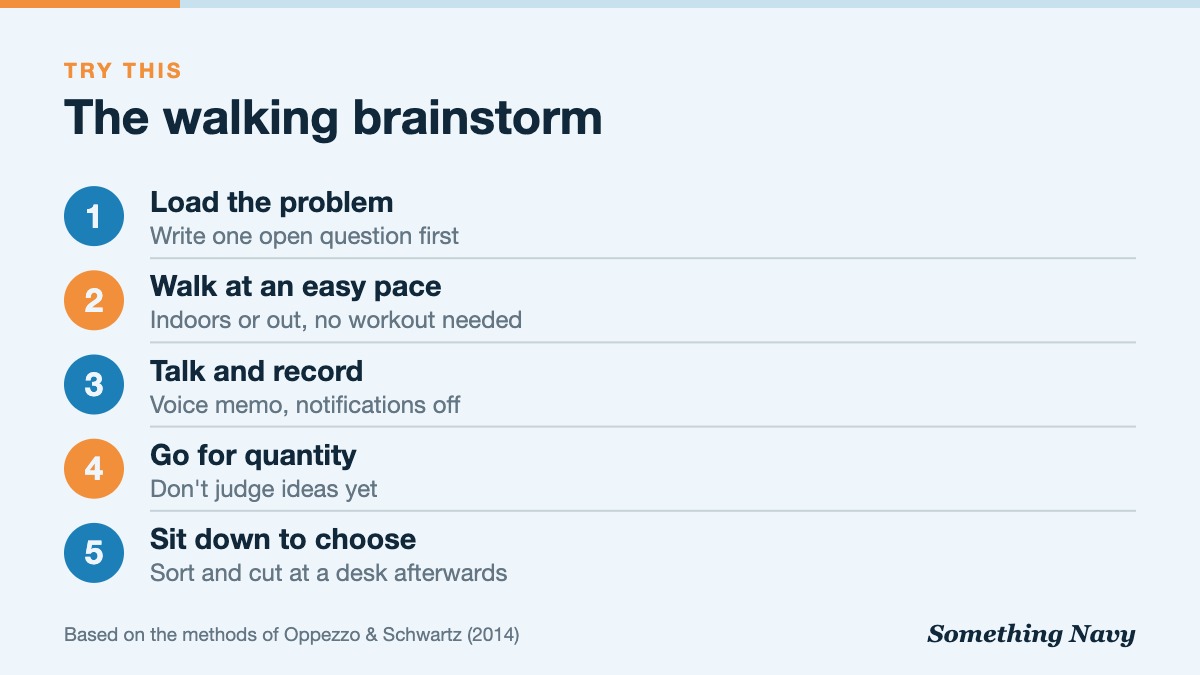
The walking brainstorm: a five-step routine
Here is a way to borrow the method, built from what the experiments actually did.
1. Load the problem before you go
Write one open question on your phone or a card: “What could we call this?” or “Ten ways to fix the Monday rush.” Open questions suit walking; yes-or-no ones do not.
2. Walk at your own easy pace
The Stanford volunteers chose a comfortable speed. This is not a workout. A corridor, a block or a treadmill will do, since the indoor walkers did as well as the outdoor ones.
3. Say ideas out loud and record them
Participants spoke their answers and were recorded. Use a voice memo, or walk with a colleague who jots things down. Keep notifications off so the phone stays a recorder.
4. Go for quantity, not quality
Do not judge as you go. Walking seems to loosen the internal editor, so let it. Silly ideas often sit next to good ones.
5. Sit down and choose
Back at a desk, sort, combine and cut. The residual effect means you will still be in a generous frame of mind for a while, but sitting is where the convergent, choosing part of the job happens best.
Let your feet do the first draft
It is reassuring, in a way, that the fix is so ordinary. No app, no retreat, no special view. Just the decision to stand up when you are stuck.
Darwin needed a loop of gravel and a pile of flints. You probably have a staircase, a pavement or a corridor. The ideas were never really hiding in the chair.
Next time the cursor blinks back at you, take the problem for a walk. Bring it home, sit down, and then decide which of its answers to keep.
Sources
- Atchley, R. A., Strayer, D. L., & Atchley, P. (2012). Creativity in the wild: Improving creative reasoning through immersion in natural settings. PLOS ONE, 7(12), e51474. DOI
- American Psychological Association. (2014, April 24). Taking a walk may lead to more creativity than sitting, study finds [Press release]. Link
- Clayton, R., Thomas, C., & Smothers, J. (2015, August 5). How to do walking meetings right. Harvard Business Review. Link
- English Heritage. (n.d.). 10 ways to experiment like Darwin. Link
- Nietzsche, F. (n.d.). The twilight of the idols (A. M. Ludovici, Trans.). Project Gutenberg. (Original work published 1889). Link
- Oppezzo, M., & Schwartz, D. L. (2014). Give your ideas some legs: The positive effect of walking on creative thinking. Journal of Experimental Psychology: Learning, Memory, and Cognition, 40(4), 1142–1152. DOI
Cover photo: Olenka V on Unsplash. Charts and graphics: Something Navy.
How we reported this. We went back to the original research for this story, 6 sources in all, listed above, and checked every figure against them. If you think we have got something wrong, tell us and we will look at it. Read more about how we work.