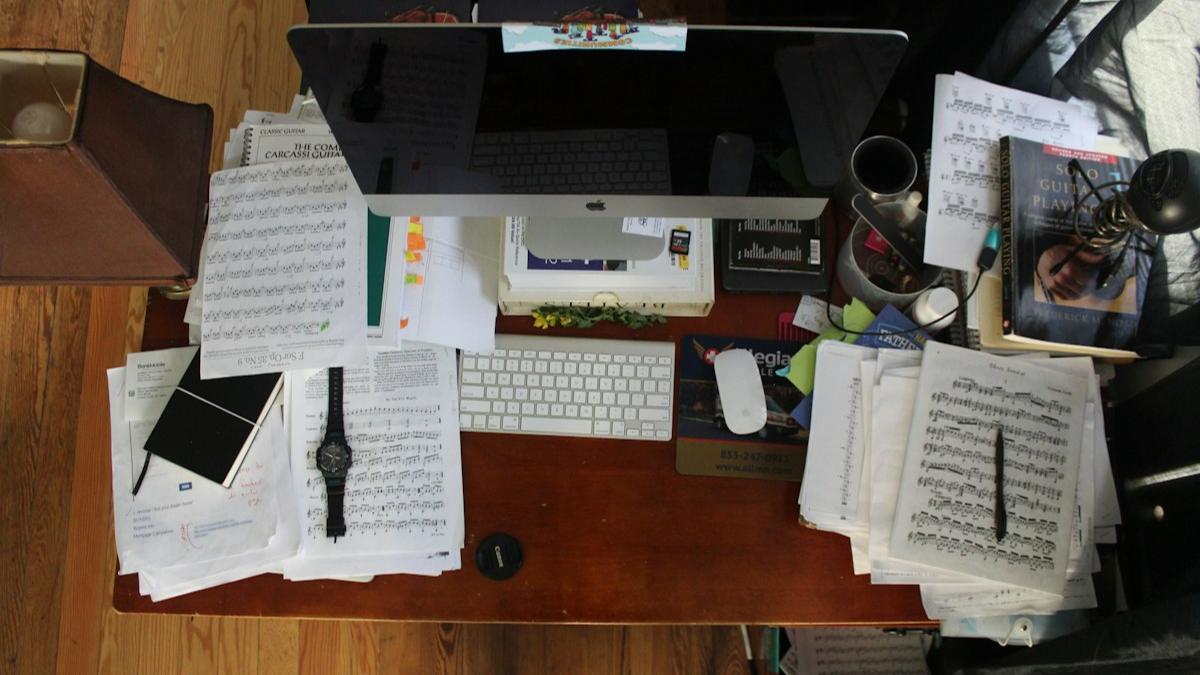
Every office has one. The desk buried under coffee cups, printouts and sticky notes, whose owner insists, with a slightly defensive smile, that they know exactly where everything is. And sooner or later, someone will defend them with a line attributed to Albert Einstein: if a cluttered desk is a sign of a cluttered mind, of what, then, is an empty desk a sign?
For a few years, it looked as though psychology had come down firmly on the side of the messy. A well-publicised study suggested that disorder could make people more creative, while tidiness nudged them towards convention. It was the kind of finding that spreads quickly, because it tells almost everyone something flattering about themselves. Then other scientists tried to repeat it. This is the case file.
The claim
The idea is simple and appealing. A messy environment, the argument goes, signals freedom from rules and convention, which helps people think in unconventional ways. A tidy one signals order and tradition, which encourages people to play it safe and do what is expected. Neither is better. They are simply suited to different kinds of thinking.
It is a neat story, and it fits a popular image of the creative genius surrounded by chaos. But a neat story is not evidence. The question is what the experiments actually showed.
Exhibit A: the 2013 experiments
The study at the centre of the debate was published in 2013 in Psychological Science by Kathleen Vohs, Joseph Redden and Ryan Rahinel of the University of Minnesota. Its title laid out the claim in full: physical order produces healthy choices, generosity and conventionality, whereas disorder produces creativity.
The researchers set up two versions of the same room. In the tidy version, papers were neatly stacked and everything was in its place. In the messy version, papers and office supplies were strewn about. Participants were randomly assigned to one room or the other and then given a series of tasks.
In the tidy room, people were more likely to donate to charity and more likely to choose an apple rather than a chocolate bar as a snack. They also preferred a menu option described as “classic”. In the messy room, people came up with ideas for new uses for ping-pong balls that independent judges rated as more creative, and they were drawn to an option labelled “new”.
Vohs explained the findings in a New York Times opinion piece titled “It’s Not ‘Mess.’ It’s Creativity.” In it she wrote that people “greatly preferred convention in the tidy room and novelty in the messy room”. Headlines around the world did the rest.
It is worth pausing on what these tasks actually measured. The “unusual uses” test, in which people list as many creative uses for an everyday object as they can, is a standard way of measuring what psychologists call divergent thinking: the ability to generate many different ideas. It is a useful laboratory measure, but it is not the same as writing a novel, solving a hard problem at work or designing a building. Even if a messy room did nudge people’s scores on such a task, the leap from there to “messy people are more creative” in everyday life is a big one. The same caution applies to choices like picking an apple over a chocolate bar. These are small, momentary decisions made in an unfamiliar setting, and they may not tell us much about how people behave at home or at work over months and years.
Exhibit B: the replication
Five years later, a team led by Alberto Manzi at Mercy College in New York put the idea to a more demanding test. Their paper, published in Frontiers in Psychology in January 2019, had a blunt title: “Workspace Disorder Does Not Influence Creativity and Executive Functions”.
They recruited 114 people and analysed 100 of them, around 50 in each condition, which the authors noted was roughly twice the size of the original groups. As before, people were randomly assigned to work in a tidy or a messy space. They then completed tasks measuring creativity, including generating unusual uses for everyday objects, and standard tests of executive functions, the mental skills involved in planning, focus and self-control.
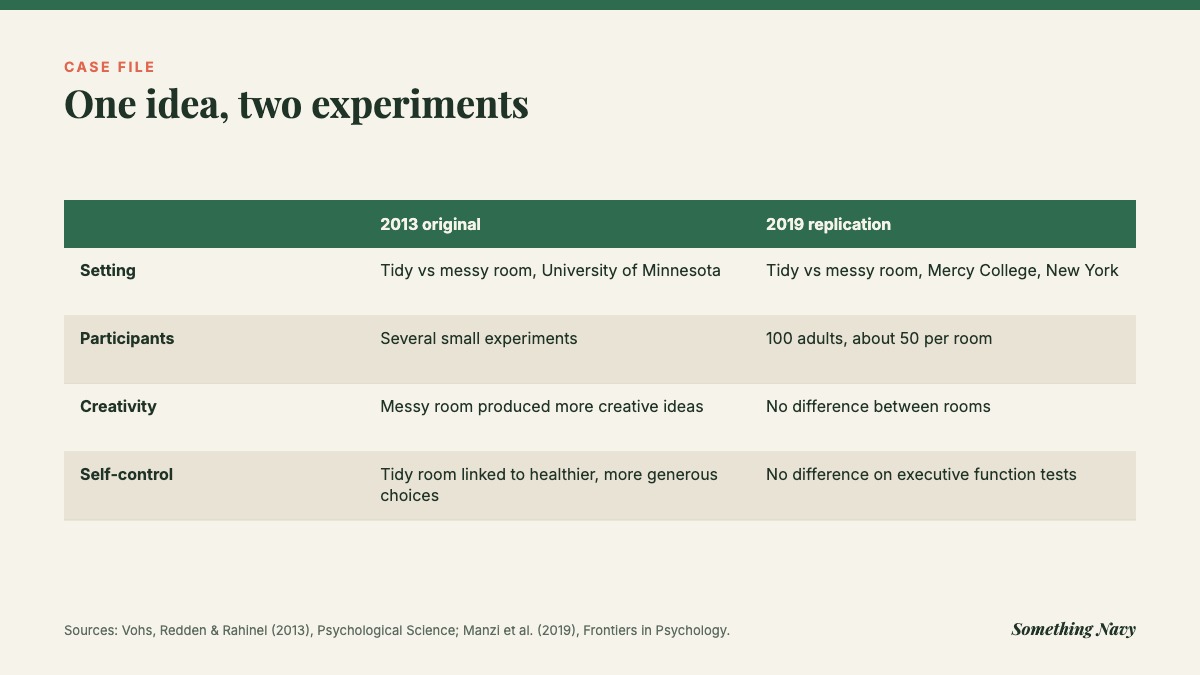
The results were flat. On the overall creativity measure, the tidy and messy groups scored almost identically. There was no meaningful difference on the executive function tests either. The authors concluded that the effect of working at a disorderly desk for a short time, if it exists at all, is small and unreliable, and does not justify the sensational claims made about it in the popular press.
One replication does not prove that an original study was wrong. The tasks were not identical, and there could be conditions under which a messy room does affect thinking. But it is a strong signal that the effect, if real, is much weaker than the headlines suggested.


How can a study find something that is not there?
It is natural to wonder how a careful experiment, published in a leading journal, can report an effect that a later study fails to find. The answer usually has nothing to do with dishonesty. It has to do with the ordinary randomness that runs through all research involving people.
Imagine you divide a few dozen people into two groups at random and give them a creativity test. Even if the room they sit in makes no difference at all, the two groups will almost never score exactly the same. One group will happen to contain a few more inventive people, or people who slept better the night before. With small groups, these chance differences can be surprisingly large, large enough to look like a real effect.
Scientists use statistics to estimate how likely it is that a difference is just chance, but those tools are not perfect. If many studies are run, some will produce striking results by luck alone. And because journals, and the media, have historically been far more interested in surprising positive findings than in studies that find nothing, those lucky results are the ones most likely to be published and shared.
Larger studies are much less vulnerable to this problem. With around 50 people in each group, the Manzi replication was better placed to detect a real effect if there was one, and better protected against being fooled by chance. That is why a single large replication can carry more weight than a smaller original.
The bigger picture: a field checking its own work
The messy-desk story did not happen in isolation. Around the same time, psychology was going through what became known as its replication crisis. In 2015, a large collaboration of researchers published an attempt to repeat 100 studies from leading psychology journals, in the journal Science. While 97% of the original studies had reported significant results, only 36% of the replications did. On average, the effects found in the replications were about half the size of the originals.
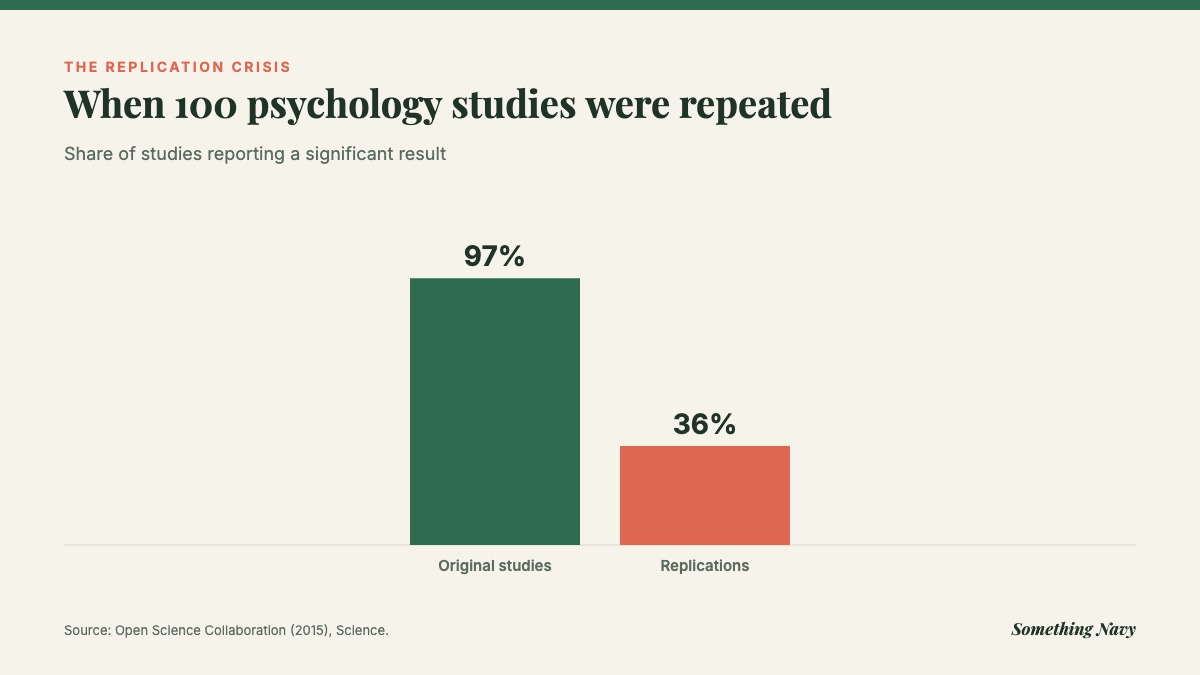
That does not mean psychology is broken, or that every surprising finding is false. It means that single studies, especially small ones with eye-catching results, are a starting point rather than a conclusion. Since then, many researchers have adopted stricter methods, such as registering their plans before collecting data and using larger samples.
A single surprising study is a reason to look harder, not a reason to rearrange your office.
What other research says about rooms and thinking
Messy desks are not the only environmental feature researchers have linked to the way we think. A handful of other studies, all published in the Journal of Consumer Research, have explored similar ideas. They are interesting, but like the messy-desk study, they are best treated as findings to be confirmed rather than rules to live by.
| Feature | What the study found | Study |
|---|---|---|
| Background noise | Moderate noise, around 70 decibels, improved performance on creative tasks compared with quieter (50 dB) or louder (85 dB) conditions. | Mehta, Zhu and Cheema, 2012 |
| Ceiling height | Higher ceilings were linked to more abstract, big-picture thinking; lower ceilings to more detail-focused thinking. | Meyers-Levy and Zhu, 2007 |
| Disorder | Disorderly surroundings appeared to threaten people’s sense of control and weaken self-regulation across four studies. | Chae and Zhu, 2014 |
Notice that the disorder study points in a different direction from the original messy-desk research. Where Vohs and colleagues linked mess to creativity, Boyoun Chae and Rui Zhu linked it to poorer self-control. Taken together, the picture is not “mess is good” or “mess is bad”. It is that the effects of our surroundings are probably subtle, variable and easy to overstate.
And that Einstein quote?
Even the famous line used to defend messy desks does not survive close inspection. According to Quote Investigator, there is no evidence that Einstein ever said it. The quote is absent from authoritative collections of his words, and the link to Einstein appears only in recent decades. Versions of the joke were circulating in American newspapers in the 1950s, credited to other people entirely. A much older line, from 1911, made the opposite point: a disordered desk was taken as evidence of a disordered brain.
Einstein may well have had a messy desk. Plenty of brilliant people do, and plenty of brilliant people are meticulously tidy. The anecdote tells us about individuals, not about whether mess causes good ideas.
Why this particular idea spread so fast
Some findings are almost designed to go viral, and the messy-desk study was one of them. It offered something for everyone. People with messy desks learned that they were secretly creative. People with tidy desks learned that they were generous and healthy. Nobody had to change anything, and everybody came away feeling good.
Stories like this also fit a cultural image we already hold, of the chaotic genius whose brilliance spills out on to every surface. When a study appears to confirm something we already suspected, we tend to scrutinise it less. That is not a criticism of readers. It is a description of how all of us process information.
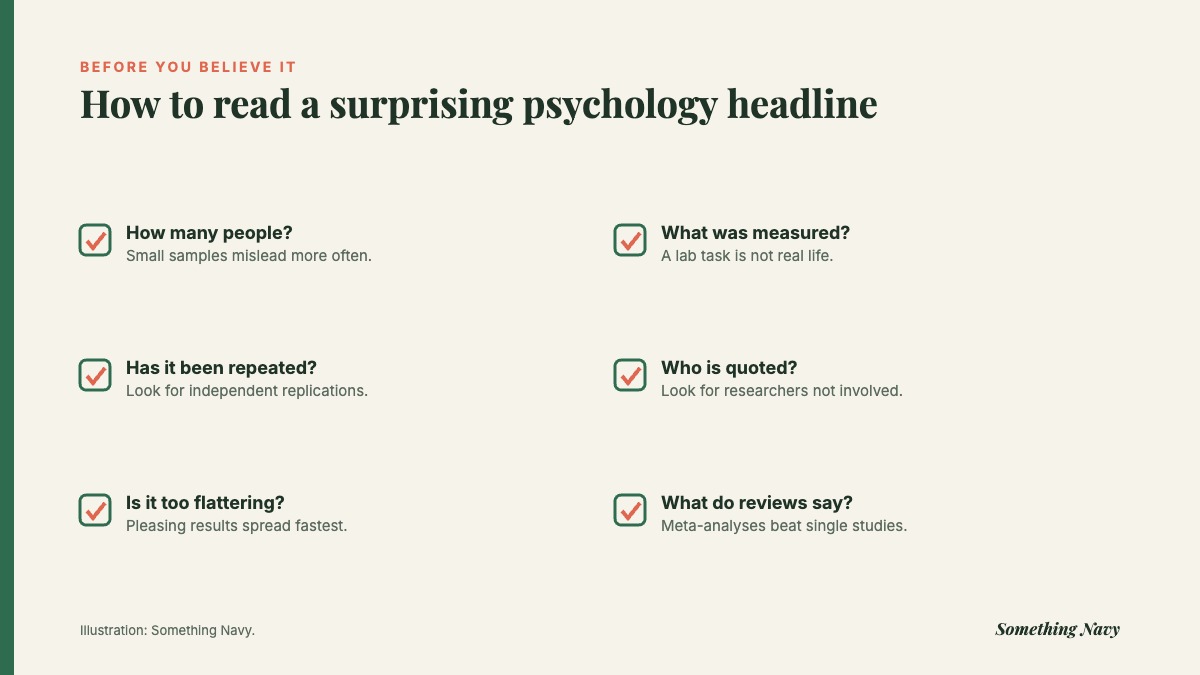
The lesson is not to distrust every psychology headline. Many findings are robust and have been replicated many times. It is to notice when a result is unusually flattering, unusually neat or based on a single study, and to hold it a little more loosely until more evidence comes in.
Home is a different question
The studies discussed here were about short spells in a messy or tidy room. They tell us little about what it is like to live with clutter day after day. That is a separate question, and research on it, which looks at stress, mood and how people feel about their homes, is more mixed and more personal. A pile of papers on a work desk for an afternoon is not the same as a home that feels chaotic every time you walk through the door.
If clutter at home bothers you, that feeling is worth taking seriously regardless of what any creativity study says. And if it does not, you can stop feeling guilty about it. The science does not demand that you tidy up in order to think clearly, and it does not give you permission to stop tidying in the name of genius either.
The verdict
On the current evidence, the claim that a messy workspace makes you more creative is not supported. The original study was intriguing and carefully presented, but a larger replication found no effect, and research on surroundings more broadly suggests that any influence is modest and inconsistent.
That leaves a more useful question than “messy or tidy?” It is “what helps you work well?” Some people genuinely think better surrounded by notes, books and half-finished sketches. Others find clutter distracting or stressful. The research does not settle which group you belong to. Your own experience is a better guide.
- Notice how you feel. If clutter makes it harder to start work, a five-minute clear-up may help more than any study.
- Match the space to the task. Spreading materials out can help early, exploratory work. Detailed checking often benefits from a clear surface.
- Be suspicious of flattering findings. Results that tell us our existing habits are secretly a strength spread fast. That is exactly why they deserve a second look.
- Look for the replication. Before changing your behaviour because of a study, check whether anyone has repeated it.
If you are interested in other famous findings that have been put to the test, our piece on enclothed cognition asks whether what you wear changes how you think, and our article on the doorway effect looks at a memory finding that turned out to be more limited than first thought.
Sources
- Vohs, K. D., Redden, J. P., & Rahinel, R. (2013). Physical order produces healthy choices, generosity, and conventionality, whereas disorder produces creativity. Psychological Science, 24(9), 1860–1867. DOI
- Vohs, K. D. (2013, September 13). It’s not ‘mess.’ It’s creativity. The New York Times. PDF
- Manzi, A., Durmysheva, Y., Pinegar, S. K., Rogers, A., & Ramos, J. (2019). Workspace disorder does not influence creativity and executive functions. Frontiers in Psychology, 9, 2662. DOI
- Open Science Collaboration (2015). Estimating the reproducibility of psychological science. Science, 349(6251). DOI
- Mehta, R., Zhu, R., & Cheema, A. (2012). Is noise always bad? Exploring the effects of ambient noise on creative cognition. Journal of Consumer Research, 39(4), 784–799. DOI
- Meyers-Levy, J., & Zhu, R. (2007). The influence of ceiling height: The effect of priming on the type of processing that people use. Journal of Consumer Research, 34(2), 174–186. DOI
- Chae, B., & Zhu, R. (2014). Environmental disorder leads to self-regulatory failure. Journal of Consumer Research, 40(6), 1203–1218. DOI
- Quote Investigator (2017). If a cluttered desk is a sign of a cluttered mind. Quote Investigator
Cover photo: Jesus Hilario H. on Unsplash. Charts and graphics: Something Navy.