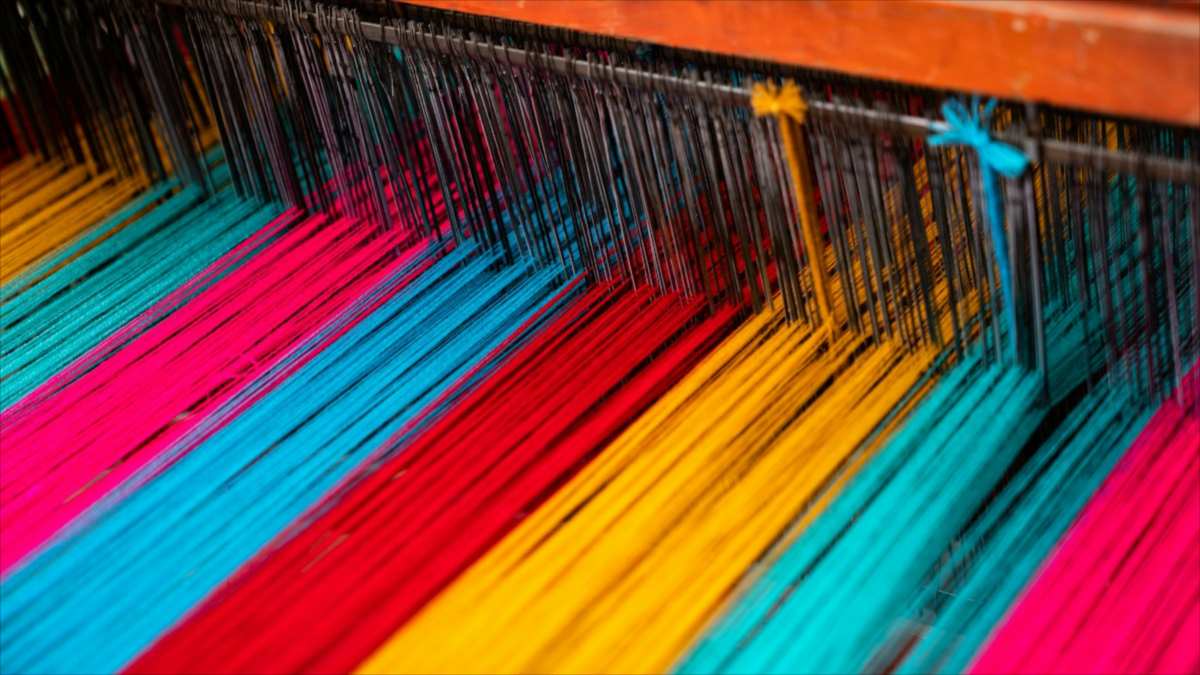
Run your thumb across a Harris Tweed jacket and it pushes back. The cloth is springy and slightly coarse, and if you look closely the brown is not brown at all but flecks of moss, rust and heather packed together.
Now picture a second jacket, cut the same way from a tweed that looks almost identical, at two-thirds of the price. Most of us still feel the pull of the first one. We tell ourselves it is about quality. Often, it is about something stranger.
Psychologists have a name for it. We treat objects as if they carry an invisible trace of where they have been and who has touched them. That instinct, called contagion, helps explain why a handful of traditional fabrics are not just surviving but finding new buyers in their second or third century.
It also explains why the fabrics that thrive tend to be the ones whose origin is protected by law.
The jeans experiment that explains your heritage habit
In 2014, George Newman and Ravi Dhar of the Yale School of Management published a series of experiments in the Journal of Marketing Research. They showed people products such as Levi’s jeans, gourmet chocolates and luxury bags, and changed one detail: where each item had been made.
Some versions came from the brand’s original factory. Others came from a newer factory in the same city, or from a factory abroad. According to Yale’s summary of the work, participants were willing to pay significantly more for the original-factory versions and saw them as carrying more of the brand’s essence.
What the study did
- Participants rated identical products that differed only in where they were made: the original factory, a newer local factory or one overseas.
- They said they would pay more for the original-factory items and judged them more authentic.
- People who scored higher on sensitivity to contagion showed a stronger preference.
- Reading a short story about contagion (laughter or poison ivy spreading) made the preference stronger still.
The key twist is that the effect did not seem to run through beliefs about better craftsmanship. It tracked how strongly people felt that “essence” rubs off. That is the same magical thinking that makes a borrowed jumper from someone you love feel warmer than it should.
A caveat worth keeping: these were mostly hypothetical choices in experiments, not tills ringing in shops. But they fit what heritage fabrics have long known instinctively. The story is part of the product.
We are not paying for the thread. We are paying for the hands and the place it passed through.
If you want the craft side of this, why handmade objects feel different to own, our earlier piece on the revival of heritage and handcrafted styles goes deeper. Here, we take a tour of five fabrics where origin is not just a story but something people have fought to protect.
Harris Tweed: an island, an Act of Parliament and a small orb
It smells faintly of wool and weather, and the label inside is a tiny globe topped with a cross. That orb is one of the oldest textile guarantees in the world. According to the cloth’s documented history, the Orb trade mark was granted in 1909 after years of argument among island producers and merchants.
In 1993 the protection went further. The Harris Tweed Act 1993 defines Harris Tweed as cloth “handwoven by the islanders at their homes in the Outer Hebrides”, finished there and made from pure virgin wool dyed and spun there too. Every stage is tied to one archipelago off Scotland’s north-west coast.
That law matters because the industry has been close to the edge. Production peaked at 7.6 million yards in 1966. By 2009, it had fallen to around 450,000 metres.
Today the picture is livelier. AFP reporting carried by FashionUnited in May 2025 put output at more than 580,000 metres in 2024, woven by about 140 weavers, according to the Harris Tweed Authority. The Authority launched a recruitment drive in 2023 as older weavers retired, and the same report describes a former banker who took up the loom in his mid-thirties.
Luxury houses and trainer brands buy the cloth, and the mills now spin brighter custom colours alongside the classic checks. The fabric changed. The place did not.
Khadi: the cloth with a political spine
Khadi feels alive in the hand, a little uneven, with slubs you can see when you hold it to the light. Those irregularities are the signature of yarn spun by hand rather than by machine.
In India, that is not just a description. Under the Khadi and Village Industries Commission (KVIC) Act of 1956, khadi means cloth woven on handlooms in India from yarn that has also been hand-spun in India. Since 2013, Khadi Mark regulations have required goods sold as khadi to carry official KVIC tags and labels, so the word itself works like a protected origin.
Khadi has always been a story fabric. It was the cloth of the independence movement, a way of wearing your politics. That history is exactly the kind of “essence” Newman and Dhar describe, and it appears to sell.
Figures reported by the Tribune in April 2025 show khadi production rising from ₹811 crore in 2013–14 to ₹3,783 crore in 2024–25. Sales of khadi garments grew from ₹1,081 crore to ₹7,146 crore over the same period. KVIC counts about 5 lakh (500,000) khadi artisans, roughly 80% of them women.
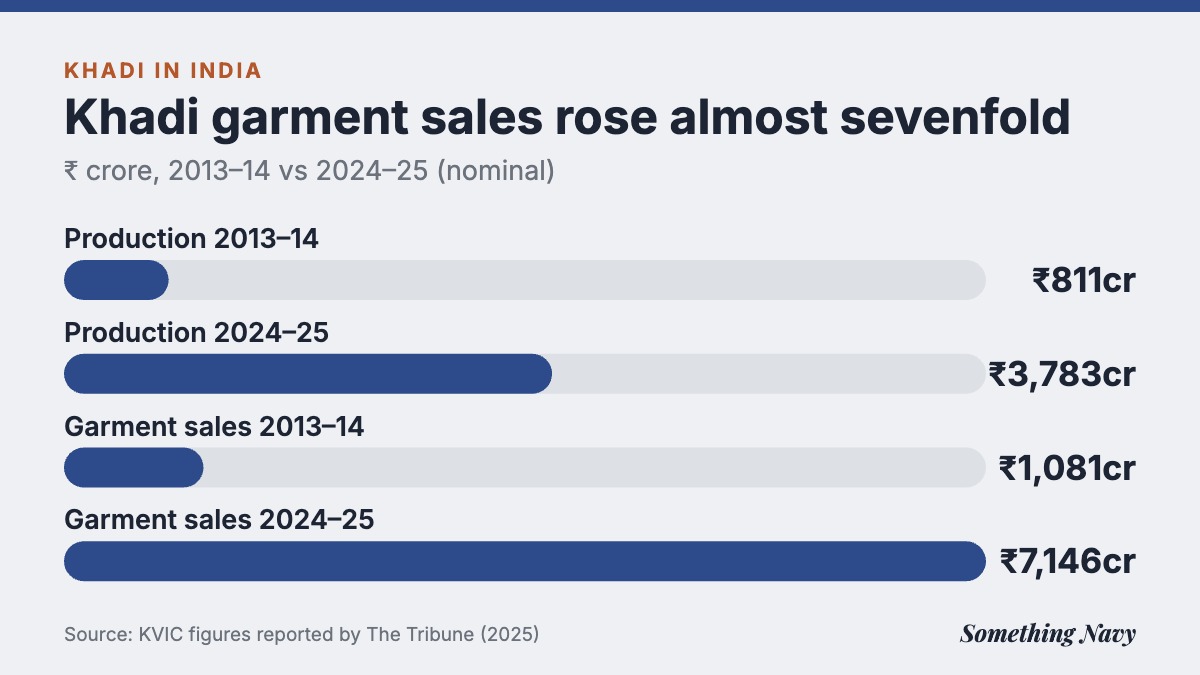
These are official figures, not independent audits, and they are in nominal rupees, so some of the growth is inflation. Even so, a sevenfold rise in garment sales over 11 years is hard to explain without a shift in how buyers see the cloth.
Awa indigo: a blue that takes a year to make
Real indigo has a smell when it is fresh from the vat, earthy and slightly sour, and the cloth comes out green before the air turns it blue. In Tokushima, on the Japanese island of Shikoku, that blue starts as leaves rather than powder.
According to the Tokushima Prefecture, indigo leaves are dried and fermented into a dye called sukumo, a process that takes almost a year, with around 100 days of fermentation. Sukumo from Tokushima is known as Awa indigo, and the prefecture produces most of Japan’s supply.
At its height in 1903, indigo covered about 15,000 hectares of Tokushima. Then cheaper Indian indigo and synthetic dye from Europe arrived, and the trade collapsed. A British chemist, R.W. Atkinson, had already visited in the 1870s and called the colour that saturated Japanese streets “Japan Blue”. The nickname outlived the fields.
The same blue runs through Japan’s mending traditions. Sashiko is a running-stitch technique used to strengthen cloth, and boro describes garments patched and re-patched over years. Both have been embraced by people who want clothes that show their history rather than hide it.
A synthetic indigo shirt can look identical. What you cannot copy is a year of fermentation in a particular valley, and that is precisely what buyers say they want.
Kente: cloth that speaks in proverbs
Kente catches the light because it is often woven with silk or rayon among the cotton, and the colour blocks feel almost architectural. Look at the edges and you can see that a large cloth is really many narrow strips sewn together.
In December 2024, UNESCO added the craftsmanship of kente from Ghana to its Representative List of the Intangible Cultural Heritage of Humanity. The listing describes strips woven on horizontal looms, and cloths named after proverbs, sayings and social situations. A wearer’s age, status and gender can shape the colours and designs chosen.
Each producing community is led by a chief weaver who sets standards and settles disputes. That is a form of origin protection, too, older than any trade mark.
UNESCO recognition is not a legal label you will find on a tag. It does something subtler: it tells the world that the knowledge belongs to particular communities. Printed “kente-style” fabric made elsewhere is a different object, however similar the pattern.
Ikat: the blur that comes from dyeing first
Ikat has a soft, feathered edge to every shape, as if the pattern were slightly out of focus. That blur is the honest fingerprint of the method: threads are bound and dyed before weaving, so the design is built into the yarn and shifts a little as it meets the loom.
Versions exist from Indonesia to India to Central Asia. In Uzbekistan, the city of Margilan has long been the heart of the ikat fabrics called atlas and adras. When Soviet-era upheaval put the old techniques at risk, local people set up the Margilan Crafts Development Centre in 2007 to train new makers and keep the knowledge alive.
In 2017, UNESCO selected that project for its Register of Good Safeguarding Practices, a list of programmes other countries can learn from. It is a reminder that revival is rarely spontaneous. Someone usually builds a school.
What protected origin actually protects
Put these five fabrics side by side and a pattern emerges. Each survives partly because a place, a law or a community has drawn a line around it and said: this is the real one.
| Fabric | Origin | Protection or mark | What to check when buying |
|---|---|---|---|
| Harris Tweed | Outer Hebrides, Scotland | Harris Tweed Act 1993; Orb trade mark | Orb label on the garment or cloth |
| Khadi | India | KVIC Act 1956; Khadi Mark (2013) | Official Khadi Mark tag; hand-spun and handwoven |
| Awa indigo | Tokushima, Japan | Regional tradition; no single legal mark | Maker named; “sukumo” or natural indigo stated |
| Kente | Ghana | UNESCO heritage listing (2024) | Woven strips, not a print; weaver or town named |
| Ikat (atlas, adras) | Margilan, Uzbekistan, and beyond | UNESCO safeguarding register (2017) | Blurred edges woven in, not printed on |
The contagion research suggests why these lines matter commercially. If buyers value a fabric partly for the “essence” of its source, then anything that guarantees the source protects the value. Remove the guarantee and the story can be borrowed by anyone with a printer.
An origin mark is a promise that the story is true.
There is a less romantic reading, too. Paying for authenticity can tip into paying for a label. The useful habit is to ask what the mark actually certifies: hand-spinning, a place, a technique, or simply a brand name.
How to buy a story that’s true
You do not need a textile degree. A few checks will separate most genuine pieces from the look-alikes.
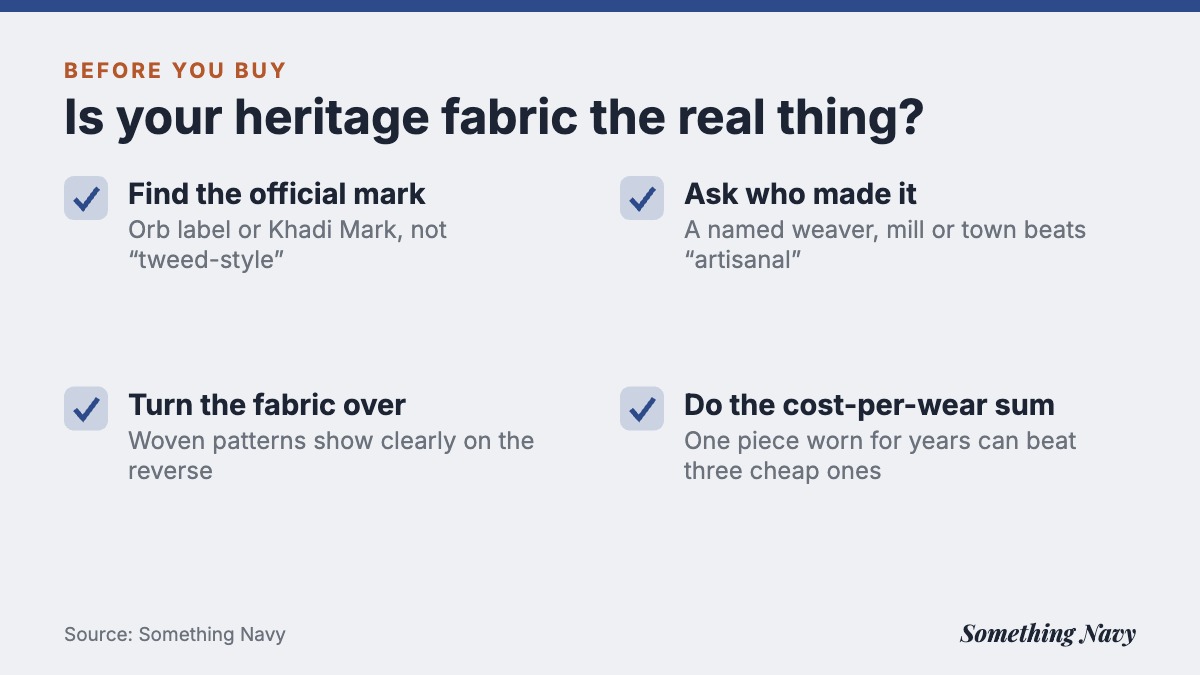
- Find the mark. The Orb and the Khadi Mark are specific, official labels. “Tweed-style” and “handloom look” are not.
- Turn it over. Woven patterns such as kente and ikat show on the reverse. Prints usually look faded or blank on the back.
- Ask who made it. A named weaver, mill or town is a good sign. Vague words like “artisanal” on their own prove nothing.
- Do the cost-per-wear sum. A heritage jacket worn for a decade can beat three cheap ones, which is the logic behind buying fewer, better basics.
If you are building a smaller wardrobe, one genuine piece of traditional cloth can anchor it for years. Our guide to building a capsule wardrobe shows where a statement fabric fits. And if what draws you is the wider question of who gets paid, our piece on ethical and fair-trade fashion picks up that thread.
The essence is real, in one sense
It is tempting to dismiss contagion as a quirk, a little superstition we carry into the shop. But for these fabrics, the belief does real work.
When enough people pay a little more for cloth from the Outer Hebrides, a weaver in his thirties can afford to leave the bank. When khadi carries a protected mark, a spinner’s hours are not undercut by a mill that borrows the name. When UNESCO names kente’s chief weavers, the knowledge has an address.
The essence you feel in your hands may be in your head. The livelihoods it supports are not.
Sources
- Newman, G. E., & Dhar, R. (2014). Authenticity is contagious: Brand essence and the original source of production. Journal of Marketing Research, 51(3), 371–386. DOI
- Harris Tweed Act 1993, c. xi. UK Parliament. Link
- FashionUnited / AFP. (2025, May 28). From banker to weaver: A Scottish island Harris Tweed industry experiences a renaissance. Link
- The Tribune. (2025, April). KVIC records Rs 1.7 lakh crore turnover in 2024-25. Link
- Tokushima Prefecture. (n.d.). Awa ai (Awa indigo). Link
- UNESCO. (2024). Craftsmanship of traditional woven textile kente (Ghana). Representative List of the Intangible Cultural Heritage of Humanity. Link
- UNESCO. (2017). Margilan Crafts Development Centre, safeguarding of the atlas and adras making traditional technologies (Uzbekistan). Register of Good Safeguarding Practices. Link
Updated 17 October 2026: we rewrote this article with new research, current figures and sources. Cover photo: Sergio Gonzalez on Unsplash. Charts and graphics: Something Navy.
How we reported this. We went back to the original research for this story, 7 sources in all, listed above, and checked every figure against them. If you think we have got something wrong, tell us and we will look at it. Read more about how we work.