
It is 8.55am and you are standing at the wardrobe with a laptop already open on the bed. Joggers or proper trousers? Nobody on the video call will see your legs.
Still, something tells you the choice matters. Put on the jumper you wear to the office and you feel more like the person who answers emails promptly. Stay in the hoodie and the day feels softer around the edges.
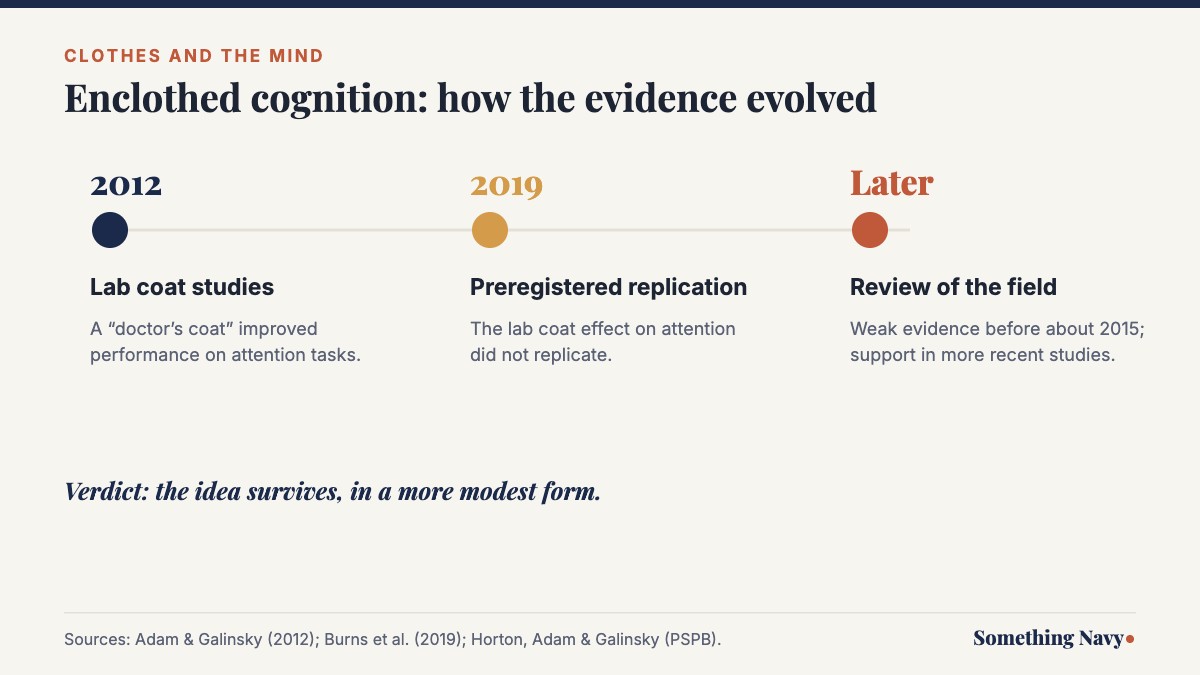
That hunch has a name. In 2012 two psychologists called it enclothed cognition: the idea that clothes change not only how others see us but how we think. The headline experiment, involving a white lab coat, travelled around the world.
Fourteen years on, the story is more interesting than the headline. The lab coat result did not hold up when it was repeated. Yet the wider idea has survived a hard look at the evidence, and the newest research suggests the most useful outfit for a home working day may not be the smart one.
A white coat, a colour test and a famous claim
Hajo Adam and Adam Galinsky, then at Northwestern University’s Kellogg School of Management, published their study in the Journal of Experimental Social Psychology in 2012. Their argument was simple: clothing works on the mind through two things together, what it symbolises and the physical fact of having it on.
In the first experiment, 58 undergraduates either wore a white lab coat or did not, then took a Stroop test, the classic task in which you name the ink colour of a word like “RED” printed in blue. People in the coat made roughly half as many errors on the tricky, mismatched trials.
The next two experiments added a twist. With 74 and then 99 students, the same white coat was described either as a doctor’s coat or as a painter’s coat. Those who believed they were wearing a doctor’s coat spotted more differences between near-identical pictures than the “painters”, and more than people who simply looked at a doctor’s coat or wrote about one.
Same garment, different story, different performance. That was the claim that made the study famous.
What the 2012 study actually did
- Three experiments with 58, 74 and 99 undergraduates.
- Wearing a lab coat versus no coat (study 1); a “doctor’s” versus “painter’s” coat (studies 2 and 3).
- Outcomes were attention tasks: Stroop errors and spot-the-difference searches.
- All three samples were small by today’s standards, and none involved real workplaces.
Then 200 students put the coat back on
By the late 2010s, psychology was counting the cost of its replication crisis. Celebrated small studies were being rerun with bigger samples and stricter rules, and many shrank or vanished. The power pose was one high-profile casualty.
Enclothed cognition got its test in 2019. Devin Burns and colleagues ran a preregistered direct replication of the Stroop experiment at four US universities, again in the Journal of Experimental Social Psychology. They recruited 200 undergraduates, split evenly between coat and no coat, and analysed 192 after exclusions.
The coat made no difference. Not to errors, not to reaction times. The team checked that their set-up was sensitive enough by detecting other, much subtler effects in the same data, and concluded that any lab coat effect on Stroop performance was too small for the original design to have picked up.
That is a real blow to the most quoted finding. It is not, on its own, a verdict on every study that followed.
The 40-study check-up
So who was right? In 2023 C. Blaine Horton, working with Hajo Adam and Adam Galinsky, published a large audit of the field online in Personality and Social Psychology Bulletin. It appeared in the journal’s print edition in February 2025, volume 51.
They gathered 105 effects from 40 studies in 24 articles, covering 3,789 participants in all, and ran two kinds of analysis. One was a standard meta-analysis. The other, called z-curve, looks at the pattern of results to estimate how many would likely replicate and whether the literature shows signs of selective publishing or statistical fishing.
The verdict split neatly in time. For studies published up to 2015, the analysis could not rule out an excess of false positives. For studies after 2015, it found no evidence of publication bias and estimated that most significant effects would be likely to replicate.
The British Psychological Society’s Research Digest summarised the effect as small to moderate and fairly consistent across types of clothing and outcomes. It also noted a weakness: the average study had 103 participants, while the authors suggested 150 or more would be better.
It is worth saying plainly that two of the three authors invented the concept. The method is designed to be hard to fool, but readers should weigh the result as a careful review by interested parties, not an independent ruling.
The fairest summary in 2026: clothes probably do nudge how we think and act. The nudge is modest. And the specific lab coat trick that made the idea famous is the part with the weakest support.
What a suit does at the negotiating table
Some of the most vivid evidence has nothing to do with lab coats. In 2014 Michael Kraus, then at the University of Illinois, and Wendy Berry Mendes at the University of California, San Francisco, asked 128 men aged 18 to 32 to negotiate the sale of a factory in pairs.
One man in each pair was randomly dressed in a business suit, in sweatpants and sandals, or in his own neutral clothes. His partner had no idea anything had been manipulated. The study appeared in the Journal of Experimental Psychology: General.
Suit-wearers walked away with average profits of $2.06m above the factory’s fair value of $20.5m. Men in sweatpants managed $0.68m. The gap in concessions was starker still: suit-wearers moved an average of $0.83m from their opening offer, against $1.58m for men in their own clothes and $2.81m for those in sweatpants, and the sweatpants group’s testosterone fell by about 20% during the task.
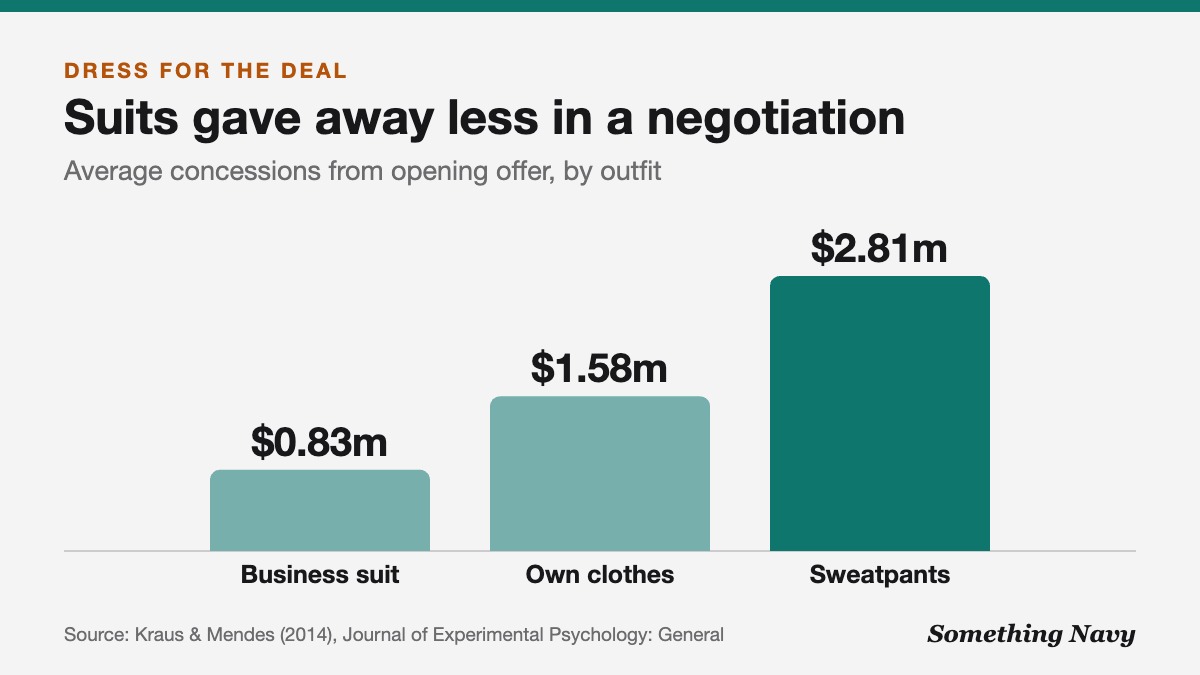
Two cautions. There were only about 20 pairs in each clothing condition, so the numbers are noisy. And the negotiation was a lab game with pretend millions, not a real deal. Still, it shows clothing working on both people at the table, the wearer and the person reading the outfit.
Formal clothes and the bird’s-eye view
A year later Michael Slepian, then at Columbia, and colleagues at California State University, Northridge, ran five studies on formal dress in Social Psychological and Personality Science.
Students who were more formally dressed than usual tended to describe actions in abstract terms, choosing “influencing the election” over “marking a ballot” as a description of voting. In a randomised study, 54 students brought a job interview outfit and a class outfit and changed into one. Those in formal clothes were quicker to see the big letter made of small letters than the small ones inside it, a sign of big-picture thinking.
In the final study, a sense of feeling powerful appeared to carry the link between formal clothing and abstract thinking. That fits a broader idea: we dress for a role, then think a little more like someone in it.


The work-from-home twist nobody expected
The pandemic turned millions of bedrooms into offices and gave researchers a natural experiment. One of the first data points came from Sydney in 2020. David Chapman and Cindy Thamrin surveyed 163 staff at five medical research institutes for the Medical Journal of Australia’s Christmas issue.
Among respondents who had worked in pyjamas during the day, 59% said their mental health had got worse while working from home, compared with 26% of those who did not. Pyjamas made no detectable difference to reported productivity.
The authors were clear that they could not tell which way the arrow pointed. Feeling low may make getting dressed harder, rather than pyjamas making people feel low. It was a small, self-selected survey, written partly in the spirit of the festive issue.
The stronger evidence came next. Erica Bailey, C. Blaine Horton and Adam Galinsky at Columbia ran two multi-day experiments with remote workers, published in Academy of Management Discoveries in 2022. Over several days, participants were randomly assigned to work in office clothes, home clothes, or a “Zoom mullet”: a work top with comfortable bottoms.
Home clothes made people feel more authentic and more engaged with their work. Office clothes did not reliably make them feel more powerful. The half-and-half mullet produced no benefit at all.
The researchers’ explanation is a match between outfit and setting. Clothes that fit the place you are in feel harmonious. Clothes that clash with it, like a blazer at the kitchen table, can feel like a costume.
The best outfit for thinking may not be the smartest one. It may be the one that matches where you are and who you are being.
Back in the office, it is about feeling good, not formal
What about people who do go in? A 2023 study in the Academy of Management Journal by Joseph Kim, Brian Holtz and Ryan Vogel followed employees from four organisations over 10 working days, alongside a set of experiments.
On days when people wore clothes they found attractive and a little distinctive, their self-esteem rose. That, in turn, went with more progress on their goals and less avoiding colleagues. Fitting the office dress code mattered too, but only on days with lots of contact with other people.
Put together with the remote work study, a pattern emerges. The helpful outfit is less about formality and more about feeling right: suited to the setting, and to you.
The evidence at a glance
| Study | Year | Sample | What it found | Replicated? |
|---|---|---|---|---|
| Adam & Galinsky | 2012 | 58, 74 and 99 students | Lab coat cut Stroop errors; “doctor’s” coat beat “painter’s” coat on attention | Stroop result: no (Burns, 2019) |
| Kraus & Mendes | 2014 | 128 men (64 pairs) | Suits: higher profits, fewer concessions | No direct replication we could find |
| Slepian et al. | 2015 | Five studies | Formal clothes linked to abstract, big-picture thinking | No direct replication we could find |
| Burns et al. | 2019 | 200 students, 4 universities | No lab coat effect on Stroop errors or speed | This was the replication |
| Chapman & Thamrin | 2020 | 163 research staff | Daytime pyjamas linked to worse mental health, not productivity | Survey only; cause unclear |
| Bailey, Horton & Galinsky | 2022 | Remote workers, two multi-day experiments | Home clothes raised authenticity and engagement; “Zoom mullet” did nothing | Not yet |
| Kim, Holtz & Vogel | 2023 | Employees at 4 organisations, 10 days | Attractive, distinctive outfits lifted self-esteem and goal progress | Not yet |
| Horton, Adam & Galinsky | 2023/2025 | 40 studies, 3,789 people | Post-2015 evidence holds up; effect small to moderate | Review of the field |
Getting dressed with the evidence in mind
None of this means a new outfit will raise your IQ. It means clothes are one of the cheaper levers you have over your mood and focus, and that they work best when they mean something to you. A few ideas worth trying:
- Match the outfit to the setting. Working from home, choose comfortable clothes you would not mind being seen in, rather than a half-smart “Zoom mullet”. The 2022 experiments found the mismatch helped nobody.
- Keep a clear start and finish. Changing out of sleepwear before work, and into something else afterwards, gives the day edges. The evidence here is indirect, but it costs nothing.
- Dress up for big-picture days. If you are planning, pitching or negotiating, the formality studies hint that a sharper outfit may help you think about the whole board. Treat it as a small edge, not a strategy.
- Choose clothes that feel like you. In the 2023 office study, attractiveness and a touch of uniqueness did more for self-esteem than simply following the dress code.
- Make the good choice the easy one. A small set of pieces you like, as in a capsule wardrobe, removes the 8.55am dilemma. Well-cut tailored basics also tend to work both at home and in the office.
And if you worry that colleagues will judge last week’s jumper, remember the spotlight effect: other people notice far less about our appearance than we assume. The audience for your clothes that matters most may be you.
The meaning lives in you, not the label
The most durable part of the 2012 idea is not the lab coat. It is the second half of the theory: that a garment works through what it means to the person wearing it.
A white coat only helped when people believed it belonged to a doctor. A suit mattered because everyone at the table read it as wealth. A hoodie at home helped because it fitted the room.
So the question at the wardrobe is not really “smart or casual?” It is closer to “who do I need to be today, and what does that person wear?”
Frequently asked questions
The broad idea has reasonable support. A review of 40 studies found that research published after 2015 holds up, with small to moderate effects, though the original lab coat result did not replicate.
Probably not in any way you would notice. A 2019 replication with 200 students across four universities found no effect of a lab coat on attention errors or speed.
Getting out of sleepwear is a sensible ritual, but you do not need office clothes. In 2022 experiments, remote workers felt more engaged in home clothes than in work clothes.
There is no good evidence that price matters. The studies point to meaning and fit with the situation, and to clothes that make you feel attractive and like yourself.
Sources
- Adam, H., & Galinsky, A. D. (2012). Enclothed cognition. Journal of Experimental Social Psychology, 48(4), 918–925. DOI
- Burns, D. M., Fox, E. L., Greenstein, M., Olbricht, G. R., & Montgomery, D. (2019). An old task in new clothes: A preregistered direct replication attempt of enclothed cognition effects on Stroop performance. Journal of Experimental Social Psychology, 83, 150–156. DOI
- Horton, C. B., Adam, H., & Galinsky, A. D. (2025). Evaluating the evidence for enclothed cognition: Z-curve and meta-analyses. Personality and Social Psychology Bulletin, 51(2), 203–221 (online 2023). DOI
- Kraus, M. W., & Mendes, W. B. (2014). Sartorial symbols of social class elicit class-consistent behavioral and physiological responses: A dyadic approach. Journal of Experimental Psychology: General, 143(6), 2330–2340. DOI
- Slepian, M. L., Ferber, S. N., Gold, J. M., & Rutchick, A. M. (2015). The cognitive consequences of formal clothing. Social Psychological and Personality Science, 6, 661–668. DOI
- Chapman, D. G., & Thamrin, C. (2020). Scientists in pyjamas: Characterising the working arrangements and productivity of Australian medical researchers during the COVID-19 pandemic. Medical Journal of Australia, 213(11). DOI
- Bailey, E. R., Horton, C. B., & Galinsky, A. D. (2022). Enclothed harmony or enclothed dissonance? The effect of attire on the authenticity, power, and engagement of remote workers. Academy of Management Discoveries. DOI
- Kim, J. K., Holtz, B. C., & Vogel, R. M. (2023). Wearing your worth at work: The consequences of employees’ daily clothing choices. Academy of Management Journal, 1411–1437. DOI
- Young, E. (2023, August 25). Enclothed cognition brushes up well. Research Digest, British Psychological Society. Link
Updated 18 October 2026: we expanded this article with newer research, fresh figures and new sections. Cover photo: Erinada Valpurgieva on Unsplash. Charts and graphics: Something Navy.
How we reported this. We went back to the original research for this story, 9 sources in all, listed above, and checked every figure against them. If you think we have got something wrong, tell us and we will look at it. Read more about how we work.