You mention, half-joking, that you might finally sign up for the Spanish class. Your partner doesn’t laugh. They ask which night it runs and say you’d be good at it.
Three months later you are ordering coffee in Seville without rehearsing the sentence in your head first.
It is easy to file that under willpower. But a body of research that began in the late 1990s suggests something stranger: some of the change in who you become was quietly done to you, by the person sitting across the kitchen table. Psychologists call it the Michelangelo phenomenon, and it works in both directions.
Four figures stuck in the marble
In the Galleria dell’Accademia in Florence, most visitors walk briskly down a long hall towards Michelangelo’s David. They pass four unfinished figures on the way, two on each side, carved for the tomb of Pope Julius II and then abandoned. As Smarthistory describes them, the bodies seem to be emerging from rough blocks of stone, the chisel marks still visible.
They are often called the Prisoners. A shoulder is free. A face is half there. The rest is still rock.
That image sits at the heart of a theory developed by the social psychologist Caryl Rusbult and her colleagues. Drawing on the art historian Ernst Gombrich, they described Michelangelo’s view of sculpture as an act of release: the artist does not invent the figure, he uncovers an ideal form already slumbering inside the stone. Their argument was that close partners do something similar to each other. Not with chisels, but with how they see us and how they treat us.
The 1999 study that named it
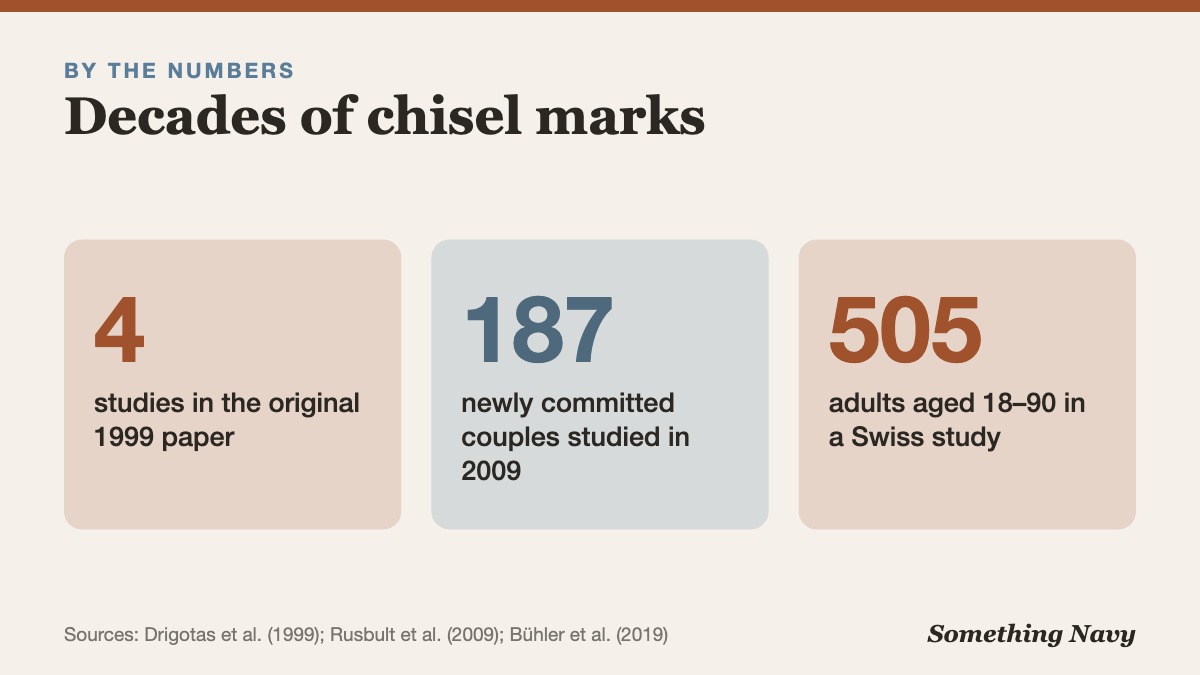
The idea was first tested at scale in a paper by Stephen Drigotas, Caryl Rusbult, Jennifer Wieselquist and Sarah Whitton, published in the Journal of Personality and Social Psychology in 1999. Across four studies, including dating couples, married couples and pairs of friends who rated each other’s relationships, they asked people about their “ideal self”: the skills, traits and goals they hoped to grow into.
They then measured two things. First, how much each partner affirmed the other’s ideal, in perception and in behaviour. Second, whether the person was actually moving towards that ideal over time.
The pattern held across the studies. When a partner saw you in ways that matched your ideal and behaved in ways that drew it out, you tended to move closer to it. And couples in which this happened were better off: better adjusted and more likely to stay together.
One detail stood out. In one analysis, participants rated 25 personal attributes. What predicted growth was not whether a trait was desirable in general, but whether it belonged to the person’s own ideal.
Being nice to someone is not the same as believing in the person they are trying to be.
How the chisel actually moves
In a 2009 review in Current Directions in Psychological Science, Rusbult, Eli Finkel of Northwestern University and Madoka Kumashiro of Goldsmiths, University of London, set out the mechanism in three steps.
It starts with perceptual affirmation. Your partner sees you as already partly the person you are aiming for, and reads the gap between who you are and who you want to be generously. A missed deadline becomes a bad week, not proof you are lazy.
Next comes behavioural affirmation. Because they see you that way, they act that way. They express confidence, react warmly to small progress, offer practical help, or simply create situations where the ideal version of you gets a chance to show up.
Then comes movement. Treated like someone who is sociable, or disciplined, or brave, you behave more like that person. Over time, the behaviour becomes part of you.
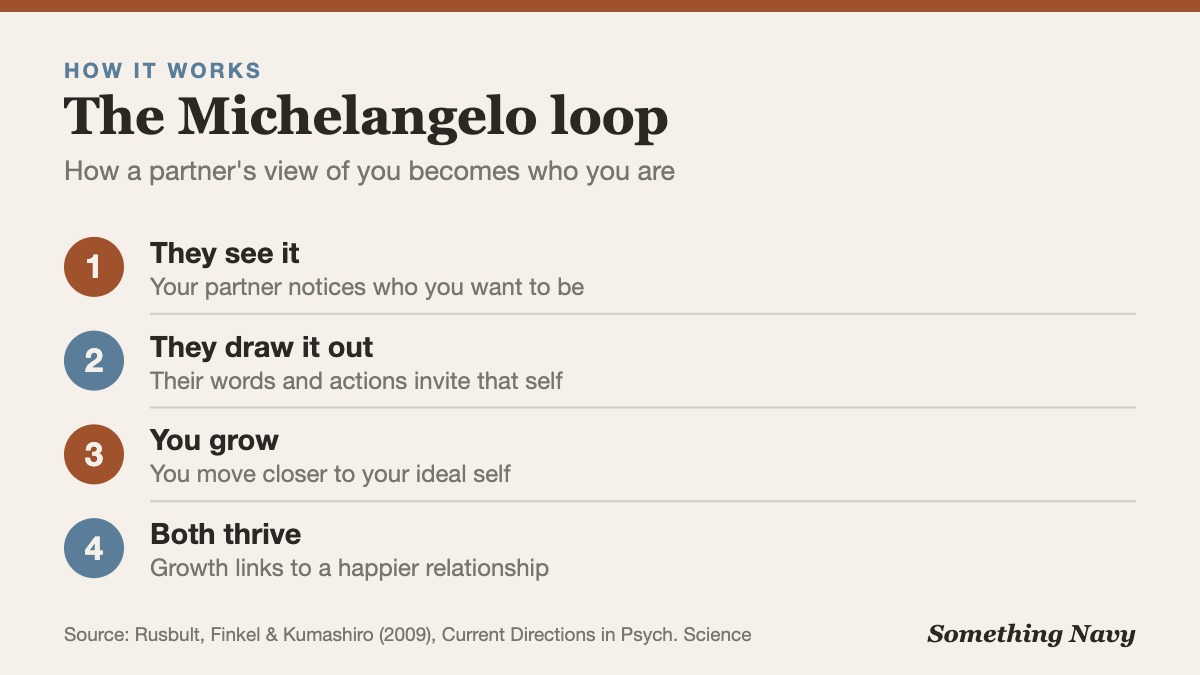
The payoff is not only personal. The review links moving towards your ideals with greater life satisfaction and psychological health, and links feeling sculpted by your partner with better couple functioning. Finkel, speaking to ScienceDaily when the review came out, put it plainly: “When our partners can chisel and polish us in a way that helps us to achieve our ideal self, that’s a wonderful thing.”


Tested on video, then checked months later
Self-reports can flatter. So the researchers also watched couples. In one study described in the 2009 review, married partners were videotaped discussing one partner’s goal, and trained coders rated how affirming the other partner was.
Four months later, the people whose partners had been rated as more affirming were more likely to have achieved the goal they had talked about.
A larger set of studies published the same year in the Journal of Personality and Social Psychology added a twist. Rusbult, Kumashiro, Kaska Kubacka and Finkel followed 187 newly committed couples and later 103 couples over six months, and ran an experiment with 160 students in Amsterdam. They found that people were especially well affirmed when their partner already resembled their ideal self.
If you want to become calmer, a calm partner models it, recognises it in you and makes it easier to practise. The experiment showed the same thing in miniature: students shown a prospective date who resembled their ideal felt more capable of reaching it.
Not everyone is equally easy to carve
Some marble is more forgiving than others. In a 2007 study in the Journal of Social and Personal Relationships, Kumashiro and colleagues followed newly committed couples in Chapel Hill, North Carolina, with many analyses based on 124 couples.
They compared two goal-pursuit styles. “Locomotors” like to get moving and get things done. “Assessors” prefer to evaluate, compare and critique. Locomotors were both easier to sculpt and better sculptors: they felt more affirmed, and their partners moved further towards their ideals. High assessors were less responsive to affirmation and gave less of it.
If you are the sort of person who weighs every option for a fortnight, a partner’s encouragement may simply have less to grip on. It is not that support fails. It is that you may need it in a more concrete, action-shaped form.
The sculptor who brings the wrong statue
Now for the uncomfortable part. A partner can also disaffirm you. The 2009 review lists the ways: indifference, pessimism, disapproval, or quietly undermining the goal. Every eye-roll at the half-finished novel is a small chip in the wrong direction.
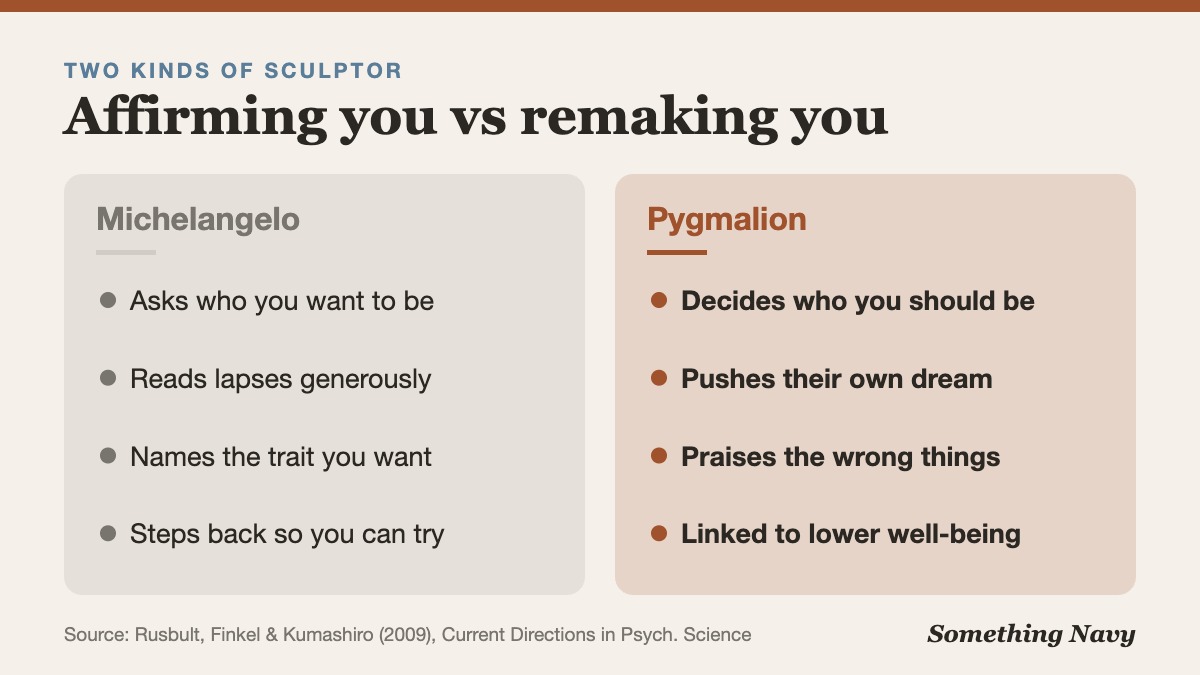
But the most interesting failure is subtler, because it comes from love. The researchers called it the Pygmalion phenomenon, after the sculptor of myth who carved his own ideal woman. Here the partner does affirm you, energetically, but towards their ideal self rather than yours.
They want you to be the marathon runner, the partner at the firm, the person who loves dinner parties. And according to the review, this kind of pushing is linked to worse personal and couple well-being. The authors’ verdict was blunt: “it is unwise to foist one’s own ideal-self representations onto others.”
Being nice to someone is not the same as believing in the person they are trying to be.
Even praise can miss. In the press coverage of the review, Finkel’s team gave the example of a leading researcher whose partner compliments her looks rather than her work. Pleasant, perhaps, but aimed at the wrong statue.
It doesn’t fade after the honeymoon
You might expect all this to matter most for young couples, still working out who they are. A Swiss study led by Janina Bühler, published in 2019, tested that with 505 adults in relationships, aged 18 to 90.
Age made little difference. Moving towards the ideal self predicted relationship and life satisfaction at every age, and a partner’s affirming behaviour predicted relationship satisfaction regardless of age or how long the couple had been together. If anything, being seen in line with your ideals mattered more for relationship satisfaction as people got older.
Recent work is looking at who finds affirming easiest. A 2026 preregistered study in Behavioral Sciences of 452 people from 258 couples found that more securely attached partners, especially those lower in attachment anxiety, reported more affirmation, which in turn tracked with movement towards ideals and better well-being. If you know your own attachment style leans anxious, that is worth sitting with.
What the evidence can and can’t tell you
A fair reader should hold this lightly. Much of the research is correlational, and several key datasets come from a single long-running study of newly committed American couples. The Swiss and 2026 studies were cross-sectional, so they cannot show what caused what.
The longitudinal and video work, and the Amsterdam experiment, push things closer to cause and effect, but most samples were modest and fairly young. It is also possible that people who are already growing simply feel more affirmed. The direction of the chisel is not always clear.
Still, the core finding has been repeated across different teams, designs and countries for more than 25 years. That is more than most relationship claims can say.
How to hold the chisel without nagging
The difference between sculpting and nagging is whose statue it is. Nagging is usually about the gap; affirmation is about the figure. Some practical translations of the research:
Ask before you assume. You cannot affirm an ideal you have guessed at. “What would you love to be better at by next year?” is a more useful question than any pep talk. People rarely volunteer this unprompted.
See the trait, not just the task. “You were so patient with your dad on the phone” lands harder than “Well done for calling”, because it describes the person they are trying to be.
Make room for the ideal self to appear. If they want to be more confident speaking, let them tell the story at dinner instead of finishing it for them. Behavioural affirmation is often just stepping back at the right moment.
Read lapses generously. One skipped run is weather, not character. Keep the long version of them in mind when the short version disappoints.
Check whose dream it is. If you are more excited about their goal than they are, you may be carving your own statue.
None of this requires grand gestures. Even research on what wrecks couples in conflict points to the same quiet arithmetic: small, repeated signals add up to how two people see each other.
Try this tonight
- Ask your partner or a close friend one question: “Who are you trying to become this year?”
- Listen for the trait underneath the goal (braver, calmer, more creative).
- This week, notice one moment they act like that person and name it out loud.
- Resist offering a plan unless they ask for one.
Friends hold chisels too
It is easy to read all this as a romance story, but the original 1999 paper included friends, who reported on how the people they knew were treated by their partners. Their outside view lined up with the couple’s own: when a friend saw the partner as highly affirming, the person tended to report more movement towards their ideals.
The same mechanism plainly applies inside friendship itself. A friend who remembers that you wanted to paint, who sends you the life-drawing class without comment, who calls you “the artist” before you would dare, is doing perceptual and behavioural affirmation in its purest form. Given how few close friends most adults actually have, that is a role worth taking seriously.
Friends also have one advantage. They are less likely to fall into the Pygmalion trap, because they usually have less riding on who you become.
The figure was always in the stone
Walk back down that corridor in Florence and the Prisoners look different. They are not failures. They are proof that the shape was always in there, waiting for someone to keep going.
Nobody grows into their best self alone. The question is only whether the people closest to you are carving towards the figure you can see, or the one they wish you were.
You get to be that sculptor for someone else, too. Start by asking what they see in the stone.
Sources
- Drigotas, S. M., Rusbult, C. E., Wieselquist, J., & Whitton, S. W. (1999). Close partner as sculptor of the ideal self: Behavioral affirmation and the Michelangelo phenomenon. Journal of Personality and Social Psychology, 77(2), 293–323. DOI
- Rusbult, C. E., Finkel, E. J., & Kumashiro, M. (2009). The Michelangelo phenomenon. Current Directions in Psychological Science, 18(6), 305–309. DOI
- Rusbult, C. E., Kumashiro, M., Kubacka, K. E., & Finkel, E. J. (2009). “The part of me that you bring out”: Ideal similarity and the Michelangelo phenomenon. Journal of Personality and Social Psychology, 96(1), 61–82. DOI
- Kumashiro, M., Rusbult, C. E., Finkenauer, C., & Stocker, S. L. (2007). To think or to do: The impact of assessment and locomotion orientation on the Michelangelo phenomenon. Journal of Social and Personal Relationships, 24(4), 591–611. DOI
- Bühler, J. L., Weidmann, R., Kumashiro, M., & Grob, A. (2019). Does Michelangelo care about age? An adult life-span perspective on the Michelangelo phenomenon. Journal of Social and Personal Relationships, 36(4), 1392–1412. DOI
- Gu, Y., Kumashiro, M., & Arriaga, X. B. (2026). Sculpted by love: Attachment security and the Michelangelo phenomenon. Behavioral Sciences, 16(7), 1237. DOI
Cover photo: Jason Briscoe on Unsplash. Charts and graphics: Something Navy.
How we reported this. We went back to the original research for this story, 6 sources in all, listed above, and checked every figure against them. If you think we have got something wrong, tell us and we will look at it. Read more about how we work.