
Friday, half past six, and you have been sitting on the same stretch of motorway for twenty minutes. The radio has given up. Your partner is in the passenger seat, scrolling, and neither of you has said anything for a while.
Then the satnav, in its calm and slightly superior voice, announces that you should “continue on the current road”. There is no other road. There is no movement on this one. You glance sideways at the same moment they do, and that is it: both of you, gone, laughing until your eyes water, at a sentence that is not remotely funny.
Five minutes later you could not explain the joke to anyone. You probably would not try.
That small, unexplainable moment is exactly what a handful of researchers have been trying to measure. Their findings point somewhere unexpected. The laughter that seems to matter most in a relationship has very little to do with humour. It has to do with timing, and with who you are sitting next to when it happens.
Most laughter has nothing to do with jokes
One of the first scientists to study this in the wild was Robert Provine, a psychology professor at the University of Maryland, Baltimore County. Rather than show people cartoons in a lab, he went out and listened to real conversations in public places, noting what was said just before people laughed.
In a 1993 paper in Ethology, Provine described 1,200 of these laugh episodes. Laughter, he found, was not scattered randomly through speech. In more than 99% of cases it fell at a pause, at the end of a phrase or sentence, almost like punctuation. And it often followed remarks that were not funny at all out of context.
Speakers laughed more than their audiences, especially women.
Writing about Provine’s work, the American Psychological Association’s Monitor summed up the oddest part plainly: only 10 to 15% of the comments that came before a laugh were “even remotely funny”. The same report noted that in his observations, laughter was 30 times more frequent in social situations than solitary ones.
Think how rarely you laugh out loud at your phone on an empty train, and how often you laugh at nothing much over a drink with a friend.
Provine’s conclusion, set out in his 2000 book Laughter: A Scientific Investigation, was that laughter is less a reaction to comedy than a signal between people. It says something like: we are relaxed, we are on the same side, this is play.
Which is why the satnav line works in the car and would die on stage.

The couples who laughed at the same moment
So what does that signal mean inside a close relationship? Laura Kurtz and Sara Algoe, psychologists at the University of North Carolina at Chapel Hill, decided to look not at how much each partner laughed, but at when they laughed together.
For their 2015 study in Personal Relationships, they filmed heterosexual couples having a simple conversation: the story of how they first met. Of the 77 couples who took part, 71 were included in the laughter analysis. Coders then went through the recordings and marked every spontaneous laugh, noting which ones overlapped, the moments when both partners were laughing at once.
The key measure was the proportion of time a couple spent in shared laughter, controlling for all the other laughter in the conversation. Being giggly people was not enough. What counted was laughing together.
That shared proportion was linked to how people rated their relationships overall. Couples who spent more of the conversation laughing together reported higher relationship quality, felt closer to each other and felt more supported by their partner.
Talking to Time when the paper came out, Kurtz put it simply: “Moments of shared laughter are potent for a relationship.”
This is a snapshot, so it shows that shared laughter and relationship quality travel together, not that one causes the other. Happy couples might laugh together because they are happy. But it makes shared laughter a visible marker, something you can see on film, of a relationship that is going well.
It is not the funniest couples who seem closest. It is the ones who find the same thing funny at the same moment.
Why laughing together makes people feel alike
So what might shared laughter be doing? Algoe’s lab followed up with experiments designed to get closer to cause and effect, and the Greater Good Science Center at UC Berkeley described the main study in 2017.
Participants believed they were video-chatting with another student of the same sex while they both watched a short clip. In fact the “partner” was pre-recorded. The clip was funny, mildly funny or not funny, and the recorded partner laughed along during the funny ones, so shared laughter could be nudged up or down while the interaction stayed friendly.
Shared laughter made people feel more similar to their partner. And feeling similar, in turn, predicted liking them more and wanting to get to know them. Two further surveys, in which people recalled a recent conversation with someone close, found the same pattern: more shared laughter went with more positive feeling, more perceived similarity and greater satisfaction with the relationship.
Algoe’s explanation, as Greater Good summarised it, is that laughing together signals to two people that they see the world in the same way. In a single unplanned second, you learn that the other person noticed the same absurd thing you did, and found it absurd in the same way.
The same Greater Good piece mentions a dissertation from Algoe’s group that found around half of everyday text messages between close partners contained shared jokes. Not grand comedy: callbacks, nicknames, private shorthand.


How an inside joke is born
Back on the motorway, nothing has moved. But something in the car has.
For the rest of the jam, every time the satnav speaks, one of you does its voice. “Continue on the current road.” By the time the traffic clears, it has become a phrase. Six months from now, one of you will say it when the queue at the post office stalls, and the other will laugh, and nobody else in the queue will know why.
That is the inside joke being born. It is a tiny piece of shared history, and every time it is used it quietly restates what Algoe’s experiments found: we noticed the same thing, we are on the same side.
Anyone listening may not get the joke. But they can probably tell that the two of you are close.
A second of laughter tells strangers who your friends are
That claim was tested on a remarkable scale. Gregory Bryant of the University of California, Los Angeles, led a team of 33 researchers whose 2016 paper in PNAS asked a simple question: can people hear friendship in a laugh?
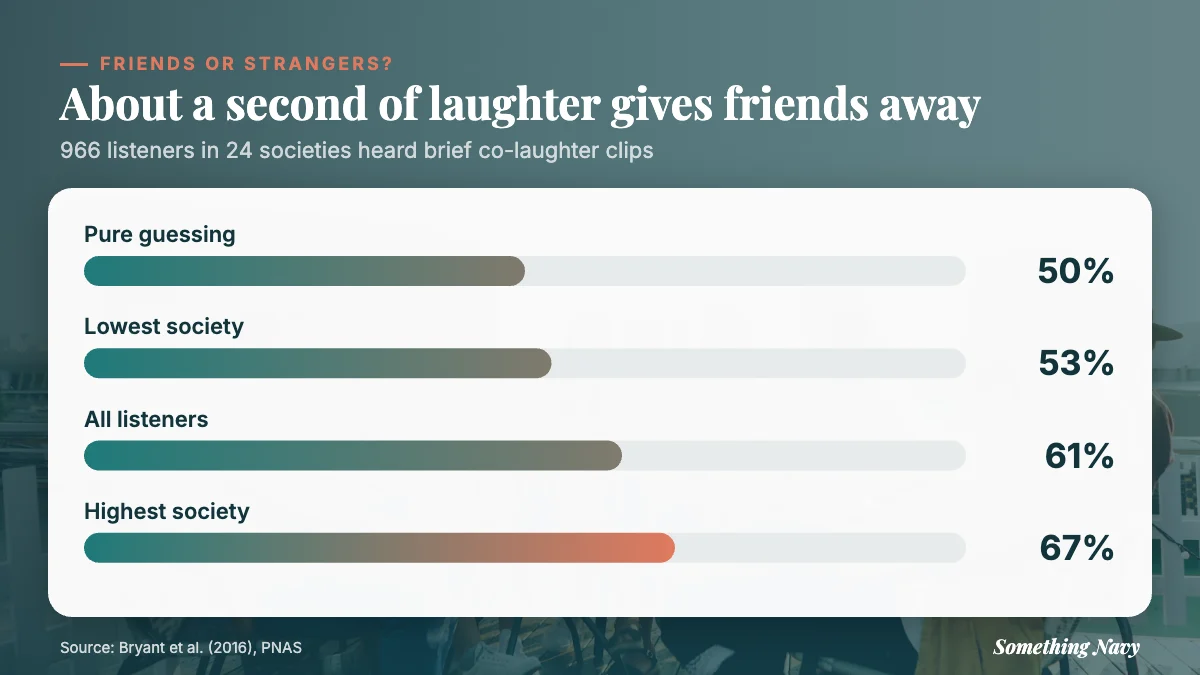
The team took recordings of conversations between American university students, made at UC Santa Cruz in 2003. Half the pairs were friends who had known each other for a while; the other half were strangers who had just met. From these conversations they cut 48 tiny clips of co-laughter, moments when both people laughed at once. On average each clip lasted about 1.1 seconds.
Then they played the clips to 966 listeners in 24 societies, from university students in Los Angeles to indigenous communities in New Guinea. Many did not speak English. They simply heard two people laughing and decided: friends or strangers?
Overall, people were right 61% of the time, where pure guessing would give 50%. Not mind-reading, but well above chance from barely a second of sound, and it held in every society tested, with accuracy from 53% to 67%.
The clearest signal came from pairs of female friends, who were identified most accurately in every society. Listeners also leaned towards calling female pairs friends in general, which muddies the picture a little.
What gave friends away? An acoustic analysis pointed to features of spontaneous, aroused laughter: shorter bursts and less regular pitch and loudness. Riccardo Fusaroli of Aarhus University, who worked on the acoustics, noted in a university news release that these are very low-level properties of the voice, not easy to control on purpose.
The authors are careful to call this “strong preliminary evidence”. All the laughter came from one set of young American students, and the clips were too short to capture how two laughs fit together over time. But the core point stands: shared laughter is a social signal that carries across language and culture.
Laughing with friends and the pain threshold
Why would something this small do so much social work? The evolutionary psychologist Robin Dunbar of the University of Oxford has a long-standing answer. Our primate relatives bond through grooming, which triggers the release of endorphins, the brain’s own opioids. But grooming is one-to-one and slow. Dunbar’s idea is that laughter may do a similar job for humans, for several people at a time.
You cannot easily measure endorphins in a cinema, so Dunbar’s team used a stand-in: pain tolerance, which rises when the body’s opioid system is active. In a 2012 paper in Proceedings of the Royal Society B, they ran six experiments, some in the lab with comedy videos and some at live performances at the Edinburgh Fringe.
Pain thresholds were significantly higher after laughter than in the control conditions, such as watching factual footage. The Conversation reported that around 15 minutes of comedy in company raised pain tolerance by about 10% on average. The effect seemed to come from the laughter itself, not just from being in a good mood.
What a brain scan shows after laughing with friends
Pain thresholds are an indirect clue. A more direct one came in 2017, when researchers at the Turku PET Centre in Finland, including Lauri Nummenmaa, working with Aalto University and Dunbar in Oxford, published a brain-imaging study in the Journal of Neuroscience.
Twelve healthy men each had two PET scans on the same day. Before one, they spent 30 minutes watching comedy clips with two close friends. Before the other, they spent 30 minutes alone. The scans used a radioactive tracer that binds to opioid receptors, so if the brain had released its own opioids, less tracer would find a free receptor.
After the laughter session, binding dropped in several regions involved in arousal and emotion, including the thalamus, the caudate nucleus and the anterior insula. That pattern is consistent with endorphin release. The men with more opioid receptors in certain areas also laughed more during the clips.
In the paper, the team concluded that this opioid activity “may be an important neurochemical pathway that supports the formation, reinforcement, and maintenance of human social bonds”.
Hold this one loosely. Twelve men is a small sample, and nobody scanned women. The comparison was with sitting alone, so it cannot fully separate laughter from simply being with friends. The researchers themselves say the findings should be treated as preliminary. Still, it fits with the pain studies, and with the feeling in the car when the giggles stop: loose, warm, oddly fond of the person beside you.
Why a good laugh makes you say more
One more piece may matter most for new relationships. Dunbar and his colleagues Gray and Parkinson wanted to know whether laughter changes what people are willing to share.
In their 2015 study in Human Nature, groups of four watched one of three clips: gentle observational comedy, an uplifting nature sequence from Planet Earth, or a dull golf instruction video. Afterwards each person wrote down five pieces of personal information they would be happy to share with a companion. According to the British Psychological Society’s Research Digest, the comedy group laughed more but did not rate the clip as more positive than the nature film.
Independent raters judged the comedy group’s disclosures as significantly more intimate. One person in the comedy group wrote about breaking a collarbone while pole dancing.
The twist: the participants themselves did not rate their own disclosures as more revealing. The laughter loosened what they said without their noticing.
Anyone who has worked through the 36 questions designed to build closeness will recognise why this matters. Closeness grows from gradual, mutual openness, and laughter seems to lower the bar for that first honest sentence. Time spent mucking about together counts towards the hours it takes to make a friend.
What the laughter research cannot tell you yet
Most of these studies are small. The couples study is correlational. The brain-scan study involved a dozen men. The cross-cultural study used one batch of recordings from young Americans. None of them shows that forcing more laughter into a struggling relationship will repair it.
And not all laughter is warm. Laughing at a partner, rather than with them, is something else entirely. The research here is about laughter that is shared and spontaneous, where both people are in on it.
Still, the picture is consistent. Laughter is overwhelmingly social, shared laughter goes with closeness, and the body seems to reward it.
How to bring more shared laughter into a relationship without forcing it
Here is the catch. You cannot schedule spontaneity. If you announce “let’s laugh more”, you will both laugh less. The Bryant study suggests friends’ laughter sounds different from the polite kind, so a performed laugh may not fool anyone.
What you can do is make room for it.
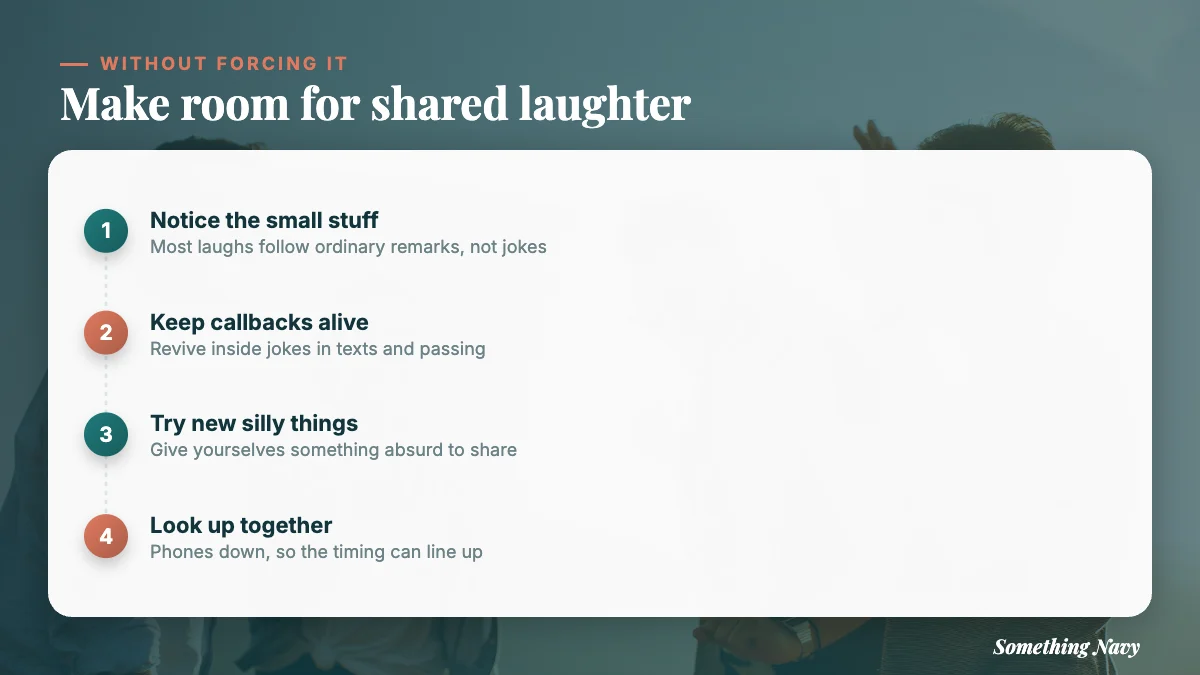
Notice what is already there. Provine’s work says most laughter follows ordinary remarks. Your relationship probably already has its satnav moments. Pay attention to them, and do not rush past them to get back to the logistics.
Keep the callbacks going. Inside jokes are compressed history. Bringing one back, in a text or across a crowded room, is a small way of saying “I remember, and we are still us”. If around half of close partners’ texts contain shared jokes, you are in good company.
Do new, slightly silly things side by side. Shared laughter needs a shared object. A badly translated menu, a terrible film, a game neither of you is good at: the absurdity gives you both something to notice at once.
Put the phone face down. The car scene only works because both people look up at the same moment. If one of you is always half in a screen, the timing never lines up. (There is a whole literature on what phone snubbing does to couples.)
Let yourself be the audience. Provine found speakers laugh more than listeners. Sometimes the generous move is simply to laugh at your partner’s silly story, and to mean it. Responding warmly to the small things they bring you is related to how you react to their good news, too.
Try this
- Tonight, ask each other: “What’s the stupidest thing that made us both laugh this year?”
- Do not try to be funny. Just tell the story together, the way the couples in the Kurtz and Algoe study described how they met.
- Notice where you both start laughing at once. That overlap is the bit the research cares about.
- If nothing comes to mind, that is useful information too. Plan one small, new, low-stakes thing to do side by side this week.
None of this is homework. If it ever starts to feel like a chore, stop. Laughter, as Provine kept pointing out, is a play signal, and play cannot be done under instruction.
Why the timing of a laugh matters more than the joke
The traffic finally thins somewhere past the junction. The radio comes back. Your partner puts their phone away and asks what you want for dinner, and the two of you settle back into the ordinary business of being a couple on a Friday night.
Nobody would film this drive. Nobody would code it. But if they did, they would find a few seconds near the start where two laughs landed on top of each other, ragged and unplanned, and they would have learned more about the two people in that car than any questionnaire could tell them.
The joke was nothing. The timing was everything.
Official links and research
- Kurtz, L. E., & Algoe, S. B. (2015). Putting laughter in context: Shared laughter as behavioral indicator of relationship well-being. Personal Relationships, 22(4), 573–590. DOI
- Provine, R. R. (1993). Laughter punctuates speech: Linguistic, social and gender contexts of laughter. Ethology, 95(4), 291–298. DOI
- Bryant, G. A., Fessler, D. M. T., Fusaroli, R., Clint, E., Aarøe, L., et al. (2016). Detecting affiliation in colaughter across 24 societies. Proceedings of the National Academy of Sciences, 113(17), 4682–4687. DOI
- Dunbar, R. I. M., Baron, R., Frangou, A., Pearce, E., van Leeuwen, E. J. C., et al. (2012). Social laughter is correlated with an elevated pain threshold. Proceedings of the Royal Society B, 279(1731), 1161–1167. DOI
- Manninen, S., Tuominen, L., Dunbar, R. I., Karjalainen, T., Hirvonen, J., et al. (2017). Social laughter triggers endogenous opioid release in humans. Journal of Neuroscience, 37(25), 6125–6131. DOI
- Gray, A. W., Parkinson, B., & Dunbar, R. I. (2015). Laughter’s influence on the intimacy of self-disclosure. Human Nature, 26(1), 28–43. DOI
- Winerman, L. (2006, June). A laughing matter. Monitor on Psychology, 37(7), 58. Link
- Suttie, J. (2017, 17 July). How laughter brings us together. Greater Good Magazine, Greater Good Science Center, UC Berkeley. Link
Cover photo: Omar Lopez on Unsplash. Charts and graphics: Something Navy, with photography by Vitaly Gariev and Helena Lopes on Unsplash.
How we reported this. Every figure was checked against the 8 sources above. Reviewed by Valentino Adkins, Senior Content Manager. Report an error · How we work