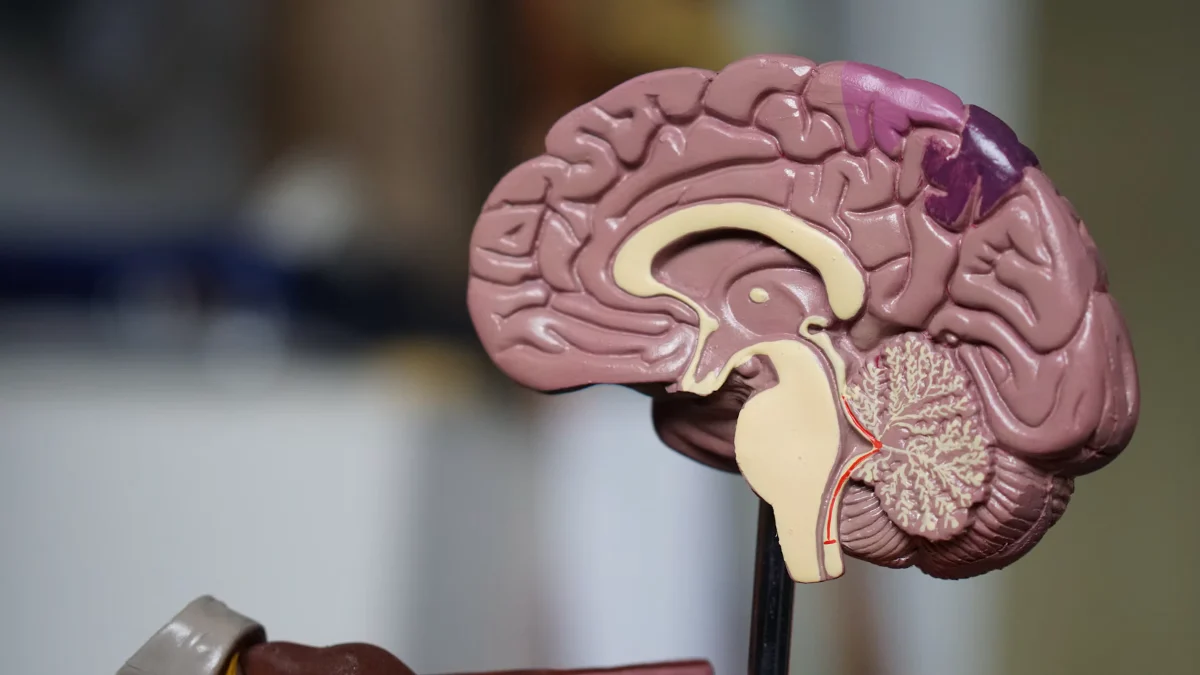

You wake at 3am, and before you have even opened your eyes, the chorus is already playing. Not the whole song. Just the same eight bars, bright and insistent, looping in a dark bedroom.
You heard it once yesterday, in a supermarket queue. You did not even like it much.
Psychologists call this involuntary musical imagery, and most of us know it by its folk name, an earworm. It is one of the most common things a mind does on its own, without being asked.
It is also far less random than it feels. When researchers look closely, a tune that sticks turns out to have a recognisable shape, a predictable set of triggers and a few weak spots that a little evidence can help you exploit.
Earworms are almost universal, and usually harmless
Start with how ordinary this is. In a 2012 paper in Psychology of Music, the Finnish researcher L. A. Liikkanen reported an online survey of 12,519 Finnish internet users. Of those, 89.2% said they experienced involuntary music at least once a week.
The same survey found a few patterns. People who spent more time practising and listening to music reported earworms more often. Women reported them more frequently than men, and episodes became less common with age in both sexes.
The experience is rarely a real problem. In two studies published in the British Journal of Psychology in 2010, Philip Beaman of the University of Reading and his colleague Tim Williams surveyed just over 100 people and then asked 12 volunteers to keep an earworm diary for four weeks.
The diary earworms lasted about 27 minutes on average, according to the British Psychological Society’s summary. Only about a third were described as unpleasant. Few came back the same day, and they rarely lasted more than 24 hours.
So if you have a tune on repeat right now, you are in very large company, and it will almost certainly be gone by tomorrow.

What 3,000 people’s earworms reveal about a sticky melody
Why that song, though? For a long time the honest answer was “nobody knows”. Then a team led by Kelly Jakubowski, a music psychologist now at Durham University, working with colleagues at Goldsmiths, University of London, set out to answer it properly.
Their study, published in Psychology of Aesthetics, Creativity, and the Arts, drew on about 3,000 people who, between 2010 and 2013, named the tunes that most often got stuck in their heads. The songs came mostly from popular genres: pop, rock, rap, and rhythm and blues.
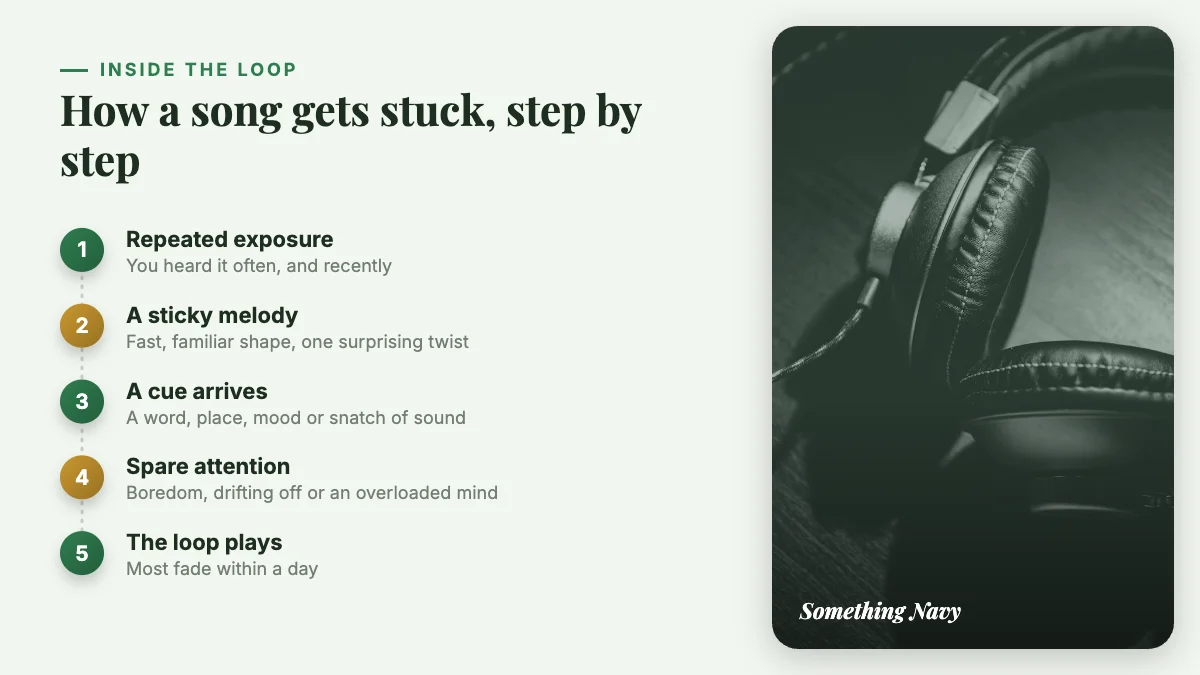
The first step was simple. Songs that had done better in the UK charts, and had charted more recently, were named more often. Exposure matters. A song you have heard dozens of times has more chances to resurface.
The second step was cleverer. The researchers took 100 frequently named earworm tunes and matched each one with a song that had never been named, but was similar in popularity and style. Then they compared the two groups on 83 features of the melody, using computer analysis.
Three differences stood out.
- Tempo. Earworms tended to be faster.
- A familiar overall shape. The rise and fall of the melody followed a contour that is common in Western pop. The American Psychological Association’s release on the study pointed to “Twinkle, Twinkle Little Star” as an example of that kind of shape.
- A twist inside it. Within that familiar outline, earworms had less common interval patterns, such as unexpected leaps or more repeated notes than typical pop.
Put together, the recipe looks like this: easy enough for the brain to hold, and just unusual enough to hold its interest.
“Our findings show that you can, to some extent, predict which songs are going to get stuck in people’s heads,” Jakubowski said in the APA release. The top three tunes named were Lady Gaga’s “Bad Romance”, Kylie Minogue’s “Can’t Get You Out Of My Head” and Journey’s “Don’t Stop Believin’”.
The phrase to notice is “to some extent”. Melody explained part of the picture, not all of it. Your personal history with a song, and the moment you are in, still matter a great deal.


How an earworm starts: exposure, then a cue
If melody is the seed, something still has to plant it. That was the question for a Goldsmiths study by Williamson and colleagues, published in Psychology of Music.
With help from BBC 6 Music and other radio stations, the team collected thousands of descriptions of people’s latest earworm and what had happened just before it began. About 600 accounts were detailed enough for close analysis, as the BPS Research Digest reported.
By far the most common trigger was recent exposure: music in a shop or gym, the radio, a ringtone, someone humming nearby. But the researchers also found subtler routes in. A word, a rhythm or a person could cue a song by association. Returning to the place where you first heard a tune could bring it back. So could looking forward to an event linked to it, or a mood that matched the song’s.
The last category is the most revealing: low-attention states such as boredom, mind-wandering and drifting towards sleep.
The authors framed earworms as a kind of involuntary memory, the same family of experience as a smell that drops you into a childhood kitchen. It is close kin to the way certain songs can carry you straight back to a particular year.
Why a busy, but not too busy, mind keeps the music out
Here the mechanism gets interesting, because attention turns out to work like a dial rather than a switch.
Ira Hyman and his students at Western Washington University explored this in a set of studies titled “Going Gaga”, published in Applied Cognitive Psychology (online in 2012, in print in 2013). They began with a survey of 299 students, who reported that the songs that stuck were usually ones they knew, liked and had heard recently.
In the lab, students listened to songs by the Beatles and more recent acts such as Lady Gaga, then did puzzles. When the sudoku or anagram tasks were overly challenging, more songs started replaying, with sudoku producing more than anagrams. A Beatles track was just as likely to become an earworm as a current hit.
Outside the lab, the university summarised the pattern this way: songs were most likely to return during low-effort activity such as walking, and during high-effort, stressful work. They were less likely when people were fully engaged.
In other words, an earworm needs a little spare room. A mind with nothing to do has plenty. So, oddly, does a mind that is overwhelmed and slipping off the task. That is the same wandering state that produces shower thoughts, just with a soundtrack.
An earworm needs a little spare room in your head. Fill that room, gently, and the music has nowhere to play.
The unfinished-song theory gets a reality check
One popular explanation says songs stick because they feel unfinished. It borrows from the Zeigarnik effect, the idea that interrupted tasks stay active in memory until they are completed. If you only hear a chorus, the theory goes, your brain keeps replaying it to close the loop.
It is an appealing story, and you will see it repeated often. But when Hyman’s team tested it directly, playing only part of a song did not make it more likely to become an earworm, as the BPS Research Digest noted.
That does not rule the idea out forever. One set of experiments with student volunteers is not the last word. But for now, the Zeigarnik explanation is better treated as a hunch than a finding.
The same team did find something useful about timing. A song that started replaying soon after people heard it was more likely to come back over the following 24 hours. The first few minutes after listening, it seems, matter.
Fighting the tune tends to make it louder
The most natural response to an earworm is to push it away. Beaman and Williams found that this rarely works.
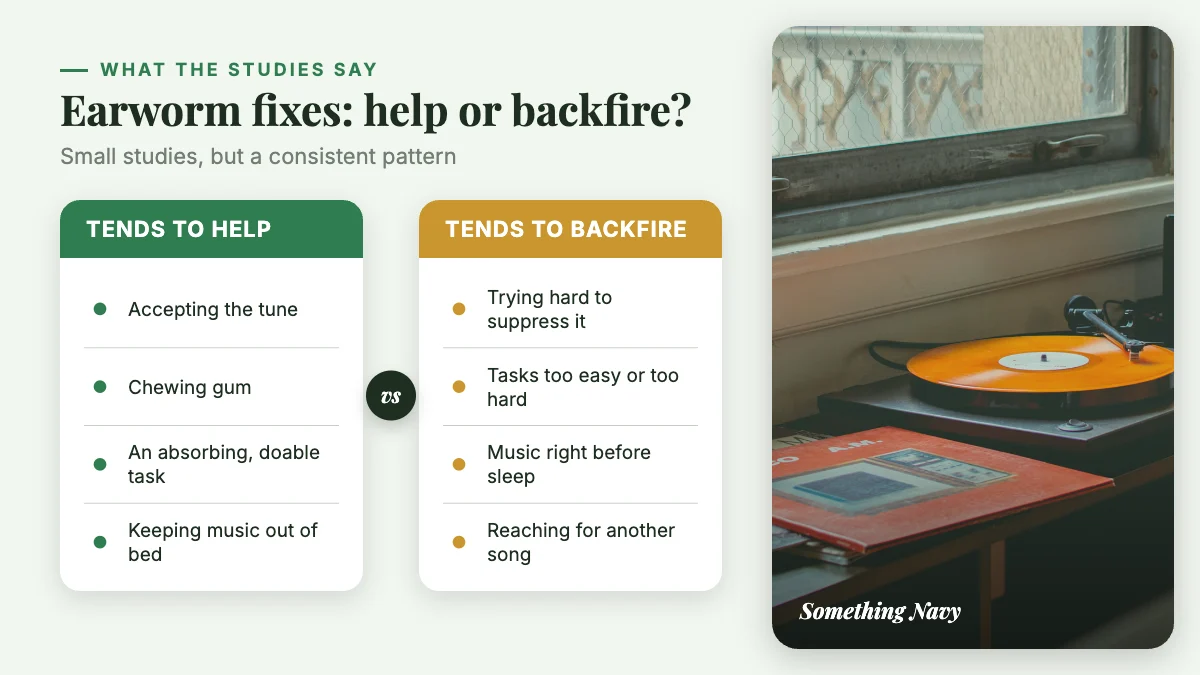
In their research, simply accepting the tune worked better than actively trying to suppress it. The authors linked this to Daniel Wegner’s theory of ironic mental control, the reason that being told not to think of a white bear makes the bear appear. To check that you are not thinking about something, the mind has to keep a lookout for it, and the lookout keeps pulling it back into view.
The British Psychological Society’s summary of the diary study also noted that most attempts at getting rid of earworms, such as deliberately thinking of another song, seemed to backfire.
This is one of the more reassuring findings in the field. The least effort is often the best strategy.


Why chewing gum can quieten a stuck song
If accepting the tune is the gentle option, there is also a surprisingly physical one.
When we imagine music, we often seem to “sing” it silently, using the same inner speech we use to rehearse a phone number. Earlier work had shown that moving the jaw or mouthing words interferes with that kind of short-term memory for sound.
So in a 2015 study in the Quarterly Journal of Experimental Psychology, Beaman, Kitty Powell and Ellie Rapley at the University of Reading tried something simple. According to the university’s press release, 98 volunteers heard catchy songs, including Maroon 5’s “Payphone” and David Guetta’s “Play Hard”. They were then asked not to think about them for three minutes, and to press a key every time they did.
Some chewed gum during that time. Others did nothing, or tapped a finger as a control. Chewing gum reduced how much people “heard” the song by about a third, and finger-tapping did not match it.
The effect is real but modest, and it was measured over minutes in a lab, with songs chosen by the researchers rather than a tune that has been bugging you all day. Still, it is cheap, harmless and has a plausible mechanism behind it: occupy the mouth, and you crowd out the inner singer.
By the numbers
- 89.2% of 12,519 Finnish survey respondents had earworms at least once a week (Liikkanen, 2012).
- About 27 minutes was the average length of an earworm in Beaman and Williams’s four-week diary study.
- 83 melodic features were compared across 100 earworms and 100 matched songs (Jakubowski et al., 2017).
- About a third less song replay among volunteers chewing gum (Beaman et al., 2015).
- Six times more likely to report poor sleep with night-time earworms at least weekly (Scullin et al., 2021).
Earworms at bedtime can cost you sleep
Which brings us back to that 3am chorus.
Michael Scullin of Baylor University in Texas studied this with Chenlu Gao and Paul Fillmore. Their findings appeared in Psychological Science in 2021.
First came an online survey of US adults; 199 responses were analysed. About a third said earworms frequently turned up around sleep, while falling asleep, during the night or on waking. According to the Association for Psychological Science, people who had night-time earworms at least once a week were six times more likely to report poor sleep quality than people who rarely had them.
That is a correlation, so the team then moved into the lab. Fifty young adults spent a night in the sleep laboratory. Before bed they listened to “Shake It Off”, “Call Me Maybe” and “Don’t Stop Believin’”, either the original recordings or instrumental versions with the lyrics removed.
Those who caught a sleep-related earworm took longer to fall asleep, woke more during the night and spent more time in light sleep. Their brain recordings showed more slow oscillations, a marker linked to memory reactivation, over the region corresponding to the primary auditory cortex.
“Our brains continue to process music even when none is playing, including apparently while we are asleep,” Scullin said in the APS release.
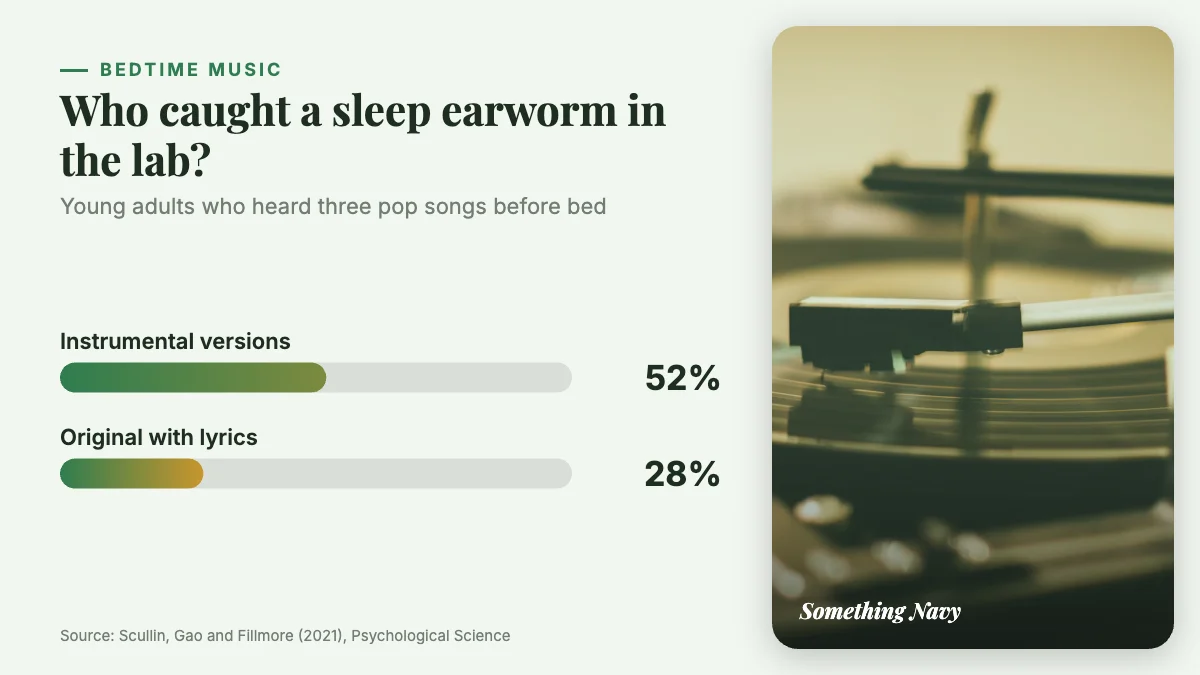
One detail surprised people. In the lab, 52% of those who heard the instrumental versions reported a sleep earworm, compared with 28% of those who heard the songs with lyrics. The researchers worded this cautiously, saying instrumental music “seemed to increase” susceptibility, so treat it as a strong hint rather than a settled fact.
If you already struggle to switch off, bedtime music joins the other evening habits that sleep researchers question.
How to get a song out of your head, based on the research
None of these is a guaranteed cure, and the studies behind them are small. But each one rests on actual evidence rather than folklore. Try them roughly in this order.
1. Let it be. Beaman and Williams found that passively accepting an earworm worked better than fighting it. In their diary study the average earworm lasted under half an hour, and nearly all were gone by the next day.
2. Chew some gum. In the Reading experiment, chewing cut the replay by about a third. It occupies the mouth and jaw that your inner voice seems to borrow.
3. Choose a task that absorbs you, at the right level. Hyman’s work suggests aiming for something engaging but manageable: a chapter of a good book, a conversation, a moderately tricky puzzle. A task that is too easy leaves room for the tune, and one that is too hard may let it back in.
4. Notice your triggers. Recent exposure is the most common cause. If a song keeps returning, a short break from it, and from the playlist that keeps serving it, removes the fuel.
5. Keep music out of bed. Scullin’s advice was to avoid music near bedtime and to stop pairing music with lying in bed, because that association alone can bring a tune back. If you like something playing as you wind down, the lab data hint that instrumental tracks may be the stickier choice.
Researchers have also suggested listening to the song all the way through, or switching to a different tune. These ideas are reasonable, but they have not been tested as rigorously, and in Beaman and Williams’s research, reaching for another song often seemed to make matters worse.
Earworms are not a malfunction. They are memory doing something it is very good at, replaying a pattern it found worth keeping, at a moment when nothing else was asking for attention.
Next time the chorus starts at 3am, you do not have to argue with it. Let it play, give your mind something gentle to hold, and it will usually wander off on its own.
Frequently asked questions
For most people, no. Surveys find they are extremely common and rarely bothersome. Researchers have noted similarities with intrusive thoughts, so anyone with distressing, persistent intrusions of any kind should mention them to a GP.
Several studies point that way. Liikkanen found that more time spent practising and listening to music went with more frequent earworms, and Hyman’s survey found musicians reported them more often.
Almost any familiar tune can. Beaman and Williams found that the songs varied widely from person to person but were always familiar to the listener, and Hyman’s team found old Beatles tracks were as sticky as new hits.
Not necessarily, but if you often wake with a tune in your head, it is worth trying a music-free wind-down. In Scullin’s research, frequent night-time earworms went with poorer sleep.
Official links and research
- Jakubowski, K., Finkel, S., Stewart, L., & Müllensiefen, D. (2017). Dissecting an earworm: Melodic features and song popularity predict involuntary musical imagery. Psychology of Aesthetics, Creativity, and the Arts, 11(2), 122–135. DOI
- American Psychological Association (2016). Psychologists identify key characteristics of earworms [press release]. Link
- Liikkanen, L. A. (2012). Musical activities predispose to involuntary musical imagery. Psychology of Music, 40(2), 236–256. DOI
- Beaman, C. P., & Williams, T. I. (2010). Earworms (stuck song syndrome): Towards a natural history of intrusive thoughts. British Journal of Psychology, 101(4), 637–653. DOI
- Williamson, V. J., Jilka, S. R., Fry, J., Finkel, S., Müllensiefen, D., & Stewart, L. (2012). How do “earworms” start? Classifying the everyday circumstances of involuntary musical imagery. Psychology of Music, 40(3), 259–284. Link
- Hyman, I. E., Jr., Burland, N. K., Duskin, H. M., Cook, M. C., Roy, C. M., McGrath, J. C., & Roundhill, R. F. (2013). Going Gaga: Investigating, creating, and manipulating the song stuck in my head. Applied Cognitive Psychology, 27(2), 204–215. DOI
- Beaman, C. P., Powell, K., & Rapley, E. (2015). Want to block earworms from conscious awareness? B(u)y gum! Quarterly Journal of Experimental Psychology, 68(6), 1049–1057. DOI
- Scullin, M. K., Gao, C., & Fillmore, P. (2021). Bedtime music, involuntary musical imagery, and sleep. Psychological Science, 32(7), 985–997. DOI
Cover photo: Lee Campbell on Unsplash. Charts and graphics: Something Navy, with photography by Blaz Photo, Travis Yewell and Jace & Afsoon on Unsplash.
How we reported this. Every figure was checked against the 8 sources above. Reviewed by Brooke Hilland, Senior Content Editor. Report an error · How we work