
Before a big interview, stand like Wonder Woman for two minutes: feet apart, hands on hips, chin up. Your body will produce more testosterone and less of the stress hormone cortisol, and you will walk into the room more confident and more willing to take risks. That, at least, was the promise.
“Power posing” became one of the most famous self-help ideas of the 2010s. The science behind it has since gone through one of the most public reversals in modern psychology, and what is left is smaller, but still interesting.
The original study
In 2010, Dana Carney, Amy Cuddy and Andy Yap published a study in Psychological Science. Participants held either two expansive “high-power” poses or two hunched “low-power” poses, each for one minute. According to the paper, the high-power posers showed higher testosterone, lower cortisol, stronger feelings of power and more willingness to take a gamble.
Two years later, Cuddy gave a TED talk titled “Your body language may shape who you are“. It became one of the most watched TED talks ever, with more than 77 million views on the TED website.

What happened next
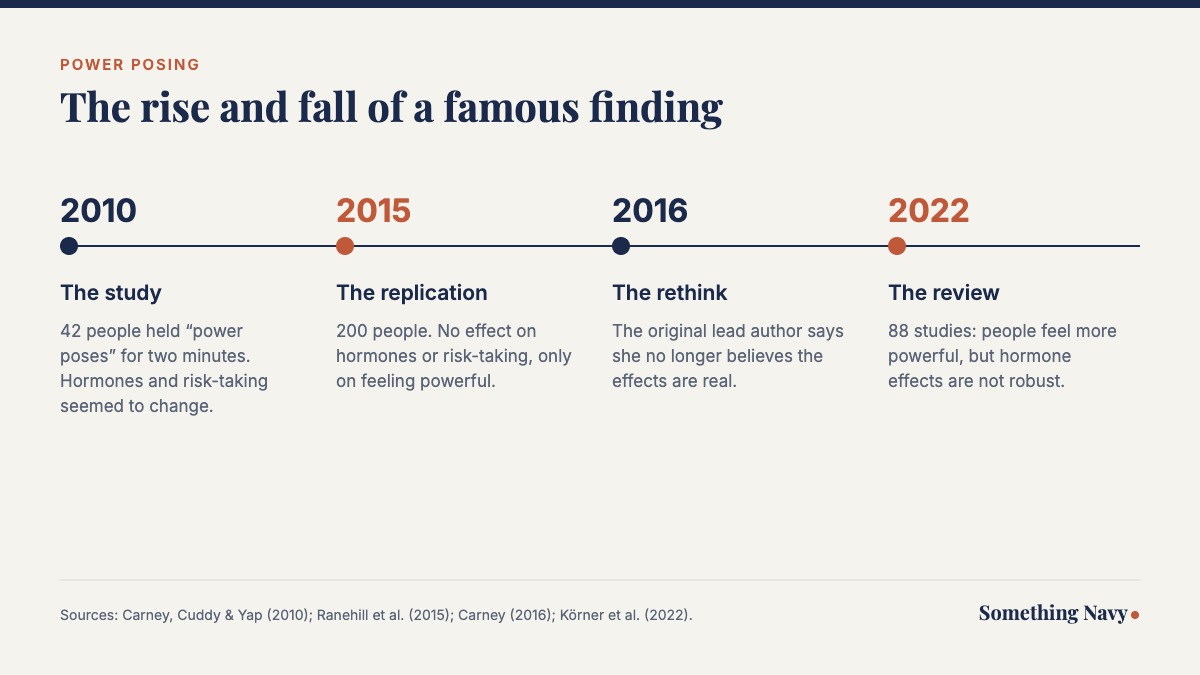
The original study had only 42 participants. In 2015, a team led by Eva Ranehill ran a much larger test with 200 people, published in Psychological Science. They found “no significant effect of power posing on hormonal levels or in any of the three behavioral tasks.” The one effect that did show up was on how powerful people said they felt.
In 2016, Carney, the original lead author, posted a statement on her university website that stunned the field. “I do not believe that ‘power pose’ effects are real,” she wrote, explaining that she had come to doubt the original findings and discouraged others from studying them. Cuddy continued to defend the broader idea that posture can affect how we feel, and in 2018 published a reply in Psychological Science arguing that the wider body of research on posture showed clear evidence of some effects.
What the evidence now says
The most comprehensive answer so far is a 2022 meta-analysis in Psychological Bulletin led by Robert Körner and Astrid Schütz. Pooling 88 studies with nearly 10,000 participants, they found that expansive postures did make people feel more powerful and confident, with a small-to-moderate effect. Effects on behaviour were weaker and less reliable. The hormone effects that made power posing famous were “not robust”.
So the dramatic version, two minutes of posing changes your body chemistry, has not held up. The modest version, standing tall can make you feel a bit more confident, has some support.
Should you still do it?
- It will not hurt. If adopting an open posture before a stressful event helps you feel steadier, there is no harm in it.
- Do not expect a transformation. Any boost is to how you feel, not to your hormones, and it is unlikely to change how others see you on its own.
- Preparation matters more. Knowing your material and rehearsing will do far more for an interview than any pose.
- Be sceptical of quick fixes. Power posing is a reminder that a striking result from one small study is not the final word.
If self-doubt is the real problem, our article on imposter syndrome looks at what research says about feeling like a fraud. For other famous findings that shrank under scrutiny, read about the red effect, and for how clothing may shape how you feel, see enclothed cognition.
Frequently asked questions
A 2022 review of 88 studies found that expansive postures can make people feel more powerful, but the claimed effects on hormones did not hold up, and effects on behaviour were weak.
A 2010 study by Dana Carney, Amy Cuddy and Andy Yap reported that holding power poses for two minutes changed hormone levels and risk-taking. It involved 42 participants.
A larger 2015 study of 200 people found no effects on hormones or behaviour. The original lead author later said she did not believe the effects were real.
Some evidence suggests that standing in an open, expansive way can make people feel a little more confident, though the effect is modest.
More in our Self-Growth section.
Sources
- Carney, D. R., Cuddy, A. J. C., & Yap, A. J. (2010). Power posing: Brief nonverbal displays affect neuroendocrine levels and risk tolerance. Psychological Science, 21(10), 1363–1368. DOI
- Ranehill, E., Dreber, A., Johannesson, M., Leiberg, S., Sul, S., & Weber, R. A. (2015). Assessing the robustness of power posing: No effect on hormones and risk tolerance in a large sample of men and women. Psychological Science. DOI
- Carney, D. R. (2016). My position on “Power Poses”. UC Berkeley
- Cuddy, A. J. C., Schultz, S. J., & Fosse, N. E. (2018). Psychological Science, 29(4), 656–666. DOI
- Körner, R., Schütz, A., et al. (2022). Psychological Bulletin. DOI
- Cuddy, A. (2012). Your body language may shape who you are. TED. TED
How we reported this. We went back to the original research for this story, 6 sources in all, listed above, and checked every figure against them. If you think we have got something wrong, tell us and we will look at it. Read more about how we work.
Cover photo: Vitaly Gariev on Unsplash. Charts and graphics: Something Navy.