There is a shelf in the hallway that leans, very slightly, to the left. A spare screw sits in a saucer beside it, because the instructions promised it would be needed and it never was.
We could replace it. A stranger would see only a cheap shelf with a tilt. We see something else: a Saturday afternoon, a lost Allen key, the small triumph of the last panel sliding home. The shelf stays.
That stubbornness has a name, and it is not sentimentality. In 2012 the psychologists Michael Norton of Harvard Business School, Daniel Mochon and Dan Ariely published a set of experiments in the Journal of Consumer Psychology under a title that reads like a proverb: “The IKEA effect: When labor leads to love”. People, they found, value what they build far above the same thing built by someone else.
The more interesting finding was the condition attached. The love only arrives if we finish.
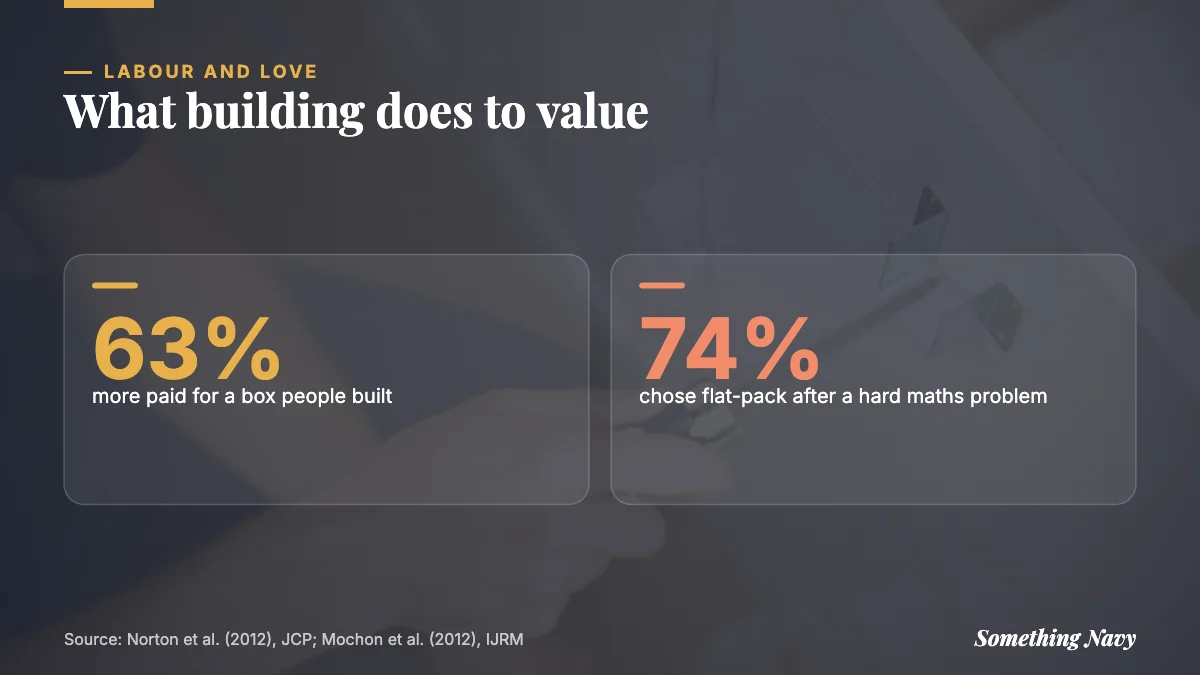
A plain black box and a 63% premium
The first experiment was almost comically modest. The team recruited 52 students at a university in the south-eastern United States and gave half of them a flat-packed IKEA storage box, plain and black, to assemble. The other half were handed an identical box that was already built and simply asked to inspect it.
Everyone then bid for their box, using a procedure that makes honest bids the sensible strategy. Builders offered an average of 78 cents; inspectors offered 48 cents. Builders also liked their boxes more, though objectively it was the same box.
A 63% premium for a few minutes with an Allen key is a lot, especially for a box participants rated as functional rather than pretty. Nobody was falling for its looks.
What the experiments did
- IKEA boxes (52 students): half built a storage box, half inspected a ready-made one; all bid for it.
- Origami (106 students): makers bid on their own frogs and cranes; others bid on the same pieces, or on experts’ work.
- Lego (118 students): people built a set, built and dismantled it, or got it ready-made.
- Unfinished boxes (39 students): some finished the box; others stopped two steps short.
Origami frogs and the price of our own clumsiness
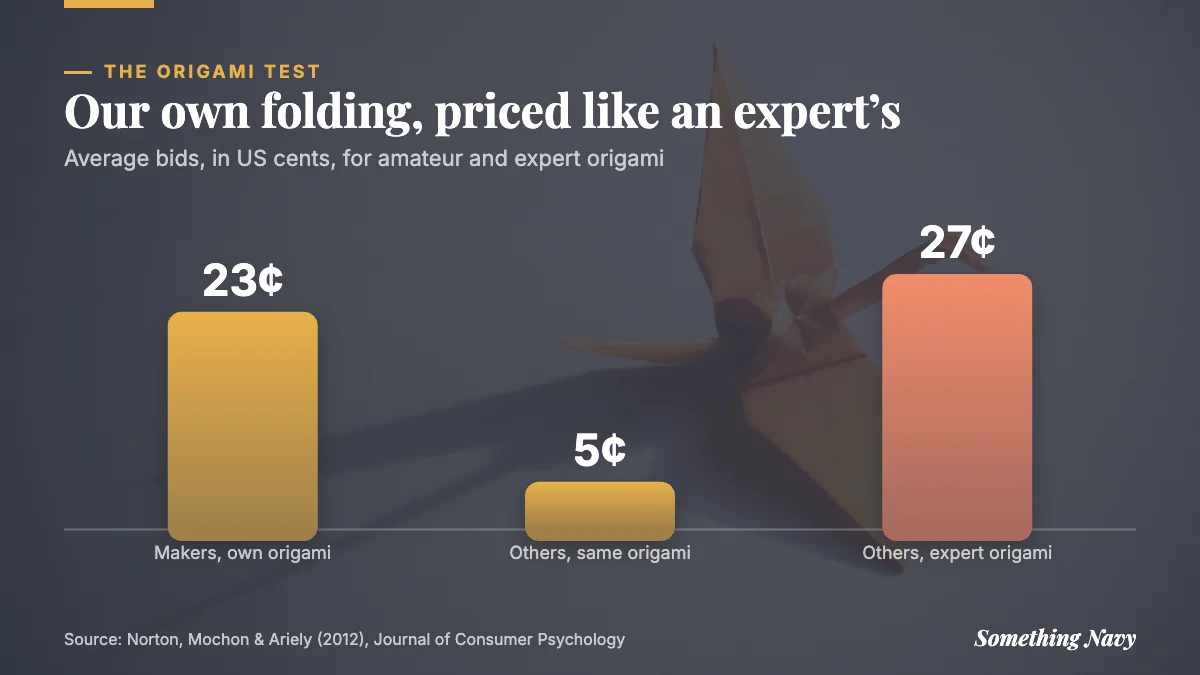
Origami is less forgiving than a box, which made it a sharper test. In a second study, 106 students folded a paper frog or crane. They then bid on their own creations, while a separate group of people, who had folded nothing, bid on the very same amateur pieces. A third group bid on frogs and cranes folded by experts.
The folders offered 23 cents for their own work. The strangers offered 5 cents for it. And for the expert pieces, crisp and symmetrical, the strangers bid 27 cents.
The numbers are quietly absurd. The makers valued their crumpled efforts at nearly five times what anyone else would pay, and almost on a par with the work of skilled folders.
Nor did the folders seem to know they were being generous. In a small follow-up, 14 students guessed that a typical fellow student would pay 21 cents for their crane, close to their own bid of 19 cents.
We do not simply love what we make. We assume everyone else can see what we see in it.
Build it, then break it: the Lego test
If effort alone were the active ingredient, any labour should do. The researchers checked this with Lego. A group of 118 students, recruited in pairs, received sets of 10 to 12 pieces that made a helicopter, a bird, a dog or a duck. Some built their set. Some built it and then took it apart again. Others were handed it ready-made.
Each person then bid on their own set and on their partner’s. Those who built and kept their model offered 84 cents for their own and 42 cents for their partner’s. Among those who built and then dismantled, the gap shrank to 43 cents against 29, too small to be statistically reliable.
Same pieces, same minutes of effort. The only difference was whether a finished thing remained at the end.


Two steps short: why unfinished work loses its glow
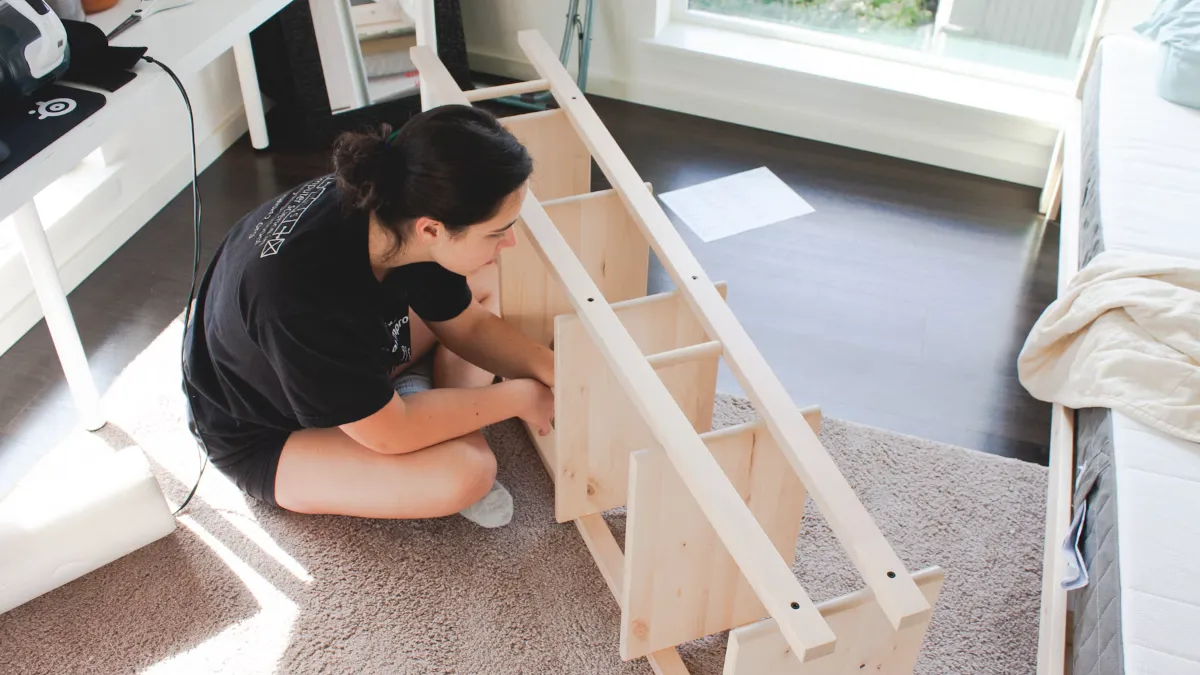
The last study pressed the point. Thirty-nine students were given the IKEA box again. Some built it fully. The rest were stopped two steps before the end, with every piece in front of them.
The finishers were willing to pay $1.46 on average. The nearly-finishers offered 59 cents, less than half as much. In the authors’ own words, labour leads to love “only when labor results in successful completion of tasks”.
It is a neat counterpoint to the Zeigarnik effect, the old finding that unfinished tasks linger in the mind. Unfinished work may nag at us. It does not seem to charm us.
An old idea in flat-pack form: effort justification
Psychologists had long suspected that suffering for something makes us like it more. The classic demonstration came in 1959, when Elliot Aronson and Judson Mills ran an experiment with 63 female college students who believed they were joining a discussion group about sex. To get in, some first had to read explicit material aloud in an embarrassing “screening” test; others read something mild. Then everyone listened to the same group discussion, which had been deliberately designed to be dull.
Those who endured the severe initiation rated the group, and its tedious conversation, more favourably. Aronson and Mills explained it with cognitive dissonance: if we have paid a price, we prefer to believe the prize was worth it.
Reading rude words aloud is a long way from a real hazing, and the study has critics. But a review in The Psychologist notes that a 1966 replication by Harold Gerard and Grover Mathewson used electric shocks instead and found the same pattern. Norton and his colleagues place the IKEA effect in this tradition. The same logic hums behind the Ben Franklin effect, where doing someone a favour warms us to them.
But the hallway shelf did not hurt. Something gentler is going on.
What a finished thing tells us about ourselves
The same three researchers explored it in a follow-up paper in the International Journal of Research in Marketing. Their idea: building makes us feel competent, and that feeling is what we pay for.
In one study, 75 people either built a small Lego car or examined one already made. Builders bid $1.20 for it; non-builders bid 57 cents. Builders reported more pride and more desire to show the car off, and that sense of competence, not a general lift in mood, accounted for the extra value.
Then came the clever part. Before an IKEA box task, some participants wrote about the value that mattered most to them, a well-established way of shoring up a person’s sense of self. For them, the IKEA effect disappeared. Secure people had less need of a box to tell them they were capable.
The reverse also held. In an online study, 41 people were given either an easy maths problem or a very hard one, then asked to choose between a ready-assembled table and one that needed building. Of those who had just struggled with the maths, 74% chose the self-assembly table. Of those who had sailed through, 27% did. A bruised ego, it seems, reaches for the flat-pack.
The most human detail: in a separate survey, 92% of people said they would pay more for products that came pre-assembled. In the abstract, we would rather not bother. In the moment, after a small knock to our confidence, the bother is the point.
The IKEA effect in children: it begins at about five
If this is about the self, it should appear as the self does. A team led by Lauren Marsh, working with Bruce Hood at the University of Bristol and with Patricia Kanngiesser of the Free University of Berlin, tested that in a paper published in the journal Cognition in 2018.
Children built a foam monster from a kit, then rated it against an identical one. Among 32 children aged 5 to 6, the self-built monster rose in their affections. Among 32 children aged 3 to 4, there was no clear bias.
Two further studies with 5- and 6-year-olds brought surprises. Making the task harder did not strengthen the effect, which sits awkwardly with effort justification. Telling children the monster would go on a wall rather than home with them did not remove it either. The authors put it memorably: “from age 5 our creations are elevated to a special status in our minds”.
A thing we have made is never only a thing. It is also a small piece of evidence about who we are.
Not invented here: when the love affair turns costly at work
Loving our own work can make us cool towards everyone else’s. Organisations call this the “not invented here” syndrome: reluctance to adopt ideas from outside the team.
The best-known early study is by Ralph Katz and Thomas Allen of MIT’s Sloan School of Management, published in R&D Management in 1982. They studied 50 project groups in the research facility of a large American company. Groups whose members had worked together for about two to four years were rated the best performers. Those that had been together for five years or more scored lowest, and longer-standing groups talked less to professionals outside.
Care is needed. Katz and Allen did not measure the IKEA effect, and their data come from one site, with performance judged by managers. The link is a family resemblance, not proof. Still, anyone who has watched a team defend a homegrown spreadsheet against a better tool will recognise it. A similar blind spot appears in the curse of knowledge: what we built feels obvious and excellent to us, because we were there.
The cake mix and the egg: a story that is only half baked
Norton’s own paper tells the famous cake mix story. In the 1950s, it goes, American housewives resisted instant cake mixes because they made baking too easy. Then the manufacturers removed the dried egg and asked bakers to add a fresh one, and sales took off.
The truth is messier. In her history Something from the Oven, Laura Shapiro records that the motivational researcher Ernest Dichter, working for General Mills, did argue that mixes left women feeling they had contributed too little. But she judges his precise role unclear, and notes that fresh eggs simply made better cakes: dried-egg mixes could taste of egg and stick to the pan. A Snopes investigation that draws on her work treats the egg legend with scepticism, and notes that the bigger marketing shift was to treat the cake as a base for elaborate icing and decoration.
So the egg belongs in the anecdote drawer. Though the icing, where the baker’s own hand showed, is not so far from the shelf in the hallway.
Using the wobble well, at home and at work
At home, finish the half-built projects. The glow comes at completion, so a small project carried to the end will probably mean more than an ambitious one left two steps short. It is part of why a home that feels like ours is so often a home we have fiddled with.
With children, letting them build the thing, imperfectly, may matter more than handing over a polished version. From about five, the Cognition team suggests, making something ties it to a child’s sense of self.
At work, the bias cuts both ways. Letting people shape a plan, not just approve it, may well deepen their attachment to it. But when judging our own proposals, ask what a stranger would bid. Origami folders assumed others would pay what they would. Outsiders offered less than a quarter as much.
Why effort makes meaning
It is tempting to file the IKEA effect under irrationality: one more way we misprice the world. And in a sense it is. A wonky box is not worth 63% more because we wrestled with it.
But the experiments also say something kinder. The premium vanished when people felt secure, and the pull to build grew when they felt shaken. It disappeared when the work was undone, and appeared in children just as they acquire a self worth confirming. What we value is less the object than the proof it carries: that we took a box of parts and some wordless diagrams and made something that stands up.
The shelf still leans. It also holds the books. Most days, that feels like enough of an argument.
Official links and research
- Norton, M. I., Mochon, D., & Ariely, D. (2012). The IKEA effect: When labor leads to love. Journal of Consumer Psychology, 22(3), 453–460. DOI
- Mochon, D., Norton, M. I., & Ariely, D. (2012). Bolstering and restoring feelings of competence via the IKEA effect. International Journal of Research in Marketing, 29(4), 363–369. DOI
- Aronson, E., & Mills, J. (1959). The effect of severity of initiation on liking for a group. Journal of Abnormal and Social Psychology, 59(2), 177–181. DOI
- Marsh, L. E., Kanngiesser, P., & Hood, B. (2018). When and how does labour lead to love? The ontogeny and mechanisms of the IKEA effect. Cognition, 170, 245–253. DOI
- Katz, R., & Allen, T. J. (1982). Investigating the Not Invented Here (NIH) syndrome: A look at the performance, tenure, and communication patterns of 50 R&D project groups. R&D Management, 12(1), 7–20. DOI
- Oxenham, S. (2015, 6 October). The initiation ceremony experiments. The Psychologist, British Psychological Society. Link
- Snopes. Fact check on the cake mix and fresh egg legend, drawing on Shapiro, L. (2004), Something from the Oven. Link
Cover photo: Louis Hansel on Unsplash. Charts and graphics: Something Navy, with photography by Yuu Khoang and Sleepline on Unsplash.
How we reported this. Every figure was checked against the 7 sources above. Reviewed by Brooke Hilland, Senior Content Editor. Report an error · How we work