
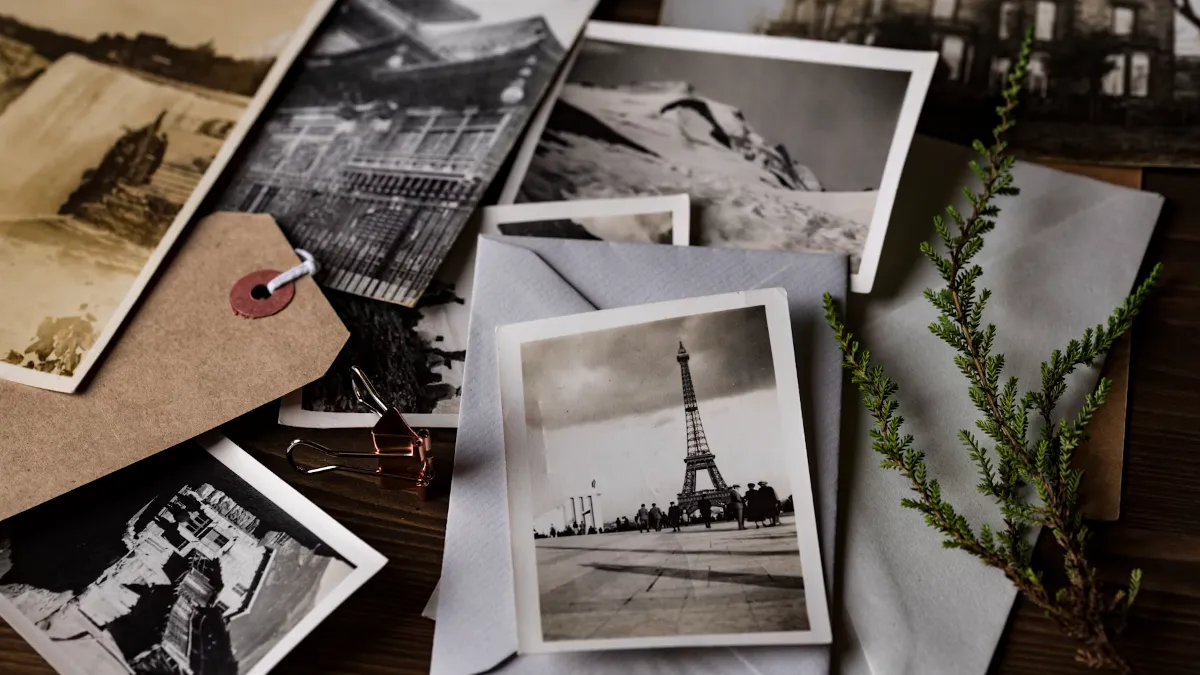
The smell arrives before the memory does. Toast slightly too dark, a radiator ticking as it warms, the damp wool of a school jumper drying over a chair.
For a second we are not in the kitchen we are standing in. We are somewhere smaller and older, with a voice in the next room we have not heard in years. Then it passes, and what is left is a strange mixture: a little sad, mostly glad, oddly warmer than before.
We call that feeling nostalgia, and we tend to treat it as harmless, or faintly embarrassing. For most of its history, it was neither. It was a medical diagnosis, and doctors believed it could kill.
The reversal since then is one of the quieter stories in modern psychology. Over the past two decades, researchers have built a case that nostalgia is not a weakness of the mind but one of its resources: a feeling that tends to arrive when we are lonely, cold or unsettled, and leaves us a little better equipped.
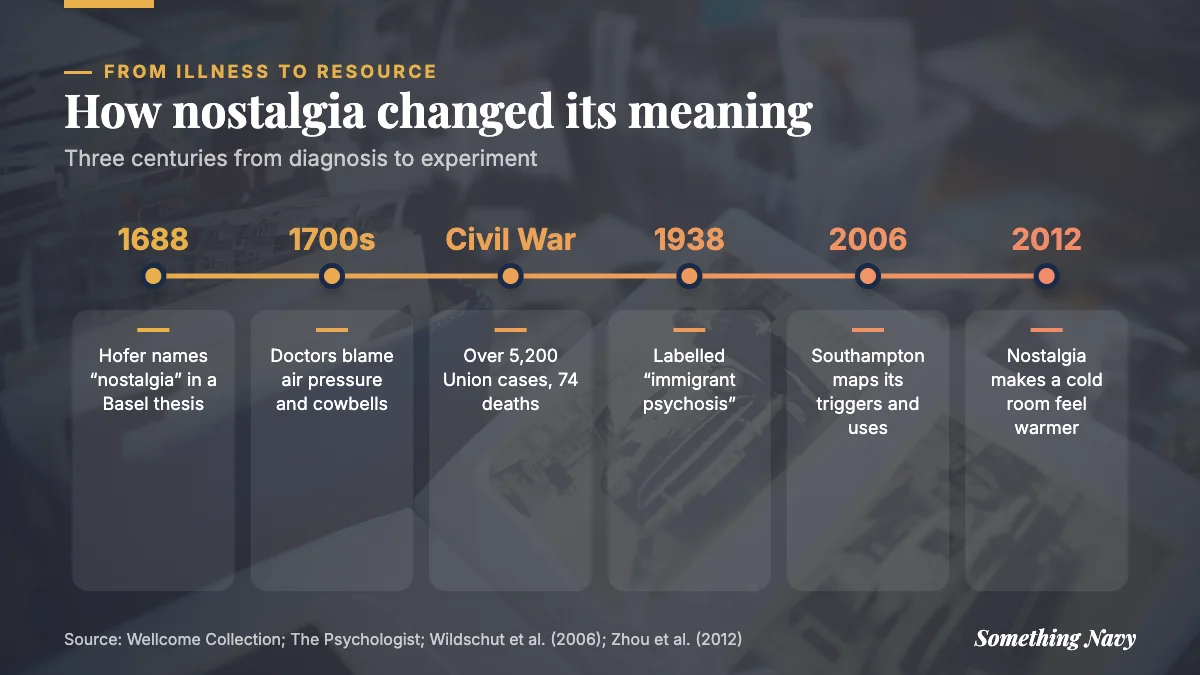
1688: a Basel dissertation names a new illness
The word was invented on purpose. In 1688 Johannes Hofer submitted a medical dissertation at the University of Basel, and in it he joined two Greek words: nostos, homecoming, and algos, pain. The ache of wanting to go home now had a clinical name.
Hofer was describing something he saw in Swiss people far from their valleys, above all the mercenaries who fought for foreign kings. He listed the symptoms with care: obsessive thoughts of home, bouts of weeping, anxiety, palpitations, loss of appetite, sleeplessness. He thought of it, as a history in The Psychologist puts it, as “a cerebral disease”.
One of his cases, as the Wellcome Collection retells it, was a young man from Basel studying in Berne. He sickened, was diagnosed with nostalgia and sent home. His symptoms eased before he had even arrived.
The cure, in other words, was the journey back.
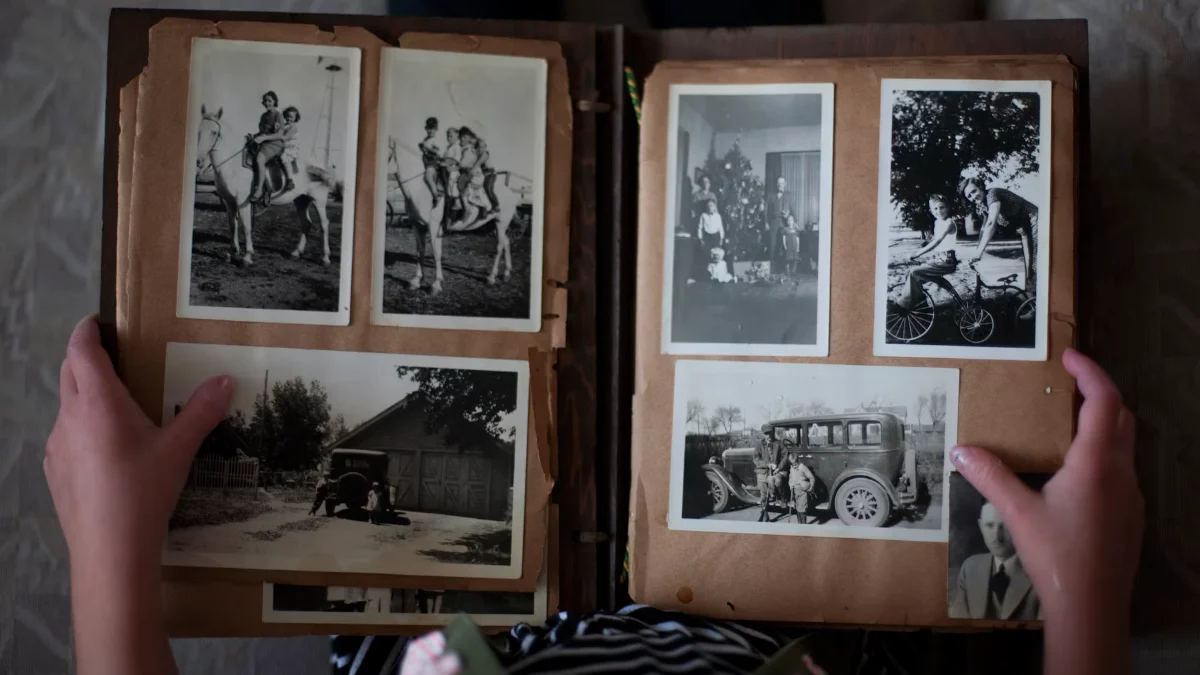
Cowbells, mountain air and a war full of homesick soldiers
Once nostalgia was a disease, physicians went looking for its cause. The Zurich doctor Johann Jakob Scheuchzer suggested in the early 1700s that it came from changes in air pressure as mountain people descended from the Alps. Some military physicians blamed the constant clanging of cowbells, which they believed damaged the eardrum and the brain.
These ideas sound quaint now, but the condition was taken seriously for two centuries. During the American Civil War, the historian Susan Matt found more than 5,200 recorded cases of nostalgia, and 74 deaths, on the Union side alone. By the late 19th century the diagnosis was falling out of favour, and by the First World War it had nearly vanished from medical use.
It did not become respectable overnight. A review of the field in The Psychologist, written by the Southampton researchers who did much to rehabilitate it, notes that in the early 19th century nostalgia was folded into melancholia and depression. In the 20th, psychoanalytic writers called it “immigrant psychosis” (Frost, 1938) and a “mentally repressive compulsive disorder” (Fodor, 1950).
What we actually remember when we feel nostalgic
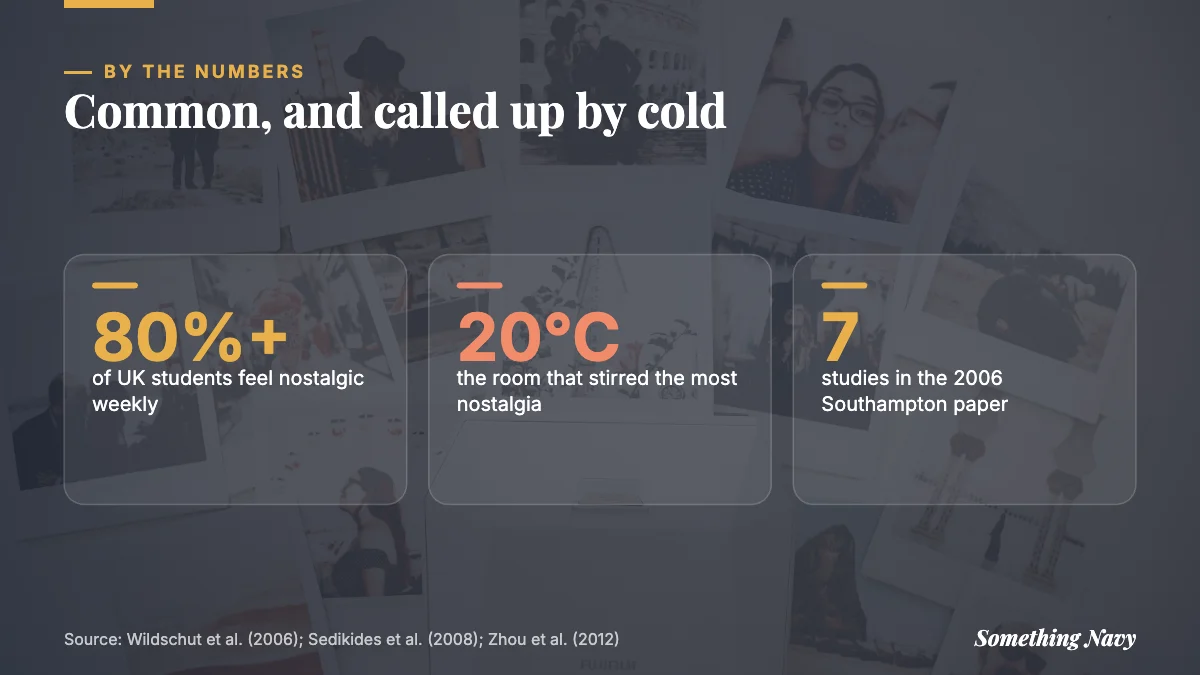
The turn came at the University of Southampton. In 2006 Tim Wildschut and Constantine Sedikides, with co-authors Jamie Arndt and Clay Routledge, published seven studies in the Journal of Personality and Social Psychology under a plain, ambitious title: “Nostalgia: Content, triggers, functions”.
They began by simply reading what nostalgia looks like. They analysed accounts sent in by American and Canadian readers of a magazine called Nostalgia, and narratives written by British undergraduates asked to describe a nostalgic experience.
A pattern emerged. In these memories, the self is almost always the main character, and rarely alone. We appear with friends, family or partners, or at the turning points of a life: a wedding, a graduation, a homecoming. The stories contained more positive emotion than negative.
Most telling of all, many of them followed a particular shape. Something painful happens early in the story, a loss or a disappointment, and it is redeemed by what comes after. Nostalgia, on this evidence, is less a highlight reel than a story about coming through.
Nostalgia is not a photograph of the good old days. It is a story in which we survive the bad ones.


Loneliness and low mood: the feelings that call the past up
The same paper asked what sets nostalgia off. In the narratives, the most common trigger was a negative mood, and the single negative feeling mentioned most often was loneliness. One participant put it simply: “I think of nostalgic experiences when I am sad as they often make me feel better.”
The team then tested this experimentally. Participants put into a bad mood reported more nostalgia than those in a neutral or good one. In another study, people who received false feedback suggesting they were highly lonely went on to feel more nostalgic than those told the opposite.
Finally, the researchers induced nostalgia and measured what followed. Nostalgic recollection strengthened people’s sense of social connection, lifted their self-regard and improved their mood.
It is not a rare visitor, either. In a later review, the same group reported that over 80% of the British undergraduates they surveyed experienced nostalgia at least once a week. A song from our teens or a smell from a grandparent’s house is enough to open the door.
How nostalgia quietly counters loneliness
If loneliness calls nostalgia up, the obvious question is whether nostalgia answers back. In 2008 Xinyue Zhou and Ding-Guo Gao of Sun Yat-Sen University in China, working with Sedikides and Wildschut, ran four studies to find out, published in Psychological Science.
Their participants were unusually varied for psychology: Chinese children, university students and factory workers. Some simply completed questionnaires about loneliness, social support and nostalgia. Others were led into feeling lonely, or into feeling nostalgic, before answering.
The results ran in two directions at once. Loneliness, unsurprisingly, made people feel they had less social support. But lonely people were also more nostalgic, and nostalgia made them feel they had more support. The direct effect pulled down; the indirect route, through memory, pushed back.
The pattern was strongest among the most resilient participants: factory workers who scored highest on the ability to recover from hardship. The authors called this the “restorative function of nostalgia”.
It makes intuitive sense. When the present is short of company, memory can still supply evidence that we have been loved and that we belonged somewhere. It does not replace a close friend, but it can remind us that we are capable of having one.
The cold room experiment: does nostalgia warm the body?
The strangest finding came next. Our language has long linked emotional and physical warmth: a warm welcome, a cold shoulder. In 2012 Zhou, Wildschut and Sedikides, with colleagues in China and at Tilburg University in the Netherlands, asked whether nostalgia might work on the body as well as the mind. Their five studies appeared in the journal Emotion under the title “Heartwarming memories”.
Five ways the researchers tested warmth
- A 30-day diary: 19 people logged their nostalgic moments each day. They felt more nostalgic on colder days.
- Three rooms: 90 undergraduates in China sat in a room at 20°C, 24°C or 28°C. The cold room stirred the most nostalgia.
- Music online: Dutch volunteers heard songs; the more nostalgic a song made them, the warmer they felt.
- Guessing the temperature: students who recalled a nostalgic event judged a cold room to be warmer.
- Iced water: 64 undergraduates recalled a nostalgic or an ordinary event, then held a hand in iced water. The nostalgic group held on longer.
Taken together, the studies point both ways. Cold seems to summon nostalgia, and nostalgia seems to soften the cold. The comfortable and hot rooms did not differ from each other; only the chill made a difference. In the iced water test, the effect was not explained by differences in general mood.
Wildschut described the role as homeostatic, a way of regulating comfort, in the University of Southampton’s announcement of the work. Recalling a time we felt held, the idea goes, lets us borrow a little of its warmth. He was also careful to add that “more research is now needed” to see whether the same holds for other kinds of physical discomfort.
It is worth holding these results lightly. The samples were modest, from 19 people in the diary study to around a hundred, and much of this work comes from one closely connected group of researchers. Findings like these earn full confidence only when independent labs repeat them. Still, the picture is coherent, and it fits our own experience of reaching for old songs and old photographs on long winter evenings, the same instinct behind a cosy home.
A past that gives the present meaning
The Southampton group pushed one step further. In work summarised in their 2008 review in Current Directions in Psychological Science, Routledge and colleagues reminded participants of their own mortality, a standard way of unsettling people in the lab. The more nostalgic people felt afterwards, the more meaningful they judged their lives to be. People prone to nostalgia, or led into it, also had fewer thoughts about death.
This may be the deepest function of all. A nostalgic memory is a piece of proof that our lives have had a shape, that certain people and places mattered, and that we were there for it. When the future feels uncertain, that proof is steadying.
We do not go back to the past to stay there. We go back to fetch something we need for the road ahead.
When nostalgia tilts towards sadness
None of this makes nostalgia a cure-all. In their 2008 review, the same researchers who championed it warned that it “may erode a sense of meaning in the present and may forestall motivation” when a person is fixated on better days gone by. A warm memory is a visit. It is not an address.
The psychologist Krystine Batcho of Le Moyne College has spent years separating kinds of nostalgia, and one of them is less comforting than the rest. She calls it anticipatory nostalgia: missing the present before it has gone. It is the parent watching a toddler and already grieving the toddler, or the last evening of a holiday spoiled by the ache of its ending.
In a 2020 study in Frontiers in Psychology, Batcho surveyed 144 undergraduates, most of them women, about both kinds. Anticipatory nostalgia was linked with feeling sad, while ordinary personal nostalgia was not. When people read happy stories, those high in personal nostalgia reported feeling happier; those high in anticipatory nostalgia did not. Earlier work, she notes, had tied anticipatory nostalgia to “difficulty enjoying the present” and a tendency towards worry.
The study is small and correlational, so it cannot say which comes first, the feeling or the sadness. In one encouraging detail, people high in anticipatory nostalgia said they learned more from sad stories. Batcho suggests, cautiously, that the habit of mourning in advance may bring its own kind of preparation.
There is a second, quieter caution in the loneliness research. Nostalgia arrives when we are hurting. If we find ourselves reaching for the past every day, the frequency itself may be worth noticing, as a sign about the present rather than a fault in the memory.
Using nostalgia well, on cold days and lonely ones
The research does not offer a prescription so much as a posture. Nostalgia seems to work best when it connects us, to people, to who we have been, to what still matters, and worst when it becomes a place to hide from the present.
- Go towards people in the memory. The most restorative nostalgic memories in these studies were social. Let a remembered friend prompt a message to a living one.
- Notice the redemption in the story. Nostalgic memories often contain hardship that turned out well. Ask what got you through it then, and whether it could help now.
- Use it on purpose, briefly. On a bleak evening, an old album or a playlist from a particular year may lift the mood. Ten minutes of looking back is a visit; three hours may be a retreat.
- Catch anticipatory nostalgia in the act. If you are mourning a moment while it is still happening, name the feeling and turn back to the thing in front of you. It has not gone yet.
- Make memories worth returning to. Rituals, small trips and shared meals are the raw material of future nostalgia. The years that blur together are the ones that leave least to go back to.
What the homesick soldiers were telling us
It is easy to smile at the doctors who blamed cowbells. But in one sense Hofer saw something real. The Swiss mercenaries were not imagining their pain. They were far from everyone who knew them, in a cold and dangerous place, and their minds kept returning home.
Three centuries later, we understand that returning differently. It was not the illness. It may have been the mind’s attempt at a remedy: a way of borrowing warmth, company and meaning from the only place still able to supply them.
The toast burns slightly, the radiator ticks, and for a moment someone we loved is in the next room. Then we come back to the kitchen we are standing in, and, if we use the moment well, we bring a little of that warmth with us.
Official links and research
- Hofer, J. (1688). Dissertatio medica de nostalgia, oder Heimwehe. University of Basel. Wellcome Collection catalogue record. Link
- Tolley, G. (2020, 8 October). The hidden history of homesickness. Wellcome Collection. Link
- Wildschut, T., Sedikides, C., & Routledge, C. (2008, 3 January). Nostalgia: From cowbells to the meaning of life. The Psychologist, British Psychological Society. Link
- Wildschut, T., Sedikides, C., Arndt, J., & Routledge, C. (2006). Nostalgia: Content, triggers, functions. Journal of Personality and Social Psychology, 91(5), 975–993. University of Southampton record. Link
- Sedikides, C., Wildschut, T., Arndt, J., & Routledge, C. (2008). Nostalgia: Past, present, and future. Current Directions in Psychological Science, 17(5), 304–307. Link
- Zhou, X., Sedikides, C., Wildschut, T., & Gao, D.-G. (2008). Counteracting loneliness: On the restorative function of nostalgia. Psychological Science, 19(10), 1023–1029. University of Southampton record. Link
- Zhou, X., Wildschut, T., Sedikides, C., Chen, X., & Vingerhoets, A. J. J. M. (2012). Heartwarming memories: Nostalgia maintains physiological comfort. Emotion, 12(4), 678–684. PubMed record. Link
- Batcho, K. I. (2020). When nostalgia tilts to sad: Anticipatory and personal nostalgia. Frontiers in Psychology, 11, 1186. DOI
Cover photo: Joanna Kosinska on Unsplash. Charts and graphics: Something Navy, with photography by Markus Spiske and Juliana Malta on Unsplash.
How we reported this. Every figure was checked against the 8 sources above. Reviewed by Brooke Hilland, Senior Content Editor. Report an error · How we work